Five Signs You Might Need a Book Intervention

Birthday Books

Birthday Books

When creating my list of books to read in 2014, I thought, I should be able to do this. I was determined to read more from this year’s list than I did in 2013. After all, there were quite a few books that I was excited to read; I was motivated. I did well at first, even reporting my numbers a few short weeks ago.

Then it happened. My husband, eldest niece, and I went to see Divergent, all having read and loved the series. And we got more than we bargained for while there: we were introduced to a book we hadn’t heard of, soon to be released in movie form, The Maze Runner.

I couldn’t help myself; I started researching it while still sitting in the theatre. Who was the author? When was it published? Is there more than one book? Why hadn’t I heard of it?

James Dashner, 2009, two sequels and one prequel – these were the easy answers. As for why I hadn’t heard of it, well, there are just so many books out there. Each new discovery adds another star or constellation to my reader’s night sky, and the funny thing is that I am never satisfied. Give me a good book, and it only makes me want more.

A few weeks later, when my husband asked what I wanted for my birthday, I got the bright idea that I could kill two birds if he got The Maze Runner for me. Since I knew he wanted to read it, too, he went ahead and bought it a few days early. I was dutifully reading another book from my list with the full knowledge that I would completely derail if Thomas said the book was any good.

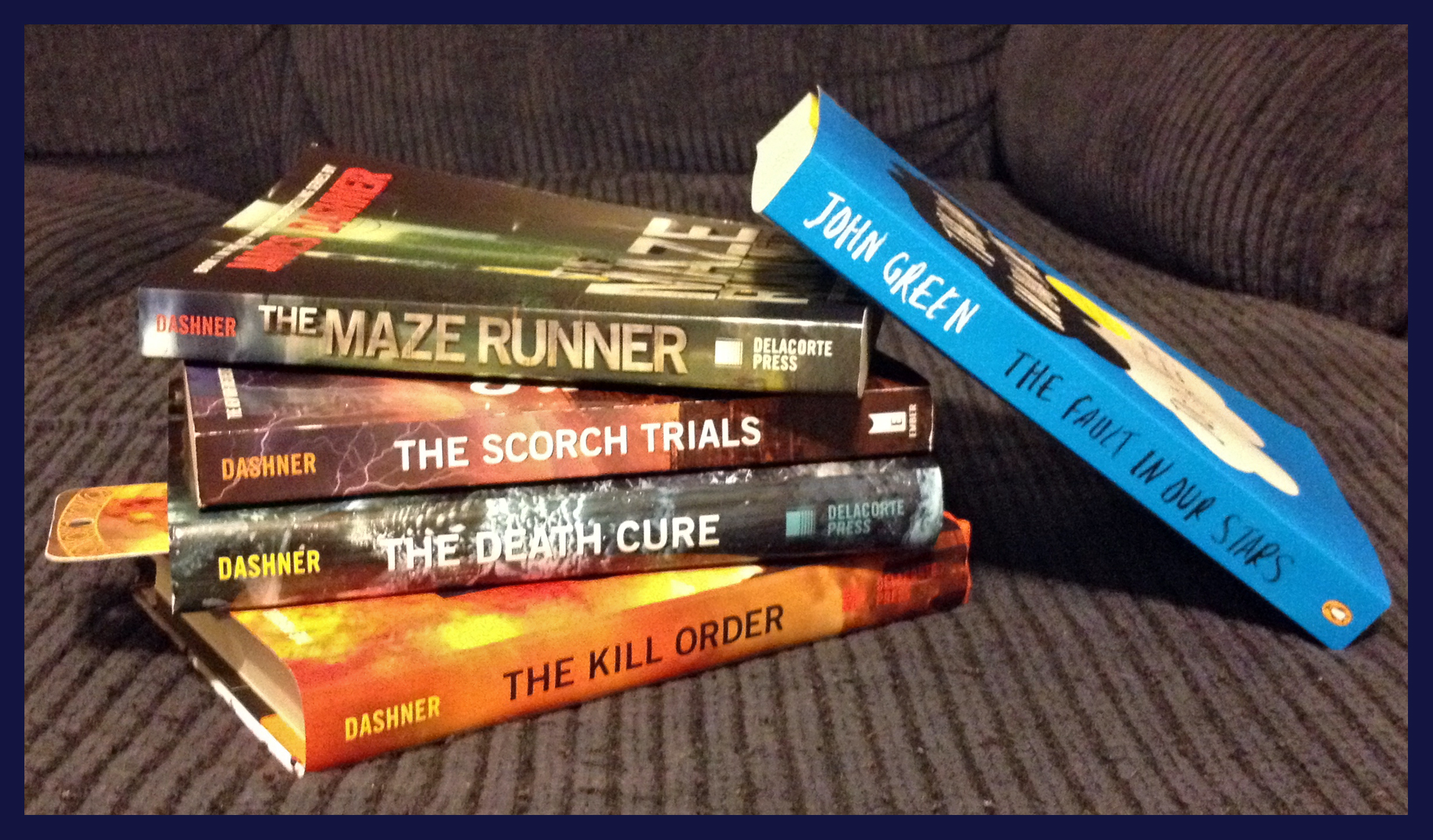
Thomas pronounced The Maze Runner worthy, so I took the cash a few relatives gave me for my birthday and went to pick up the rest of the series. The cashier told me that if I didn’t care about them being a matched set, I could buy all three from the bargain section. Which saved me enough money to buy a fourth book, John Green’s The Fault in Our Stars.

That silly movie trailer, aided by a little extra cash, just made my original 2014 book list a lot harder to finish. I might need a…

Book Intervention

Here are five signs that you might need one, too:

1. You always have a book in the car, just in case you get stuck in traffic.

No, I don’t read or text while driving, but I do when stopped at a light. Hey, I have a very stop-and-go commute, and I get tired of listening to the radio. And if I’m not the driver, you better believe I have a book with me. I feel bad for people who get carsick – such a great reading opportunity missed.

2. You panic when you forget your book.

It’s one thing if you’re just going to the store, but it’s full-scale panic mode when you are stuck at a social event with nothing to do except make small-talk with people you hardly know. Or even people you do know. It’s kind of a joke among my family that I’m often in the background of photos, oblivious to my surroundings, absorbed in a book. Everyone’s opening Christmas presents, and I’m reading. Or I sneak a book into a movie to read before the lights go down.

3. You can never read all the books on your to-do list because you keep adding more.

When I was pregnant with my first son, I was determined to read every book in the house. I figured that I might never have the chance to read after my little bundle of joy came into the world. I’m happy to report that not only did I finish all the books in the house, but reading does continue post-baby. And ever since making that discovery, I’ve been buying more books than I can read again.

4. You spend your disposable income on purses big enough to hold a good-sized hardback.

Okay, maybe men don’t have this problem, but I certainly do. I also carry my laptop, so my poor purse was begging to be replaced. I’m happy to report that my new purse holds the laptop and a novel quite comfortably. Could I get a Kindle or just read on my iPhone? Sure, and I have. But I just love actual books (read more about that here), and I love owning them. The book fair is in town this week, and I think there’s going to be more backsliding, which means…

5. You forego putting your china out in favor of shelving your books in the china cabinet.

Or on top of the piano. Or in stacks around the house. I’m doing a pretty good job of keeping them neat (at least, I did until my latest quadruple purchase). But although I’ve dreamed of having a house with a proper library, I somehow think it still wouldn’t be enough. Give me shelves, and I will gladly fill them, then continue getting more.

You know, if this is a vice, I’m not sure I want to give it up. Please tell me I’m not alone. If this sounds like you, too, do we need an intervention, or just some uninterrupted reading time? Methinks the latter.

Happy reading.

Enhanced by Zemanta

When Easter Seems Far Away

Storm clouds over swifts creek

Storm Clouds (Photo credit: Wikipedia)

Easter is coming, one of my favorite times of year. I love both the sacred and secular aspects. I get a kick out of watching my kids hunt eggs, and every year, I look forward to preparing myself for Easter joy by first attending my church’s Maundy Thursday service. It doesn’t just commemorate the Last Supper but the events of Good Friday in the form of a service of tenebrae (darkness).

For me to truly appreciate Easter, I must first immerse myself in the grief of the disciples during Jesus’ last hours. No matter what you think or believe about him, Jesus was certainly real and suffered a terrible death. Imagine how his followers felt – people who had hope that he would put the Romans in their place and bring God’s kingdom as only a holy monarch could do – watching him be mocked and put to death in such a humiliating fashion. They must have lost all hope, unaware that Easter was coming.

Holy Week encompasses the lows and highs of humanity, much as some days or weeks stand out in our own lives. Life doesn’t wait for a time when you can handle it to fling you off your mountaintop into the valley. It’s only appropriate that I had one of those “stand out” days on Maundy Thursday.

It was a busy day. My kindergartner had his school egg hunt and Easter party, and his school day ended on a high. In the afternoon, I had to rush to get all my grocery shopping done and get through my usual chores, so I could go to church. As my children were splashing and giggling in the bathtub, I received the unexpected and numbing news that our family, with whom we just spent a wonderful vacation, had experienced a terrible loss. My heart ached, and I wished I could be across the country to comfort them. I felt helpless, confused. How could this happen? And during Easter week, of all times.

Because life goes on amidst tragedy, I went to church as planned, reminded that there are many people for whom Easter never seems to arrive – or is pulled right out from under them. I don’t mean the specific Christian celebration of Easter; I mean the rainbow that follows that storm, the light that banishes the shadows. Hope.

Everyone spends time in the valley, whether it’s losing a loved one, going in for a routine check up and leaving with the knowledge of a mortal illness, or being knocked flat by a sudden life change. During these times, our Easters are slow in arriving. We can become lost in the whys and trying to make sense out of something senseless.

As a writer, I often explore my feelings or try to work through a difficult situation by writing. Painters may lose themselves in acrylics and a blank canvas. Songwriters create some of the most moving melodies and lyrics. I’m thinking in particular of the stories behind the hymns Precious Lord and It Is Well with My Soul. These songs have brought comfort to generations of Christians, even though they were written from the depths of grief.

Enjoy your Easters, your mountaintop experiences. Unexpected joy is a gift that balances the dark times, the tenebrae of our lives. But don’t get so high in the clouds that you become deaf and blind to the darkness that still consumes others. Your own valley experiences can help you be the quiet listener, the compassionate friend, the comforter for someone else in need. You may not even realize that working through your own grief has helped the sun rise for someone who is still lost in the valley.


Precious Lord, take my hand.

Easter Lily (Animated)

Easter Lily (Photo credit: ClaraDon)

Lead me on, let me stand.

I am tired, I am weak, I am worn.

Through the storm, through the night,

Lead me on to the light.

Take my hand, Lord. Lead me home.

                                                                 – Thomas A. Dorsey

Enhanced by Zemanta

5 Reasons You Should Join a Writers’ Workshop (and One Reason You Shouldn’t)

English: Tessa Laird writing workshop

Writing Workshop (Photo credit: Wikipedia)

A common flaw among many new writers is the idea that criticism is bad, and any corrections made to their golden prose mars the original genius.

With the right attitude, however, this can be overcome in the workshop setting.

Yes, I was a new writer at one time – or at least new on the workshop scene. I was in my late teens and had been writing for years, but as for my serious attempts at fiction, the only people who had read it were teachers or family members, none of them writers. My mother can proofread like a fiend, and my teachers could tell me all day long what was wrong with my grammar, but as far as improving my stories, I was kind of on my own.

So I wrote grammatically correct, typo-free stories that just weren’t all that easy or fun to read.

I thought I knew how to write a bestseller. After all, I’d subscribed to Writer’s Digest from the time I was old enough to afford a subscription, and I read anything about the craft that I could get my hands on.

After visiting one fiction workshop, just to test the waters, I realized how much I could benefit from not just knowing how I should write but receiving critiques and criticism from other writers.


The Workshop Format

Not all fiction workshops are created equal. I’ve attended anywhere between 120 and 150 individual sessions, the majority in person (usually in a classroom setting) but a few online. Anyone who tells you online is preferable either has only experienced this version and doesn’t know better or hasn’t attended a live workshop with a successful format. Dialogue between the critique-ers is such an important element, and in my opinion, it’s hard to capture that online.

There are workshops for creative non-fiction and fiction alike. Choose whichever best fits your needs. I chose fiction, and I took my friend Ari’s semester-long workshop seven times, four for credit and three post baccalaureate. Workshops are available at colleges at the undergrad and grad levels, but I’ve attended others put on by small groups of writers who couldn’t commit to an entire semester or weekly meeting. The Internet is a great resource for finding one in your area.

Ari’s format was pretty straight forward. We almost always received stories a week in advance, read them and marked them with edits and critiques, and when we met for the workshop itself, we sat in a circle, and he read the story aloud. Then we started in with our comments and critiques, in no particular order, and we kept going until Ari felt we were done. The author sat among us the whole time but was not allowed to say one word or make any kind of gesture or facial expression to “help” the conversation. Authors were merely flies on the wall.

It’s tough being the author in this situation, especially those times when it’s obvious that no one gets it. But as Ari pointed out, the majority is often – although not always – right. If an entire room of people can’t make sense of the story, chances are that changes need to be made. How to implement those changes is up to the author, often based on suggestions from the other participants.

I’ve heard of other workshops in which the author is allowed to respond or engage in the dialogue, but as hard as it is to just sit there and take it, it really is beneficial to be silent. For one, the workshop is full of other writers who will all be in the hot seat at some point, and if you can’t respect one another, you don’t need to be there. The workshop is not a place for personal attacks but a place of learning and growth. It’s a place of safety, although not necessarily comfort. By not being able to respond, the author can learn where the story falls short because other readers are allowed to express their own perspective without the author’s bias.

I also know of workshops that allow the author to read the story, instead of the instructor or another writer. The problem with this is that the author will read it how he or she intends it to sound – whether it’s truly written that way. Another reader may not get the inflection right, may not get the exact cadence, but this will highlight for the author problems within the text. This is how, after all, the general public will likely read it – something the author needs to know.


5 Benefits of Joining a Writers’ Workshop

1. Meet other writers.

Many of us are introverts, and the idea of venturing out to meet new people is frightening. My writing meant enough to me that it was worth the discomfort of meeting a roomful of new people. I never intended to make life-long friends, never intended to spend time with these people or become involved in their lives. And that didn’t happen at first. But the wonderful thing about workshops is that if they’re effective, the same people will attend again and again. My second semester, a group of us bonded and created Fiction Fix, and it’s still going strong today, well over a decade later. My instructor and friend Ari gained such respect for me that he agreed to workshop my first finished novel. A few of the friends I made in the workshop have even chosen me as their editor. One recently published her first novel. (Check out Brightleaf.) Don’t complain that you don’t have any connections – join a workshop and start making some!

2. Develop a thick skin.

The publishing world is harsh. I know this from both having my own fiction rejected numerous times and working for Fiction Fix, where we’ve rejected a lot of… refuse. If you’re serious about publishing but cry every time someone says something negative about your work, you won’t make it long in this industry. Sure, some of the comments you’ll get are unwarranted, but you need to learn to filter out the hurtful stuff from ignorant jerks and utilize the nuggets of pure wisdom.

The workshop environment is the perfect place to grow your alligator hide because, as I said, it’s a safe place. No one’s out to get you, just to help you. Criticism is merely a means to help you improve. Your first workshop will be tough, but it gets easier, I promise.

3. Sharpen your editing skills.

Even if you don’t plan to edit professionally, it’s handy to be able to self-correct. Spelling and grammar may not be your thing. They are for me, but there are amazing storytellers who can’t spell their way out of a paper bag – and that’s what the professionals are there for. But after you’ve attended enough workshops – and I’m talking about workshops that tackle others’ stories, not just your own – you’ll start to pick up on things by osmosis, and you will inevitably meet an author or two who has concrete editing advice that will stick. You’ll soon find yourself looking for the errors in your own work that you’ve found in others’ stories.

4. Discover your own style.

My earliest stories were formatted after Michael Crichton‘s style. A few years later, I moved on to Stephen King. If you’re not careful, you can easily fall into the pattern of imitating whatever author you’re reading at the time. While imitation may be the sincerest form of flattery, it’s not good to let it dictate how you write.

What you want is a consistent style that is yours and yours alone. Just as you may be able to hear a song on the radio and immediately know who it is because of the distinct sound, you want someone to pick up your story and say, “Yep, this is Bob through and through.” (And I mean that in a good way, of course – not “Oh great, it’s him again.”) Sure, you may borrow different aspects from your favorite writers, but the end product should be all you.

In the workshop setting, I learned about POV (point of view), clichés that drive people nuts, and “rules” that may not be grammatical law but are certainly stylistic norms among seasoned writers. Yes, these issues are covered in any number of books and blogs and interviews, but it’s so much more informative to get this information in a practical setting. It took me a year of workshops to find my own particular style, my writer’s voice. And it sticks whether I’m writing children’s picture books, middle grade fantasy, young adult dystopian fiction, adult sci-fi, or even this blog.

5. Improve your writing.

This may be your ultimate goal, and it’s certainly a worthy one. If you come to the writing table with an open mind, the above four will automatically improve your writing. You’ll have friends who care enough to be honest about what does and does not work, who will support you in every literary endeavor (and then some); you’ll mature enough to be able to hear their criticisms without getting your feelings hurt; you’ll develop the tools necessary to not only fix what needs to be fixed but to not make those mistakes next time; and you’ll create a style that becomes your own literary hallmark. Sure, I still write garbage that’s not fit to print. But I’ve internalized so much valuable advice that I have an inner critic who says: You’re going to write that?! You know better! Many of my first drafts are better than what I thought of as “polished” in my pre-workshop days.


Why You Shouldn’t Sign up for a Writers’ Workshop

There are many other benefits of joining a writers’ workshop, but if you read #5 above and thought, I don’t need to improve my writing, then maybe you need to step back and do some soul searching.

I find it sad that some people are unable to improve because they simply use workshops as a venue to receive accolades for their writing. They are very disappointed when someone points out flaws. How dare they! these writers think – and sadly, a lot of them are not new to the writing game. They should know better. One older writer who attended my first workshop quit after his story was critiqued because we didn’t give the response he wanted, and he didn’t think he could get anything else out of our sessions. Another writer was so disillusioned when no one understood his story that he refused to go back and make changes. These are the  type people who most need the workshop and, sadly, get the least out of it because they refuse to think they need to improve.

I do admit that I expected praise for my brilliance when I workshopped my first story. Turns out it wasn’t quite as brilliant as I thought. I was taken aback, sure, but I learned a lot. So I guess I need to add, as a prerequisite, that you should leave as much of your ego as you can at the door – and then just leave it there for good.

If you can do this, your workshop experience will change your writing life in unexpected, life-changing, and lasting ways.
Enhanced by Zemanta

What to Read, What to Read?

My Books

Books (Photo credit: Jennerally)

At the end of 2012 and again at the end of 2013, I posted lists of the books I planned to read in the next twelve months. I’ll have to say that I’m pretty proud of my progress so far. It’s just into the second quarter of the year, and I’m already on the tenth book from my list of 23 titles. I’ve only gotten sidetracked once so far (something that happened quite often last year), so I have some hope of actually getting through my entire list.

It was fun looking at the year ahead and asking myself, “What do I want to read?” Whereas many people look forward to vacations and promotions and other big events (and I do, too, don’t get me wrong), I love the anticipation of discovering new fictional landscapes and re-reading some of my old favorites.

When it comes to choosing books, I know that some people read book jackets and may even skim a few pages before making a final decision. Others will look for titles that have won awards. But that’s not really my style. How, then, do I choose the books for my list? Many times, I read books by authors that I’ve read before. If I’ve had good luck in the past, I’m likely to read more titles by those authors.

Other times, I’ll either see a movie or the preview of a movie based on a novel, and if intrigued, I’ll pick up the original books. This happened most recently with the Divergent series, which I read, then saw the movie. It also happened with Harry Potter. I saw the first two movies, then jumped on the bandwagon. Every time, I’m pleased that I got the books because there’s just so much more to love on the written page.

Lastly, and perhaps the greatest way to introduce me to new books is through recommendations and reviews from friends who know what I like to read. In fact, that one extra book I’ve read this year was from a friend who is responsible for lending me some of my favorite titles. When I see someone with similar tastes with a book in hand, I’m always interested to see if there’s a new favorite in the making.

I love personal recommendations and book reviews because they’re not written by some writer who’s paid to make books sound good. Reviews have sometimes saved me from wasting my time (“It turned out to be a good love story in the end, but the writing wasn’t any good.”) and have often encouraged me to try books that I might not have read, otherwise (“It’s long, but you’ll want to make time for it.”).

My regular readers know that I’m on the staff of Fiction Fix, and one of our goals is to not only publish great new fiction but to also encourage people to read until they’re full to overflowing. In order to mix up our blog a little bit, we decided to write book reviews – but in new and fun ways. The first way was in haiku form, the second as six-word reviews. Read the whole story here, and check out the haiku reviews, all of which are now up. (One six-word review is available, with more to follow.)

I don’t know about you, but these reviews have certainly encouraged me to expand my library, yet again. And it’s never too late to make your own “must read” list.

Song of Years haiku

Enhanced by Zemanta