The Name Game

English: British versions of the Harry Potter ...

British Versions of the Harry Potter Series (Photo credit: Wikipedia)

Every so often, I’ll meet someone who compliments my name with something like: “Oh, Sarah is my favorite girl name. If I’d had a daughter, she would have been Sarah.”

And then there are the times that I meet someone with a name that I like. Yes, there are a couple girl names that Thomas and I picked before we knew we would have boys, but more often, I’ll meet someone named Emma or Jake, and I’ll open my mouth and start to say they’re my favorites… then stop myself because I can’t say I ever would have given my children those names. You see, those names belong to my characters.

Maybe it’s just natural that I became a writer because I certainly couldn’t have enough children to use the dozens of names on my list. When I first started writing fiction, one of the perks was that my characters could have the names that I love – or just the opposite: I could give the antagonists names I didn’t like, therefore delivering a little poetic justice.

I never went much further than that with regard to naming, except when I started to write fantasy, I made up names, as well. And that’s when I got into trouble. I workshopped my middle grade fantasy with a number of other writers, and I realized that I should have been paying better attention. Two names in particular jumped out at the other writers. One made them think of a particular Disney cartoon character that I had forgotten existed, and the other made them think of Nazis. Whoops.

I happened to remember reading something about J.K. Rowling and how she chose names for the Harry Potter series. Harry was a name she had always loved, so it was natural that she give it to the main character. Other names, however, she carefully chose by reading Brewer’s Dictionary of Phrase and Fable. I immediately went to the nearest Barnes & Noble and bought a copy.

The Naming Books

The Naming Books

The book was almost 900 pages, and I read it cover-to-cover. I couldn’t use names that Rowling had already used, such as “Argus” (for Argus Filch), but I did find others that suited my needs – and their characters – much better than the names I originally chose. I also went to my favorite used bookstore Chamblin Bookmine and picked up German-to-English and Latin-to-English dictionaries. Then I discovered a great website www.behindthename.com, which has meanings of names from a vast number of cultures. Then I began the laborious process of renaming.

Whereas before, when I picked many names willy-nilly, now every single one had a purpose. I even carefully looked into the meanings of my favorites to make sure they were still appropriate. What I was somewhat surprised to learn was that two names in particular already had meanings (one of them strangely specific) that fit perfectly with those characters’ personalities and preferences. Other names didn’t fit at all, so I tossed them. And as for the ones that I just made up out of my head… well, I had to be a lot more careful not to make the book sound like Nazi Germany.

Since it was a fantasy, for the made up names I turned to my foreign language dictionaries (sometimes supplemented by information I found on the internet) to make new words that had a meaning for both me and the story. It took months, but once I found my method, it was much easier to assign new names.

I recently read an article in Authors Publish Magazine addressing this very issue. Give it a read to discover another author’s method behind assigning names (specifically for novels set in the United States).

When Thomas and I named our children, we didn’t just pick names out of thin air. We scoured the baby name book, looking for names and meanings that we liked. We knew that our children would have to live with their names for at least eighteen years, and we hoped that they would like the names we gave them and choose to go by them their whole lives. I even chose special middle names for them – names of two of my favorite characters, who also happen to be brothers.

Many authors are like me and have children of their own, but many don’t. Either way, our stories are our babies, in a very real sense, and the names we choose are important, even if that may seem laughable to someone who doesn’t write. So if I meet you, and you happen to be Stella or Michael or Lucian or Ingrid (I could keep going forever, I’m afraid), and I give a little smile upon hearing your name, know that it’s another of my favorites, and you may read it in one of my novels one day.

Enhanced by Zemanta

What Are You Reading?

Reading a book

Reading a book (Photo credit: Wikipedia)

That’s right: what are you reading? If you’re a writer, you better have an answer.

If you want to know why, check out this week’s blog here, care of Fiction Fix.

Speaking of reading, I’ve already read seven books from this year’s list. How are you doing?

And one more thing: if you don’t have anything new to read, check out the latest issue of Fiction Fix, volume 15. It just came out this week, it’s free, and there’s some great stuff in there. Enjoy!

Enhanced by Zemanta

Sugar-Coated Broccoli Just Tastes Like Really Nasty Broccoli

English: Trophy case at Theodore Roosevelt Hig...

Trophy case at Theodore Roosevelt High School in Kent, Ohio. (Photo credit: Wikipedia)

I’ve been toying with the idea of addressing a particular issue for a few months now, but I never quite knew how to approach it. And then this week, almost as if giving me permission, I read Matt Walsh’s blog and figured it was time.

Early in his post, Walsh talks about how we give trophies for everything now, especially mediocrity. I suppose that things have been going that way since I was a kid, although I was never a recipient of the “showing up” award. The first trophy I received (one of very few) was when I was fourteen, and it took me years to achieve it. I felt underachieved, indeed, when I started dating my husband because his bedroom’s shelves were filled with trophies he’d earned for his athletic prowess.

But I don’t mind my lack of accolades. Thomas and I know that we’re worthwhile people without all that. Besides, it’s better than doing the opposite and displaying junk of no value. I know someone who wanted to frame her husband’s military discharge papers. While not a dishonorable discharge, neither was it an honorable one. Summed up, it was basically: “You served your time. Thanks and good-bye.” Was that something to be proud of and display in a place of prominence?

And while I have no problem saying these things about myself and other people, I can completely understand why the situation changes when you throw your own kids into the mix. I certainly want to applaud my children’s achievements.

But what if they don’t have any? What if they do nothing exceptional, yet are surrounded by kids that do? Wouldn’t it help their feelings, give them a morale boost, to just give them a little something for showing up?

It’s situations like this that make it very easy for people without kids to criticize those who do. But since I’m in that inner circle now, I can safely criticize – and hold myself accountable at the same time.

Good parents (notice I didn’t say “all” parents) are forced to learn a whole new meaning of sacrifice and responsibility, and still there are no guarantees. The child who receives the best education may never get the big-paying job. The child who starts taking music lessons as a toddler may never get into Julliard. The child who is involved in sports from the age of four may never win a single trophy, and it’s a struggle to be the parent and just watch this happen.

My husband is a natural athlete and is one of those kinds of people who could nap through school and still pass. I was an overachiever and earned academic scholarships without even trying in college. Neither of us had to study very hard. When I was pregnant with our first son, we focused on reading books that would help us raise a healthy and conscientious child. We weren’t worried about his academic skills. I mean, look at us. It was in the bag, baby.

Peter started school when he was three, and I put him in two days a week. I daydreamed about my first parent-teacher conference, during which his teacher would tell me that he was her brightest star, knew all of his letters, and needed a bit more of a challenge than pre-school.

Instead, she shared his assessment results, and they were on the low side of average. Nothing special, not to mention there were certain measures I needed to take to help him catch up with the other kids, some of which were close to a year younger. His behavior was fine, of course, and I know I should have been thrilled with that. But I felt distinctly like I’d done something wrong.

The next year, when he was in pre-kindergarten full-time, his teachers were concerned that he didn’t know all his letters. I knew, with a new baby, that I hadn’t been as diligent as I should, so we pulled out the flashcards and got to work. To my dismay, as soon as Peter mastered a letter that caused him trouble, he would lose a letter that had never been a problem. Like there was a file cabinet in his brain that could only hold so much.

Looking back over Peter’s early toddler years, I can see the pattern because I now know what is wrong. I would ask him to do a couple simple tasks, and he would only do one. I would get frustrated when he couldn’t name a letter that we’d just gone over. This otherwise compliant and well-behaved kid caused us both trouble when it came to following directions and academics. Extra tutoring over the summer before he started kindergarten did little to help, so I wasn’t surprised when his reading assessment at the beginning of the year placed him as one of the worst readers.

When my husband and I went for the parent-teacher conference this year, it was with no illusions. I was prepared to apologize for falling down on my most important job but was met with empathy and compassion and a great deal of love from Peter’s two teachers. What was obvious to everyone in the room was that there was a problem, but it was something we could fix, since we cared enough to face it.

My husband comes from a long line of dyslexic men, but it skipped right over him and landed on Peter instead. But the problem goes deeper than that. Peter’s working memory – what helps him remember to do two or more simple tasks at a time, among other things – only functions at about twenty percent of what is normal in a kid his age. The kid can remember trips we took when he was two, can build almost anything with blocks, and has a working vocabulary much more sophisticated than his six years, so I never would have realized it without a professional diagnosis. And there was also absolutely nothing I could have done to change this. In fact, I could have continued being in denial and berated him for being lazy, just perpetuating the problem.

So what in the world does this have to do with sugar-coated broccoli? I’m not really picking on broccoli in particular. I mean, it’s obviously a very nutritious food, and although I don’t care for it raw, I love it roasted. But sweeten it up, disguise it under a layer of sugar, and – yuck. But isn’t this what our society does in so many ways?

In the name of protection, we sugar-coat things for our kids and raise them to be adults who are ill-equipped to deal with reality. Congrats, you showed up. Think about how anticlimactic the Super Bowl would be if the losing team were also showered with confetti, awarded a trophy, and gave rings to every player? They worked hard to get there, which in itself is a reward, but they’re not the ultimate winners.

I’m not saying that we should go out of our way to suppress kids, to not give them incentives to improve and perform their best. I’m also not saying that they aren’t special. Scientifically speaking, our DNA proves that each of us is unique, and people are certainly more than a string of genetic code. But none of them is God’s gift to mankind, and to treat them as if they are does them a gross disservice.

There’s a fine line we have to walk, and although it’s difficult to do so, if we are realistic and honest about our children’s limitations and strengths, we can help them survive and even thrive in an otherwise unfair and cruel world.

At six, Peter knows that he has trouble reading and doing some of the tasks that come easily to his friends. He also knows that he’s getting help but that there are other areas in which he needs no help at all. He also has an inkling that it’s a hard world, but I hope that I am raising a person who can help brighten it, even if he mixes up his M’s and W’s.

It’s hard to admit that one of the most precious people in my world has a problem. But, although his story is nowhere near it’s end, it is moving toward a happy ending as we re-train his brain. I hope this gives other parents permission to face tough realities instead of turning a blind eye and continuing to reward average-ness and even serious issues. In Peter’s case, his rewards mark his progress toward realizing his full potential. Find your child’s strengths, and build them up to bolster the weaknesses. While a spoonful of sugar makes a great song, it does nothing to solve real problems.

Enhanced by Zemanta

What Will You Read in 2014?

IMG_2164

All day long, I’ve done what I could only dream about doing this time last year: I’ve sat on the couch reading a good book. Last December, I yearned for some good fiction after a few months of reading a bunch of how-to and reference materials. So at the close of the year, I looked over the books in my personal library and made a list of titles I hoped to read in 2013. It was a pretty ambitious list, one that I knew I probably wouldn’t finish, but I took a good stab at it. I did read seven of the fourteen books from my list, plus an additional ten that I hadn’t planned on reading.

I have to add a quick note about one of these unplanned books: I edited a novel called Brightleaf this year, and it was published in September. The author is my friend Raleigh Rand, and although I didn’t read this book in the traditional sense of sitting down and reading it for pleasure, I enjoyed every moment of editing it and would highly recommend it. (There’s a story behind this book, but that’s for another blog.)

So when thinking about my book list for the upcoming year, I waited until after Christmas. I can always count on someone to come through with a great book or three, and I had a sneaking suspicion (mainly because he asked me right out what I wanted) that my husband would get me Veronica Roth’s Divergent. I wasn’t disappointed. I went ahead and bought the next two books – and it’s a good thing. I started reading it this morning and am already more than 140 pages in – I’ll be done before 2014.

In addition, an unexpected gift was a book of Mark Twain’s writings from my friend Georgene. I promised that I would quote it a bunch this year, so that’s on the list. Also, my aunt ordered Bess Streeter Aldrich’s The Rim of the Prairie for me, a book I’ve read before, but alas, it was borrowed. Also (and I’m bragging now), I received two books that are a writer’s best friend – hand-crafted, leather-bound blank books. My sister-in-law convinced my husband to splurge on one (thank you!), and my aunt bought the other – they know me so well. When I’m not reading, I’m usually writing, and I can’t wait to fill them.

This year’s list will be composed of three kinds of books – the ones I still have to read from the 2013 list, books that I want to re-read, and brand new ones. And, as happened this year, I am sure that other books will pop into my life and expand my literary horizons still further.

Click on the links below to read more about these books, and if you purchase one from one of my links, you’ll support my blog.

Books I read in 2013:

My 2014 Book List:

Do I really think I’ll finish all these books? Not a chance. (I still do have to feed my kids and clean the house, after all.) But it will be fun trying. What books do you plan to tackle in the new year? Happy reading!

Support the Locals

The Family Business

The Family Business

This week, I’ve had a hard time finding my inspiration. In addition to this being just a crazy-busy week, I’ve watched my grandmother decline from what seemed a somewhat stable condition in the hospital to being restrained, sedated, and placed on a ventilator. It doesn’t help that this all happened right before Christmas.

As my family tries to figure out what to do and what our future may look like, I can’t help but think that this could have been prevented. While I am grateful for today’s technology and the comforts and progress it has afforded us, I can’t help but yearn for the days (long before my time) when doctors rode their horses out to homes in the middle of the night to deliver babies. Of course those “good old days” were stressful for those involved, but at least the doctors knew their patients. They lived in community together. In contrast, my grandmother has gotten lost in the shuffle of hundreds of other patients, and one of her nurses actually refused to help her find her pen the other day because she was a nurse and above such piddling duties as actually helping a patient.

I’m not going to apologize for sounding bitter. My grandmother isn’t the only victim, here. The problem is that people are turning into names on charts that aren’t read thoroughly, numbers, statistics. And it’s not just in hospitals, either.

Yet yesterday afternoon, I was reminded that there are places where people are still known as individuals. I had to go to our pharmacy, and it is not a chain store. My parents and I have used them for years, and all the ladies who work there know me and my kids. The parking is atrocious, and they aren’t a superstore, where you can buy a TV while you’re waiting. But if you need a pharmacy, I can’t think of a better place to go. When I go there, they always hug my kids and want to know how I am – not just medically, either. I support this local company and get so much more than a product at a good price.

There is a reason why people push “buying local.” For food, it’s about the healthiest way to go, especially if you can find something like local honey, which helps people fight allergies in their particular regions. But there are other benefits, as well. In a world where it seems that everyone now wants to achieve viral video fame, it’s nice to go to a place where there are real people who know me for me. It’s something that I think has gotten lost in the digital age, kind of like my grandmother getting lost at the hospital. The good thing is that there are people fighting it, people who want to create and maintain real relationships.

I work with my parents at our family’s business, and although there are many hardships that come with running a small business, there are so many benefits. Many people don’t understand, when you’re in a niche market, that you don’t serve everyone. You serve the people whose needs fit your particular skills, and in that way you provide services and products of a higher quality than big businesses that try to please everybody and, in doing so, turn out shoddy work. And we have customers who continue to come to us because they know they’re stimulating the local economy (one family’s economy, in particular!) and that we will remember their names when they come back.

Get to know the restaurant and shop owners of places you frequent. By supporting the local businesses in your community, you will get back some of that humanity that our world is doing a good job of suppressing. And if you find yourself becoming a statistic one day, the relationships that you make at these places will become so much more important than having thousands of followers on your favorite social network.

Acts of Kindness – Random or Otherwise

Hospital

Hospital (Photo credit: José Goulão)

This time of year can be painful for so many because while everyone else seems to be enjoying the seasonal festivities, someone is spending a first Christmas alone. Someone else is spending it in the hospital with a bleak outlook. A whole city is in mourning on the anniversary of a terrible elementary school massacre. But do you know what the survivors of the Sandy Hook murders want? Not media attention but kindness, random acts of kindness. If their beloved children and teachers can no longer be with them, at least they – and others – can do good in their memory.

This week, when I became one of the stressed out loved ones of a person in distress, I was reminded just how important these acts of kindness are.

I awoke Tuesday morning to discover that my grandmother had a bout with congestive heart failure in the night, and rescue had broken down her front door and transported her to the hospital. This is the woman who beat a rare brain infection over twenty years ago and basically lived with few medical problems until her first experience with congestive heart failure four years ago. My elder son and I were with her the afternoon it happened, and I felt absolutely helpless. This week, she was alone, and I feel like I should have been there. I drove right by her neighborhood earlier in the day, foregoing a visit because I knew she would be taking her afternoon nap. I will always wonder if I could have helped her if I had just stopped by.

Our family is fortunate because we all live in the same vicinity, so we’ve taken turns helping. And this week, it’s taken a village. Someone has had to stay with her almost constantly. Deprived of oxygen and sleep, her usually tack-sharp mind became delusional, and she blamed us for conspiring to put her in a home and take her money. It hurt us to see her in such a state, not to mention our own bruised feelings.

I met my cousin at her house on Tuesday, figuring that I could at least help get things ready for the repair man to fix her door. Being in her empty house, seeing it untidy, finding the phone where she dropped it – it was tough. But we had work to do. I had exactly $100 in my wallet, which happened to be what the repair man required for materials and labor to fix the door. I left the money for him rather than make someone else run to the bank. After all, I didn’t think I would need it that day.

My cousin and I gathered a bag full of items Grandmama needed, and I took them to the hospital, which by the way, charges two dollars if you want to use their parking garages (which I did because it was pouring). After a quick visit, I got all the way up to the sixth floor of the parking garage before I realized I had no money. I went back in, figuring I could ask one of my aunts for a couple dollars. Then I got lost. And I was already ten minutes late to pick up my son from school.

I saw a man dressed in scrubs, and I asked him for directions to the ICU. He didn’t work there and didn’t know. “Well, I really just need an ATM,” I said. He did know where to find one of those, so I hopped in the elevator with him, shaking my head at my ridiculous situation. When he realized why I needed money, he pulled out his wallet and gave me two dollars, insisting that I not waste my money on ATM fees.

Shocked, I stood in the elevator with his money and called, “God bless you!” as he walked out. I felt like saying something cheesy, like I would pay it forward, but the doors closed, and I was on my way to the parking garage again.

The beginning of what turned into a rough week for my family was touched by this simple act of kindness. It didn’t seem like much – just two dollars. But it was something he absolutely did not have to do – but did gladly anyway. He gave me back some of the time I was already borrowing from the receptionist at my son’s school, who sat with Peter while he waited for me to show up. I haven’t been able to stop thinking about it and am determined to pay attention to those times when I, too, can make a small but significant difference in someone else’s day.

In the season when my family celebrates the greatest gift ever sent to Earth, so many people have allowed themselves to be consumed with wanting – and then not even being satisfied when they get whatever it is they think they want. They don’t see the people around them who would trade all the gifts in the world for one more Christmas with a deceased loved one – or a peaceful Christmas at home instead of in a hospital or nursing home.

Yet there are others who give, even when they don’t have to. They may not even realize that their small gestures mean so much. To them, I say thank you. Thank you for keeping me from being totally jaded, for reminding me that there is, indeed, still good in this world.

My Favorite Kind of Problem

Novels in a Polish bookstore

Books (Photo credit: Wikipedia)

My kindergartener brought home Scholastic’s December 2013 book list this week, and oh my goodness, I’m in heaven. I love giving (and getting) books more than any other kind of gift. Does that make me a boring gift giver? Well, I’m afraid so. Unless, of course, you love books, too, and you’re on the receiving end.

I was excited when I spotted a set of books that follows the ones my son is reading right now, but I couldn’t stop there. With books for two and three dollars, how could I? I’m singling out all the kids in my family and seeing if anything on this book list is appropriate for them. My love for books runs so deep that I just have to share.

This, of course, led to me wonder what books I would like. While I feel guilty other times of the year when I add to my already seam-bursting collection, when it comes to Christmas, I might as well get something I really like.

Now, I know that I posted the list of books that I hoped to read this year, and I’ve fallen woefully short of my goal (read it here). But I had to make myself accountable, even though I knew it was nearly impossible. It’s kind of a wonderful problem, having more books than I can possibly finish in 365 days. The thing is, had I stuck to the plan, I might have come close to finishing, but then new books kept barging into my life, and here I am, with a fair few titles under my belt, just not all the ones I originally planned. (Anyhow, I still have a few more weeks, so maybe things won’t look so bleak at the end of December.)

I don’t know why I can’t give up this habit. It alternates between despair (Will I ever finish all these books?) to excitement (I have so many books to read! I can’t wait for the next one!). This week, when I’ve barely had time to read two pages every day, I’ve felt a lot of the former. Why do I keep torturing myself? Well, because someone will tell me I need to check out a book, and I will – and I’ll love it. If I keep sticking to the same authors and the same styles, I’ll miss out on so much. So in the spirit of egging myself on, I have to ask: what books should I get this year? If I’m going to further interrupt the list of books I originally planned to read, they have to be worth it. Any suggestions?

When Is It Okay to Have?

English: The iPad on a table in the Apple case

iPad in an Apple case (Photo credit: Wikipedia)

This week, a small group of friends and I pondered when it’s okay to not just want but to have new things. We live in a commercially-driven, consumer culture, in which to have is often portrayed as the greatest good. To not have… Well, what’s the point of living if you don’t have the latest and greatest thing?

There has always been a disparity between the haves and the have-nots, but in a nation when even the poorest of us can have a free cell phone and access to computer technology through public libraries, it’s easy to mistake great strides in progress with a feeling of entitlement to those things progress provides.

Trying to pinpoint when our culture made this shift, I automatically thought of the iPod, the iMac, the iPhone, and the iPad, just to name a few. Now, I enjoy my Apple products, but why the focus on “i”? The way we treat these commodities as if we can’t function without the latest version, I think the more fitting prefix would be “my.”

But the problem has been around much longer than that. When was it that women decided that the fancier the diamond ring, the more they’re truly loved? When did it become not just okay but common practice to take out a second or third mortgage in order to pay for a wedding? When did we allow our children to become miniature dictators about their birthday celebrations, pitching fits amidst balloons, presents, and pony rides because it’s still not enough? When did we start labeling entrees that could easily feed two or three as a single meal, convincing consumers that normal portions are not enough?

Have I touched a nerve yet? Even those of us who strive to live more simply can’t help but be affected because we live in the middle of Overabundance and Overindulgence Central. And when the extreme becomes the norm, you look like the odd one out when you try to reclaim the former, simpler ways.

Simpler does not mean easier, by the way. Nowadays, for example, it’s a real fight to encourage kids to be creative on their own, without the influence of TV. Yet we have fancy flatscreens with hundreds of channels and DVRs to record all the shows that we cannot live without. We think about the joys of living in harmony with nature, maybe off the grid in a little cabin. And as long as that cabin comes equipped with wifi, well and good because God knows it’s going to get boring listening to yourself think too much.

I am just as guilty as anyone else, which is probably why I’m coming down so hard. While I’ve never been a technological pioneer (I’d rather let someone else figure out the glitches first), I have succumbed to the “i” fever and feel practically naked if I leave my house without my MacBook and my iPhone. I own ridiculous winter clothes that I either choose to wear in the heat (because I live in Florida) or that I refuse to get rid of because it snowed here in 1989, so it could happen again any time, right? I dream about a five-bedroom house, yet we’re a family of four. I don’t dream about cleaning all that extra space, of course, but wouldn’t it be nice for each of the kids to have his own room, plus a spare for guests, and an extra one for an office or just storage for all my – gulp – junk?

There is something addictive about wanting more. And simply getting more does not solve the problem. It’s the pursuit that drives us. It’s the difference between those who work 60 hours a week in order to pay the bills and those who work all that extra to be able to acquire more stuff that they don’t need.

My friend was worried about her desire for an iPad. Everyone has one, right? She salivates over them, while chastising herself at the same time because the money for an iPad could be money toward a good cause. Should we never get anything we want? Should we sell all our possessions to help the poor and take a vow of poverty to make things more fair? And what then? We see the iPad we wanted to begin with, salivate over it again, and then feel both envy and an undeserved self-righteousness that we are so good to deny ourselves what we so want.

I think both extremes are dangerous. On the one hand, you have people who obsess over things. They ruin their lives not only by buying what they don’t need, but by continuing to do so to their financial and emotional detriment. On the other hand, you have people who are bitter in their denial of self.

The problem lies in that people don’t care. Or maybe they care too much – about the wrong things. They don’t even try to justify anymore. It would be so easy to say, Once I buy this [fill in the product of your choice], I’ll be more efficient, and I’ll have more time to spend with my family. And that’s a good thing, right? But more often, we say, I want it, therefore I deserve it, and I don’t care what lengths I have to go to in order to get it.

My friends and I came to the quasi-comfortable conclusion that it’s not wrong in and of itself to spend money on a new iPad or a nice outfit or whatever. Sometimes a little gift to yourself can lift your mood, help solve a problem, or keep things on an even keel, so you don’t drown in the extremes.

But before you make that next purchase of whatever it is, think about the purpose your things serve. Or put another way: is the new iPad serving you, or are you serving it?

Why I Will Never Outgrow My Love for Physical Books

Books 2008

Books 2008 (Photo credit: // Denise //)

I recently recommended a book to a friend, then offered to let him borrow my copy. I half expected him to refuse, not because he wasn’t interested in the book but because he is a tech-savvy guy: I figured he would rather read it on an e-device. So I was surprised when he accepted my offer, saying, as if surprised himself, that he has read so many books on his Kindle lately that he was craving the experience of reading and feel of a paper book. I think he’ll be really pleased when he reads this one (the one on top picture below, Bess Streeter Aldrich‘s Miss Bishop). Just the texture of the cover puts me partly into the world of the story.
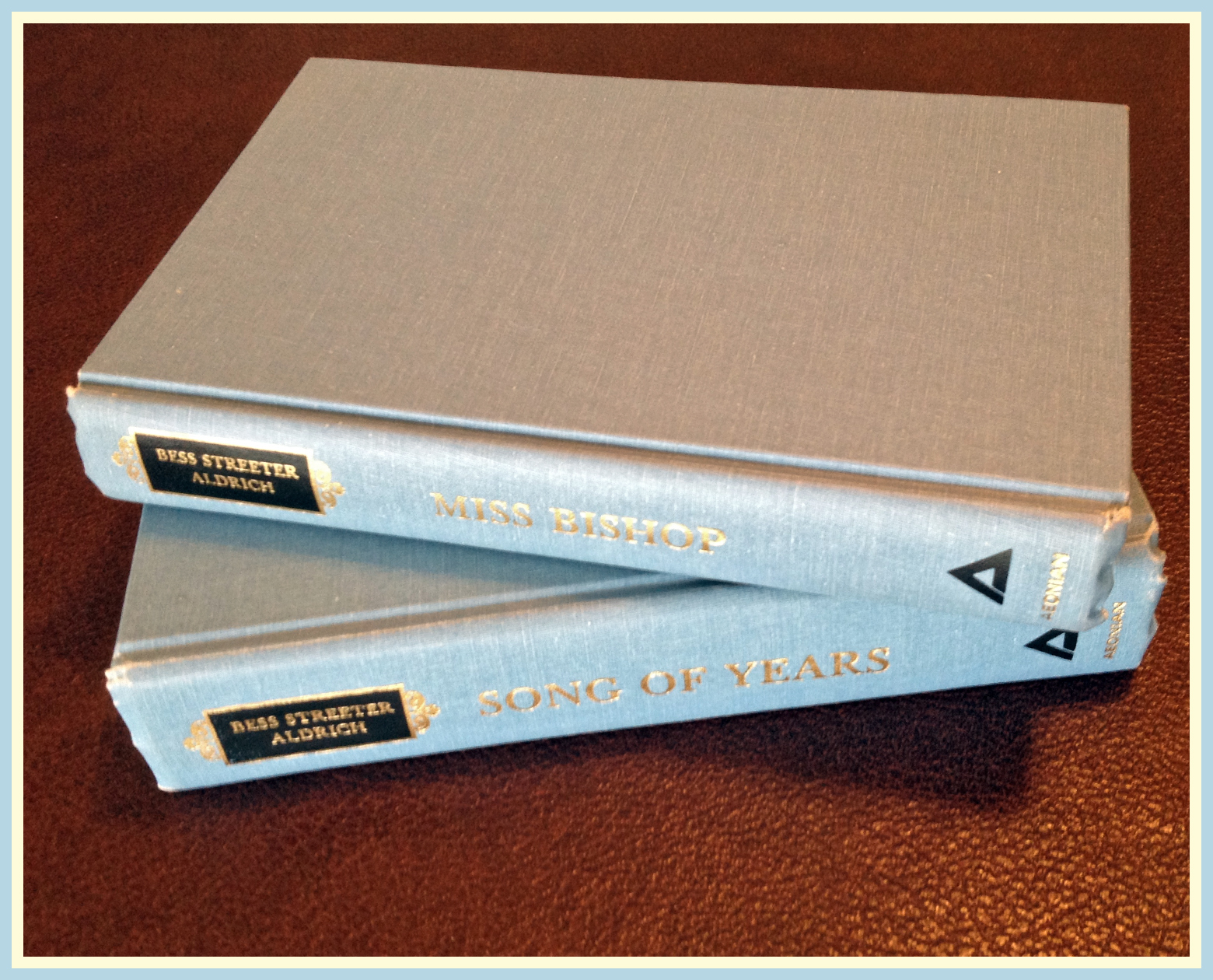
Books by Bess Streeter Aldrich

Books by Bess Streeter Aldrich

There is a giant push in the publishing industry, as well as a movement in modern readership, toward e-publication. And as someone who edits for an online literary journal and makes much of her living online (including one e-published short story at Smashwords.com), I am grateful for this technology.

At the same time, I still nurture that dream of some day walking into a bookstore and seeing my book on the shelf. (Or even better – seeing it purchased by an eager reader.) I cannot imagine any author not wanting this. But with the chances of landing an agent or publisher being so slim and the cost of self-publishing prohibitive for many, e-publishing is quite attractive.

When I was in the seventh grade, I was part of a small research group that researched and proposed a new kind of virtual book. It was the mid-1990s, and we didn’t even have the internet available for us to do our research, so this was quite a far-reaching idea for the time. We hoped that we would win an award – and maybe even enough grant money to create a prototype. But while I was honored to be chosen to work on such a project, the idea of the product really bothered me. Everyone else in the group was excited to create some virtual experience that would make people never want to go back to the traditional books again. I quietly kept my qualms to myself.

I doubt it was just my feelings about the project, but it never went anywhere. That doesn’t mean, of course, that the industry didn’t move forward without us. And there is a great use for e-books – don’t misread what may sound like a lack of enthusiasm on my part. I have a friend who travels all over the world and is also an avid reader. Her Kindle is her best friend. She can load eight or nine books on it for her trip and never have to worry about all that extra bulk in her luggage.

Tablets have so much going for them, and they only get more sophisticated as time goes on. Some books are only available via e-reader, and it’s much more convenient reading them on a tablet or a smartphone then having to sit at your desktop every time you want to read. I’ve purchased several books and read them this way, and what’s great is that I can read and fold laundry at the same time, not having to worry about the book flipping itself closed. If I ever end up some place with only my phone to keep me company, I have any number of public domain books available with one swipe.

So why would I ever need a physical book again? I mean, aside from wanting to publish one, of course. It would do me no good to see one on a bookstore’s shelf if people suddenly decided they didn’t want books anymore. But they still do. Even though they cost more. Even though they take up space.

I would have to argue that there is something viscerally satisfying – and I’m not talking about eating the pages. It’s something in the feel of a physical book that trumps the convenience of e-books. Especially if, like my friend, you haven’t read one in a while. It just feels good to run your fingers over the pages, to hear that rustle of paper. Sometimes the texture is fine. Sometimes the pages are thick. And when you’ve been with a book for a while, you wear it in like a good pair of shoes. You know the feel of it in your hands, and it’s not just the story you miss when it’s gone. I also like to see my progress, especially on a really thick book (my favorite kind). I feel like I’ve accomplished something as my bookmark moves from the front to the back.

Georgene's Bookmark

Georgene’s Bookmark

Oh, and bookmarks. How could I forget bookmarks? My friend Georgene, artist extraordinaire, made this one for me – isn’t it gorgeous? I confess that while some people have a shoe fetish or an obsession with jewelry, I have a thing for bookmarks. It’s best that I avoid the accessory section in general at bookstores because I’m liable to spend just as much on those little things as the books themselves. Oh wait – e-books come with bookmarks already in the program. Which is good because your kids can’t pull the bookmarks out and make you lose your spot. But then you also don’t have your friend’s art or Edward Cullen or Harry Potter looking at you every time you mark a page.

You might have many more reasons why you still keep books on your shelves – or why you continue to buy them. Or maybe you take issue with my whole argument. But if you do, I have one more thing I would like for you to consider: remember my friend and the book I’m lending him? Well, that wouldn’t be possible if another friend hadn’t bought the book for me to begin with. This, I think, has to be my favorite thing about owning actual, paper books. I love giving and receiving them as gifts. (There’s something so personal about giving a book you know will speak to someone.) I love lending them to others, and I’ve discovered so many wonderful books that I never would have known about if friends hadn’t lent them to me. My parents still have books that belonged to my dad when he was a kid, and the third generation is enjoying them now. We enjoy a person-to-person library system with no due dates, and as long as you’re careful about who you share with, it always pays off.

I am absolutely not advocating that we boycott e-books and e-readers. Just the opposite: I am grateful that we have the choice. What I am saying is that you don’t have to buy into the commercials that try to convince you that anything without an “e” in front of it is going the way of the T-Rex. After all, people still run outside, even though we have treadmills. And we bake cakes from scratch, even though we have cake mixes. We do what works for us, given our individual situations, and when a friend decides to share a book that might take up some space on your table or in your purse, it’s still an offer well-worth accepting.

Remember

The former World Trade Center twin towers. The...

The former World Trade Center twin towers. (Photo credit: Wikipedia)

If we don’t do it any other time, every year when September 11th rolls around, those of us who were around in 2001 reflect on where we were and what we were doing when we heard the news. My calendar calls it “Patriot Day.” Others refer to it as “Remembrance Day.” And it is good, therapeutic even, to remember.

I was a college sophomore, eighteen years old, carpooling with Thomas to our Tuesday morning class. He liked to listen to a morning radio show that grated on my nerves. The hosts were crass jerks, so when we heard one of them say that a plane had flown into one of the World Trade Towers, we figured it was some kind of sick joke. It was soon apparent, however, from the hosts’ shocked-sounding voices that they were merely giving a play-by-play of what they must have been watching on live TV. And as we searched for a parking spot, we heard that the second tower was hit. One of the hosts said one plane could be a terrible tragedy, but two was terrorism.

I was numb. Terrorism? In New York City? Thomas and I walked to our class, where everyone whispered or sat in shocked silence. Our professor, when she arrived, had no idea what had happened, and we were all too shell-shocked to say anything. She apologized profusely for it the next time our class convened. I don’t know if anyone remembered what happened in class that day.

Thomas and I went our separate ways for our next classes; we felt we had to because what if the other professors hadn’t turned on the news? We still didn’t understand the ramifications of what had happened. I walked into my classroom, and the TVs, which were usually off, showed more smoking wreckage – but not of the Twin Towers. One of my classmates was a military wife, and she was in tears. That’s how I found out about the attack at the Pentagon.

The rest of the day, week, and month were surreal. I didn’t know any of the victims, but I live in a military town and have family in the military. Everyone was glued to the TV or theorizing about what would happen next. We clung to our families for comfort.

I remember, as days passed and the likelihood of finding survivors lessened, watching people on TV as they showed pictures of loved ones. One man had a photo of his wife, who was pregnant with their first child. Too many days had passed, I knew, but I still prayed for her to be found safe. She wasn’t. There are too many stories like that.

Then someone created a slideshow, and it became a horrifying Internet sensation. Every picture was of a person jumping out of one of the Towers, choosing to end their lives rather than wait for the buildings to collapse. I didn’t know whether to be offended or savagely proud that someone had captured the last moments of those people’s lives. It seemed like exploitation. I can’t imagine the despair of the jumpers – or family members who saw that slide show. I prayed for them, too.

If remembering is what we do today, it’s so easy to get caught up in the negativity. Why didn’t we prevent it? Why did it happen to begin with? How can we stop such atrocities from ever happening again? It’s easy to point fingers, not only at leaders back then but at more current leaders. While an attack of that magnitude hasn’t happened again, there are other terrible acts that have happened. Too many. And no matter what we do, we will never be able to eradicate evil. Was that too strong a word? I’ll say it again: evil. I didn’t say the devil or blame it on something mystical. Maybe people aren’t evil to the core – I don’t know. But they certainly commit evil acts, and when they are bent on those acts, all the second-guessing in the world can’t stop them.

I won’t apologize for getting overly emotional or being so direct. But I also can’t end it there. Almost three thousand lives were lost September 11th, 2001. But not all of those people were the victims in the buildings that were hit or the planes that hit them. First responders sacrificed their lives to save as many as they could. They will say that they simply did their jobs, and that’s true; they had excellent training that carried them into dangers that many of us wouldn’t be able to face. They are the good in this equation. Does that mean they never made a bad decision, that they maybe didn’t say something they regretted before leaving the house that morning? Of course not. They’re human, too. But in the moments that mattered, they chose to face horrible odds, some dying in the process. Thanks to them, the death toll didn’t reach three thousand.

On this day when I can (and do) remember the terrible things, instead of dwelling on them, I remember that there are people who will do the right thing, when it comes right down to it. They won’t sit by and video the event, won’t run the other way, thinking it’s someone else’s problem, but instead they’ll give of themselves – even unto death – to help someone else. And for all of you who did that then and do that on a daily basis, I cannot thank you enough.