Procrastination (I’m Writing This When I Should Be Writing Something Else)

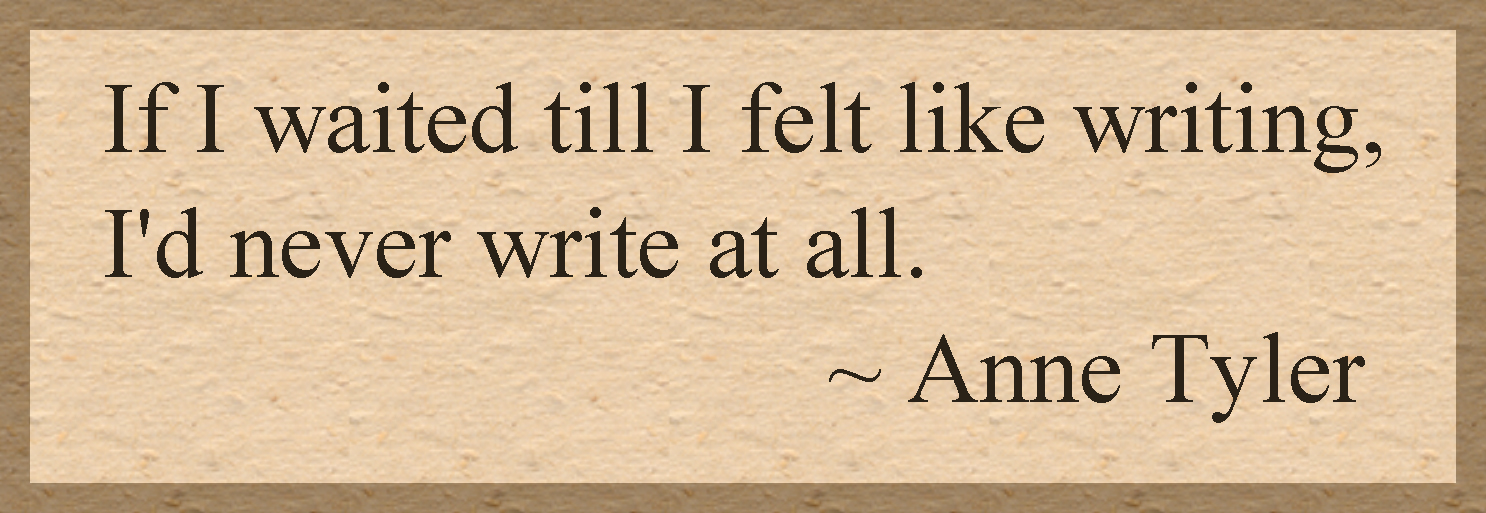
Anne Tyler Quote

Anne Tyler might just have a point. Take this post, for instance: I’ve been thinking about writing about procrastination for a while. And what’s the best way to do this? Well, to procrastinate, of course. (I find it’s often helpful to write about things that I’ve experienced first-hand.) Granted, I did have other topics to cover first, which I did. Then I even sat down and wrote a few paragraphs. Which I let sit for five days. Then I came back and erased them all.

Sometimes I don’t write because I have other things to do. I am a very structured person, and as such, I cannot allow myself to write a blog post or edit my novel or read for pleasure when I need to pack my son’s lunch or send an important e-mail or wash a load of laundry. But sometimes I don’t write because… well, maybe I’m just wasting time on Facebook. Granted, I don’t do that too often – and I even got rid of all the games on my phone to eliminate those distractions – but there are still plenty of times when I should be writing, but I do things that could easily wait until later instead.

If such a self-disciplined person as me has a hard time staying on task, what hope is there for writers who aren’t nearly as structured to ever start the writing process?

I have a two-part answer, and the first part is that I think it’s a me thing, separate from being self-disciplined.

This isn’t something that’s just happened to me since having kids. It’s something that’s gone on as long as I’ve written. I remember spending afternoons at my parents’ business, pacing through the same four rooms, building scenes in my mind, sometimes even muttering the lines. I would hash over those same scenes ad infinitum. I still do this, although nowadays, I’m not a teenager with a bunch of free time but a mom who squeezes all of her creative thinking into stolen moments in the shower or car or while folding laundry.

The second part of my answer is that thinking is a part of the writing process – or any creative process. Now, the problem is that if you don’t ever move beyond thinking – to the actual doing part – you are not a writer or a painter or an inventor (or whatever) but merely someone who aspires to be one of those things.

Philip Pullman Quote

Thank you for making my point, Mr. Pullman. And my problem is that I don’t always take my ideas to my “desk.”

Sometimes I’ll think over a scene so much that I just assume I’ve written it. And then, as often happens, I’ll move onto something else. Months or even years later, I may look for that scene, only to discover that it was only ever in my head. Other times, I do sit down to write, but the words that were perfected in my mind have all but evaporated. Or they just don’t ring true anymore. Something has changed between the initial thinking and the writing.

Madeleine L'Engle Quote II

Well said, Ms. L’Engle – and the same thing can apply to blogs. But I don’t think it’s a totally bad thing. I think internalizing a scene or some dialogue or just an idea is all a part of the writing process. As long as I do eventually sit down and write (like I’m doing right now), it adds up to the creative whole.

Earlier this week, I discovered an incongruity in my novel. A scene hinged on my protagonist having an opinion based on a conversation she overheard. Unfortunately, I realized this conversation happened when she was three or four and would have been way over her head at the time (if she’d even been paying attention). I had to re-work the scene, keeping the content but changing how it happened. I couldn’t move on until I’d fixed the scene, and I had to think it through first. For several days.

I’ll admit, I was a little intimidated by it. When you realize that you’ve created a problem that you have to write your way out of, sometimes the easy way out is just to give up – set the manuscript aside. And I’ve done that before, but I can’t with this one because I’m shopping literary agents. I had to tackle that scene, and after letting it simmer and then reading a few scenes around it, I figured out a solution.

Madeleine L'Engle Quote

Yet again, I feel like Madeleine L’Engle is talking to me. I am that woman with children and another job – a woman who wants to write, who needs to. After all, I can only procrastinate so long before the creative dam breaks. I have legitimate distractions, but I also have stories to tell. So I will continue to fight myself but understand that sometimes it’s okay to just think – as long as I do carve out that time to take my ideas to my desk-slash-laptop.

Speaking of which, I think it’s about time to wrap this up so I can get back to it.

Spring “Cleaning”

Inheritance Cycle

Inheritance Cycle (Photo credit: Wikipedia)

I really wish I could tell you that I spent a good chunk of spring break getting rid of toys and clothes and giving my house the overhaul that it needs. Sadly, while I did the usual laundry and daily upkeep, I didn’t spend a lot of much-needed time cleaning.

My hope for our spring break, after returning from a few days at Disney World, was to catch up on my freelance projects and recreational reading. Any cleaning that happened in addition to that was gravy.

But would you believe it? My kids actually expected to do fun stuff for spring break. I know – can you believe the nerve? Really, they were little troupers. I had a lot of not-fun-for-kids stuff packed into those five weekdays. Now, they did get to stay up later than usual and watch movies and play outside, but there was still tutoring and the dentist and grocery shopping. I finally took them to the park last Friday, where they could just be kids.

It didn’t leave a whole lot of time for all that catching up I’d planned to do. I should have known better, but when spring break is on the horizon, it looks so sweet, has so much promise.

I did make some good progress on my biggest book project (and absolutely zero on another). I edited a bunch of my novel and only had a little left when school went back into session. In all honesty, I was happy to get any of that done.

But what I didn’t do much of was read for fun. Granted, I’m reading Eldest (sequel to Eragon). Not only is it close to 700 pages, but they’re a very cumbersome almost-700 pages. There’s a reason these books are on my book list for the third year in a row – and there’s also a reason I’m tackling them early.

For the first couple months of the year, I stuck to my 2015 book list, but to get more titles under my belt and break up the pace a little, I decided to read shorter books in between the Inheritance Cycle books. Aaaaand… well, I may have fallen off my book list wagon and bought a new book.

It was a shorty, I promise, and it was a really good one – a new-to-me author with a unique style that I admire, even if I can’t emulate it. (It was Daniel Woodrell’s Winter’s Bone, in case you’re wondering.) The only problem was that I made a sort-of promise to myself that I wouldn’t buy any new books until I read through all the other new books that I already own, and this was a new book.

But after that little detour, I’m back on track again. Except…

One of the other things the kids and I did on spring break was to stop by my favorite local bookstore, and because the owner knows what a sucker I am for books, she reminded me that their 40% off spring cleaning sale was coming up.

You should be proud of me. I only bought four, two of them chosen by my elder son. But I have to say it makes me happy to know that there are more books for next year’s list if I don’t get to them this year.

New Books!

New Books!

Plus, I also have to say that sometimes you get a nice surprise where you don’t expect it. That book on the top left – The Fantastic Flying Books of Mr. Morris Lessmore – is amazing. I highly recommend it if you love books; you don’t even have to have kids to appreciate it. I likely would not have bought it on my own, but Peter was excited to see it because he’d heard it before in his school’s library. I’ll have to say I’m pretty proud of my little bibliophile.

Despite not checking one thing off on my to-do list, I’m pretty happy with my spring break. It’s the little things.

How Do You Know What to Cut?


http://www.gettyimages.com/detail/138307331

Last year I asked a number of beta readers to read my 120,000-word NaNoWriMo 2013 novel. After receiving an excellent critique from one of these beta readers, I shared with him how annoyed I was that I was somehow supposed to cut my word count in half. “What would you cut?” he asked. He understood that the novel had issues that needed to be fixed, but he didn’t think length was one of them. He couldn’t fathom how I could drastically cut yet keep the same story.

But I’ve done it. (Well, I haven’t cut it in half, but I’ve cut over 40,000 words.) When he recently offered to read the edited version of my novel, the question changed to, “How do you know what to cut?” My friend is simply curious and fascinated about the writing process, but many writers want to know the same thing. Lost, they wonder if they can cut and still keep the integrity of their stories.

It comes down to more than just correcting typos. Typos I can fix all day, and in fact, I was the queen of clean copies back before I took my first fiction workshop. Clean copies that weren’t all that great to read, as it turns out.

After my first story was critiqued, I discovered that I wasn’t the prodigy I’d always imagined myself to be. I assumed, at first, that people just didn’t get what I was trying to say. It was their problem. It was humbling to realize that they didn’t get me because my stories were a mess.

The credit goes to Ari, who led those fiction workshops. Much of how I write and edit today goes all the way back to those seven semester-long workshops that I took from 2002 to 2005.

Reading others’ stories and discussing them brought to light so many issues that are common among many writers, not to mention learning a lot of tough lessons when my own stories were critiqued. Ari has all kinds of pet peeves, and to this day, I don’t think I’ve written a sentence that starts, “As he went to the fridge” or “As she tied her shoes.” That particular type of sentence drove Ari nuts, and I guess it’s because it shows up so often. The point isn’t to avoid that one kind of sentence but to be intentional. Don’t fall into the trap of using the same sentence structure over and over again. You’ll find yourself on the slippery slope to lazy, sloppy writing.

Showing instead of telling was another biggie. (You can read more about that here.) I used to be the type of writer who had to describe the layout of every room and the outfit of every character. Was this necessary? Nope. That’s not to say that all descriptions are bad, but what you write must add to the story.

For instance, Harry Potter’s lightning scar, green eyes, and trademark glasses form a quick mental picture, and the scar and eyes have their own stories. But is it important to know what brand of jeans or what color shirt he wears? Do we need to know every single item he keeps on top of his dresser? Only the ones that may come up later. Why? Chekov explains it so well: “If you say in the first chapter that there is a rifle hanging on the wall, in the second or third chapter it absolutely must go off. If it’s not going to be fired it shouldn’t be hanging there.”

Eragon and its sequels are popular young adult novels that run to excess when it comes to descriptions and scenes that don’t move the story forward. Each book could easily be cut by tens of thousands of words. Some descriptions are helpful. We’re dealing with a fantasy world, after all. But too much bogs down the text, gives it a plodding pace. I enjoy these books, but I know I have to invest a lot of time when I want to read them. Not because they’re thick books but because there’s a lot of unneeded padding packed into those pages.

You may have heard the phrase, “Kill your darlings” (attributed to just about every well-known writer, and it’s because they all know it’s true). Does this mean that I need to cut every word, every line, every scene that I’m proud of? Well, not quite. But what it does mean is that writers often get attached to bits of prose that ought not be included in the manuscripts where they currently reside.

Ugh. But I worked so hard on that scene. The words flow beautifully. If there’s one thing I won’t cut, it’s that line…

I’ve been there and cut that. My trick to save myself from writer’s remorse is to save all major revisions as separate documents. Then I don’t feel quite as bad about nixing a line or scene when I know I can go back and paste it in again. Which I’ve done.

It takes a certain willingness to cut any- and everything that is not essential to the story. It takes a thick skin when you realize what you cut the first time wasn’t enough (even if it was a lot), and you have to go back and perform major surgery again. It also takes a certain editorial know-how, which may mean that you’ll either have to hire an editor or babysit your favorite reader’s kids for the next five years. Even if you’re a proficient editor, I highly recommend beta readers. (Just be ready to read their stories, too. It’s only fair.)

As Stephen King recommends in On Writing: A Memoir of the Craft, temporal distance also helps. Take a month off; then come back to a manuscript with fresh eyes. You’ll be surprised at the number of throw away scenes that seemed brilliant at the time but are really just filler – and conversely, the number of excellent scenes you’re surprised you actually wrote. (And while we’re talking about On Writing, which I highly recommend you get, King also gives an excellent example of a block of text before, during, and after editing, so you can see the actual process.)

You may notice, after coming back to your story after a break, that you don’t like your opening chapter. You don’t even need that first scene, in the grand scheme of things. Or maybe it belongs much later. Be open to not just cutting words out of sentences, but restructuring completely. We’re not just talking a face lift or a nose job. We’re talking vivisection. It’s going to be messy, and it’s not going to look like the story you started with, but as I reassure everyone who’s read my beta novel and liked it, I haven’t changed the content, unless I improved it.

Last, please read your text aloud. I know it’s difficult if you have a full house and little privacy, but you really need to do this. You will be surprised how good something sounds in your head but how terrible it sounds when spoken. You’ll notice where you start to bore yourself. Or if you read aloud to another person, you’ll see where you lose your audience.

In all of these ways, you can transform a story, for instance, that opens with a girl thinking about how scared she is and how much she misses her old life (and why) to a story that puts the thing she fears on her doorstep and makes her take action.

How’s Your Writing Going?


Embed from Getty Images

When I was 25, I met a friend for coffee on one of her infrequent visits home. After being inseparable as kids, we eventually drifted into our different lives. Hers seemed glamorous to me: she’s a debutante who attended an Ivy League school, then traveled abroad to pursue other degrees. She drives the most expensive sports cars and vacations all over the world. When she called and told me she was in town, I couldn’t turn down the chance to catch up with her.

I knew we wouldn’t be able to meet long because my 11-month-old son would be up from his nap soon. I was so happy to see her – and impressed with myself for losing all my baby weight and then some – that I never thought how plain I would look in my jeans and t-shirt next to her designer outfit. I never thought she’d care to know what I’d been up to. What was there to say? I’m a mom. After catching her up on baby news (which doesn’t take long when you’re talking to someone who doesn’t have kids), she asked about my writing.

Writing? What writing? Oh, wait, you mean how I thought getting a degree in English would set me on the path to bestseller-dom? While I kept up with my daily journal, my fiction had gone the way of the dinosaur. I wouldn’t call it a slump. It was just that I was busy and happy not writing. After I missed the “published author” mile marker on the highway of my life, I moved on to “starting a family” and didn’t look back. Yes, I still wrote, but it wasn’t the kind of writing that kept me up at night.

And that was so not how I had envisioned my life – to be unpublished and happy. By the time I was 13, I knew that I wanted to make a living writing novels. I had no inclination to get a regular job and write after hours. I wanted to provide for my family through my books. And I was naive enough to think that I could go to college and get an English degree, and somehow, I would be in that perfect position to fulfill my dream.

Here’s what I often imagined: a home office overlooking a fenced-in backyard, where my future, well-adjusted children would run around and play, allowing me to work in peace. And then we would go out for ice cream and a movie, and we would take vacations whenever we wanted, and if my husband decided to get a job, it would just be because he wanted to, not because we were dependent on his salary.

Obviously, I had no idea what being a parent or an adult is really like, much less how the publishing world works.

But by 25, I was well aware of the perils of the publishing world. I’d already received rejections from literary agents. I’d even gone through a period when I thought maybe I couldn’t write. Maybe I would just be an editor, but I got over that when I realized that I simply hadn’t found my voice yet. After I did, I found joy in writing again. But I still had nothing to show for it, other than the title of “Editor-in-Chief” for a fledgling literary journal.

My entire writing “career” has been full of these ups and downs. I do actually make money as a writer, but it’s certainly not enough to buy us the house with the big yard and to keep my husband from having to work. It’s my lack of steady employment that makes him have to work so hard to pick up my slack. Part of me wishes that I’d gone to work for a newspaper or local magazine or even a small publisher. I would be able to carry more of the financial load, although that’s not at all the kind of writing that feeds my soul.

Yet despite being married to a starving artist, my husband believes in me. That doesn’t mean he thinks I’ll make millions, but he’s always my first reader, and even though he protests that he never knows what to say, I can always trust him for an honest opinion. The book that I’m shopping around right now is the best thing I’ve ever written, but just because it’s the best thing I’ve produced to this point doesn’t mean it’s perfect – or anywhere close to the best thing out there.

Amidst editing and querying and doing a whole lot of work that could amount to a lot of nothing, I finally asked him if I should even bother. I’d been gearing myself up to ask for several days. He loves me, but he’s not afraid to give me the painful truth. He told me it’s a good story, and he wants me to get recognition for it (although that in no way guarantees anything about getting it published).

Then he asked me if I would quit writing, even if it wasn’t any good.

While I would certainly quit wasting both my and the literary agents’ time by querying, I would never quit writing because it’s my outlet.

I still have that dream of making a living as a novelist. I still want to have a positive answer when I meet with a friend for coffee. If she were to ask me this week how my writing is going, my answer is that it’s great. I’m editing a story I love and that I know has potential. It still needs work, but maybe someday…

Here’s a quote from Sylvia Plath that I found earlier this week:

And by the way, everything in life is writable about if you have the outgoing guts to do it, and the imagination to improvise. The worst enemy to creativity is self-doubt.

I have the guts and the imagination, but I also have self-doubt. It’s what made me ask my husband if all this was worth the effort. It’s what makes me cringe when someone looks at me expectantly, like, “Well, you wrote a novel, why isn’t it in bookstores yet?” I think self-doubt is healthy because it makes us look honestly at ourselves. It’s only harmful when it turns into a loss of confidence; then it’s apparent in your writing and your outlook and can turn into a self-fulfilling prophecy. What self-doubt should do is help us re-evaluate our goals and adjust them to be realistic.

I think the enemy of creativity is really regret. Getting to a certain point and wishing you hadn’t done what you’d done. While I sometimes wish I’d done something to augment my position, I certainly have never regretted writing. If my stories never see the light of day, at least I was happy creating them.

***

Before you go away thinking that my sweet friend didn’t understand me at all and didn’t care about my life, let me tell you her response to my lack of stellar news. She said, “But you’re a mom.”

She said it with admiration and almost reverence. Yeah, I’m a mom. And quite often a writer mom. Like I said, no regrets.

Just When I Thought I Was Done…

Edit your manuscript until your fingers bleed and you have memorized every last word. Then, when you are certain you are on the verge of insanity… edit one more time!           –C.K. Webb


English: Manuscript fragment from Chapter 14 o...

Editing (manuscript fragment from chapter 14 of Herman Melville’s The Confidence-Man/photo credit: Wikipedia)


You guessed it. In the midst of querying, when I’m supposed to be done editing, I’m still editing. As a friend once told me (and I’ve heard it echoed by numerous other writers), you will always find something you want to fix with your manuscript.

I thought I was done; truly, I did. After all, I put my novel through a lot. Before I let anyone lay eyes on it, I edited out the embarrassing first draft kind of garbage that no one needs to see. Then I distributed it to beta readers. The feedback was incredible, allowing me to make more much-needed changes.

Amidst these changes, I signed up for a workshop with a team of literary agents, in which I had the opportunity to really work on the first 10 pages. After all, the first 10 pages may be all anyone ever sees if they don’t compel people to keep reading.

So I got my criticism, swallowed it even though it tasted bad, and I changed my book some more. One comment was that my manuscript was much too long, so I cut over 30,000 words. With a new ending and lots of proofreading under my belt, I figured I should quit procrastinating and start querying.

Nowadays, the majority of literary agents ask for a sample of the manuscript. The most common request I’ve seen is for the first 10 pages, although the odd agent wants 20 or the first three chapters. (Some even ask for the entire manuscript, bless their hearts.) The theme seems to be that they want to see a significant enough chunk to get a good feel for how the rest of the book will (or won’t) flow.

I was a little stumped when I found an agent who only asked for the first chapter. After I cut and pasted that one lonely chapter into my e-mail query, I realized that it wasn’t an adequate representation of my story. Without the next few pages to go with it, the pacing was too slow, and it ended in a bad place. I had edited it down from a much longer first chapter. Also, when I was concentrating on 10 pages, I didn’t pay much attention to how the first chapter ended because the first 10 pages went well into chapter two. I should have made sure that chapter one had an enticing ending. You know what the last word of that chapter was? “Okay.” Which is not okay, unless you’re John Green.

Thus began revision number four.

A couple years ago, while querying a different novel, I decided that I would make absolutely no changes (unless I found a typo) on my manuscript during the querying phase. I sent out 10 at a time, and it wasn’t until after each round of rejections that I looked over my query letter and manuscript for ways to improve.

This time, I’m making corrections as I go. Never have I made so many changes from one query to the next. If an agent happens to like the version of my book with an anticlimactic ending to the first chapter, I have that version saved. But I’m not going with the status quo anymore. I will not sit around and say, “Oh, it can wait.” It could be that the agent who’s right for me is the next one I query, and if that’s the case, I don’t want to send a chunk of my book that I know I can improve.

Painful? Yes. And I love editing. But it’s hard to think, I’ve done all I can do, only to look back and see that you didn’t.

This likely means more drastic cuts for my book. I’ve already come to the realization that I may have to trim it by another 10,000 words-plus in order for anyone to even give it a serious look. Do I think the word count alone should be the deciding factor over whether my manuscript it rejected or accepted? Absolutely not. (And I’ve climbed on that soapbox before.) But I also think that it would be a mistake to grow complacent.

So it’s time to continue cutting, revising, and searching. The right agent is out there, I know it. It will just take a more vigilant search than last time, and I have to be willing to do my part to earn a contract.

What Comes After NaNoWriMo? (2014 Version)

I won!

I won!

For the third year now, I’ve written a post entitled “What Comes After NaNoWriMo?”, so since we’re into December now, it’s time to post this year’s version. (Read the first two here and here.)

In case it’s your first time stumbling across my blog, and you’re like “NaNo-what?”, it’s short for National Novel Writing Month (which is November). Writers sign up through nanowrimo.org, and starting on November first, they each must write a 50,000-word novel from scratch by November 30th.

In 2012, I thought everyone who participated was crazy. Then last year, I turned into one of those crazy people and wrote 80,000 words by the end of November, and I finished the first draft of that novel in early February. I didn’t know whether I would participate again this year, although my first time was an amazing experience. It just wasn’t one I was sure I could replicate.

Then in the spring, I had an idea for a new novel, but the problem was: could I wait until November? I did discover a way around that problem (read about it here), but as the summer months came and went, I realized that what I really wanted to write this year was the sequel for last year’s NaNo novel. And so when November rolled around, I was ready. Sort of.

Actually, I was stressing over editing the first novel. There were some problems with the end that I had to resolve before being able to start book two. So November first found me making those final changes, and I started NaNoWriMo 2014 with a bang. I wrote over 4000 words, which put me ahead of the game (you need to write 1667 words per day to finish on time, but my personal goal was 2000).

Unfortunately, it was well before the dreaded second week slump that I had my own personal slump. This year, although I enjoyed the writing process, it was a completely different experience than last year. Many days, I struggled to achieve my word count goal, and a couple nights, I didn’t come anywhere close.

It was one day last week when I confided to my husband that I’d finally reached a scene with some action – about 38,000 words in. What that means is that when I go back to edit, I’m going to have to cut out a lot of deadwood. I joked that it would end up being a two chapter novel when I got done with it.

The wonderful thing is that, after that point, I had a much easier time writing this book. If I were able to average 2000 words a day, that would put me at 60,000 words at the end of the month. And as of November 30th, I actually had 61K. The last 20,000 words were the easiest for me to write; it only took me to the end of the month to find my stride.

As with last year, my goal now is to finish the novel. Last year’s novel ended up being 148,000 words, which I have now cut down to 99,000. Still long for a the young adult genre, but it’s a lot tighter than it was. As for this one, I will be surprised if it’s longer than 80,000 words. I hope to finish it by the end of December, if at all possible, and then start editing.

I’m not about to fool myself that this one will be any easier to edit. After having such a hard time finding my momentum, it’s going to need some serious work. But yet again, CreateSpace is offering two free copies to all NaNoWriMo winners who submit by June 30th (see all the winner goodies here). And unlike last year, when I submitted so late that I didn’t have time to fix a submission issue before the deadline, I plan to make it ahead of schedule and actually get those two books for free.

How about the rest of you? Did you struggle like me and keep plugging away? Did you realize your idea wasn’t what you thought and scrap it halfway through? Or did you surpass all your goals and end up with a monster novel on your hands at the end of the month?

And for those of you who still don’t know if you can handle a project of this magnitude, I encourage you to consider signing up next year. And there are a couple opportunities before November when you can sign up for Camp NaNoWriMo and warm up those writing muscles. Why not? You might discover you have some unexpected literary tricks up your sleeves.

Sometimes You Have to Freeze Your Characters in Carbonite (Don’t Worry, It’s Temporary)


Embed from Getty Images

What a difference one week makes! If you read last week’s blog, I was gearing up for NaNoWriMo and nervous about starting. Not because of the whole 50,000 words in a month thing. I did it last year, so how hard could it be to do it again?

What I was worried about was finishing last year’s NaNo novel in time to move on to the sequel, which is this year’s NaNo novel. I was still deep in my last edit, and although I didn’t have many pages to go, I was at the crucial point where I needed to make the most drastic changes.

During the editing process, I cut almost 50,000 words (ironic – don’t you think? – since that’s the number I need to type this month). Cutting I can do all day. But the closer I got to the end, the more it became like slogging through verbal quicksand. It was the part of the editing process that I dreaded most. I had quite a bit of hard work ahead of me. On the one hand, I still needed to cut 3000 words, and on the other, I needed to add to the ending to improve it.

Then something wonderful happened, something that I hope happens many times this month (although it hasn’t yet): I had a brainwave. Whenever I read a novel with a plot twist or a really clever scene, I wonder if it was always a part of the plan or if it developed over time or maybe if it popped up out of nowhere, just in time to save the story. And while I’m not saying that I came up with something brilliant like the vanishing cabinet in Harry Potter and the Half-Blood Prince, this brainwave explained some of the points that I was afraid would never gel. This included making quite a few cuts and changing the ending even more than planned, and I just couldn’t stay up long enough to finish. Editing when you’re half asleep isn’t always in the best interest of the story, but on the plus side, I got to sleep on the brainwave.

November first, the first day of National Novel Writing Month, wasn’t much better. I had my weekly editing work for Fiction Fix and my son’s t-ball game. When the afternoon rolled around and I finally got a chance to edit, I would fix a scene, move on, add some more, realize that this affected an earlier scene, go back, rewrite again… and stare at the computer screen a lot as I tried to figure it all out.

I finally got it, finally realized exactly how it needed to end, and it dovetailed perfectly with the opening of the second book.

Half of my goals from last week were in the bag: I’d finished editing and gotten my word count under 100,000.

And as soon as I finished, I was supposed open up a brand new document and leave my editing hat at the proverbial door. Forget cutting! Now is the time for extraneous adverbs and adjectives. For people to ask sweetly and say quietly and walk quickly and wear elaborate gowns with one hundred buttons down the back, belled sleeves, and sweetheart necklines. Sometimes you have to break all your rules in order to get the job done – and tell your inner editor to shut up while you do it.

Typing that first page was painful. All I could think was, This isn’t a good opening line! No one will ever read beyond this.

And that’s how it’s been all week. My inspiration has just kind of fizzled. I’ve kept up with my word count, but the only reason I’ve been able to do so was because I typed over 4000 words that first day. I’ve seen a lot of things that need the axe. Even as I type, I think, This’ll get cut in the next draft.

But not in this one. Right now, I must plow on. It may be a tough slog the whole month. At least I’ve figured out why, not that it really helps. You see, I’m in the second book slump. This happens in trilogies. Okay, instant fix: don’t write a trilogy. It’s not that simple, though. My story needs to be told that way. And I’m not saying that all middle books should be thrown away, but often it’s necessary for the plot to slow or tough things to happen in order for better things to happen later in the trilogy. And so I think that the writing process naturally reflects some of the difficulties within the story. (And besides, it can happen in series with more than three books. Think about New Moon from the The Twilight Saga or Harry Potter and the Order of the Phoenix: necessary but often painful to read.)

The best example I can think of actually comes from the movie Star Wars: the Empire Strikes Back. First of all, what happened to Mark Hamill? Yeah, he’s still a stud, running around the swamps of Dagobah with Yoda on his back and all, but he’s not nearly as cute as in the first movie. Plus he loses an arm (Luke Skywalker, I mean, not Mark Hamill). And then Han Solo turns into a carbonite-cicle. It’s depressing stuff. If you’re a Star Wars fan, you still love it, but yikes. Thank goodness for Return of the Jedi, right?

And that’s what I have to keep in mind. There will be ups for every down. And the great light at the end of the tunnel is my book three, but I can’t get too distracted by that right now because, God-willing, I won’t start on it until NaNoWriMo 2015. What I need is to get through this book – not just get through but give it the attention it deserves, see it on its own terms rather than compared with its companions.

There is a time for choosing my words with great care, for analyzing and fine-tuning, but November is not one of those times. Editor, hop in the backseat. Writer, say whatever you want because you can always cut it out and make it pretty later. After all, the great thing about first drafts is that you can make all the mistakes you want and fix them before anyone finds out. My inner editor needs to take a forced month-long vacation, so I can get some work done.

Haunted by My Story


Embed from Getty Images

November is so close it’s almost scary.

It was just a few weeks ago that I was surprised by October’s arrival, so how could I let November sneak up on me, too? Lots of important things happen in November: Thanksgiving; Christmas shopping; several important birthdays, including my elder son’s; two clients’ book projects are due; a slew of writing assignments for a new client…

And the month-long time-gobbler that is both daunting and exciting, NaNoWriMo (National Novel Writing Month). Last year, I participated for the first time, and I will say again and keep on saying that it was the most fun I’ve ever had writing. In fact, I think it’s the best writing I’ve ever produced.

The goal this year is to at least match the enthusiasm and success of last year – or surpass it.

For the early part of this year, I wasn’t worried about NaNoWriMo 2014 because I was still finishing my 2013 novel. In early July, I produced 10 copies for beta readers. And then what typically happens when I’m busy with one project – I had a great idea for a new novel.

If you keep up with my blog, you’ll know that I decided to hold off writing, saving that new story for NaNoWriMo this year. But as my beta readers started giving me their critiques on my 2013 NaNo novel, I realized I wanted to edit it and write the sequel for NaNo this year. (And don’t worry about my new novel idea – I wrote a few important scenes and took plenty of notes for when I’m ready to start up with it again.)

I figured that it would be easy to edit last year’s book by October and even start querying literary agents again, saying, And if you like this, I’ll be working on the sequel in November.

Except that if today is the corner, then November is right around it, and I’m not done editing the first book yet.

Forget agents – I’ve got to finish this book in order to be able to properly start the next one. There’s nothing that says I absolutely have to start with the opening scene. If I feel like it, I can start with the last one (and yes, I already know what it will be – a cliffhanger leading up to book three, hee-hee). But I so want to start with confidence. That, and I don’t want a lot of editing to slow me down. 50,000 words in one month is a lot. Granted, I wrote 80,000 last November, but they say that lightning doesn’t strike the same place twice, so…

If only I’d written the first book perfectly to start with, right? But that would make me a magician or a novel goddess or something, which I am not. Or if I am, someone forgot to tell the big publishing houses because I’m still waiting for my million-dollar advance.

Instead of dreaming about gross improbabilities (or impossibilities if I don’t get myself in gear), I need to do both stories justice. The ending of book one was so hard to nail, but talking with several of my beta readers helped cement what I need to do to make it more satisfactory, yet leave readers hungry for the sequel. Now I’ve just got to make that happen, so I can pick right up where I left off on book two. By Saturday.

Picture me biting all my fingernails at once.

So I’m posting a tad earlier than usual in order to fully immerse myself in last year’s novel, and I hope that the next time I crawl out of my writer’s hole to blink at the sun, I will have nothing but positive results. And since sharing goals is a great way to stay on track, here they are:

  • Finish editing book one (soon!)
  • Get it under 100,000 words (I still have 3400 to cut – eek!)
  • Write seamless transition from the first to the second book
  • Write 14,000 words by the end of November 7th

Like I said, it’s daunting and exciting. And did I mention terrifying and exhilarating? Time to go to bed so I can indulge in a few NaNo nightmares.

Happy writing!

When Books Disappoint

English: Open book icon

English: Open book icon (Photo credit: Wikipedia)

I was so proud of myself earlier this year: I’d created my 2014 book list, and I stuck to it. I read nine of the 23 books on that list in the first quarter of the year. That’s pretty good, right? I could even afford to get a little sidetracked. Which I did as soon as my birthday hit in April. Yes, I kept plugging away at my book list, but I figured it wouldn’t hurt to treat myself to some new fiction.

I love books, but I also love my goals – to a fault. I’ll drive myself (and my family) crazy with them. At war with myself over the new books that I want to read and the books that I already own that I should read, usually the new fiction wins. I mean, it has the whole excitement factor with it. And in April, I discovered two new-to-me authors, both young adult. I can blame a movie trailer for one, and the other came recommended by several people. If you read this post in April, you may even know which books I’m talking about.

Being the dutiful goal-reacher that I am, I continued reading whatever it was I was in the middle of at the time, and I let my husband go ahead and read the new books. We were particularly excited about the newly-purchased series, whose first book-to-movie adaptation was due to be released in theatres over the summer.

As soon as Thomas finished the first book and moved on to the second, I had to know: “Was it as good as we thought?”

Poor dude. He didn’t want to burst my bubble. His answer was, “Well, it’s not The Hunger Games or Divergent.”

But of course, what is? I set my standards pretty high, but at the end of the day, I don’t want to read books that are just like the ones that I already like. I want variety, originality. But I also want excellence.

So I eventually got around to the series and plunged right in. It wasn’t a challenging read, but that’s okay. It was more action-oriented, which I already expected, after seeing the movie trailer. It also raised a lot of questions, which I love. But…

I was getting toward the end of the book, pretty much after the big plot reveal. Of course, the plot was still moving forward because there are sequels, but things were winding down. Then something gruesome happened, something that was written purely for its shock value. This one scene was written 1) to freak out the characters and 2) to appeal to the adolescent male readership. Marketing is important; I get it. There was still hope for the overall story. On to Book 2.

The weirdness continued. Gruesome and sometimes unexplainable (or explained on a very rickety foundation) things happened. The characters were baffled, so we were in the same boat. The story ended. The loose ends that got tied up didn’t make much sense. But there was still hope for Book 3.

Can you guess what happened? I was very dissatisfied with the ending of Book 3. And since it’s adolescent lit, I’ll put it in adolescent terms: it sucked.

Now, Sarah, you may be thinking, aren’t you being a little hypocritical? Aren’t you okay with not-happy endings?

Oh, there’s a big difference. If the not-happy ending is justified, if it’s realistic, if it fits with the character of the story, I’ll buy it. I may be very broken up about it, but I’ll bow to the author’s decision. But you know what? I still had an inkling of hope. Because there was a fourth book. Although it’s a prequel and wouldn’t change the crappy ending, I was hoping for some kind of explanation or justification. And the prequel gave an answer – sort of. It was still a very unbelievable premise for why things happened the way they did throughout the series, but I guess for 13-year-old boys, they’d buy it. I mean, people die and get shot up, so it’s all cool, right? I mean, as long as the hero gets the girl (doesn’t matter which girl), we can all go home happy.

I grasped for anything that could save these books in my very discriminating eyes, but a scene in that final book kind of killed the whole series for me. I won’t spoil what actually happened, but I’ll give you a for-instance:

Say we have a novel with zombies. They’re so in right now, so why not? So let’s have our protagonists being chased down a residential street by zombies. The only way they will survive is if they can get inside one of these deserted houses and lock the door. So what do they do? They outrun the zombies and make it into a house, and the zombies are so far behind that they feel pretty good about their hiding place.

Except.

Except the last idiot in through the door neglects to lock it. Not only that – she doesn’t even shut it! So when the zombies catch up, brainless as they are, they’re eventually going to try the wide-open door, right? But that’s okay because it makes for great tension, and when the girl realizes her idiotic mistake and has to kill a zombie in the process of slamming and locking the door, it will bring up all kinds of questions about life and death that she can now explore, and – BOOM! – we have an opportunity for character development.

Wait – you’re not cool with that? It ticks you off that she left the door open because no person in the world would possibly do that? Well, in this book that I read, although there aren’t zombies, something very similar happened, and it ticked me off that an editor would ever let something that flagrantly unrealistic pass. It was a device, and neither a subtle nor a good one, at that.

But, Sarah, these are kids’ books. Don’t be so hard on the author.

Whoa, whoa, whoa. Yes, kids’ books are written differently because the audience is different, but a terrible device is a terrible device, no matter the target age. And since the advent of Harry Potter, it’s not only become acceptable but expected that parents will read this fiction, too. Not because they’re screening it for their kids (although they do that, too) but for their own enjoyment. And it’s not just the parents. People of all ages, with and without kids, read YA lit now. And they’ve come to expect excellence, just like I do, because audiences of all ages deserve as much, right? So what if 13-year-old boys don’t appreciate all the nuances yet? Give them excellence, and they’ll appreciate it, even if they can’t articulate why. It’s like a taste test. You may not realize how awful that cardboard-tasting cake is until you taste the real thing, but once you’ve had that taste, don’t ever try to pass cardboard for the good stuff again.

I’m glad that people write lit that will excite young boys. What a difficult demographic to please! But after finishing that last book and reading some of the reviews, I saw that I wasn’t the only reader who was underwhelmed. Several expressed the hopes that a fifth book might be published, in order to right all the wrongs of the previous four. Others were outright disgusted in what they’d originally thought was the greatest series they’d ever read. And what’s sad is that it could have been a “greatest series.” I know the author has the talent. There would have been lots of changes, sure, lots of work, but he could have pulled it off.

Oh well, you win some, you lose some, right? It’s not like this is the first time I’ve ever been disappointed. And as my mom tells me whenever I come across something I don’t like, I can at least take notes and know what not to do, myself. So it wasn’t an entirely wasted experience. The author made me care for most of the characters, and the story had some cool elements. It just… wasn’t executed all that well. And I suppose that’s the most annoying part. When something has potential, when it’s grasping but doesn’t quite reach, I’m so much more disappointed than I would be if I had no hope for the book to begin with.

It kind of gives me hope that if those novels can be so successful, maybe someone will look at mine.

Or maybe the author just had a favorite uncle in the publishing industry. Gosh, I’m cynical tonight.

On the bright side, the other novelist I discovered at the time was John Green. And boy, does he ever deliver. So my birthday books weren’t a total bust, after all.

Show Me a Story

Author J.K. Rowling reads from Harry Potter an...

Author J.K. Rowling sharing a story at the White House. Screenshot taken from official White House video. (Photo credit: Wikipedia)

Last week, my son took some things to school for show and tell, except it’s not called “show and tell” anymore. I don’t know if this is a global change or just one at his school. For them, it’s “show and share” (and for younger kids, it’s just “share”). The cynic in me thought that it’s just another way to say the same old thing a different way.

But then I got thinking because that’s what I do. Is there a difference between show and tell and show and share? Certainly, people don’t like to be told what to do. Sharing seems a lot more friendly, and the change of one word could be a way to encourage children to take turns, etc., etc.

And for writers, of course, there’s something in that one poor word, “tell,” that just makes us cringe.

As an editor for a fiction journal, I throw that little four-letter word around all the time. It’s a great reason to reject a story. One part of the job description for readers and editors at Fiction Fix is to give notes on why we accept or reject each story. I try to pull quotes from stories, where applicable. If the dialogue is awful, I use an example. If the piece is full of malapropisms, I’ll list a couple. And if there’s too much telling, I include that in my notes, as well. Except one story this week… I couldn’t choose. There were too many examples, each worse than the last. In the end, I noted that the entire piece was one grand example of telling. Minor problems we can fix, but rewriting the whole story? That’s just a skill that the author needs to learn.

But what’s so wrong with telling, anyway? Isn’t at least some telling necessary? After all, they’re called storytellers, not storyshowers (well, and no wonder because you could easily read it as “showers” instead of “show-ers”).

Some telling is necessary, of course. But in this particular story this week, telling was in the form of: “And another nine years passed, and little Joey was suddenly in high school.” Yawn. I’ve read much more creative ways in which to show the passage of time.

One example of an author who I think did a great job with telling was J.K. Rowling in her Harry Potter series. The more fantastical the world, the more world-building is necessary, and that can easily turn into info-dumping, AKA telling. To create the wizarding world, not only did Rowling have to introduce new names and places and ideas to her readers, but she also had to introduce them to one very important character: Harry Potter, himself. What a great way to present much-needed information! As Harry was fascinated with his first owl post and trip to Diaogn Alley, so were we, and we got to see it through his eyes. We were shown.

But then, there were other times when we had to learn important information, and an author with less finesse could have completely blown it. Instead, Rowling had two characters in place, Hermione Granger and Albus Dumbledore, who were storehouses of knowledge. Hermione, being the bookworm that she was, knew more than most witches and wizards her age to begin with, and if she didn’t know, she went to the library to find out. And Dumbledore… well, he was full of all kinds of bizarre and useful bits of knowledge, although he was slow in divulging it all. Potter fans, do you remember the end of the first five books? With a sense of relief, you knew that Dumbledore would tie up quite a few loose ends… and leave you hanging just a little, which was where the next book would pick up.

Other means of imparting facts in unique ways that Rowling and other authors have utilized are by having the characters find facts and discover clues in books, e-mails, letters, diaries, newspapers. We’ve all read dictionaries and textbooks, right? That’s where we get our info, too, so it’s perfectly acceptable for characters to gain their insights in this way, as long as the author doesn’t rely on it too heavily. After all, the narrative does still have to move forward.

But then there are the ever-so-awkward dialogues, telephone conversations, and internal monologues that are meant to convey something important. For instance, a first person narrator will have a more difficult time describing him- or herself than if the book has a third person narrator. Say the female narrator needs to come across as humble. She’s beautiful, but she can’t tell you that herself. So instead, someone says it to her… but it gets overdone:

“Oh, Celeste,” Amanda gushed, “the way you’ve braided your hair is just so becoming! I love the way the light catches your golden highlights, and your blue dress just brings out the blue in your eyes perfectly!”

Okay, so we know that Celeste’s hair looks nice and that she has golden highlights. And her eyes are blue. But do people talk like this? (Admittedly, some do, but they are few and far between. And doesn’t that drive you nuts? Also, note the use of the word “gushed.” Ick. Please don’t write or talk like this because your average person doesn’t.)

Here’s a more natural way to convey similar information:

“Oh, Celeste,” Amanda said. “Look at you! Didn’t I say you would clean up well? And that blue is just the perfect color on you.”

Wait a minute. What happened to the braid, the hair color, the specific reference to the eyes? What happened to the gushing? Although most people don’t like relying on italics, that’s how I tend to hear people when they’re talking, and an italicized word here or there saves you from overused dialogue tags, such as “gushed.” And how important was the physical description, anyway? The more you write, the more you’ll discover that things like this don’t always matter. But, if you’re still not sure, here’s another way to get your point across:

I tried the braid that my mom had shown me, and although I would have preferred sweats over dressing up, the blue sheath she had picked out matched my eyes, at least. I smiled in the mirror, already imagining how Amanda would gush when she walked in the door.

Okay, so maybe it’s not a masterpiece, but you get a little bit of description, plus some character development. (See how she’s uncomfortable but pleased at the same time?)

Oh, and the telephone conversation. Listen to someone talking on the phone one day. From one side of a conversation, you can pick up a lot, but you usually have to fill in a lot of the blanks yourself (or sometimes let them remain a mystery). So in books (and movies, too), should the characters spell out everything for the readers’ sakes? Check out this one-sided conversation for what not to do:

“Hi, Mom. It’s Cindy… I know you expected me to call earlier, but there was a line at the phone… Yes, I guess a lot of other kids are homesick, too… I miss you a lot, but it’s been a great week here at Camp Sparkly Lake, where you’ve sent me for two weeks… Uh-huh, I’ve made a couple friends already. Jessica is a cheerleader just like me, and she can do a backflip, also just like me…”

It could go on and on. Why would Cindy say so much stuff that her mom already knows? People don’t talk like this! I know that you’re trying to minimize the telling, but this isn’t the way to do it. Try instead:

“Hi, Mom… I’m sorry, but there was a line at the phone… Yeah, probably, and I guess I am a little, too. I mean, I miss you a lot, but at least I’ve made a couple friends… Yeah, there’s another cheerleader here named Jessica, and she can match me backflip for backflip. Pretty cool, huh?”

Here, you can imagine what the mom’s saying, and Cindy’s responses are much more natural. As for the other information, like the name of the camp and how long Cindy’s staying, these can be told quickly, but in a way that won’t turn off your readers:

Although the line to the phone looked about a mile long, I supposed it was time to call home and give my mom an update on my first week at Camp Sparkly Lake.

Ta-da! A teensy bit of telling can go a long way.

Which is good advice for me to heed. As an editor, telling slaps me in the face and leaves me reeling. Yet as a writer, info-dumping is so seductive. And since I tend toward the fantastical (or at least magical realism), there’s usually quite a bit of world-building involved.

It’s so difficult to craft those opening pages, believe me. On the one hand, you have to capture the interest of Any Reader, that fickle person who will drop your book like a live grenade if you can’t seal the deal within a sentence or two. On the other hand, you have to create the rules and boundaries of your fictional world up front. If you do a bang-up job of painting your characters in the beginning, waiting until ten pages in to wallop the readers with a garbage load of information, you’re not doing anyone any favors. You have to impart info without hanging a flashing, neon sign over it that reads: WORLD-BUILDING GOING ON HERE! LOTS OF INFO TO DUMP! DON’T GET BORED! I PROMISE IT’S IMPORTANT TO THE STORY, AND YOU WON’T REGRET THIS IN 50 PAGES! Yeah, right. As I’ve said countless times, every word must count.

If you follow my blog, you know that I’m almost done editing last year’s NaNoWriMo novel. The first draft clocked in at 148,000 words. The second draft, which I distributed to beta readers, was 129,000. It took lot of editing on my part to cut those 19,000 words, but it wasn’t enough. I have to take some of my own medicine, and my goal by the end of this month is to not only be done editing it but to have it under 100,000 words. (Right now it stands at 107K.) My readers have asked me how I can cut so much. And they liked the book, so I must have done something right. But at the same time, I know that my first person present narrator needs to keep some things to herself. She doesn’t need to think of what she’s going to do, explain it, and then act. Yes, I’m in the storytelling business, but I would much rather show it.

I would much rather leave my readers wanting more.

With a good book, even picky writers and editors like me won’t notice the craft. It will melt away, and the story will shine through. That doesn’t mean that we won’t savor great lines or powerful scenes. But what it does mean is that the writing won’t get in the way. It will serve the story completely, as it’s meant to. And in the end, we won’t think, Well, a lot of years passed, and those characters sure did grow up – they must have because that’s what the narrator kept telling me. Instead, we’ll think, Has this author written anything else? I’ve got to have it now! I’ve got to read more books like this, and maybe one day, I’ll be able to write something this great, too.

Something worth sharing.