Move Over and Let the Characters Drive

Dumbledore as portrayed by the late Richard Ha...

Dumbledore as portrayed by the late Richard Harris in Harry Potter and the Philosopher’s Stone. (Photo credit: Wikipedia)

I love reading books that are so good that you just have to talk to someone else about them. My husband and I have read a few of those lately. After finishing the latest trilogy, Thomas Googled the author to see if there were any interviews about the series’ ending. Sure enough, he found one in which she talked about how her characters continually surprised her.

“It’s just like so many authors say,” he told me, looking somewhat bemused.

“It’s true,” I confirmed.

As crazy as it sounds, we authors don’t have the total control over our characters that we wished we did. Yet some authors insist on absolutely smothering the life out of their characters to make them bend to their wills. You’ll know these characters when you meet them because they’re inconsistent, like someone is forcing them to do things they weren’t meant to do.

Since I think it’s safe to talk about the Harry Potter books without fear of spoiling the ending (and if you haven’t read them, shame on you), I’d like to bring up something author J.K. Rowling said back in the days when all the fans were itching for Harry Potter and the Deathly Hallows (Book 7). Thomas and I checked her website on a daily basis, theorized with friends, skimmed the news for any possible updates, and any time J.K. Rowling came out with something – anything – new, we were beside ourselves with glee. And no, I am not exaggerating (although Thomas can suppress his glee a lot more than I can).

And one day, she said that she was having a particularly hard time with Dumbledore. Well, first of all, that made everyone scratch their heads because he died at the end of Harry Potter and the Half-Blood Prince (Book 6) – or did he?

But more amusing to me, aside from this nugget, was the image of Jo Rowling fighting her characters to straighten up and fly right. Characters will be difficult, and although non-writers may think we authors crazy or schizophrenic or overly imaginative to say so, there is an element involved that defies explanation.

There are some people who feel compelled to write in order to create characters that fulfill unrequited wishes. These characters are forced into ill-fitting molds. The beautiful girl that said no to a date with the nerdy guy suddenly falls in love with him. The bully at school finally get his come-uppance. The evil boss sees the error of her ways and starts treating her employees like human beings. These characters feel flat. They don’t do much – except what the author designed them to do.

What is truly beautiful, however, is when these characters are allowed to take control of their existences, teaching the author a thing or two while living their stories. Harry was an absolute teenage brat in Harry Potter And The Order Of The Phoenix. Sirius Black died laughing, in the thick of battle. Dumbledore gave his life, leaving a mess and a number of unanswered questions. Dobby – well, I don’t even want to mention him because I know it will start my mom crying. But the point is that J.K. Rowling could have made Harry a sweet fifteen-year-old, leaving everyone wondering if she remembered at all what teenagers are like. She could have let all of her characters live, eliminating the very important sacrifices that they made. Everyone would have hugged and been happy, and the story would have stalled and rung false. It would have cheapened their dear, fictional lives.

So next time you read a book and can’t believe that the author did something that you feel is the deepest betrayal, consider how you would feel if the author had taken the easy way out instead. I don’t know about you, but I don’t read in order to feel all warm and fuzzy inside. I read to suspend disbelief for a time, to form a relationship with characters, to have an absolutely amazing experience – that may hurt at times but will also deliver a great deal of truth in a fictional package. The stories that I love the most are the ones that leave me conflicted, that keep me up at night, that sometimes break my heart. Maybe things didn’t turn out the way they could have, but often, they turn out exactly as they should have.

Enhanced by Zemanta

Ditch the Prologue (For Now)

Writing

Writing (Photo credit: jjpacres)

In January, I wrote about my quandary over whether I should keep the prologue of my middle grade novel or scrap it. (Read that post here.) At the time, I decided it could stay. After all, the very literary agent and author who brought this issue to my attention read the opening of my book and said it was a strong start. I figured it would be silly to mess with a sure thing.

Content with my decision, I honed my query letter to a quirky perfection and sent it out to the masses. I received rejections, which I expected. What discouraged me, however, was the number of agents who did not respond at all. It’s normal to a point, even for agents to throw away SASE’s, but even the agents who invited writers to query again if there was no response didn’t respond to my reminders.

It’s hard to face the truth sometimes, especially when it meant that the book I’d poured myself into for ten-plus years didn’t even merit a “no, thank you.” And I did everything I was supposed to, following submission guidelines to a T, never sending attachments, the whole bit. The only thing that left was the story itself: something had to be wrong with it.

I mulled over this issue a lot but felt too discouraged to sit down and make any more changes. And I’ve been busy, too. But while I’ve gone about my life, the whole prologue or not issue has continued to percolate. You see, when I first wrote the book, there was no prologue, so I should be able to go back and just cut it out, right?   But the thing my readers liked when I added the prologue was that is answered some of their questions while still keeping the characters in the dark. My problem became: if I go back to starting with Chapter One, how will I keep my readers happy? I don’t want to bog the story down with too much background information up front. Prologues are great for plunging readers into the world of the story. On the flip side, they’re notorious for hiding very tedious first chapters.

I’ve considered my favorite books and the methods their authors employ. Michael Crichton’s books often have introductions as well as prologues, sometimes involving characters that don’t appear at all in the greater book. They do pack an early punch, but he had a knack for introducing facts in a way that don’t interrupt the story. Now, I am no Michael Crichton, so I should probably not write a prologue just because he did.

Stephenie Meyer, author of The Twilight Saga Collection, also uses prologues, and although I love her books, I can see how her prologues are literary devices, meant to pull readers in. To be honest, I read them but immediately forgot about them. They are poor teasers that really do not add to the story.

When put in that light, I suppose prologues are somewhat expendable. Or even if they’re not, people may read them as such. I don’t want to turn off an agent by having the word “Prologue” at the beginning of my novel.   Which is where Harry Potter and the Sorcerer’s Stone (Book 1) comes in. Often, prologues pre-date the story with an important bit of backstory, so when this particular book opens ten years before the rest of the book, it could easily be labeled a prologue – yet author J.K. Rowling calls it “Chapter One” instead. This makes a difference, although it’s a subtle one: by calling it the first chapter, I think that Rowling makes a statement about how readers should approach the story. In essence, she says, “Listen up! The story is starting.”

Hmm… I wonder if this works on literary agents, too.

Of course, it doesn’t mean I’m going to simply change “Prologue” to “Chapter One” in my own book and have done with it. There are still some prologue-y things about it that need to change, which include making a smooth transition into the next chapter, along with spreading out any possible info dumping to make it more palatable. I have my work cut out for me. But after letting my novel sit so long, I think I am ready to make these difficult changes and send it out again. Maybe it will grab someone’s attention this time.

Why I Will Never Outgrow My Love for Physical Books

Books 2008

Books 2008 (Photo credit: // Denise //)

I recently recommended a book to a friend, then offered to let him borrow my copy. I half expected him to refuse, not because he wasn’t interested in the book but because he is a tech-savvy guy: I figured he would rather read it on an e-device. So I was surprised when he accepted my offer, saying, as if surprised himself, that he has read so many books on his Kindle lately that he was craving the experience of reading and feel of a paper book. I think he’ll be really pleased when he reads this one (the one on top picture below, Bess Streeter Aldrich‘s Miss Bishop). Just the texture of the cover puts me partly into the world of the story.
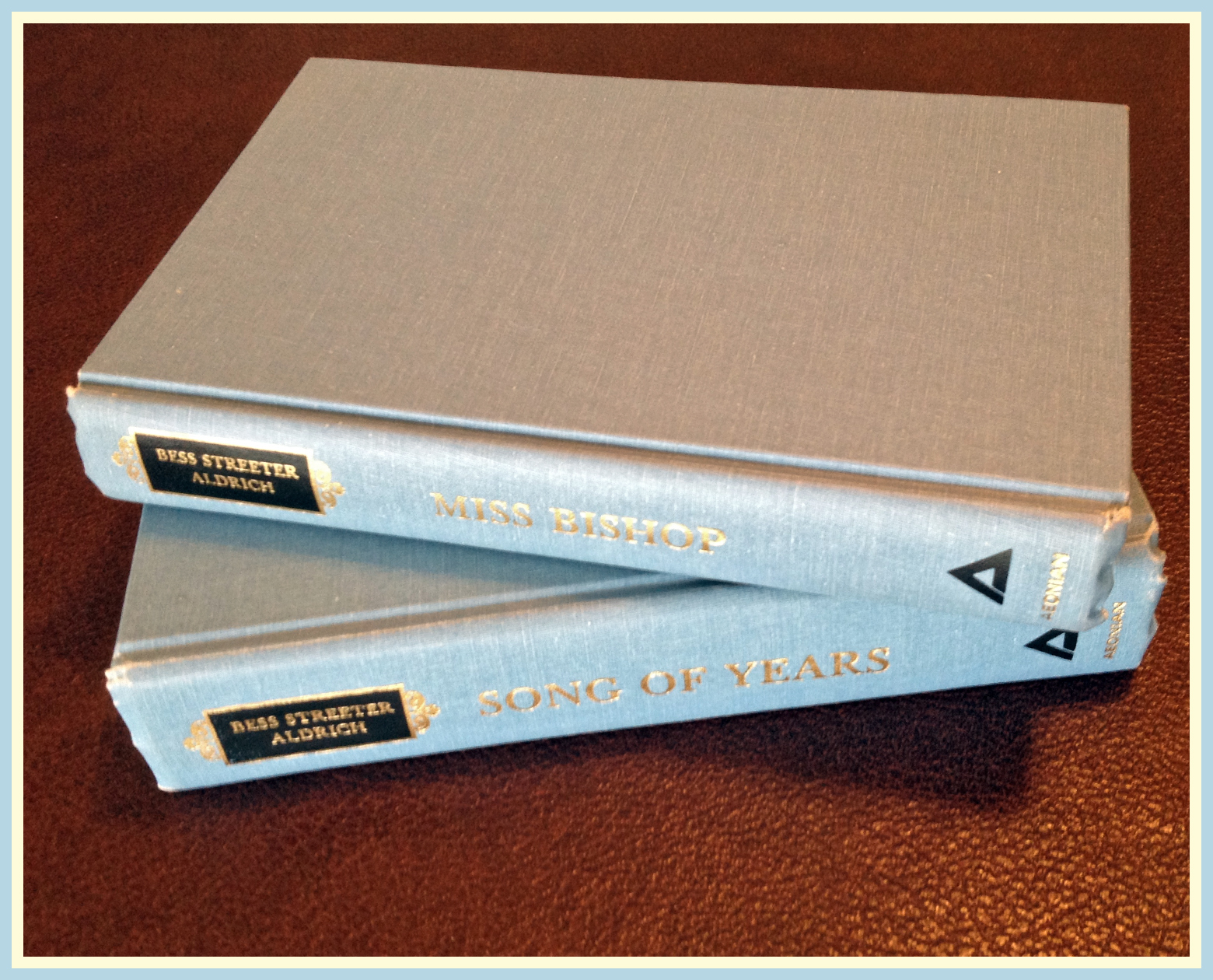
Books by Bess Streeter Aldrich

Books by Bess Streeter Aldrich

There is a giant push in the publishing industry, as well as a movement in modern readership, toward e-publication. And as someone who edits for an online literary journal and makes much of her living online (including one e-published short story at Smashwords.com), I am grateful for this technology.

At the same time, I still nurture that dream of some day walking into a bookstore and seeing my book on the shelf. (Or even better – seeing it purchased by an eager reader.) I cannot imagine any author not wanting this. But with the chances of landing an agent or publisher being so slim and the cost of self-publishing prohibitive for many, e-publishing is quite attractive.

When I was in the seventh grade, I was part of a small research group that researched and proposed a new kind of virtual book. It was the mid-1990s, and we didn’t even have the internet available for us to do our research, so this was quite a far-reaching idea for the time. We hoped that we would win an award – and maybe even enough grant money to create a prototype. But while I was honored to be chosen to work on such a project, the idea of the product really bothered me. Everyone else in the group was excited to create some virtual experience that would make people never want to go back to the traditional books again. I quietly kept my qualms to myself.

I doubt it was just my feelings about the project, but it never went anywhere. That doesn’t mean, of course, that the industry didn’t move forward without us. And there is a great use for e-books – don’t misread what may sound like a lack of enthusiasm on my part. I have a friend who travels all over the world and is also an avid reader. Her Kindle is her best friend. She can load eight or nine books on it for her trip and never have to worry about all that extra bulk in her luggage.

Tablets have so much going for them, and they only get more sophisticated as time goes on. Some books are only available via e-reader, and it’s much more convenient reading them on a tablet or a smartphone then having to sit at your desktop every time you want to read. I’ve purchased several books and read them this way, and what’s great is that I can read and fold laundry at the same time, not having to worry about the book flipping itself closed. If I ever end up some place with only my phone to keep me company, I have any number of public domain books available with one swipe.

So why would I ever need a physical book again? I mean, aside from wanting to publish one, of course. It would do me no good to see one on a bookstore’s shelf if people suddenly decided they didn’t want books anymore. But they still do. Even though they cost more. Even though they take up space.

I would have to argue that there is something viscerally satisfying – and I’m not talking about eating the pages. It’s something in the feel of a physical book that trumps the convenience of e-books. Especially if, like my friend, you haven’t read one in a while. It just feels good to run your fingers over the pages, to hear that rustle of paper. Sometimes the texture is fine. Sometimes the pages are thick. And when you’ve been with a book for a while, you wear it in like a good pair of shoes. You know the feel of it in your hands, and it’s not just the story you miss when it’s gone. I also like to see my progress, especially on a really thick book (my favorite kind). I feel like I’ve accomplished something as my bookmark moves from the front to the back.

Georgene's Bookmark

Georgene’s Bookmark

Oh, and bookmarks. How could I forget bookmarks? My friend Georgene, artist extraordinaire, made this one for me – isn’t it gorgeous? I confess that while some people have a shoe fetish or an obsession with jewelry, I have a thing for bookmarks. It’s best that I avoid the accessory section in general at bookstores because I’m liable to spend just as much on those little things as the books themselves. Oh wait – e-books come with bookmarks already in the program. Which is good because your kids can’t pull the bookmarks out and make you lose your spot. But then you also don’t have your friend’s art or Edward Cullen or Harry Potter looking at you every time you mark a page.

You might have many more reasons why you still keep books on your shelves – or why you continue to buy them. Or maybe you take issue with my whole argument. But if you do, I have one more thing I would like for you to consider: remember my friend and the book I’m lending him? Well, that wouldn’t be possible if another friend hadn’t bought the book for me to begin with. This, I think, has to be my favorite thing about owning actual, paper books. I love giving and receiving them as gifts. (There’s something so personal about giving a book you know will speak to someone.) I love lending them to others, and I’ve discovered so many wonderful books that I never would have known about if friends hadn’t lent them to me. My parents still have books that belonged to my dad when he was a kid, and the third generation is enjoying them now. We enjoy a person-to-person library system with no due dates, and as long as you’re careful about who you share with, it always pays off.

I am absolutely not advocating that we boycott e-books and e-readers. Just the opposite: I am grateful that we have the choice. What I am saying is that you don’t have to buy into the commercials that try to convince you that anything without an “e” in front of it is going the way of the T-Rex. After all, people still run outside, even though we have treadmills. And we bake cakes from scratch, even though we have cake mixes. We do what works for us, given our individual situations, and when a friend decides to share a book that might take up some space on your table or in your purse, it’s still an offer well-worth accepting.

Five Points to Hufflepuff, Please

English: Coat of arms Hufflepuff, house of Hog...

Coat of arms Hufflepuff (Photo credit: Wikipedia)

Every week, I read a number of submissions for the online journal Fiction Fix, and the authors’ cover letters are available, as well. Although I don’t always read the queries, I sometimes check them out to see if there is any kind of intro to the story. I can’t tell you how many times I’ve started reading a piece, only to wonder if it was some sort of attempt at humor or just terribly written. If the author clues me in with something like, “This is a dark comedy,” at least I’ll have an idea of how I’m supposed to read it. One time, I had to re-write a critique when I found out that the current story was a lightly edited memoir, recorded from an elderly woman who had served as a nurse in WWII. There were still parts I thought should have been cut, but I could no longer argue that it was unrealistic; as subjective as the point of view was, the events had actually happened.

One other thing that Fiction Fix does is to award well-written or unique cover letters. The ones that are nominated by the staff for Fiction Fix‘s Gypsy Sachet Award are tagged, and I always read them. I’m actually quite disappointed, sometimes, when the cover letter knocks my socks off, and then the story that follows is just meh. I do understand that writing a great query does not guarantee publication, but it goes a long way toward warming an editorial staff toward a particular author.

When it comes to submitting queries for my own stories, I keep these preferences in mind. I want to include all the pertinent info, but I also want to do so in a way that doesn’t bore the agent or editor to death. They have to read this stuff all day, and mine shouldn’t be the one that makes them decide to take a lunch break at 9:00 A.M.

I keep a file of all the queries I’ve ever written to literary agents, and once I receive a rejection (or once it’s been so long that I have to accept I’ve been rejected, form letter or no), I change the font of the entire thing to red. So far, I have twenty-seven of these ugly red things, going back to late 2004. I know, in almost nine years of literary agent querying, that’s not very many, but if you consider that eleven are from this year. . . it’s kind of depressing.

Why do I keep the darn things hanging around, reminding me of my failures? Well, for one thing, I don’t want to send the same query to the same place that’s already rejected me. For another, I don’t want to make the same mistakes, and at least I can look back and see if I’ve improved.

Assisting me this with year’s queries was literary agent Mary Kole, whose advice I obtained from her book Writing Irresistible Kidlit. Kole gives a brilliant sample query from one of her own clients, although she is quick to point out that “even the most amazing query in the world can’t stand in for a brilliant book” (271, Kindle version). Too true. It’s also true that it’s hard to make a bad story sound good (while being honest, that is), but it’s also a sad fact that many agents request a query only – no sample chapters, not even a helpful synopsis. So while it’s easy for agents to say that they’re looking for a great novel, not a great query, if the only thing they ever see is the query, it has to be top notch.

There are two querying problems I’ve always had: boiling the plot of a novel down to a few short paragraphs and keeping it interesting. Brevity is a problem of mine, anyway (which you know if you’ve read many of my posts), and it’s especially hard snail mailing a query because all that necessary heading stuff eats up so many lines. With this most recent go-round, I’ve both e-mailed and snail mailed queries, and believe me, it was fun trying to cram the same info into two very different formats. But I did it, with Mary Kole’s help.

To digress for a moment, I’ve read countless sample queries, and I’ve written many more than the twenty-seven rejections currently on file. Plenty of how-to publications outline the proper cover letter format, and supposedly all the author has to do is fill in the blanks with her particular information, and the job’s done, right? Or, say you see a great cover letter that won an author a literary agent – I should just be able to swap out his info for mine. But it never works out so neatly. I find that successful letters have personal touches that simply cannot be copied. It’s all very well for an author to candidly admit that he and his wife blew the $500 he received for his award-winning short story instead of buying groceries, but I haven’t won $500; I don’t have a cute little story like that. Plus, since my published works were for adults, and I’m currently shopping a middle grade novel, mentioning my publishing history hardly seems pertinent.

So how to achieve just the right tone, find the perfect words to not only adequately say what I need but also win over an agent? Kole gives an excellent formula for coming up with what she calls the meat. “The best way to hook me into reading further is to make me care,” she writes (264). Good point. How does one do this? Well, by answering some very basic questions about the story: “WHO is your character?”; “WHAT is the event that launches the story (the Inciting Incident)?”; “WHAT (or who) does the protagonist want most in the world?”; “WHO (or what) is in the way of her getting what she wants (her obstacle)?”; and “WHAT is at stake if the protagonist doesn’t get what she wants?” (264). Put that way, it’s a lot easier than, “Tell us about your novel in three paragraphs.” For someone who’s known to ramble, specific parameters are a must. (Plus Kole answers her own questions using The Hunger Games as her example, which is awesome.)

After going through this exercise, what I had was bare bones, but I was able to succinctly state the most important aspects of my story. (This can also be used as a writing tool, to show how much a story still needs to develop and/or how much exposition needs to be cut.) At least the meat of my query was good.

As for the rest, ugh. I muddled my way through and was much more confident than in years past, but I was still missing that last bit of inspiration.

It finally came – late – from one of the agents way down on my list. (Actually, she was the last one, but the one before her was a snail mail query that I hadn’t yet sent, so I was able to tweak it, too.) This agent works for quite a large agency; she was one of twenty-one agents listed on the website. I love it when agents have bios because, otherwise, I’m unsure of how our personalities might mesh or collide (although that’s not a problem yet). This particular agent set the bar really high, asking for a “wonderful, personalized query letter.” And the kicker: “Five points to Ravenclaw if you can make me laugh out loud!”

I’m always afraid to admit that I love Harry Potter, especially since I write fantasy. Oh, it’s just another J.K. Rowling wannabe, I can hear them saying. But it couldn’t hurt, I thought, to mention that Harry Potter was my inspiration for getting into kidlit again. Or that the five points would do me more good in Hufflepuff than in Ravenclaw (and that has more to do with me being a Jill-of-all-trades than a Cedric Diggory groupie).

So I sent those two queries off, and my fingers are crossed. If one of them lands me an agent, maybe I’ll provide the letter as one of those useless samples that kind of (but not really) helps other authors. The important thing is to be yourself in your query, and this particular agent was one of the first to give me specific permission to do that. I suppose it’s only fair to let them know who they’re dealing with, anyway.

Good-Bye, Little Decade

English: Traditional Devil's Food Birthday Cake

Birthday Cake (Photo credit: Wikipedia)

As I write this, it is the last day I will ever be twenty-something, and while I would usually rather crawl under a rock than draw attention to my birthday, this one’s kind of a biggie. I could not wait to get out of my teens. I started college when I was seventeen, the youngest kid in my orientation class. I was always self-conscious about my age and went to great pains to stay inconspicuous. Every birthday, I thought, “Well, at least now I can say I’m in my twenties,” “Now maybe I’ll get some respect, since I’m past twenty-five,” and so on. But even now, I know that most of you are probably rolling your eyes, thinking I’m still a baby. I reach this age with mixed emotions because there were things I always assumed I would do before I hit thirty. But here I am, as unpublished and anonymous as ever, at least as far as the brick-and-mortar bookstores are concerned. But is that what life’s all about, anyway? I’ve thought a lot about what did happen in my twenties lately, and it’s been a pretty eventful ten years, even if I didn’t accomplish every single goal.

20

Two months after turning 20, I set my wedding date and started planning. I finished writing my first novel and started the long process of revising. I graduated with a BA (English/Philosophy) six months to the day before my wedding. I hardly noticed that I was finished with school, so immersed was in the editing and typesetting process of the second volume of Fiction Fix.

21

Thomas and I got married two months after I turned 21. I was actually the breadwinner the first five months we were married (scary thought because my salary was not spectacular). We lived in a tiny apartment and loved it, although we were excited (and naive) about becoming homeowners in the near future. 2004 was also what I think of as the Year of the Hurricane. There were four big storms, at least for Northeast Florida, and we spent many a night playing Scrabble by candlelight. A couple months before my next birthday, Thomas and I put a deposit down on our condo.

22

Not wanting to go month-to-month on our rent, Thomas and I moved in with his parents the weekend that I turned 22. Then our condo complex’s original builders went out of business, and it turned into a huge fiasco. We were assured our condo would be ready by September—November at the latest. We should have just walked away, but the $4000 we’d put down seemed like too much to lose. Oh well. One cool thing I did that year was to travel to New York with a group of choral friends, where we performed contemporary British composer John Rutter’s Requiem in a mass choir in Carnegie Hall. Even better than singing in Carnegie Hall was being directed by Rutter himself.

23

In May of 2006, Thomas and I became homeowners. We tried to put the extra six months of waiting behind us, figuring that in a couple years, we’d make all our money back, plus some, then get a house where we could raise a family. Ha. Anyhow, we moved in and adopted our kitty Willow shortly afterward. That fall, I had gum surgery, in preparation for getting braces. But before filling my mouth with metal, I found out I was pregnant.

24

It was mostly the year of the inflating, pregnant belly (and everything that goes with it). I cannot forget that this was also the year the last Harry Potter book came out. My parents, Thomas, and I went to Barnes and Noble for the midnight release. I read it aloud all the way home and much of the next day. (Thomas read ahead while I napped—hey, give me a break, I was pregnant.) Sad to think we’ll never go to a midnight Harry Potter book release again. Our first son Peter was born a few months later. The middle-of-the-night feedings, colic, and reflux were a pain, but his first few weeks are still magical to me. It’s a time I also associate with the movie The Departed, which we watched almost constantly for a month or two. When Peter was four months old, I got braces. At that point, the economy had already tanked, and my job at my family’s small business started to disappear. I transitioned to bookkeeper, which is much less than full-time. If I’d known, then, that we would have to survive on little more than Thomas’s salary, I probably wouldn’t have paid $6000+ to fix my bite, but it was money better spent than the $4000 we wasted on the condo’s deposit.

 25

For several months, my family focused on my maternal grandfather and his failing health. I’m so glad that he lived long enough to know Peter, whom he adored. We honored his 89 years with a beautiful memorial service. Just a few months after Grandaddy died, my church ordained me as a deacon (in the Presbyterian church, we’re the lay people who provide pastoral care for the congregation and staff), and I know he would have been proud. On the writing front, I took a break from Fiction Fix to concentrate on being a mom. And on the mommy front, Peter was more and better than I ever could have imagined. I worried I would never lose the baby weight, but constant exercise and an appliance installed in the roof of my mouth that made it almost impossible to eat helped me lose an extra 20 pounds. Never fear, my orthodontist fit me with a new appliance, and my appetite was back by the time we took Peter on his first trip to Disney World.

26

On my 26th birthday, we went to Disney again, and I became extremely sick. When we got home, I was diagnosed with double ear infections and tonsillitis. But the fun was only starting; the antibiotic I took gave me hives that covered my entire body, including inside my mouth. Ugh. It was also the year when we realized that we had already lived in the condo three years and would continue to live there longer than expected. A lot longer. But we cringed at the idea of selling it and only breaking even or maybe even taking a couple-thousand dollar hit. I wish we had. But I had high hopes for making lots of money and paying off the balance because I finally landed a literary agent. That means publication, right? Wrong. It took the better part of two years to figure out that she didn’t care at all about selling my book to traditional publishers.

27

We went to Universal Islands of Adventure the weekend that the Wizarding World of Harry Potter opened. (Very bad idea, especially when you have a toddler in diapers.) Later that week, Peter was ring bearer in my cousin’s wedding. The next month, Peter was potty trained, his incentive two more trips to Disney World. In between the trips, I finally got my braces off. By that point, people were bugging us about having another kid, and with the braces off, I was ready to entertain the idea. Less than two weeks before I turned 28, we found out we were expecting our second child. I was also in a writing funk. I was looking for a good reason to ditch my useless agent, so I told her I was pregnant and didn’t want to write anymore. That’s not exactly true, but I had given up on publishing. I’d thought about starting a website, but I was too depressed by the whole not-getting-anywhere thing to do much about it. When I found out I was pregnant, I spent my meager savings for my website on baby stuff.

28

I spent most of the year tired. A few months before we welcomed baby Ian, Peter started three-year-old preschool at the same elementary school I attended. Thomas also went back to school to finish his bachelor’s. Due to laziness, tiredness, and being pregnant, Peter and I ate at Five Guys a lot, which was probably a big factor in gaining more weight with baby number two than baby number one. Ian was born two weeks before Christmas, and things weren’t quite as magical as when Peter was born. It took us a while to adjust to a very different little boy, but we love our baby just as much as his big brother.

 29

Without a doubt, this has been the busiest year of my life thus far. I kind of got my writing mojo back and started this blog and discovered Smashwords. I started working with Fiction Fix again, after a four year hiatus. I also started getting up at 4:30 every day to exercise; it’s the only time I can do it now that Peter’s in school five days a week. I joined three different committees at my church and also started taking Sewanee’s Education for Ministry four-year course. We took the boys to Legoland to celebrate their birthdays, then Disney World at the beginning of this year. We put the condo on the market in January, figuring no one would ever want to buy it, and within 24 hours, we had an offer (although for much less than we originally paid). It was a whirlwind, finding a place to live and moving so quickly. The condo days are finally behind us; we actually have a house big enough for all of our stuff, although we weren’t brave enough to actually buy again. Since I’m not publishing bestsellers yet, I decided to start substitute teaching at Peter’s school, and I’m earning an income, while still not having to work full-time. I’m once again searching for an agent. Maybe I’ll actually get published one day. And if not by a traditional publisher, I’m determined to make my book the best it can be and publish it as an ebook, if nothing else. I always thought, Well, if I’m not published by the time I’m thirty, I’ll just save a chunk of money and self-publish. When you start writing a book at nineteen, you think that ten-plus years is more than sufficient for perfecting it and going through the entire publication process. Well, guess what, thirty is here, although a hardback copy of my book is not, it’s not the end of the world. Instead of giving myself a timeline, I have a list of prospective agents, and once they’re exhausted, I’ll go to plan B.

As for my thirties, my boys will be adolescents by the end of this decade. I’m sad, on the one hand, that I won’t have cuddly infants anymore, but I love watching them grow and learn. Maybe during this decade, we’ll plunge into the housing market again, maybe not. At least now we’re much better informed. And maybe that miracle of publication will happen for me. My dream, one that I have every time I volunteer in Peter’s school library, is for a child to come in one day and ask for my book. Wouldn’t that be cool? But if not, the best thing about being forced into some semblance of patience is that I’ve discovered how many other joys there are in life.

Now, bring it on, thirties!

A Book Affair

Books

Books (Photo credit: henry)

I’ve never been one to blow through my paycheck on a shopping spree. I do buy clothes more often than my husband but not nearly as often as most women. I never buy jewelry. I don’t have a lot of knickknacks or art, although, with a mother who is an artist, I certainly appreciate great artistic talent. I don’t care about TVs, home theatres, or electronics gadgets. I am only occasionally tempted by purses or things with multiple pockets and compartments (and the bigger the better). Really, the only item in existence that is a potential budget buster for this girl is a book.

This past week I helped set up the Scholastic book fair at my son’s school. Book lovers can imagine my agony as I unpacked and shelved all sorts of treasures. The few books whose covers were torn during transport went back into the original boxes, never to be displayed; every time I found one, I wanted to offer it a home, even if I’d never heard of it before. And every time I found one I had already read, I wanted to say, “Oh, oh! I read this—has anyone else? You have to read this!”

I often avoid bookstores if I don’t have extra spending money because the temptation to buy is so great. At the end of 2012, I wrote a post about the books I hoped to read this year. Of course, I haven’t yet been able to read nearly as much as I hoped, but I’ve already gone through several that I adore and can see myself going back to again and again (including one title that was at the book fair, Erin Morgenstern’s The Night Circus). But within days of publishing that list, what do you think I did? I went out and bought more books. Now, I know there’s no way in the world that I’ll be able to read all of those books this year. I suppose I could shut myself in my room with a box of tissues (just in case), but it’s not like I have a maid to take care of the house, a nanny to watch my kids, or a trust fund to pay for it all.

Why do I keep plaguing myself with these books? Why can’t I stop? There are much more harmful vices, I know, but even if I’m not destroying my relationships or running up credit card debt with my habit, I’m certainly running out of places to put each new purchase. I converted my china cabinet into a bookcase, and now I’ve taken over most of the top of my spinet piano, as well. Whenever I want to have fun and internet browse for my dream home, houses with built-in bookshelves automatically jump to the top of my list.

Part of me wonders why I never became a librarian. I didn’t want to spend any more time in college than I absolutely had to, however, so forget the master’s in library science. But I could still work in a school library somewhere. Whenever I volunteer in my son’s school’s media center, I bask in the atmosphere of so many well-loved published works. And since I went to school there, too, and received much joy browsing those shelves as a girl, it’s even more of a magical experience. I listen in wonder as kids come in, excited to find a new book, and the media specialist rattles off titles that she thinks will interest boys and girls of all different ages. She’s my hero.

My husband has always been a great gift giver. At birthdays and Christmas, he’ll ask what I want, and often I list a number of books that I’d like or say, “You know what I like to read. Just surprise me.” He’s responsible for many of the tomes that crowd our shelves and spill over into the rest of our house, including the Harry Potter, Artemis Fowl, and The Hunger Games series. He discovered early on that I couldn’t care less about jewelry, perfumes, flowers, spa days—in other words, things that would delight most other women. The first gift he ever bought for me (and the only piece of jewelry he’s given me, except for the wedding rings we exchanged) was a watch. I’d been going on for a while about how I needed a new one, and I still wear it today, almost fourteen years later. My mom jokes that it’s my engagement watch. But what she forgets is that Thomas followed the watch with a book, The Girl Who Loved Tom Gordon, by one of my favorite authors, Stephen King. I think I know which gift really won my heart.

To Prologue or Not to Prologue?

Storm Brewing, Vancouver

 Photo credit: world of jan

I am getting ready to do the whole submit-and-reject thing again with my list of agents. Who knows, maybe I’ll get lucky this time. Like I’ve said before, my novel is much improved from the last time I tried to get an agent. And this time I have a little more hope for my query. The thing I’m nervous about, however, is the bit of story I’m submitting, the bit that will make an agent excited (or not) about my writing. The bit that kids will probably read and then decide if they want to spend their allowances on my book.

I recently attended a webinar with agent Mary Kole, and the first topic she addressed in her Q&A (and it also gets a good-sized section in her book Writing Irresistible Kidlit: The Ultimate Guide to Crafting Fiction for Young Adult and Middle Grade Readers) is about prologues—and she strongly suggests not to write them. The argument against them is that the prologue will pack a punch, fooling readers into thinking the first chapter will continue being just as exciting. In actuality, the first chapter is a big disappointment, including back story and info dump and blah-ness. Why not just write a strong start to begin with?

I’d never considered prologues in that light before. I can think of plenty of books that had prologues that I really enjoyed, but in none of them did I feel cheated when I got to Chapter One. The first chapter of J.K. Rowling’s Harry Potter And The Sorcerer’s Stone is like a prologue in that it starts years before the present of the rest of the story. Whether you call it a prologue or the first chapter, it is what it is, right?

The opening of my book is the same—an opening years (actually decades) before the main story. It sets up the plot and gives a taste of what happened to get us to the story. And beta readers like the book much better with this bit of fore-story included. So what’s a writer to do? I’m going to include it, dadgummit. But just for kicks, I’m going to put it here, see what you think. I’ve always hesitated to put my unpublished fiction online because, if readers like it, but it gets changed, they might be disappointed with the published work. Or if it’s terrible now, I’m metaphorically shooting myself in the foot. Well, I’m shooting away. Here it is, the prologue/opening/whatever-you-want-to-call-it of what is currently titled Kingdom of Secrets. Read below, or download the PDF from the My Fiction page, and then let me have it!


Kingdom of Secrets: Prologue Excerpt

by Sarah Cotchaleovitch

Ella knew she shouldn’t do it. Mama wouldn’t like it one bit.

After much lip gnawing and twisting of her brown hair between her stubby fingers, Ella decided she couldn’t let the poor pup die.

She ran inside to fetch her mother’s emergency kit from the cupboard over the sink.

Climbing onto a chair, Ella scrambled onto the counter and stood on her tiptoes, but the cupboard was still too high for a girl of four to reach. Not to be thwarted, she got down and dragged the stool up to the chair. She hoisted it onto the counter, stood on top, and swung the cupboard door wide, revealing Mama’s kit.

Movement through the kitchen window caught her attention, reminding her there was a sick pilfit pup waiting outside.

“I’m coming, I’m coming,” Ella whispered. She nearly toppled off the stool in her haste.

Kit held in front of her, she scuttled outside. The pup lay panting in the shade of the hedge, looking for all of Terra like a cross between a raccoon and a dwarf rabbit.

“Don’t worry. I’ll make you all better.”

The pup gave a half-hearted yelp and closed his eyes.

Ella’s favorite thing about the emergency kit was the bottle of hot water. Whenever her mother bought another one, the merchant always promised her silver back if it went cold before two months’ time.

How often had she seen Mama brew a restorative? Into a bowl went a splash of hot water; steam spiraled into the air. The first part was a success, at least.

“Let’s see, let’s see.” Ella’s fingers played over the jars. She couldn’t read, so she trusted her memory of what the ingredients looked like. A bead of sweat formed on her brow and slid down her nose. She brushed it away, gave her concoction a quick stir, and held the bowl under the pup’s snout. “Drink, boy. It’s good.”

The pup opened his eyes and whimpered.

“It’s okay, I promise. Just—just take a sip.” She tilted the bowl toward him.

His black nose twitched, and the pup tested the liquid with his tongue. Starting slowly, he lapped every bit and licked the bowl clean.

Ella moved the pup’s head onto her lap, running her fingers through his silver fur. After a wash and a brush, he would be the fluffiest pilfit in Jackson Village.

The pup sighed. Ella held her breath. He opened his eyes: blue with brown flecks.

“You’re so pretty, Clumps,” she said, naming him without a second thought.

He sat up and yelped, an almost-human sound, the sound of a healthy pilfit.

“Oh, Clumps, you’re all better!” She hugged him to her chest.

“Ella!”

The girl stumbled upward, Clumps dangling without protest in her arms.

Her mother stood at the kitchen window. “Is that my emergency kit?” Dark-haired and blue-eyed like Ella, Mama was madder than a fish in firegrass at the moment.

“Mama! Mama, he was dying. I had to! His mama—she got into the poison mushrooms. All his brothers and sisters died, but I saved him, Mama! Oh, please, please can I keep him?”

Her mother’s face told Ella that she could not keep Clumps, nor would she be allowed a pet for the rest of her life. She mightn’t ever be allowed in the kitchen again, either.

But next second Mama was gone from the window, and that was worse. She was coming to Investigate the Situation.

“Clumps, maybe you’d better go.”

Too late, here she was.

Ella’s mother leaned over and scooped the pilfit pup into her arms. Gentler than her tone suggested, she scratched behind Clumps’s ears, prodded him a little, made him open his mouth. “I’ve got to be more careful around you,” she muttered. “You brewed that restorative perfectly. How did you figure it out?”

“Just. . . just watching you, Mama.” Ella pressed her lips together. This was turning out differently than expected.

“Well, you know I’m going to tell your father when he comes home. We’ll talk about whether you can keep this pup—”

“His name’s Clumps, Mama.”

“Oh, you’ve named him already?”

“Yes, Mama.”

Ella’s mother handed the pup back to her. “Let me be very clear,” she said in her this-is-your-last-warning voice. “You may never get into my things without asking permission again. And never brew a cloakbane without my help. Got it?”

Ella’s eyes were wide and tearful. She nodded slowly twice. Maybe it would be a while before she brewed another, but if she could save the life of a pilfit pup, she knew she could do other wonderful things.

She would give the whole incident some time to filter to the back of her mother’s memory before mentioning that, though.

Time, That Fickle Fiend

Time flies–unless it stands still. Time is kind to some, cruel to others. Time supposedly heals all wounds (although that’s a theory I don’t want to test). And even the staunchest of pacifists kill time.

My grandmother used to have a saying, “Life is like a roll of toilet paper; the closer you get to the end, the faster it goes.” Well, if that’s true, then there are times when I am sure that my demise is near. But, to temper that, I have some days that feel like they last for months.

Do you ever remember, when you were a kid, how long everything took? Summer break or my birthday or Christmas were always forever away. Or, my personal favorite, I was convinced that it was a four-hour drive from Jacksonville to Disney World until I was a teenager and realized it was much closer to two. Excitement and anticipation made the waiting both painful and delicious.

There were other times when my own dread of something stretched time until I couldn’t see past the obstacle of the moment. Piano recitals were the worst. The day of was terrible, but usually that whole week, there was nothing for me to do but dread my performance. There might be birthday parties to attend that weekend, family coming from out of town, a trip the following week—none of it existed as long as that piano recital was in the way. Then, the recital itself was almost an out-of-body experience, during which someone else’s hands flew over the keys, and at the end I stood and bowed, wondering what had happened. After a few minutes of disbelief, I realized that it was over and my life could continue.

How interesting it is that time fluctuates like this, yet it’s a static thing, in as much as a minute equals sixty seconds and an hour equals sixty minutes and so on. Even when we tamper with time by either falling back or springing forward, we don’t actually gain or lose time. It’s not as if a vacuum swallows that precious hour in the spring and spits it out again in the fall. Rather, we re-label the hours that already exist, and during the adjustment period, we often feel like we’re running late when it’s suddenly sunny at seven in the morning.

Adults are very protective of their time. It is a precious commodity of which I, at least, am very protective. I know that I never seem to have enough. Few things will set me on edge or make me lose my temper like running late. Or what about working on the computer for hours, only for it to crash? That’s time that I’ll never get back, not to mention that I can never exactly replicate what I lost.

And I have to split my time between all those things that I want or feel I need to do and my children. I have to remind myself that they are only little once, to enjoy every moment. I look forward to each new stage and achievement, but I will never get back those moments already past. They grow so quickly, and they’ll be in college before I know it, or so I’ve heard. On the other hand, when I was pregnant, I thought they would never get here. Why is nine months so long on that end of the pregnancy, yet after the baby is born, nine months fly by (except for those moments that drag when the baby doesn’t sleep, nor does anyone else in the house)? It was bizarre during my second pregnancy to both watch my first son grow and develop at a lightning pace, but to also feel like I was mired down, barely changing. I was convinced that baby was never going to come. Like the piano recital, I couldn’t see past his birth, which seemed to be years away. (Yikes, can you imagine how an elephant feels?)

My fascination with time extends into books I read and shows or movies that I watch. Right now I’m rereading Artemis Fowl: The Time Paradox. I just got through the big reveal, where all the time pieces fall into place, and I am still amazed/flummoxed at how author Eoin Colfer pulls it off. And how can I forget my first awe-filled readings of Harry Potter and the Prisoner of Azkaban or A Wrinkle in Time? I think it’s in my blood be attracted to stories like this, even when they make my head spin. Although I hesitate to call myself a Trekkie (we never went to Star Trek conventions dressed in unflattering, duo-toned bodysuits, although I did buy my dad Hamlet translated into Klingon one year), I grew up watching Star Trek: The Next Generation and later Deep Space Nine. Despite their corniness, the episodes or movies that I remember with fondness all, in some way or other, deal with time travel or getting caught in a time loop. Other favorite movies are Click (I cry every time), MementoDéjà Vu, Meet the Robinsons, and of course the Back to the Future trilogy. And even though I’m not into romance, per se, I love the two Outlander books that I’ve read so far. The writing and story are good, but the time travel quandary itself is what attracted me to the series.

As for my own writing, I haven’t tackled time travel yet. It’s so mind-boggling that I’m afraid I wouldn’t be up to the task. Of course, I never thought that I would write young adult fiction, either, until I began reading so much of it that a young adult story began to blossom within me. I guess that means I’m just going to have to sacrifice and read some more time-related literature if I want to pursue the precarious time continuum in my own writing. What a shame.

Why Can’t All Stories Be Happy?

“True art has a mythic quality in that it speaks of
that which was true, is true, and will be true.”
Madeleine L’Engle

I read all kinds of fiction. As soon as I say that I don’t like something—romance, for instance—I find myself halfway through Diana Gabaldon’s Outlander and loving every page. There is one genre, however, that I just cannot stomach, that of the no-conflict, unrealistically sticky-sweet happy-ending romance. People explain it away, saying, “There’s so much sadness in real life; I like reading something where I know there will be a happy ending.” Well, what’s wrong with that? I mean, I would like for my ending to be happy, so why do I keep reading the stuff that has unhappy endings (not to mention beginnings and middles)?

In my fiction workshop days, we sometimes discussed truth in fiction. Fiction is story, through which authors convey truth. Take allegories like Aesop’s Fables. What about Jesus’ parables? Nuggets or even great chunks of truth can be mined or chiseled out of stories. And what is more true than a life full of bumps and potholes?

If fiction at all resembles real life, then endings can’t all be “happily ever after.” Sorry. Think about your favorite books and movies. How many of them include elements of tragedy? There is nothing like following the story of someone who goes through adversity and triumphs in the end. Often, however, that “in the end” might not happen until years after the protagonist has died—or it could be a sacrifice on his or her part that brings about the triumphal ending. (Can you imagine a Harry Potter in which his parents don’t die? Yeah, it’d be a lot happier, but then it wouldn’t be a story. Once upon a time there was a baby named Harry Potter. He grew up with his parents. He was a trouble-maker at school like his dad, but he got the girl in the end. Anyone could have written that, and it would have sold zero copies and movie rights.)

There are those out there on the opposite end of the spectrum who like to write sad endings simply to go against the happy-ending grain. For instance, I could rewrite Cinderella so that instead of riding off with the prince after trying on her glass slipper, she gets trampled by the horses pulling the transformed pumpkin carriage. This kind of writing only works in satire. If it’s written as a romance, and that’s the end, a lot of people will be banging on the bookstore’s door, demanding a refund. It’s a slap in the face and just as pointless, to me, as writing a happy ending for happy ending’s sake.

There is a happy medium, and I promise these books are worth reading, even if you have to go through some pain to get there. One of my favorite series of books is the Anne of Green Gables series, by L.M. Montgomery. If you’ve read the first three, you know that many of the “tragedies” in Anne’s life are simply the mishaps of a young mischief-magnet. She grows up, matures, and gets her prince charming, right? Well. . . If you read the whole series (and there are eight books, ending when her children are adults), you get sucked into World War I. And although there is a new romance between Anne’s youngest daughter and a friend-turned-soldier, there is tragedy as well. I won’t spoil it; please read the books yourselves. But to people actually living through World War I, don’t you think they appreciated reading something in which the young heroine-turned-mother suffered, grieved, yet survived like the rest of the world? Yes, it would have been much happier if her family had escaped the horrors of war, but I know I would not have been so moved, so drawn back to them again and again, if that tragic element had not been there.

To boil it all down, it’s fine if the princess gets her prince charming, but I won’t complain—actually, I’ll keep turning the pages hours after I should have gone to sleep—if she has to go through hell to get him.

If It’s “Sing, Sang, Sung,” Why Isn’t It “Bring, Brang, Brung”?

Cover of "The Oxford English Dictionary (...

Cover via Amazon

Or “think, thank, thunk,” for that matter.

The more I study and learn about the English language, the more I realize that there are more exceptions than there are rules. Still, that doesn’t deter me from sinking my teeth into the many conundrums of the English language. From the tender age of seven, when I heard a boy in my second grade class say “brung,”  I have been a grammar snob.

By the fifth grade, my English teacher introduced an exercise in which we had to copy a few sentences off the classroom’s overhead projector, inserting corrections where there were mistakes in her copy. One day, I raised my hand and pointed out that “weird” was spelled wrong. I remember she squinted at the exercise, as if wondering what I meant. She had it spelled “wierd” and hadn’t even caught it. I explained that “weird” was weird because it broke the i-before-e-except-after-c rule.

Ah, the English language, so full of idiosyncrasies. It’s no wonder foreigners have a difficult time mastering it, not to mention natives. It is an ever-morphing language, and many words that were used in one way a hundred years (or more) ago have completely different uses now.

One of my college professors touted the Oxford English Dictionary (an amazing resource, by the way). It doesn’t just give definitions but the etymology of words, as well. Her example was how you might compliment a girl by saying she is a doll. This wasn’t always the case, however. An early definition of “doll” was actually “prostitute.”

And that doesn’t even start to cover regional or national differences. When I realized that the Harry Potter series had different word choices and phrases in the Bloomsbury editions (the original ones printed in England), I immediately bought every single one because I wanted the authentic versions. I had no idea that “pudding” meant “dessert.” And, in Order of the Phoenix, I almost busted a gut when George Weasley commented (in a conversation about fifth year exams), “Fred and I managed to keep our peckers up somehow” (205). I get the feeling that that doesn’t mean the same thing across the pond as it does over here, otherwise it wouldn’t have been in a young adult novel.

If you’re a wordsmith, editor, or just flummoxed by this whole language thing, I recommend Grammar Girl or this list of words that aren’t. Or if you feel like throwing your hands in the air and giving up, remember Gallagher? His video will entertain you, at least, even if it doesn’t provide all the answers. And I would love to hear about your favorite misused word or phrase. You never know—we could popularize it enough to get it accepted into the dictionary.