Does the Genre Really Matter?

All seven books in the Harry Potter series in ...

All seven books in the Harry Potter series. (Photo credit: Wikipedia)

Wanted: Good fiction.

To be more specific, fiction that draws me in right from the start. Fiction in which the characters are believable, in which I can hear the dialogue in my mind. Fiction that makes me think, raises tough questions, makes me cry, makes me emote. Fiction that makes me want to talk to someone else about it. Fiction that saddens me when it’s over.

I like to think that if I were a literary agent, that’s what I would list under my “interests.” Because, try as I might, I can’t pin down a favorite style or genre. Now, there are certain things that I definitely don’t like. Mediocre writing, inconsistency, lack of craft. Like I said, I want the characters to be believable. If the debutante protagonist has never scrambled an egg in her life, I won’t believe it when she whips a six-course meal out of thin air. (Unless she’s magic, of course – and if she is, I better have a hint of it first.) I don’t want adverbs trying to tell me how desperately someone says something. Show me the desperation with a sweaty brow and shaking hands. I don’t want plots that are so insubstantial they can be knocked over by a sneeze.  I don’t want endings that are unrealistically happy or tragedies that are unnecessary, the only point being to make the reader cry.

I really just want a good story, one in which I can forget that I’m reading at all.

This is why labels kind of bother me. Romances, for instance. Label it like that, and I don’t want to read it. Why? Because all the romance novels I saw growing up had half-naked men massaging busty women’s shoulders on their front covers, and I really don’t want to read a novel that’s connected by one sex scene after another. So I was shocked to discover a truly excellent book that is sold in the romance section. Although the story revolves around a love story (or stories, really), it’s so much more than that. I’m speaking of Diana Gabaldon’s Outlander.

Or take the case of my friend who told me that he could not stand to read fantasy. Wouldn’t give Harry Potter the time of day because of how it’s categorized. I’ve known other people who won’t read these wonderful books, not because of the fantasy and magic, but because they’re so-called “kids’ stuff.” Well, if kids’ stuff comes with a side of good beating the crap out of evil, I’m on board with it.

How about Stephen King? He’s known as the king of horror, yet while he started that way, his more recent books (and my favorites) are much more sci-fi, fantasy, and I-don’t-know-what. They’re just good stories. Not to mention that the guy knows how to write and how to instruct writers how to write. Chances are, if you call him a hack, you haven’t read much beyond Cujo or Pet Sematary.

When I looked for beta readers for my novel RIP, I decided to go the vague route. People asked, “What’s it about?” or “What genre is it?” I told them that it was young adult, and fortunately, my beta readers were kind enough to read because they know me. One actually told me he wouldn’t have usually read that kind of book, but he was glad that he did. Good thing I kept my mouth shut, right?

But, as I posted a couple weeks ago, I was able to workshop a portion of my novel with an agent, and in my introduction, I told her it was young adult. It was almost as if, by giving that tiny bit of a description, it put blinders on her. My book was much too long. She was unwilling to consider almost anything about the content until I addressed the length. Young adult novels generally have a word count, and mine exceeded it by double. (Nevermind that books like Twilight are half again as long as mine.) Now, she is right: there are many thousands of words that I can cut, but shouldn’t she be trying to sell a story, not a word count? (That’s an issue for another blog.)

This whole issue has gotten me thinking: does labeling novels with a genre help or hinder? If I had just told the agent: here’s the beginning of my novel, would she have judged me for not nailing down a genre?

I don’t go through bookstores and read book jackets or first pages until I find something I think I want, but many other people find their books by following this practice. (Or if not in a bookstore, online.) What about someone who only picks books from the Christian lit shelves? This person might never consider reading Veronica Roth’s Divergent series because it’s sold as young adult and dystopian – would completely miss the way that Roth’s Christianity colors her novels.

While talking books with a friend recently, we got onto young adult lit, specifically John Green‘s books (which are awesome, by the way – do yourself a favor, and read them). My friend said, in a semi-surprised tone, that he’d gone on a young adult lit binge lately. And he’s in his forties with no kids. I find this wonderful – that a book written “for” an audience in their teens can speak to such a wider audience.

Of course, I totally get that if there were no classifications, I could very well mistakenly shop my novel with agents who are only interested in political thrillers or erotica. And marketing is another issue. No matter what, there are people who will refuse to read anything except X, even though they would really enjoy Y, if only they would give it a chance.

But it seems, in the effort to makes genres more attractive to more people, sub-genres have to be added. You ought to check out this list from Writer’s Digest. And it’s not even complete! I just heard of a new genre called New Adult. Each genre and sub-genre has its own little specifications, and if you hope to publish, you have to try to fit the mold. Well, what if I don’t want to? What if I just want to write or read a good book? What if I want to mull it over afterward and then say, “I think I just read a really good Western. Who knew? I never thought I would enjoy a book like that.”

All I’m asking for is a little bit more of an open mind. From agents, publishers, and readers, alike. Hey, I’ll try to have one, too.

I suppose this is why I’m not a big publishing executive. The bottom line is important, I know. Believe me, I want to make a living in this business, too. But at the end of the day, piles of money aren’t going to captivate me. But a great story will every time.

Dyslexia – A Mere Stumbling Block on the Path to Book Creation

“Peter is still getting his M’s and W’s mixed up.”

This was Peter’s kindergarten teacher four months ago. Peter is six. He should have known all of his letters a year ago. In fact, he did. So why the sudden trouble with these two? I was a bit disappointed when she told me, but I wasn’t surprised.

Peter has dyslexia. On top of that, his working memory does not function at 100%, making it difficult for him to retain everything we do to help him overcome his learning hurdles. It’s better than it was. This time last year, his working memory only functioned at about 20%, and he’s in an intensive program that’s helping, but it’s still a struggle.

So Peter and I practiced with M and W flashcards, and right about the time he got those two letters down, he slid back again and started having trouble with B and D. Peter is aware that he has a hard time reading. He knows his friends read books a couple levels beyond his capabilities. He groans whenever I make him read or do flashcards. Sometimes I’ll give him a night off and just read a book to him. The poor kid. Up until he had to start reading them himself, he had a love-love relationship with books.

I focus on Peter’s strengths. He’s good at math. He’s athletic. He can build anything, loves making inventions, and is very creative. But at the same time, I don’t want him to give up on reading, to think that it’s something a lot of people can do but is unattainable for him.

Then he happened to be watching the Disney Channel when Bella Thorne’s TTI came on. TTI’s (or “The Time I…”) are clips about some of the actors in Disney’s shows. I hadn’t seen Bella Thorne’s TTI since Peter was diagnosed.

Why does Bella Thorne’s particular TTI matter? Well, because she has dyslexia. She started talking about why reading was a challenge, and how she mixed up B and D and M and W. Peter turned to me, eyes alight, and said, “Hey! That’s just like me!”

http://www.youtube.com/watch?v=vhhSLneazQ8

It couldn’t have been more perfect.

I made sure to point out to him that she can read now, even though it’s a challenge.

I know it boggles Peter’s mind that I write. When I pulled my children’s book Hero out of mothballs earlier this year, I decided to involve Peter by using him as a first reader. I read it to him while he sat with me at my computer, looking at a screen with a bunch of symbols that he struggled to make sense of. With no illustrations to guide him, he didn’t connect with the story. I had to read passages twice and ask him questions about them to make them stick.

And then it hit me: Peter can draw. He may struggle to read Hero, but I knew if he helped illustrate it, he’d have some ownership. Even with dyslexia, he could still be a part of the book creation process.

Peter learning cursive

Peter learning cursive

If you’re a regular reader, you know that we did it (and you can read about it here). Peter is half-shy, half-proud when he helps me deliver a book. Even though he’s quick to say that it’s too tough for him to read (yet), he loves that his name is on the cover, that it’s our book. He even asked me to teach him cursive, so he can sign the inside cover.

Starting in the fall, I’m going to talk to elementary school students about writing and illustrating a picture book. I’m excited for them to know that a regular mom can make children’s books, but I’m even more excited to encourage them by telling Peter’s story. Books are for everyone – for bookworms like me, those who struggle like Peter, and everyone in between.

Don’t forget, through July 26th, all of my proceeds from Hero are going to WSB’s Care-a-Thon to benefit the Aflac Cancer and Blood Disorders Center of Children’s Healthcare of Atlanta. Click here for all the details, including where you can buy Hero in Northeast Florida. You can also get yours from Amazon.com, or message me for a signed copy.

Bread and Circuses and Why I Write

The chase

The chase (Photo credit: focusshoot)

I grew up on all kinds of nature shows. My dad has always been fascinated with all things wild, and since he was in charge of the remote, I saw quite a bit of PBS and Discovery Channel back in the day. Later add channels like Animal Planet, TLC, and NatGeo, and I was in nature heaven. Was.

Steve Irwin 1962 - 2006

Steve Irwin 1962 – 2006 (Photo credit: pauliepaul)

My kids love these kinds of shows, too. When we can find them. My elder son recently took an interest in reptiles, and so my husband told him about Steve Irwin, the Crocodile Hunter, and looked for some of his old shows on the web. I’m glad for this resource because good luck finding anything like that on TV. We finally found a different reptile guy with some shows on Netflix, but it’s rare to find a good nature show on TV anymore.

Then this week I just happened to see this article about Animal Planet’s Call of the Wildman: “Animals Are Injured in This ‘100 Percent Fake’ Reality Show.” Not only is it bothersome that apparently animals were drugged for a good number of these shows, but the attitude behind it all is what drove this deception to begin with. In 2008, Animal Planet’s president Marjorie Kaplan said, “We’re looking to be an entertainment destination, not a natural history channel.”

I suppose this makes sense, considering that I can never find the good old lioness-chasing-a-hyena type show anymore. Still, it sickens me how so-called reality TV (or what the article calls “guided reality”) has taken over.

Think about TLC – The Learning Channel, for goodness’ sake! What do you learn there? I’ll tell you: what not to wear, how to make a cake that looks like a person, and how bratty, four-year-old beauty pageant contestants behave at home (and worse).

Who came up with the idea that we need to watch how people supposedly live in order to be entertained, anyway? Hey, I’ve got an idea: follow me around with a camera all day. I’ve got two young boys. It should be entertaining, right? Well, maybe not. I know! You can jazz it up by putting us into some kind of controversial situation. Or rile my kids up, and make them drive me crazy.

Someone please tell me when reality became so fake.

As my mother pointed out when I mentioned the Animal Planet article, human nature hasn’t changed much over the millennia. As we did in Ancient Rome, we continue to do now: give us bread and circuses (food and entertainment), and we’re pacified. Just because we’re not watching slaves-turned-gladiators slaughter each other anymore doesn’t make us more sophisticated. Instead, we exploit people who are too ignorant to know that the world is making fun of them (or worse yet – they don’t care and just want the money); we turn ludicrous contests into “must-see” TV; and we stage all kinds of nonsense in order to make people think that the so-called “Wildman” is a hero.

I’m not saying that all TV shows are worthless or that tuning in upon occasion is bad. Hey, my husband and I used to love watching Top Shot and cooking competitions on the Food Network. But at some point, enough is enough. Nowadays, people think that the only way you can break into the music or cooking or fashion industry is to win a competition on one of these shows. And if you don’t, you’re worthless. Whatever happened to trying to break into your industry of choice the old-fashioned way – by forging out there and proving yourself without all the attention and sensationalism? And whatever happened to being entertained by, I don’t know, a professional entertainer instead of a “real” person’s stupidity?

All of this got me thinking. As my regular readers know, I am an avid reader, and my dream is to be a published novelist. Years ago, I was forced to consider both why I read and why I write, which goes right back to bread and circuses, right? No, I’m not talking about reading The Hunger Games. I’m talking about reading and writing indiscriminately.

Back in the days when I attended my friend and mentor Ari’s fiction workshops, he sometimes cornered the class by making us think about things we often take for granted. We knew that, according to the Gospel of Ari, we always had to read something, but he also wanted us to consider why we were reading. And we went around the room, each of us saying why we read. On another occasion, we had to say why we write.

Here are the answers that Ari did not want to hear: “I read to escape” and “I write for the money.”

I can’t remember what I said, but if Ari were to ask me now after years (okay, over a decade) to think about it, I have plenty of answers. I don’t read fiction to escape but rather to augment my life. I read to find out what could happen if. I love it when an author creates a setting (dystopian America) or a character (vampire) that is obviously not real, but I believe anyway. I love it when a story transports me to a new place, and I don’t even have to leave my couch. And as an introvert, I can meet all kinds of new people without ever having to introduce myself.

As for why I write, if I’d had the guts, here is what I would have said:

Of course I want to make money writing fiction. That’s why I’m not getting a useful degree that will get me some high-paying job. I’m young enough to still have the hope to make a living writing novels.

But that doesn’t mean writing any old novel. Unlike Animal Planet, I’m not going to change my M.O. mid-course to make a buck. I sometimes joke that if I decided to write Forty Shades of Pink or something raunchy like that, I would make it big. But at what cost? And besides, I can’t write that kind of garbage, anyway. At the end of the day, I can only write what brings me joy – which is what I want to read but simply hasn’t been written yet.

So I continue to be a starving artist (or nearly so).

There are writers out there who can memorize a formula and whip up a story that fits the mold. And people will continue to read them. People who maybe haven’t stopped to think why they read. People who have never considered that fiction can be more than an escape or sensationalism.

But I am not one of those readers or writers, so I’ll keep writing what moves me. I’ll go against popular culture and do something really real for a change. I’m happy with who I am and what I do – with not a single camera in sight to document how I go about my life – and I’m trying to raise my kids to find that same satisfaction. It’s going to be tougher for them than it was for me, but thank goodness for parental controls, archived TV shows, and zoos. We can keep it real just fine on our own.

Don’t Judge a Book by Its Author

You can’t blame a writer for what the characters say.

                                                                                                                                             –Truman Capote


The Casual Vacancy

The Casual Vacancy (Photo credit: Darlene Acero)


Avid readers, do you remember a time when you discovered a new writer, fell in love with one book, then went crazy looking for all of his or her other publications?

This has happened a number of times with me, from my early days of reading with authors like Beverly Cleary and Louisa May Alcott, then ramping up to Agatha Christie, J.R.R. Tolkien, Michael Crichton, and then Stephen King. In every case, I devoured their books, as many as I could get my hands on.

But sometimes… sometimes this doesn’t happen. Sure, every prolific author has an off-book or two. Even in the middle of bestseller series, it’s not uncommon to have a middle-of-the-road slump. (Harry Potter And The Order Of The Phoenix comes to mind.)

Sometimes, it’s no fault of the author’s, though, because they get pigeonholed. They commit the unforgivable sin of writing outside of one particular genre and so get panned by masses of once-adoring fans.

This often happens with actors. Think about how many of them, in the effort to avoid being typecast, take on just about any role they’re offered to prove they can do something other than what originally made them famous. You might be disillusioned when your favorite child actor tries to show she’s all grown up by portraying a risqué character.

Now, authors aren’t going around in the nude to prove that they’re all grown up. But sometimes we treat them as if they’re doing just that. If you find out that your favorite children’s author has an adult title coming out soon, don’t be shocked that it’s not all “See Dick and Jane” anymore. Dick and Jane might be doing something that you don’t want your children to read about. And that’s fine. Writing for children doesn’t mean they have nothing else to offer the writing world.

The opposite it true for authors such as Stephen King. Many people shy away from him because he’s known primarily as an author of “horror” stories. But I’ve found that he actually writes much more fantasy and suspense than horror, not to mention moving love stories, at least one hard-boiled mystery, and one of the best non-fiction books on the craft of writing that I’ve ever read. (Check it out here.)

Truman Capote was right: we can’t blame writers for what their characters say and do. There is a certain amount of censoring that automatically happens if your story is meant for younger audiences, but the truth must always prevail. As Stephen R. Donaldson writes about the creative process:

[N]one of us can explain how it works. In a sense, writers don’t get ideas: ideas get writers. They happen to us. If we don’t submit to their power, we lose them; so by trying to control or censor them we can make the negative choice of encouraging them to leave us alone.

I don’t know about you, but it sounds very unattractive to tick off my muse by not letting the story be the story. I recently posted about striking gold with a story idea for this year’s NaNoWriMo. When this idea first occurred, I assumed that it would be another young adult novel. After all, the main characters are teenagers, and most of my stories end up going the middle grade or young adult route.

Yet the more I’ve thought about this new premise, I’ve realized that my novel might actually be for adults. That’s not to say that young adults wouldn’t ever read it – after all, I started reading Stephen King when I was 14 – but the amount of censoring I’d have to do to make it appropriate would change the intent and tone of the story. I suppose I could make it work, but would that be right?

This reminds me of a book I read recently, The Casual Vacancy by J.K. Rowling. Oh, you’ve heard of her? Yeah, she wrote that itty bitty Harry Potter series that a few people around the world seem to like.

Okay, if you know me, you know that I’m a Harry Potter nut. I bought The Casual Vacancy, which Rowling published as an adult novel, with no illusions of it containing wand-wielding teenage wizards. In the early pages, I sometimes scratched my head over this being the same author of the seven books I so dearly love. True, there are teenagers in her new book, but they’re facing very real temptations and demons, not the fantastical kind. The language, the grittiness was sometimes hard to reconcile with my previous experience of this author.

But knowing how hard it is to force a story into a genre that it’s not, I had an easier time – making my preconceived notions of Rowling disappear into the background – than many other readers who gave up on the book when they discovered it’s not about adult wizards. Rowling still has her fingerprints all over it, but in the form of turns of phrase, descriptions, and little gems that claim her no matter what the genre.

As much as I love most things young adult and fantasy, what I love above all are characters that come to life on the page and stories that pull me in. When I allowed the story to take over, it both compelled and moved me. It took a lot of courage for Rowling to put herself out there and publish something so different than the series that made her a household name. I know of people she’s upset because they expected more of the same, but I admire her for letting the story take the lead.

If you’re an author wrestling with a story unlike anything you’ve ever written, here’s some great advice from Anne Lamott’s Bird by Bird: “[S]ome days it feels like you just have to keep getting out of your own way so that whatever it is that wants to be written can use you to write it.”

Getting out of your own way means ditching those preconceived notions about what you can and should write. Let the story tell itself – at least in the first draft – and you can figure out what’s still appropriate to keep in the revision process.

And if you’re a reader who tends to pigeonhole, open your mind a little bit. Realize that the best authors, the ones that convey the truth through pages and pages of lies, are simply doing what Stephen R. Donaldson wrote about: they’re allowing the creative process to work as it should. To censor it, to hold back, would be to lie in the worst possible way.

For writers to deny themselves the chance to branch out into other genres and interests is to deny growth within the craft, to deny them doing what they’re meant to do.

Writers don’t just love to write – they must. Lamott also says:

We write to expose the unexposed. If there is one door in the castle you have been told not to go through, you must. Otherwise, you’ll just be rearranging furniture in rooms you’ve already been in. Most human beings are dedicated to keeping that one door shut. But the writer’s job is to see what’s behind it, to see the bleak unspeakable stuff, and to turn the unspeakable into words—not just any words but if we can, into rhythm and blues.

Amen? Amen.

Enhanced by Zemanta

Five Signs You Might Need a Book Intervention

Birthday Books

Birthday Books

When creating my list of books to read in 2014, I thought, I should be able to do this. I was determined to read more from this year’s list than I did in 2013. After all, there were quite a few books that I was excited to read; I was motivated. I did well at first, even reporting my numbers a few short weeks ago.

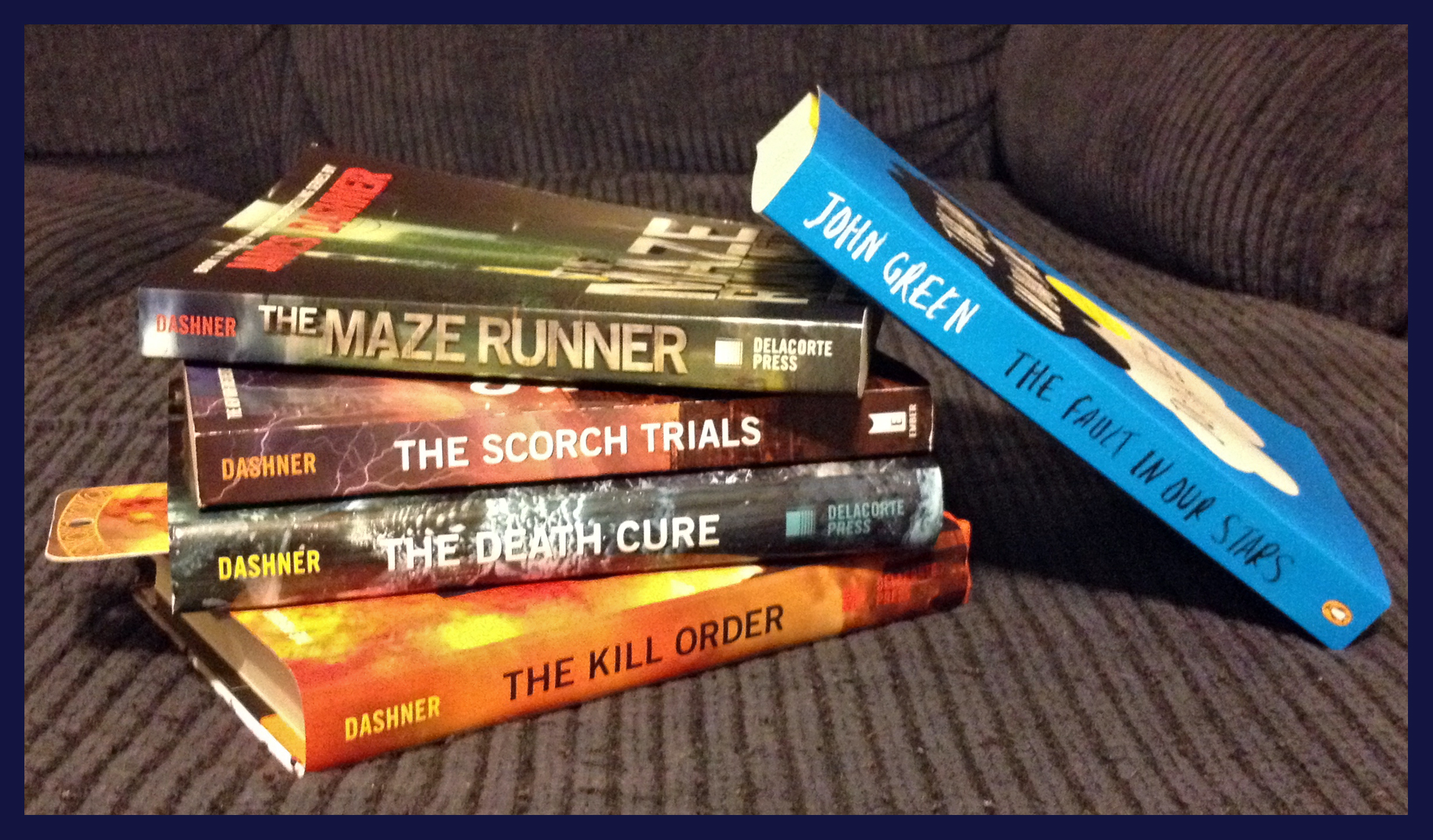
Then it happened. My husband, eldest niece, and I went to see Divergent, all having read and loved the series. And we got more than we bargained for while there: we were introduced to a book we hadn’t heard of, soon to be released in movie form, The Maze Runner.

I couldn’t help myself; I started researching it while still sitting in the theatre. Who was the author? When was it published? Is there more than one book? Why hadn’t I heard of it?

James Dashner, 2009, two sequels and one prequel – these were the easy answers. As for why I hadn’t heard of it, well, there are just so many books out there. Each new discovery adds another star or constellation to my reader’s night sky, and the funny thing is that I am never satisfied. Give me a good book, and it only makes me want more.

A few weeks later, when my husband asked what I wanted for my birthday, I got the bright idea that I could kill two birds if he got The Maze Runner for me. Since I knew he wanted to read it, too, he went ahead and bought it a few days early. I was dutifully reading another book from my list with the full knowledge that I would completely derail if Thomas said the book was any good.

Thomas pronounced The Maze Runner worthy, so I took the cash a few relatives gave me for my birthday and went to pick up the rest of the series. The cashier told me that if I didn’t care about them being a matched set, I could buy all three from the bargain section. Which saved me enough money to buy a fourth book, John Green’s The Fault in Our Stars.

That silly movie trailer, aided by a little extra cash, just made my original 2014 book list a lot harder to finish. I might need a…

Book Intervention

Here are five signs that you might need one, too:

1. You always have a book in the car, just in case you get stuck in traffic.

No, I don’t read or text while driving, but I do when stopped at a light. Hey, I have a very stop-and-go commute, and I get tired of listening to the radio. And if I’m not the driver, you better believe I have a book with me. I feel bad for people who get carsick – such a great reading opportunity missed.

2. You panic when you forget your book.

It’s one thing if you’re just going to the store, but it’s full-scale panic mode when you are stuck at a social event with nothing to do except make small-talk with people you hardly know. Or even people you do know. It’s kind of a joke among my family that I’m often in the background of photos, oblivious to my surroundings, absorbed in a book. Everyone’s opening Christmas presents, and I’m reading. Or I sneak a book into a movie to read before the lights go down.

3. You can never read all the books on your to-do list because you keep adding more.

When I was pregnant with my first son, I was determined to read every book in the house. I figured that I might never have the chance to read after my little bundle of joy came into the world. I’m happy to report that not only did I finish all the books in the house, but reading does continue post-baby. And ever since making that discovery, I’ve been buying more books than I can read again.

4. You spend your disposable income on purses big enough to hold a good-sized hardback.

Okay, maybe men don’t have this problem, but I certainly do. I also carry my laptop, so my poor purse was begging to be replaced. I’m happy to report that my new purse holds the laptop and a novel quite comfortably. Could I get a Kindle or just read on my iPhone? Sure, and I have. But I just love actual books (read more about that here), and I love owning them. The book fair is in town this week, and I think there’s going to be more backsliding, which means…

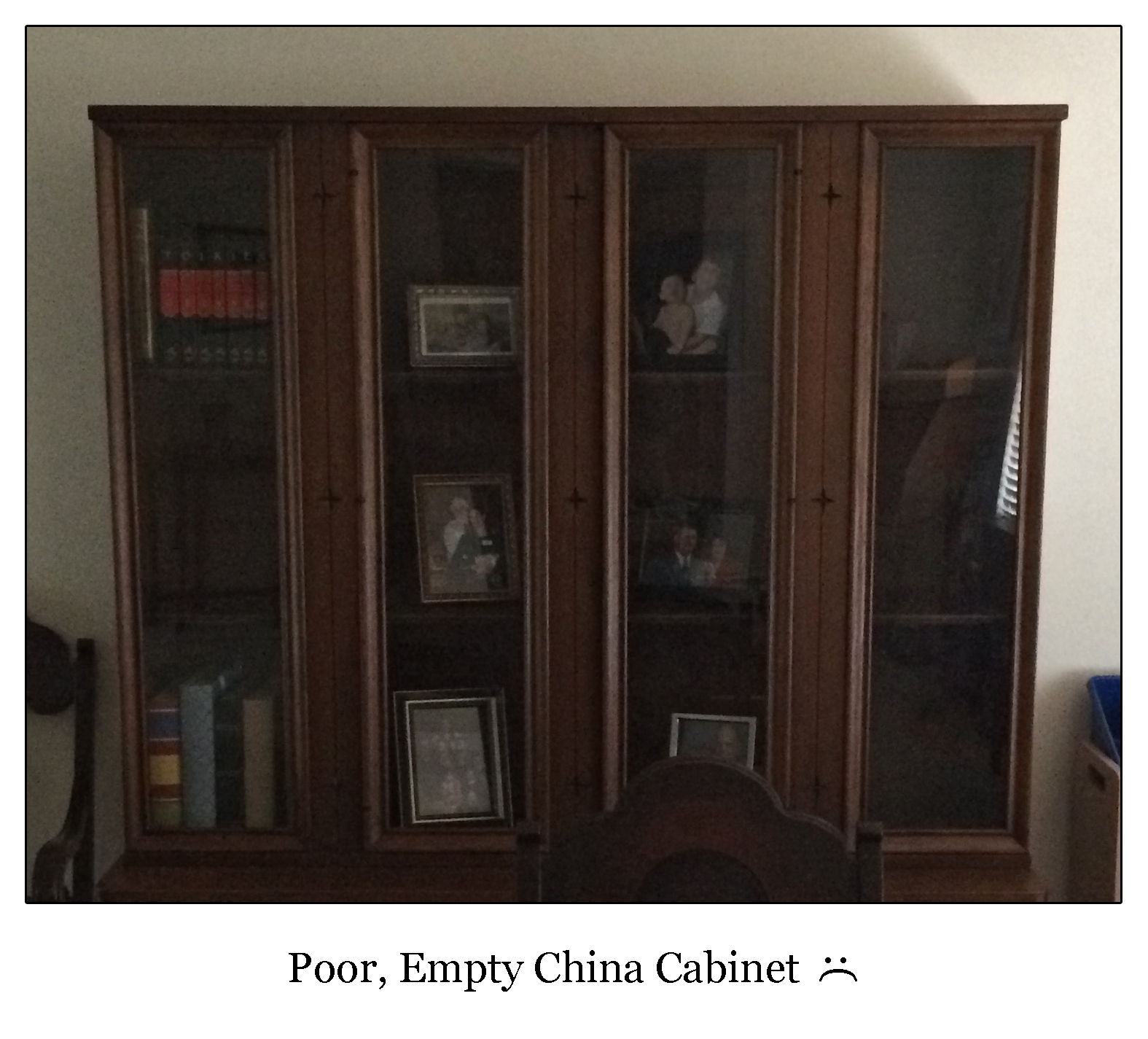
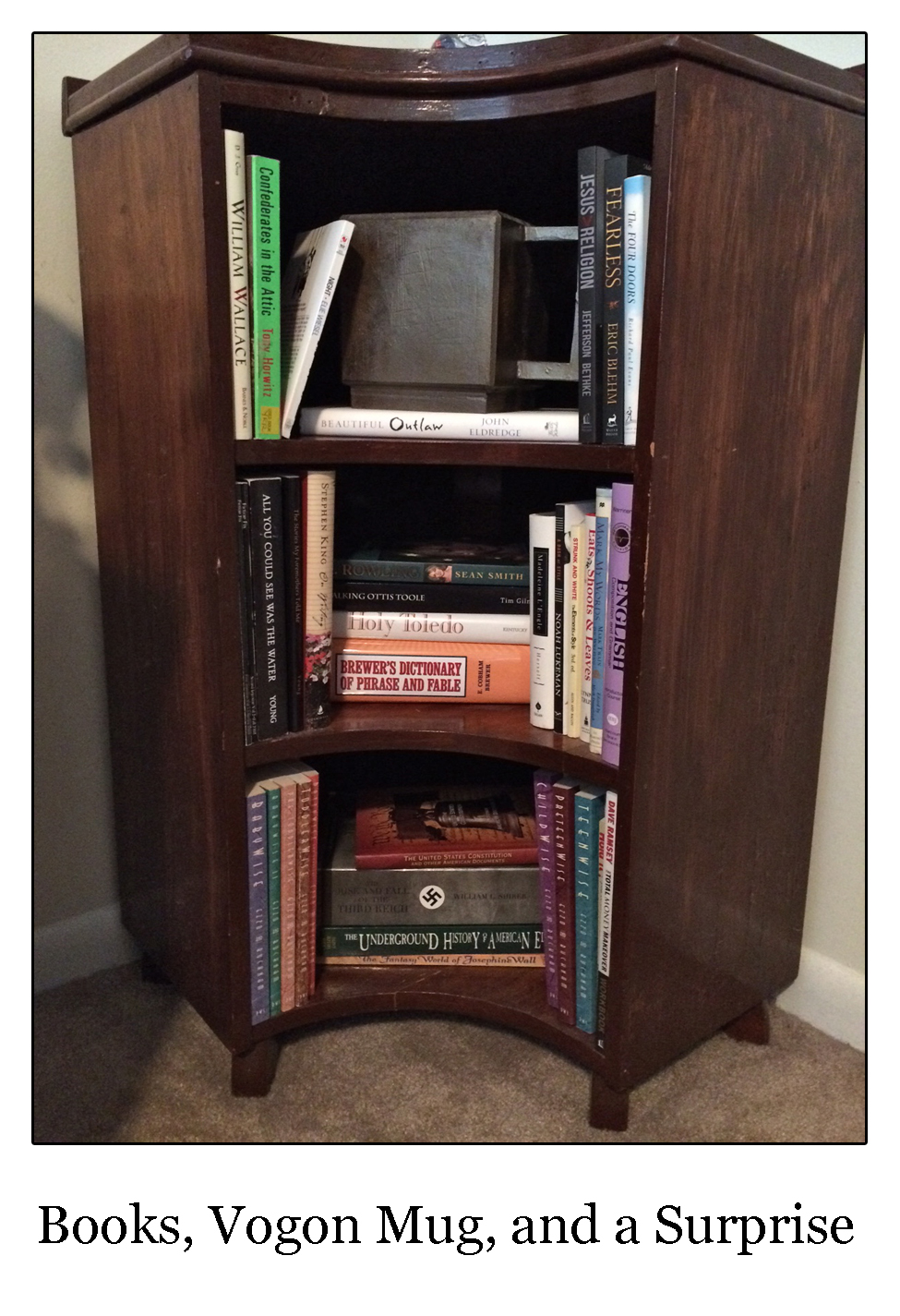
5. You forego putting your china out in favor of shelving your books in the china cabinet.

Or on top of the piano. Or in stacks around the house. I’m doing a pretty good job of keeping them neat (at least, I did until my latest quadruple purchase). But although I’ve dreamed of having a house with a proper library, I somehow think it still wouldn’t be enough. Give me shelves, and I will gladly fill them, then continue getting more.

You know, if this is a vice, I’m not sure I want to give it up. Please tell me I’m not alone. If this sounds like you, too, do we need an intervention, or just some uninterrupted reading time? Methinks the latter.

Happy reading.

Enhanced by Zemanta

What to Read, What to Read?

My Books

Books (Photo credit: Jennerally)

At the end of 2012 and again at the end of 2013, I posted lists of the books I planned to read in the next twelve months. I’ll have to say that I’m pretty proud of my progress so far. It’s just into the second quarter of the year, and I’m already on the tenth book from my list of 23 titles. I’ve only gotten sidetracked once so far (something that happened quite often last year), so I have some hope of actually getting through my entire list.

It was fun looking at the year ahead and asking myself, “What do I want to read?” Whereas many people look forward to vacations and promotions and other big events (and I do, too, don’t get me wrong), I love the anticipation of discovering new fictional landscapes and re-reading some of my old favorites.

When it comes to choosing books, I know that some people read book jackets and may even skim a few pages before making a final decision. Others will look for titles that have won awards. But that’s not really my style. How, then, do I choose the books for my list? Many times, I read books by authors that I’ve read before. If I’ve had good luck in the past, I’m likely to read more titles by those authors.

Other times, I’ll either see a movie or the preview of a movie based on a novel, and if intrigued, I’ll pick up the original books. This happened most recently with the Divergent series, which I read, then saw the movie. It also happened with Harry Potter. I saw the first two movies, then jumped on the bandwagon. Every time, I’m pleased that I got the books because there’s just so much more to love on the written page.

Lastly, and perhaps the greatest way to introduce me to new books is through recommendations and reviews from friends who know what I like to read. In fact, that one extra book I’ve read this year was from a friend who is responsible for lending me some of my favorite titles. When I see someone with similar tastes with a book in hand, I’m always interested to see if there’s a new favorite in the making.

I love personal recommendations and book reviews because they’re not written by some writer who’s paid to make books sound good. Reviews have sometimes saved me from wasting my time (“It turned out to be a good love story in the end, but the writing wasn’t any good.”) and have often encouraged me to try books that I might not have read, otherwise (“It’s long, but you’ll want to make time for it.”).

My regular readers know that I’m on the staff of Fiction Fix, and one of our goals is to not only publish great new fiction but to also encourage people to read until they’re full to overflowing. In order to mix up our blog a little bit, we decided to write book reviews – but in new and fun ways. The first way was in haiku form, the second as six-word reviews. Read the whole story here, and check out the haiku reviews, all of which are now up. (One six-word review is available, with more to follow.)

I don’t know about you, but these reviews have certainly encouraged me to expand my library, yet again. And it’s never too late to make your own “must read” list.

Song of Years haiku

Enhanced by Zemanta

Three Ways to Manage Your Busy Schedule – Instead of Letting It Manage You

Laura's work desk 13/05/2008

Piles of Work (Photo credit: Laura Whitehead)

After substituting in kindergarten for the third time this week, I drove home with that relieved, TGIF feeling. I love teaching, especially the freedom of being a substitute, but it makes for a busy day, often with no breaks or time to think.

But the entire weekend stretched ahead of me, with plenty of time to decompress and do the things I wanted to do.

My little fantasy didn’t even survive the drive home. I knew there was a pile of laundry waiting to be washed, plants that needed to be watered, sippy cups to be washed and refilled, and I still had my daily bookkeeping duties for the family business that I’d put off in order to substitute.

When I walked in the door, I discovered more things to do: a book sitting on the kitchen table that I need to read for a class next week; a pair of pants that need to be re-hemmed; a looming trip to the store before my son’s t-ball game. Oh yes, and then the t-ball game itself.

I also took on a new project today that I have to finish before we go on our spring break vacation, plus a novella to read for Fiction Fix, not to mention my personal fiction projects. Sometimes it’s hard to figure out what to do first when there are so many tasks at hand. Better just to take a nap and ignore them all, right?

If your life follows a similar pattern, you may feel that you’re always behind and rarely or never get to do anything for yourself. And it’s all too easy to give in to a negative attitude.

When Peter started playing t-ball, I dreaded the practices and games. My time is already so limited that I didn’t know when I would ever get anything done.

I had two choices: succumb to despair and have a nervous breakdown, or adapt and make the most of my new schedule.

I chose the latter, and you know what? I’m still able to embrace all the new projects I’ve taken on, and I’m even finding that elusive “me” time. Here are three tips that have helped me, and I hope they’ll help you, too:

1. Use Technology to Your Advantage

I know of people who have gotten rid of their TVs and phones because of the distractions they cause. If this seems a little drastic to you, there are ways to turn your electronics into a boon rather than a procrastinator’s crutch.

Did you know that there are a plethora of apps and computer programs that can help you manage your time? Some, like SelfControl from Mac users or SelfRestraint for Windows, block the internet altogether for set amounts of time. Just search for “time management apps” to see lists of what’s available and which one best fits your needs and personality.

Some of you may be able to control your electronics use by sheer will power. I fall into this category. I used to check my email any time I woke in the middle of the night, and the result was that I always had a hard time getting back to sleep. I finally made a deal with myself: don’t check email at night. It was as simple as that. If someone texts me, I know it’s urgent. Otherwise, it can wait.

Another thing I love is my phone’s timer, which I use in conjunction with step number two.

2. Take Baby Steps

When I have enough projects to fill a mile-long to-do list, I tackle them a bit at a time, baby-step style, and there are two ways to do this. As mentioned above, you can use that handy timer on your phone and work in blocks of time, or you can set goals, like editing one chapter and then moving on to a different project.

I’m currently rotating five projects in this manner, employing whichever method makes sense for each project, whittling away until they’re done. At the end of a hard day, instead of feeling like I’ve fallen short by ignoring one project while spending all my time on another, I can see that each one is closer to completion, even if only by a little bit.

3. Schedule Recreational Activities

It is very discouraging to run into someone on a Monday and have to come up with an answer to the “What’d you do this weekend?” question. I often stand there in utter silence, knowing I was busy but not able to remember anything specific. “Oh yeah,” I might say after a few seconds, “I weeded the lawn all day Saturday.” Exciting stuff, right?

When piles of laundry, flowerbeds full of weeds, grad school projects, and your kids’ sports schedules hijack what could have been your spare time, you feel like you’re stuck in a rut. This is when you can get in trouble by either going off the deep-end and throwing all responsibility to the wind, or you can wallow in self-pity and start hating anyone who did manage to enjoy her weekend.

If, instead, you schedule regular periods of recreation, just as you would schedule all the work that you need to do, you will have something to look forward to every day.

This is easier said than done, I know. Part of my personal promise to myself was to leave work well enough alone after my kids were in bed every night. If I could just hold out until they were in bed, I could read or write whatever my heart desired. But sometimes there’s not enough time in the day to get all my work done, and there’s still quite a bit left to finish after the kiddos are down. But I still make sure that I read or write or watch the occasional movie because my brain craves that break. Afterward, it’s much easier to work.

You may have more time but feel guilty about using it. Don’t! Fit in the occasional golf game or fishing trip or cup of coffee with a friend, if that’s what floats your boat. If you ignore opportunities such as these in order to “save” your enjoyment for a blow-out, two-week vacation that eats up a quarter of your annual salary, think of all the misery you’re subjecting yourself to in the meantime. Wouldn’t it be a shame to turn something you used to love doing, such as being a freelance writer, into a task to which you feel enslaved? I would rather have a few minutes of rest or fun every day, and the vacations, although they aren’t many, are truly special.

However you choose to do it, find time to do something not work-related on a regular basis, and you will be able to attack your projects again with renewed vigor and enjoyment.

Oh, and by the way, your house is patient: it will wait for you to clean it. Wash you underwear, by all means, but I won’t look at your baseboards if you won’t look at mine.

Do you have too many things to do 24/7/365? How do you manage your own workload?

Enhanced by Zemanta

What Are You Reading?

Reading a book

Reading a book (Photo credit: Wikipedia)

That’s right: what are you reading? If you’re a writer, you better have an answer.

If you want to know why, check out this week’s blog here, care of Fiction Fix.

Speaking of reading, I’ve already read seven books from this year’s list. How are you doing?

And one more thing: if you don’t have anything new to read, check out the latest issue of Fiction Fix, volume 15. It just came out this week, it’s free, and there’s some great stuff in there. Enjoy!

Enhanced by Zemanta

Move Over and Let the Characters Drive

Dumbledore as portrayed by the late Richard Ha...

Dumbledore as portrayed by the late Richard Harris in Harry Potter and the Philosopher’s Stone. (Photo credit: Wikipedia)

I love reading books that are so good that you just have to talk to someone else about them. My husband and I have read a few of those lately. After finishing the latest trilogy, Thomas Googled the author to see if there were any interviews about the series’ ending. Sure enough, he found one in which she talked about how her characters continually surprised her.

“It’s just like so many authors say,” he told me, looking somewhat bemused.

“It’s true,” I confirmed.

As crazy as it sounds, we authors don’t have the total control over our characters that we wished we did. Yet some authors insist on absolutely smothering the life out of their characters to make them bend to their wills. You’ll know these characters when you meet them because they’re inconsistent, like someone is forcing them to do things they weren’t meant to do.

Since I think it’s safe to talk about the Harry Potter books without fear of spoiling the ending (and if you haven’t read them, shame on you), I’d like to bring up something author J.K. Rowling said back in the days when all the fans were itching for Harry Potter and the Deathly Hallows (Book 7). Thomas and I checked her website on a daily basis, theorized with friends, skimmed the news for any possible updates, and any time J.K. Rowling came out with something – anything – new, we were beside ourselves with glee. And no, I am not exaggerating (although Thomas can suppress his glee a lot more than I can).

And one day, she said that she was having a particularly hard time with Dumbledore. Well, first of all, that made everyone scratch their heads because he died at the end of Harry Potter and the Half-Blood Prince (Book 6) – or did he?

But more amusing to me, aside from this nugget, was the image of Jo Rowling fighting her characters to straighten up and fly right. Characters will be difficult, and although non-writers may think we authors crazy or schizophrenic or overly imaginative to say so, there is an element involved that defies explanation.

There are some people who feel compelled to write in order to create characters that fulfill unrequited wishes. These characters are forced into ill-fitting molds. The beautiful girl that said no to a date with the nerdy guy suddenly falls in love with him. The bully at school finally get his come-uppance. The evil boss sees the error of her ways and starts treating her employees like human beings. These characters feel flat. They don’t do much – except what the author designed them to do.

What is truly beautiful, however, is when these characters are allowed to take control of their existences, teaching the author a thing or two while living their stories. Harry was an absolute teenage brat in Harry Potter And The Order Of The Phoenix. Sirius Black died laughing, in the thick of battle. Dumbledore gave his life, leaving a mess and a number of unanswered questions. Dobby – well, I don’t even want to mention him because I know it will start my mom crying. But the point is that J.K. Rowling could have made Harry a sweet fifteen-year-old, leaving everyone wondering if she remembered at all what teenagers are like. She could have let all of her characters live, eliminating the very important sacrifices that they made. Everyone would have hugged and been happy, and the story would have stalled and rung false. It would have cheapened their dear, fictional lives.

So next time you read a book and can’t believe that the author did something that you feel is the deepest betrayal, consider how you would feel if the author had taken the easy way out instead. I don’t know about you, but I don’t read in order to feel all warm and fuzzy inside. I read to suspend disbelief for a time, to form a relationship with characters, to have an absolutely amazing experience – that may hurt at times but will also deliver a great deal of truth in a fictional package. The stories that I love the most are the ones that leave me conflicted, that keep me up at night, that sometimes break my heart. Maybe things didn’t turn out the way they could have, but often, they turn out exactly as they should have.

Enhanced by Zemanta

What Will You Read in 2014?

IMG_2164

All day long, I’ve done what I could only dream about doing this time last year: I’ve sat on the couch reading a good book. Last December, I yearned for some good fiction after a few months of reading a bunch of how-to and reference materials. So at the close of the year, I looked over the books in my personal library and made a list of titles I hoped to read in 2013. It was a pretty ambitious list, one that I knew I probably wouldn’t finish, but I took a good stab at it. I did read seven of the fourteen books from my list, plus an additional ten that I hadn’t planned on reading.

I have to add a quick note about one of these unplanned books: I edited a novel called Brightleaf this year, and it was published in September. The author is my friend Raleigh Rand, and although I didn’t read this book in the traditional sense of sitting down and reading it for pleasure, I enjoyed every moment of editing it and would highly recommend it. (There’s a story behind this book, but that’s for another blog.)

So when thinking about my book list for the upcoming year, I waited until after Christmas. I can always count on someone to come through with a great book or three, and I had a sneaking suspicion (mainly because he asked me right out what I wanted) that my husband would get me Veronica Roth’s Divergent. I wasn’t disappointed. I went ahead and bought the next two books – and it’s a good thing. I started reading it this morning and am already more than 140 pages in – I’ll be done before 2014.

In addition, an unexpected gift was a book of Mark Twain’s writings from my friend Georgene. I promised that I would quote it a bunch this year, so that’s on the list. Also, my aunt ordered Bess Streeter Aldrich’s The Rim of the Prairie for me, a book I’ve read before, but alas, it was borrowed. Also (and I’m bragging now), I received two books that are a writer’s best friend – hand-crafted, leather-bound blank books. My sister-in-law convinced my husband to splurge on one (thank you!), and my aunt bought the other – they know me so well. When I’m not reading, I’m usually writing, and I can’t wait to fill them.

This year’s list will be composed of three kinds of books – the ones I still have to read from the 2013 list, books that I want to re-read, and brand new ones. And, as happened this year, I am sure that other books will pop into my life and expand my literary horizons still further.

Click on the links below to read more about these books, and if you purchase one from one of my links, you’ll support my blog.

Books I read in 2013:

My 2014 Book List:

Do I really think I’ll finish all these books? Not a chance. (I still do have to feed my kids and clean the house, after all.) But it will be fun trying. What books do you plan to tackle in the new year? Happy reading!