Playing Catch Up

Embed from Getty Images

During spring break, I was excited about the possibility of being able to cross off many much-neglected items on my to-do list. During that week, however, I was disappointed (as I often am) with the amount I was actually able to accomplish. Sure, I was home more than usual, but then so were the kids, and they had expectations, as well.

Since spring break, life has not become any less hectic. I’m not going to summarize all my busy-ness here – you can read any number of my recent blogs to get the idea. Just suffice it to say that, with the end of the school year drawing near, I was excited to see the proverbial light at the end of the tunnel.

Last weekend, I planned to partially unplug – which I did! My husband and I spent the night away from home sans kids, TV, and wifi. It was somewhat of a surreal experience, and we couldn’t help but say “The kids would love this” or “We’ll have to bring the boys here” at the beach and the fort and a little fudge shop near our bed and breakfast. But we survived and even managed to enjoy ourselves.

One of the things I’d hoped to do was catch up on my reading. If you follow my yearly list of books that I hope to read, Christopher Paolini’s Inheritance Cycle has been on there since 2013 – and I’m finally almost done! I had hoped to finish by the time my son finished school on Thursday, but I knew that was a very ambitious goal. Still, I only have a little over 200 pages to go, so I’ll definitely be through in the next couple days.

The reason I am so eager to finish (other than wanting to know what happens – this is a great series!) is because I have so much work that I need to do. While many other moms are posting selfies from the beach and running around like crazy people trying to keep their kids occupied, I plan to spend a lot of time at home. (Don’t worry – I still have plenty of fun activities planned for my kids!) This is partially because I’m tired of my commute, and our gas bill needs a little bit of a break, but it’s also because my to-do list includes clients’ projects, and these clients have been very patient. They know that I substitute teach during the year and, therefore, have an erratic schedule, but now they’re expecting results. I mean, what excuses do I have anymore?

I held off writing this post for a couple days, hoping that I’d be able to report that I spent the first full day of summer break plowing through my jobs and striking off to-do list items left and right. And I did make some progress, but it’s been slow. The children are still underfoot, although they’ve been great so far. My little one even likes my implementation of “work time” (where I have them sit at their table and color, write, or do quiet projects for a few minutes), thus giving them some structure and me some peace while I do my own work.

My goal (you know how I love goals) is to keep forging ahead, even if I only have two or three hours a day to devote to my projects. Although I’m not going to totally unplug during our upcoming family vacation (a girl still has to blog and write fiction when the mood strikes, right?), I don’t want to leave projects hanging over my head – or clients calling, only to be disappointed that I’ve put their work on hold for two weeks.

Okay, goals set. Deep breath. Next week, my to-do list is going to get a lot shorter.

Unplugging (At Least a Little Bit)

Embed from Getty Images

I’ve seen many an article in which the writer talks about how he or she has gotten rid of smart phones permanently, and I’ll have to say that I’m not one of those people. Believe me, I fought even getting an iPhone much longer than is normal for a so-called millennial, but I finally got one three years ago. I don’t play games on it (although I did at first), and I’m not the type of person who has to have the latest version. I like it for the convenience of being able to take snapshots and videos of my kids and check my email on the run and make phone calls and look up obscure trivia all in one device. But that also doesn’t mean that I’m glued to my phone all day. My rule is that I simply don’t use it at all if ever I wake up in the middle of the night (unless, of course, I get an emergency call or text). It’s easy for me to ignore it. In fact, there are some times when I am so busy that I’ll got 12 hours without doing more than checking the time.

But then there are those other people who can’t pull themselves away from whichever device is their vice of choice (and see how “vice” is already there in “device” – it’s like it was planned that way). These people check their email if they happen to wake up at three A.M. They play Farmville at their children’s band concerts or ballet recitals. They talk through the checkout line at the grocery store and text while driving. A lot of this comes down to a lack of common sense as well as courtesy – blog topics for another day.

The iPhone isn’t my problem, anyway. We have a semi-joke in our house about “my” MacBook. We bought this computer almost four years ago when my husband went back to school. At the time, I thought it would be great to have after he graduated, in addition to our desktop model. And for the longest time, I didn’t do much with it. He took it to class, typed term papers on it – was even typing one in the hospital room when our second son was born – but then… well, I kind of took it over after he graduated. (Don’t worry – I did get him an iPad mini to make up for stealing his tech.) By that point, our desktop computer was on it’s last legs, but I wasn’t worried about replacing it – the MacBook was more than adequate. It’s where I do everything from this blog to typing my NaNoWriMo novels to doing my freelance work to editing photos and creating photo books (for me and for clients). I’ve taken it on every vacation since we bought it, including Disney World, and I’ll even carry it in the car to work on projects if it’s a ride of 30 minutes or more (and when I’m not driving, obviously).

But this weekend I’m going to leave it at home.

That’s right – I’m letting go! My in-laws are taking the kids Friday after school through Monday – the longest I’ve gone childless since November 5, 2007. And this time, instead of my husband working half the nights they’re away, we’ve actually booked a room at my friend’s bed and breakfast – a first for us. My elder son was shocked to hear that we’re going to be doing fun stuff, too. And here’s something really different for me, the planner: we don’t have a plan. We’re going to go and just do nothing – or anything. And I’m not taking the laptop. I’m not going to write at all. Now, it’s only going to be for one night, but these are baby steps, folks. While I love writing, my husband can tell you that sitting down to innocently write a scene turns into balancing the budget for an hour and editing for Fiction Fix and any number of other computer-related distractions. We’ll take our phones (and probably the iPad) so we can FaceTime our kids and watch Netflix to our hearts’ content. I’ve been so busy lately that I refuse to go on a vacation only to do more of the same while paying extra for the room. (And see – I’m even posting this blog early just to make sure I’m distraction-free.)

We’ll have our books and a new-to-us area to explore. It’s going to be the perfect pair-of-introverts weekend.

Is May the New December?

I’ve noticed a pattern over the past several years, especially since I started substitute teaching: the school year speeds up exponentially after spring break. It’s like a race to the end of the year, to fit in all the end-of-year projects and parties and field trips. Everyone, especially the children, can feel that summer break is fast approaching, and life takes on a frenetic pace.

Maybe that’s why I’ve heard more than one person complain that May is the new December, as if December is a bad month. I quietly took issue with this notion. My favorite time of year is Advent, preparing for the birth of the Christ child. I love the Christmas music, Christmas shopping, wrapping Christmas presents at night while watching Christmas movies, doing the Advent calendar with my kids, and – yes – my seasonal socks. Yet for many people it’s a nightmare of obligations and deadlines and buying presents for people they don’t really like. I get it – December can be stressful. Not to mention that if you’re in college, you have exams, while all you can think about is the long break that’s so close you can almost touch it. I can certainly commiserate because I was a December college graduate. And that year, while I thought it would be such a relief to finally be done with school forever-and-ever-amen, I found myself immersed in not only editing but also typesetting the second volume of Fiction Fix when our previous typesetter bailed. People were counting on me, and I wasn’t able to enjoy December – or even being done with college – like I’d expected.

Maybe this is how my friends feel this month.

For me this year, May is more than teacher’s gifts and good-byes and summer planning. I took the Florida Teacher Certification Examination this past Monday, which meant cramming for almost two weeks. As soon as I got through with that, I took on the end-of-year books for my first grader’s class. These books hold the kids’ projects from August through the end of the year – over 20 pages of 12×18 construction paper – but what I didn’t realize was that about half of these projects still had to be glued to the paper before the books could be assembled. Another mom and I thought we could knock it out on Tuesday, only to find out we were in way over our heads. I’ve taken pages home every night, still have five or six to go, and need to finish by Tuesday.

First Grade Book-in-Progress

So my May has been busy. I’ve put off the usual things that fill up my to-do list, things that are still waiting for my attention, and I can feel them getting ready to pile back on. Like two freelance projects that I hope to finish in the next month, before our family vacation. Like a friend’s novel that I’ve been slowly beta reading since January. Like my own fiction projects, which I blogged about as recently as last week.

But I’ve been living with a kind of giddy feeling, anticipating the (temporary, at least) cessation of certain obligations. This weekend alone, three culminated: yesterday was my son’s last baseball game of the season; this morning was the last Sunday school class I have to teach until September; and this afternoon was my community chorale’s last concert of our spring season. Not to mention that this week will be the last meeting of my third-year Education for Ministry group (which means I’m almost finished with the 1000+-page history book we’ve been discussing since last fall). After Memorial Day weekend, my son has a partial week of school, and then first grade will be over.

What this means is that, even though we have school for a few more days, when we’re home for the evening, we’re home. I’ll have time to cook and actually enjoy supper. By the end of the month, I won’t have to wake up at 4:30 for a blessed two-and-a-half months. This doesn’t mean that I’m just going to sit around and twiddle my thumbs all summer – the kids and I will be plenty busy – but it does mean that I will be able to stop and breathe for a minute.

I love summers because I get a break. I’m grateful for this because so many parents aren’t able to have the time off with their kids. But if I’m not careful, I can allow myself to dread the end of summer break. I have to remind myself that I always love the beginning of a new school year, and I have ever since I was a kid. This year, my little guy will start preschool, so it’s going to be even more exciting. As my kids grow, everything seems to speed up, and I have to be careful not to stress too much over all the activities and responsibilities that go with being a mom-slash-chauffeur. What I do, I do for them and for us as a family. School and tutoring and daily chores are part of our life, but if we begin to allow the fun stuff – the baseball and the play dates and the trips to the park – become obligations instead of fun, it will be time to reassess. I don’t ever want to let a particular month turn into a time of dread, and I hope everyone else embroiled in the busyness of these times will do the same.

Identity Crisis

As both an editor and an author, I used to assume that if someone claimed to be a author, he had to know how to spell (or at least turn over a manuscript relatively free of typos). But I’ve learned that that is not the case at all. And while it’s handy to be able to easily pick out typos, bad syntax, and gaping plot holes, it is something of a disadvantage when the editor part of me gets in the way of the author part.

When I participated in National Novel Writing Month, both in 2013 and 2014, I had to remind myself that to write 50,000 words in 30 days, I had to set my internal editor aside. A friend of mine posted this on Facebook recently, and I can totally relate:

Month-Long Novel Agreement

As I’ve said many times, I love both the outpouring of raw story as well as the subsequent cutting, adding, tweaking, and rearranging that come with the editing process. It’s hard to say which I enjoy more, although it’s quite satisfying to read something I’ve edited and note its improvement. And it’s also wonderful to have those Aha! moments (usually in the car or shower – totally not convenient times to write) that provide just the right solution to a problem that’s been irritating me.

This last can happen in either stage. When writing this past November, I counted on these moments to get me through long periods of stagnation. This book was the sequel to my 2013 NaNoWriMo novel, and as such, I sometimes wrote something that either solved a problem in the first book or necessitated a change in that earlier storyline. I had to jot down these ideas and come back to them later; I didn’t have time to both write 50,000 words of my new novel as well as edit the old one.

But I finished NaNoWriMo 2014, set it aside to percolate while I made those necessary changes to NaNoWriMo 2013, and I even had a date written in my calendar for when I would switch gears again to start editing the sequel.

February 24th was when I was supposed to get back to the 2014 book. It’s now May 9th. I’m still on the first book. Granted, all the changes I’ve made so far have been necessary – and I even had an Aha! moment as recently as this past week. But the editor in me is tired. She wants to move on to something else. She wants to talk to the frustrated author of NaNoWriMo 2014 and hash some things out. But I can’t give equal space to both right now, and the more they argue, the less work I get done.

I presented this issue to my husband, and he gave me the answer that I knew all along (but that I needed to have reaffirmed): finish editing the first book. After all, I have to make sure I know exactly how it will end in order to have a smooth transition to the sequel.

I often hear jokes about artists and how they’re flighty and unorganized. That’s why it’s so odd for me to be a stickler when it comes to grammar, punctuation, formatting – you name it – but also creative enough to invent new worlds. For me, the two are so interconnected that they will always need to work in tandem. But I wonder if it’s freeing to not worry about spelling properly, to just hand a manuscript over to someone else to correct. Not that I write without any outside input at all – a second pair of eyes to catch typos and plot inconsistencies is always necessary. Especially because…

Writing Quote

I don’t know what numbers one through three are, but number four certainly does have a point – all the more reason for me to find out if the story in my head gets across at all, even if it’s not as eloquent or funny or moving as I originally thought. Because of my Grammar Nazism, I sometimes worry that I’m not the author I should be. Maybe I’m too careful, too precise, too self-censored (God forbid). Maybe one part of my inner writer holds back the other.

Editing my novel is necessary (it really is – auto format deleted about two-thirds of my sections breaks, and I have to put them back in), but it’s almost time to move on. Besides, I have a good incentive: CreateSpace is offering two free copies of NaNoWriMo winners’ novels again, and I don’t want to miss the deadline like I did last year. I want to give my beta readers the chance to tear another novel to shreds, to give me good reason to sink my teeth into another good edit… and to gear up for NaNoWriMo 2015. After all, these books are a part of a trilogy, and unless my muse materializes and does the dirty work for me, the author in me is going to take the driver’s seat on November first.

Procrastination (I’m Writing This When I Should Be Writing Something Else)

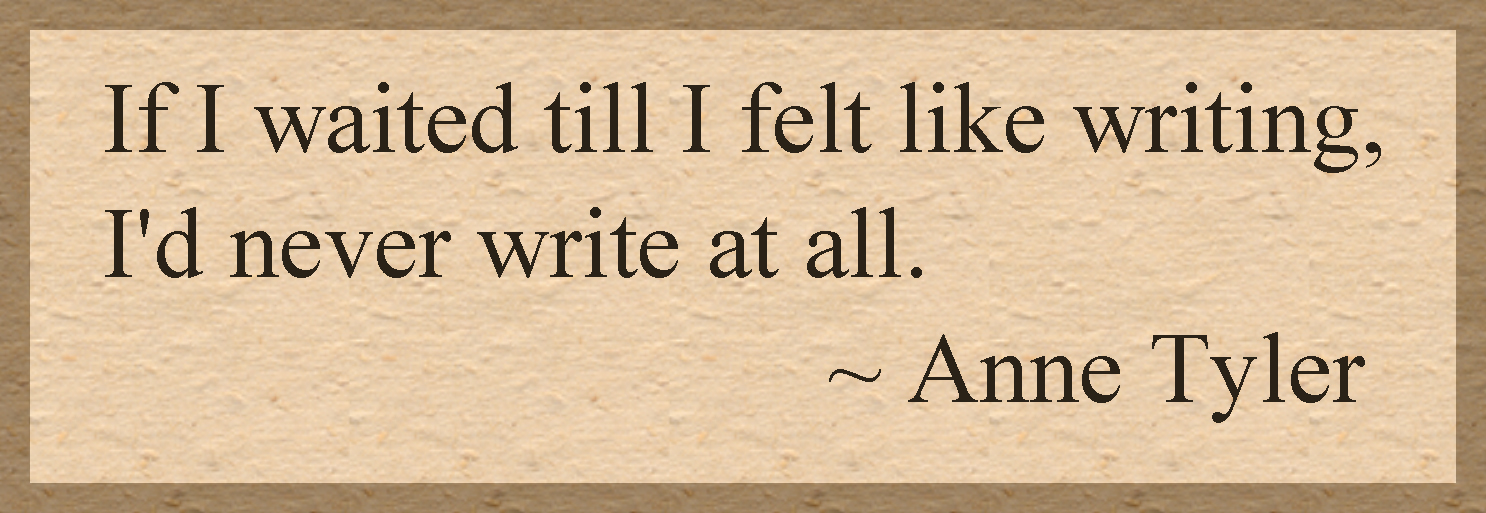
Anne Tyler Quote

Anne Tyler might just have a point. Take this post, for instance: I’ve been thinking about writing about procrastination for a while. And what’s the best way to do this? Well, to procrastinate, of course. (I find it’s often helpful to write about things that I’ve experienced first-hand.) Granted, I did have other topics to cover first, which I did. Then I even sat down and wrote a few paragraphs. Which I let sit for five days. Then I came back and erased them all.

Sometimes I don’t write because I have other things to do. I am a very structured person, and as such, I cannot allow myself to write a blog post or edit my novel or read for pleasure when I need to pack my son’s lunch or send an important e-mail or wash a load of laundry. But sometimes I don’t write because… well, maybe I’m just wasting time on Facebook. Granted, I don’t do that too often – and I even got rid of all the games on my phone to eliminate those distractions – but there are still plenty of times when I should be writing, but I do things that could easily wait until later instead.

If such a self-disciplined person as me has a hard time staying on task, what hope is there for writers who aren’t nearly as structured to ever start the writing process?

I have a two-part answer, and the first part is that I think it’s a me thing, separate from being self-disciplined.

This isn’t something that’s just happened to me since having kids. It’s something that’s gone on as long as I’ve written. I remember spending afternoons at my parents’ business, pacing through the same four rooms, building scenes in my mind, sometimes even muttering the lines. I would hash over those same scenes ad infinitum. I still do this, although nowadays, I’m not a teenager with a bunch of free time but a mom who squeezes all of her creative thinking into stolen moments in the shower or car or while folding laundry.

The second part of my answer is that thinking is a part of the writing process – or any creative process. Now, the problem is that if you don’t ever move beyond thinking – to the actual doing part – you are not a writer or a painter or an inventor (or whatever) but merely someone who aspires to be one of those things.

Philip Pullman Quote

Thank you for making my point, Mr. Pullman. And my problem is that I don’t always take my ideas to my “desk.”

Sometimes I’ll think over a scene so much that I just assume I’ve written it. And then, as often happens, I’ll move onto something else. Months or even years later, I may look for that scene, only to discover that it was only ever in my head. Other times, I do sit down to write, but the words that were perfected in my mind have all but evaporated. Or they just don’t ring true anymore. Something has changed between the initial thinking and the writing.

Madeleine L'Engle Quote II

Well said, Ms. L’Engle – and the same thing can apply to blogs. But I don’t think it’s a totally bad thing. I think internalizing a scene or some dialogue or just an idea is all a part of the writing process. As long as I do eventually sit down and write (like I’m doing right now), it adds up to the creative whole.

Earlier this week, I discovered an incongruity in my novel. A scene hinged on my protagonist having an opinion based on a conversation she overheard. Unfortunately, I realized this conversation happened when she was three or four and would have been way over her head at the time (if she’d even been paying attention). I had to re-work the scene, keeping the content but changing how it happened. I couldn’t move on until I’d fixed the scene, and I had to think it through first. For several days.

I’ll admit, I was a little intimidated by it. When you realize that you’ve created a problem that you have to write your way out of, sometimes the easy way out is just to give up – set the manuscript aside. And I’ve done that before, but I can’t with this one because I’m shopping literary agents. I had to tackle that scene, and after letting it simmer and then reading a few scenes around it, I figured out a solution.

Madeleine L'Engle Quote

Yet again, I feel like Madeleine L’Engle is talking to me. I am that woman with children and another job – a woman who wants to write, who needs to. After all, I can only procrastinate so long before the creative dam breaks. I have legitimate distractions, but I also have stories to tell. So I will continue to fight myself but understand that sometimes it’s okay to just think – as long as I do carve out that time to take my ideas to my desk-slash-laptop.

Speaking of which, I think it’s about time to wrap this up so I can get back to it.

Spring “Cleaning”

Inheritance Cycle

Inheritance Cycle (Photo credit: Wikipedia)

I really wish I could tell you that I spent a good chunk of spring break getting rid of toys and clothes and giving my house the overhaul that it needs. Sadly, while I did the usual laundry and daily upkeep, I didn’t spend a lot of much-needed time cleaning.

My hope for our spring break, after returning from a few days at Disney World, was to catch up on my freelance projects and recreational reading. Any cleaning that happened in addition to that was gravy.

But would you believe it? My kids actually expected to do fun stuff for spring break. I know – can you believe the nerve? Really, they were little troupers. I had a lot of not-fun-for-kids stuff packed into those five weekdays. Now, they did get to stay up later than usual and watch movies and play outside, but there was still tutoring and the dentist and grocery shopping. I finally took them to the park last Friday, where they could just be kids.

It didn’t leave a whole lot of time for all that catching up I’d planned to do. I should have known better, but when spring break is on the horizon, it looks so sweet, has so much promise.

I did make some good progress on my biggest book project (and absolutely zero on another). I edited a bunch of my novel and only had a little left when school went back into session. In all honesty, I was happy to get any of that done.

But what I didn’t do much of was read for fun. Granted, I’m reading Eldest (sequel to Eragon). Not only is it close to 700 pages, but they’re a very cumbersome almost-700 pages. There’s a reason these books are on my book list for the third year in a row – and there’s also a reason I’m tackling them early.

For the first couple months of the year, I stuck to my 2015 book list, but to get more titles under my belt and break up the pace a little, I decided to read shorter books in between the Inheritance Cycle books. Aaaaand… well, I may have fallen off my book list wagon and bought a new book.

It was a shorty, I promise, and it was a really good one – a new-to-me author with a unique style that I admire, even if I can’t emulate it. (It was Daniel Woodrell’s Winter’s Bone, in case you’re wondering.) The only problem was that I made a sort-of promise to myself that I wouldn’t buy any new books until I read through all the other new books that I already own, and this was a new book.

But after that little detour, I’m back on track again. Except…

One of the other things the kids and I did on spring break was to stop by my favorite local bookstore, and because the owner knows what a sucker I am for books, she reminded me that their 40% off spring cleaning sale was coming up.

You should be proud of me. I only bought four, two of them chosen by my elder son. But I have to say it makes me happy to know that there are more books for next year’s list if I don’t get to them this year.

New Books!

New Books!

Plus, I also have to say that sometimes you get a nice surprise where you don’t expect it. That book on the top left – The Fantastic Flying Books of Mr. Morris Lessmore – is amazing. I highly recommend it if you love books; you don’t even have to have kids to appreciate it. I likely would not have bought it on my own, but Peter was excited to see it because he’d heard it before in his school’s library. I’ll have to say I’m pretty proud of my little bibliophile.

Despite not checking one thing off on my to-do list, I’m pretty happy with my spring break. It’s the little things.

How Do You Know What to Cut?


http://www.gettyimages.com/detail/138307331

Last year I asked a number of beta readers to read my 120,000-word NaNoWriMo 2013 novel. After receiving an excellent critique from one of these beta readers, I shared with him how annoyed I was that I was somehow supposed to cut my word count in half. “What would you cut?” he asked. He understood that the novel had issues that needed to be fixed, but he didn’t think length was one of them. He couldn’t fathom how I could drastically cut yet keep the same story.

But I’ve done it. (Well, I haven’t cut it in half, but I’ve cut over 40,000 words.) When he recently offered to read the edited version of my novel, the question changed to, “How do you know what to cut?” My friend is simply curious and fascinated about the writing process, but many writers want to know the same thing. Lost, they wonder if they can cut and still keep the integrity of their stories.

It comes down to more than just correcting typos. Typos I can fix all day, and in fact, I was the queen of clean copies back before I took my first fiction workshop. Clean copies that weren’t all that great to read, as it turns out.

After my first story was critiqued, I discovered that I wasn’t the prodigy I’d always imagined myself to be. I assumed, at first, that people just didn’t get what I was trying to say. It was their problem. It was humbling to realize that they didn’t get me because my stories were a mess.

The credit goes to Ari, who led those fiction workshops. Much of how I write and edit today goes all the way back to those seven semester-long workshops that I took from 2002 to 2005.

Reading others’ stories and discussing them brought to light so many issues that are common among many writers, not to mention learning a lot of tough lessons when my own stories were critiqued. Ari has all kinds of pet peeves, and to this day, I don’t think I’ve written a sentence that starts, “As he went to the fridge” or “As she tied her shoes.” That particular type of sentence drove Ari nuts, and I guess it’s because it shows up so often. The point isn’t to avoid that one kind of sentence but to be intentional. Don’t fall into the trap of using the same sentence structure over and over again. You’ll find yourself on the slippery slope to lazy, sloppy writing.

Showing instead of telling was another biggie. (You can read more about that here.) I used to be the type of writer who had to describe the layout of every room and the outfit of every character. Was this necessary? Nope. That’s not to say that all descriptions are bad, but what you write must add to the story.

For instance, Harry Potter’s lightning scar, green eyes, and trademark glasses form a quick mental picture, and the scar and eyes have their own stories. But is it important to know what brand of jeans or what color shirt he wears? Do we need to know every single item he keeps on top of his dresser? Only the ones that may come up later. Why? Chekov explains it so well: “If you say in the first chapter that there is a rifle hanging on the wall, in the second or third chapter it absolutely must go off. If it’s not going to be fired it shouldn’t be hanging there.”

Eragon and its sequels are popular young adult novels that run to excess when it comes to descriptions and scenes that don’t move the story forward. Each book could easily be cut by tens of thousands of words. Some descriptions are helpful. We’re dealing with a fantasy world, after all. But too much bogs down the text, gives it a plodding pace. I enjoy these books, but I know I have to invest a lot of time when I want to read them. Not because they’re thick books but because there’s a lot of unneeded padding packed into those pages.

You may have heard the phrase, “Kill your darlings” (attributed to just about every well-known writer, and it’s because they all know it’s true). Does this mean that I need to cut every word, every line, every scene that I’m proud of? Well, not quite. But what it does mean is that writers often get attached to bits of prose that ought not be included in the manuscripts where they currently reside.

Ugh. But I worked so hard on that scene. The words flow beautifully. If there’s one thing I won’t cut, it’s that line…

I’ve been there and cut that. My trick to save myself from writer’s remorse is to save all major revisions as separate documents. Then I don’t feel quite as bad about nixing a line or scene when I know I can go back and paste it in again. Which I’ve done.

It takes a certain willingness to cut any- and everything that is not essential to the story. It takes a thick skin when you realize what you cut the first time wasn’t enough (even if it was a lot), and you have to go back and perform major surgery again. It also takes a certain editorial know-how, which may mean that you’ll either have to hire an editor or babysit your favorite reader’s kids for the next five years. Even if you’re a proficient editor, I highly recommend beta readers. (Just be ready to read their stories, too. It’s only fair.)

As Stephen King recommends in On Writing: A Memoir of the Craft, temporal distance also helps. Take a month off; then come back to a manuscript with fresh eyes. You’ll be surprised at the number of throw away scenes that seemed brilliant at the time but are really just filler – and conversely, the number of excellent scenes you’re surprised you actually wrote. (And while we’re talking about On Writing, which I highly recommend you get, King also gives an excellent example of a block of text before, during, and after editing, so you can see the actual process.)

You may notice, after coming back to your story after a break, that you don’t like your opening chapter. You don’t even need that first scene, in the grand scheme of things. Or maybe it belongs much later. Be open to not just cutting words out of sentences, but restructuring completely. We’re not just talking a face lift or a nose job. We’re talking vivisection. It’s going to be messy, and it’s not going to look like the story you started with, but as I reassure everyone who’s read my beta novel and liked it, I haven’t changed the content, unless I improved it.

Last, please read your text aloud. I know it’s difficult if you have a full house and little privacy, but you really need to do this. You will be surprised how good something sounds in your head but how terrible it sounds when spoken. You’ll notice where you start to bore yourself. Or if you read aloud to another person, you’ll see where you lose your audience.

In all of these ways, you can transform a story, for instance, that opens with a girl thinking about how scared she is and how much she misses her old life (and why) to a story that puts the thing she fears on her doorstep and makes her take action.

How’s Your Writing Going?


Embed from Getty Images

When I was 25, I met a friend for coffee on one of her infrequent visits home. After being inseparable as kids, we eventually drifted into our different lives. Hers seemed glamorous to me: she’s a debutante who attended an Ivy League school, then traveled abroad to pursue other degrees. She drives the most expensive sports cars and vacations all over the world. When she called and told me she was in town, I couldn’t turn down the chance to catch up with her.

I knew we wouldn’t be able to meet long because my 11-month-old son would be up from his nap soon. I was so happy to see her – and impressed with myself for losing all my baby weight and then some – that I never thought how plain I would look in my jeans and t-shirt next to her designer outfit. I never thought she’d care to know what I’d been up to. What was there to say? I’m a mom. After catching her up on baby news (which doesn’t take long when you’re talking to someone who doesn’t have kids), she asked about my writing.

Writing? What writing? Oh, wait, you mean how I thought getting a degree in English would set me on the path to bestseller-dom? While I kept up with my daily journal, my fiction had gone the way of the dinosaur. I wouldn’t call it a slump. It was just that I was busy and happy not writing. After I missed the “published author” mile marker on the highway of my life, I moved on to “starting a family” and didn’t look back. Yes, I still wrote, but it wasn’t the kind of writing that kept me up at night.

And that was so not how I had envisioned my life – to be unpublished and happy. By the time I was 13, I knew that I wanted to make a living writing novels. I had no inclination to get a regular job and write after hours. I wanted to provide for my family through my books. And I was naive enough to think that I could go to college and get an English degree, and somehow, I would be in that perfect position to fulfill my dream.

Here’s what I often imagined: a home office overlooking a fenced-in backyard, where my future, well-adjusted children would run around and play, allowing me to work in peace. And then we would go out for ice cream and a movie, and we would take vacations whenever we wanted, and if my husband decided to get a job, it would just be because he wanted to, not because we were dependent on his salary.

Obviously, I had no idea what being a parent or an adult is really like, much less how the publishing world works.

But by 25, I was well aware of the perils of the publishing world. I’d already received rejections from literary agents. I’d even gone through a period when I thought maybe I couldn’t write. Maybe I would just be an editor, but I got over that when I realized that I simply hadn’t found my voice yet. After I did, I found joy in writing again. But I still had nothing to show for it, other than the title of “Editor-in-Chief” for a fledgling literary journal.

My entire writing “career” has been full of these ups and downs. I do actually make money as a writer, but it’s certainly not enough to buy us the house with the big yard and to keep my husband from having to work. It’s my lack of steady employment that makes him have to work so hard to pick up my slack. Part of me wishes that I’d gone to work for a newspaper or local magazine or even a small publisher. I would be able to carry more of the financial load, although that’s not at all the kind of writing that feeds my soul.

Yet despite being married to a starving artist, my husband believes in me. That doesn’t mean he thinks I’ll make millions, but he’s always my first reader, and even though he protests that he never knows what to say, I can always trust him for an honest opinion. The book that I’m shopping around right now is the best thing I’ve ever written, but just because it’s the best thing I’ve produced to this point doesn’t mean it’s perfect – or anywhere close to the best thing out there.

Amidst editing and querying and doing a whole lot of work that could amount to a lot of nothing, I finally asked him if I should even bother. I’d been gearing myself up to ask for several days. He loves me, but he’s not afraid to give me the painful truth. He told me it’s a good story, and he wants me to get recognition for it (although that in no way guarantees anything about getting it published).

Then he asked me if I would quit writing, even if it wasn’t any good.

While I would certainly quit wasting both my and the literary agents’ time by querying, I would never quit writing because it’s my outlet.

I still have that dream of making a living as a novelist. I still want to have a positive answer when I meet with a friend for coffee. If she were to ask me this week how my writing is going, my answer is that it’s great. I’m editing a story I love and that I know has potential. It still needs work, but maybe someday…

Here’s a quote from Sylvia Plath that I found earlier this week:

And by the way, everything in life is writable about if you have the outgoing guts to do it, and the imagination to improvise. The worst enemy to creativity is self-doubt.

I have the guts and the imagination, but I also have self-doubt. It’s what made me ask my husband if all this was worth the effort. It’s what makes me cringe when someone looks at me expectantly, like, “Well, you wrote a novel, why isn’t it in bookstores yet?” I think self-doubt is healthy because it makes us look honestly at ourselves. It’s only harmful when it turns into a loss of confidence; then it’s apparent in your writing and your outlook and can turn into a self-fulfilling prophecy. What self-doubt should do is help us re-evaluate our goals and adjust them to be realistic.

I think the enemy of creativity is really regret. Getting to a certain point and wishing you hadn’t done what you’d done. While I sometimes wish I’d done something to augment my position, I certainly have never regretted writing. If my stories never see the light of day, at least I was happy creating them.

***

Before you go away thinking that my sweet friend didn’t understand me at all and didn’t care about my life, let me tell you her response to my lack of stellar news. She said, “But you’re a mom.”

She said it with admiration and almost reverence. Yeah, I’m a mom. And quite often a writer mom. Like I said, no regrets.

Just When I Thought I Was Done…

Edit your manuscript until your fingers bleed and you have memorized every last word. Then, when you are certain you are on the verge of insanity… edit one more time!           –C.K. Webb


English: Manuscript fragment from Chapter 14 o...

Editing (manuscript fragment from chapter 14 of Herman Melville’s The Confidence-Man/photo credit: Wikipedia)


You guessed it. In the midst of querying, when I’m supposed to be done editing, I’m still editing. As a friend once told me (and I’ve heard it echoed by numerous other writers), you will always find something you want to fix with your manuscript.

I thought I was done; truly, I did. After all, I put my novel through a lot. Before I let anyone lay eyes on it, I edited out the embarrassing first draft kind of garbage that no one needs to see. Then I distributed it to beta readers. The feedback was incredible, allowing me to make more much-needed changes.

Amidst these changes, I signed up for a workshop with a team of literary agents, in which I had the opportunity to really work on the first 10 pages. After all, the first 10 pages may be all anyone ever sees if they don’t compel people to keep reading.

So I got my criticism, swallowed it even though it tasted bad, and I changed my book some more. One comment was that my manuscript was much too long, so I cut over 30,000 words. With a new ending and lots of proofreading under my belt, I figured I should quit procrastinating and start querying.

Nowadays, the majority of literary agents ask for a sample of the manuscript. The most common request I’ve seen is for the first 10 pages, although the odd agent wants 20 or the first three chapters. (Some even ask for the entire manuscript, bless their hearts.) The theme seems to be that they want to see a significant enough chunk to get a good feel for how the rest of the book will (or won’t) flow.

I was a little stumped when I found an agent who only asked for the first chapter. After I cut and pasted that one lonely chapter into my e-mail query, I realized that it wasn’t an adequate representation of my story. Without the next few pages to go with it, the pacing was too slow, and it ended in a bad place. I had edited it down from a much longer first chapter. Also, when I was concentrating on 10 pages, I didn’t pay much attention to how the first chapter ended because the first 10 pages went well into chapter two. I should have made sure that chapter one had an enticing ending. You know what the last word of that chapter was? “Okay.” Which is not okay, unless you’re John Green.

Thus began revision number four.

A couple years ago, while querying a different novel, I decided that I would make absolutely no changes (unless I found a typo) on my manuscript during the querying phase. I sent out 10 at a time, and it wasn’t until after each round of rejections that I looked over my query letter and manuscript for ways to improve.

This time, I’m making corrections as I go. Never have I made so many changes from one query to the next. If an agent happens to like the version of my book with an anticlimactic ending to the first chapter, I have that version saved. But I’m not going with the status quo anymore. I will not sit around and say, “Oh, it can wait.” It could be that the agent who’s right for me is the next one I query, and if that’s the case, I don’t want to send a chunk of my book that I know I can improve.

Painful? Yes. And I love editing. But it’s hard to think, I’ve done all I can do, only to look back and see that you didn’t.

This likely means more drastic cuts for my book. I’ve already come to the realization that I may have to trim it by another 10,000 words-plus in order for anyone to even give it a serious look. Do I think the word count alone should be the deciding factor over whether my manuscript it rejected or accepted? Absolutely not. (And I’ve climbed on that soapbox before.) But I also think that it would be a mistake to grow complacent.

So it’s time to continue cutting, revising, and searching. The right agent is out there, I know it. It will just take a more vigilant search than last time, and I have to be willing to do my part to earn a contract.

How to Choose Your Future Literary Agent


Embed from Getty Images

I wish it were as easy as reading a list of potential agents and picking out your favorite. Unfortunately, the agent has to pick you back. But if that happy day of acceptance ever does come, you don’t want to have that sinking feeling that of all the agents you queried, this really wasn’t the one you wanted. You want to be excited about everyone you’re querying, and it’s a lot easier to achieve this goal now than ever before.

Back when I first started querying, it was a lot harder to research potential agents because many of the agencies didn’t have websites. I would buy a copy of Writer’s Market and look for the agents that were interested in young adult, juvenile, or children’s lit (middle grade didn’t even exist back then). Some of the well-known agencies listed their big-name clients, although most didn’t. And often the list of agents was far from complete. I would just have to take a stab at it, with no idea if my story was at all appropriate for the person I picked. Those days, I figured that if I stirred up any kind of interest, I would be happy and call it a day with my search.

I think that’s why I was so eager to sign on with my former scammer agent. I never considered that an agent might not be right for me. But after ditching the scammer and looking for legitimate representation again, I decided that I might want to research the next steps. If I were to luck out and land a real agent, what would I expect? What I found kind of surprised me. Not about the publication process but about the courting process.

You see, rarely does an agent send a “Sign on the dotted line – I’ll represent you, and we’ll make millions!” response to a query. I’m not saying it hasn’t happened (although if it does, beware). I’m just saying that an agent may want to see more of your manuscript but then get cold feet. Or – Lord help us – several agents may be interested, and then you’re faced with the daunting job of choosing. Although a positive response is a great alternative to an outright rejection, it doesn’t mean you’re done with the querying process. Only now, the ball’s in your court. It may turn out that only one of these people you thought you liked is really the right fit. It might be that you don’t like any of them and have to keep looking. Kind of depressing, but you don’t want the wrong person representing the fictional world you’ve worked so hard to create.

If you’re building a list of agents to query, the tools are out there to help you find a great match, and I’m going to give you a couple examples of how I’ve used this information to narrow my search. I am strictly giving my opinions of the following agencies. What looks good to me may look horrible to you, but I’ll try to explain as best I can, so you can make an equally informed decision.

First, check out The Bent Agency’s website (click here). Simple but appealing (to me, at least) with bright colors and a stack of books. But the copy is what shines; it certainly sounds as if they’re enthusiastic about their authors. And not only that – enthusiastic for submissions, too. Each agent has her or his own page, and of all the sites I’ve checked out recently, these have the most personable bios. I know exactly which of these agents I would like to have a cup of coffee with. One even has an invitation to her blog. These aren’t people sitting in a tower, looking down on the masses of unpublished wannabes. They’re real people, and they’re not afraid to mingle with us other real folks.

Contrast this with Sterling Lord Literistic (click here). Sterling Lord is the actual name of one of the agents. His parents must have known he would go on to have an agency that would represent the likes of Jack Kerouac and Ken Kesey, not to mention famous children’s books, such as Corduroy, The Berenstain Bears, and Fancy Nancy. SLL has a gorgeous website. It screams, “Professional! We know what we’re doing! We’ve spent big bucks on our marketing, and you’ll see why when you read our author list!”, but it can also be a little off-putting. From their submissions page: “Sterling Lord Literistic is highly selective in offering representation to writers. We receive an extraordinarily large number of unsolicited submissions and can seriously consider only those with merit.” Sounds kind of like, “You’d better think twice before you waste our time.”

Okay, maybe that’s a little harsh. Maybe I was also a little bit rejected by them two years ago. (But I do give them props for actually mailing my rejection via SASE rather than making me guess.) That didn’t stop me from looking at them again. After all, they have new agents on staff, and if you’re seriously looking for an agent, then you know that your best bet to get your foot in the door is usually with an agent who is trying to build his or her client list.

The problem is that while The Bent Agency’s list of agents made me feel all cozy and warm and encouraged, the deeper I looked into Sterling Lord Literistic, the more I realized I was out of my league. Sure, to be represented by them would be amazing, but none of their bios really spoke to me. I may be able to put on a good front, but I’ll always feel like a toddler walking in my mom’s big-girl shoes with these kinds of people. Maybe they speak to other authors who will go on to sell millions of books, but not this girl.

I would still love to sell millions of books, by the way, but if I ever do, I want my agent to be someone that I feel I can be myself with. It’s one of those trust your gut instinct kinds of things, and I’m at the point where I don’t want to waste my time querying someone who doesn’t excite me.

So I’m being picky. I’m using the internet as a tool to delve deeper and deeper and find the agents with whom I hope to connect. (I’m also vetting them on Preditors & Editors – don’t worry! Do yourself a favor, and always check reviews of literary agents before querying them.) Instead of looking for agencies that sell big name authors, I’m looking at agents who are enthusiastic about what I write. I’m looking at agents who are maybe a little quirky and have a sense of humor and who don’t know exactly what they want because they’re willing to have their minds blown by something totally unexpected. (Not saying that’ll be my story, but I do like that kind of agent.) I’m looking for agencies who take a chance on new authors that I’ve never heard of before. Who knows – maybe one day I’ll be one of those authors.

It’s liberating to feel that I have this choice. It’s also nerve-wracking and scary to put myself out there and not know if what I’ve done is good enough. But it makes me feel like I’m doing the right thing for my story, which at the end of the day, is finding someone who cares about it as much as I do. For everyone who is looking for representation, I suggest that you settle for nothing less.


Embed from Getty Images

For a great place to start, check out Writer’s Digest‘s Editor Blogs/Guide to Literary Agents (click here). You’ll find all kinds of helpful articles, as well as the bios and submission info for new literary agents.