Back to School (Not So) Blues

Stress

Stress (Photo credit: Alan Cleaver)

My son went back to school on Tuesday, and I actually allowed my worries about getting back into the school routine to taint my last few days of summer break with unease. I wasn’t walking around in a funk, but I certainly did stress some. Part of that could be remembering the meltdown I had the day before Peter went back to school last year. And then there are all the questions. Can I get everything done in the mornings? How will my younger son behave without the distraction of his elder brother? Will my house ever be clean again? When will I read and write? Instead of looking forward to autumn, which is my favorite season, I focused on the little things that get under my skin.

I guess the problem is that my summer was just too good. I really enjoyed the freedom afforded me this year. I don’t remember a time when I’ve ever been so productive, as far as writing goes. I wanted to publish my latest story on Smashwords (I have another story, “Stranded,” published there already), and I did finish editing it right on schedule. But I decided to try my hand with the children’s literary magazine market instead. This is a new venture for me – and a new way to get rejected. Still, I figured it’s worth a shot. Maybe the story will end up on Smashwords anyway, just not as soon as planned. I also wrote blog content weeks in advance, something that I’ve missed this week. Plus, I loved the slightly later bedtime for everyone in the house. I found a nice rhythm of getting laundry done, cleaning the house, and cooking the majority of our meals from scratch. With things going so smoothly, the looming prospect of shaking everything up was daunting. “Disciplined” should be my middle name because I almost always have a plan for everything and generally stick to it. My problem is that when things don’t go as planned, I’m liable to have a conniption.

What I discovered this week, however, is that it’s kind of like what they say about riding a bike. And I haven’t even fallen off yet, which is a plus. Peter and I went to visit his kindergarten classroom on Monday, and I was immediately swept up by the school bug that made me want to volunteer and substitute teach there to begin with. It’s like Disney World for elementary school (and if there’s anything I love, it’s Disney). After only two days back on the get-up-at-4:30-and-out-of-the-house-before-7:00 schedule, I wondered why I was so worried. Yes, I have less time to clean the house, less time to relax, less time to write because, during the school year, when I’m either substituting or spending my days at my parents’ business. But since I’ve been at work every day, I’ve gotten to see my parents more, and work hasn’t piled up like it did over the summer, when I only came in a few hours every week. My younger son’s nap time has adjusted about two hours earlier, so my productivity during his nap is simply at a different time and station. I carry my laptop with me everywhere, typing and researching in my spare moments. And it’s working.

I wish I could say it will always be smooth sailing, but there have already been days when I’ve gone to bed with too much left to do. If I have a new goal, it’s not to stress out too much about it. And another nice perk is that the guys (well, my husband and five-year-old – not so much the toddler) are pitching in, too. The things that I often did myself over the summer, like cleaning and cooking, are shared responsibilities now. Why in the world do I have to be supermom? I can adjust, if only I’m willing to be flexible, and if I can just let go of my usual I’ll-do-it-myself attitude and allow myself to be satisfied with things that aren’t one hundred percent my way, I’ll make it through just fine.

Why Didn’t I Think of This Before?

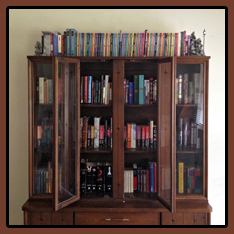
My Books (some of them)

My Books (some of them)

If you’ve ever seen Disney’s Beauty and the Beast and you’re a book-oholic like I am, your dream house might include a library like the one in the Beast’s castle. You know the kind – book-filled shelves stretching into the stratosphere, complete with those rolling ladder thingies that are absolute necessities if you want reach the upper shelves.

Of course, my fantasy house doesn’t stop there. I want books everywhere. I’ve seen houses where the stairs are shelves with books underneath or where unconventionally-shaped bookcases are built into the walls and nooks of every room.

Since, however, reality is quite a different thing than my dreams, my books reside in my china cabinet (the china is in boxes who knows where), on top of my spinet piano, in a small, three-shelf corner bookcase in my room, and the cookbooks are above the cabinets in the kitchen (let’s be honest: they’re all over the kitchen). The only reason my five-year-old’s bookshelf still has room on it is because his little brother strews the board books throughout the house, so I can’t even claim eminent domain and stash my stuff there. If I decide to buy one more book for myself. . . well, I guess I haven’t put any knickknacks on top of the buffet for a reason.

Space isn’t the only problem. Believe me, I will find room, if I have to balance them on top of fan blades or do something less creative like stack them in the corners. I do have several books in “the cloud” (either Kindle or iBook editions), but I prefer to read physical books with actual pages (although I do publish online – but that’s for another blog). So recently, when I realized that I was going to finish Drums of Autumn (Outlander), the fourth book in Diana Gabaldon’s Outlander series, I just couldn’t stomach shelling out another thirty bucks on a book that I want but don’t need. (Read this post to see how much catching up I have to do to reach 2013’s reading goal.)

Now, some of you have already figured out the obvious solution, which saves both space and money, and you’ll think I’m an idiot for not coming to the same conclusion earlier: just check out the book from the library. Well, duh, why didn’t I think of that?

Time to ‘fess. The last time I checked out a book from a local public library was when I was fourteen. And yes, that was over half my life ago. It’s rather shameful, I admit. I mean, my dad worked in libraries as a teenager, my mother worked in our former church’s media center, and one of my favorite places to volunteer at my son’s school is in the library. So why the decade-plus hiatus?

When I was fourteen, I started reading really long books – thousand-plus pagers. They took longer to read than libraries’ allotted two-week borrowing period, and I wanted to spend my time reading them rather than going back to renew all the time. Plus, once I started earning a little spending money, I could afford my own books and immediately grew my collection. I went from bugging my dad to search the various libraries for new Agatha Christies once a week or so to buying almost every Stephen King title available. It also didn’t hurt that we lived near an awesome used bookstore. (Chamblin Bookmine rocks!) Lastly, whereas I couldn’t care less about many other material things, books are the key to my heart – I want to possess them. (My husband figured that one out pretty quickly.)

Now, I did spend quite a bit of time in my university’s library back in my college days, but I didn’t go for the fun of it. When you associate going to the library with study groups and research papers, it kind of loses its appeal.

Then, early in our marriage, my husband and I moved to a different county, thus making my poor, unused library card obsolete anyway. We lived about ten minutes from a very nice library – which was right over the county line. And these two counties do not share benefits. I could enter that library, sure. But check a book out? No way, Jose. The closest library within our own county was over twenty minutes away, and since I was out of the habit. . . Well, you get the idea.

After I had kids, I heard people talk about story times at the various libraries around town, but it never occurred to me to take them. I’m a busy mom, I work, and I am somewhat anti-social. If another mom had invited me, I probably would have considered it. But I should have gone anyway, regardless. I recently had to meet a friend during the week, and the most convenient time was just after story time. So I figured I’d tag along with her, and at least my younger son would enjoy it. Peter was the oldest kid there by far, but I was glad that he was entranced by all the books. Unfortunately, it was, yet again, a library in the wrong county. Peter sometimes checks out books from our church’s library, but after seeing the real thing, he begged me to get a card. We now live less than ten minutes away from a library with an excellent children’s department, so I finally broke down and went. Not only could Peter have access to far more than I could ever afford, but it was clear that if I wanted to read The Fiery Cross (Outlander), I would have to go to the library or dip into the diaper fund. Sorry, books. When you have a twenty-month-old, diapers win.

Hey, I could get used to this. Now Peter has a new reason to be excited to read. And the two-week deadline gives me new incentive to read, read, read.

But just to make sure, when I checked out Gabaldon’s next 900-plus page doorstop, I asked the librarian how my chances were of renewing it.

She looked at me, taking in the baby on one hip and the energetic five-year-old next to me. I’m sure she was thinking, Good luck finishing this in the next two months, lady. Then she smiled and said, “They’re good.”

Story Trumps Writer

Dumbledore as portrayed by the late Richard Ha...

Dumbledore as portrayed by the late Richard Harris in Harry Potter and the Philosopher’s Stone. (Photo credit: Wikipedia)

While waiting for my latest round of literary agent rejections to come in, I haven’t just been twiddling my thumbs, wondering what to do. I’ve been working on other writing projects, such as short stories. One is getting close to being publishable, and while I was wondering what in the world I would write next, a new one popped into my head. But, as usually happens with a little idea, it turned into a big one. A really big one. From March to June, I wrote close to thirty-three thousand words, mostly backstory. When I weave all that in with the present-day, how long is this thing going to be?

I was talking to my mom about how happy I’ve been writing this story – sometimes three thousand words in a day – except for that I don’t know exactly where it’s going. That’s kind of a problem when it comes to publishing. But I’m good at having epiphanies. Sometimes it takes two or four or seven years to get one, so this is most likely a long-term project, but I’ll get there. The funny thing is, the end scene is already done. It pretty much came fully blown into my head while driving home one night. I was frantic to write as much of it as I could remember when I finally sat down with my laptop. It’s a good scene, but a tragic one, one that I’d like to be able to change in an epilogue, although I can’t imagine how I would.

When I told my mom that I don’t really want to end my book like this, she said, “Well, you are the writer.”

“Yes,” I said, “but it’s the story. Story trumps writer.”

I know people think I’m being all mystical and strange when I say things like this. And I’m such a practical person that it seems uncharacteristic for me. But it’s so true. In 2007, when it seemed that everyone who had a life was waiting with bated breath for Harry Potter and the Deathly Hallows (Book 7) to be published, I checked J.K. Rowling’s website all the time for possible insights and updates. And I remember her saying at one point that Dumbledore wasn’t cooperating. [Spoiler Alert] Nevermind that he was already dead, it intrigued me that her character was giving her trouble. None of my characters had done that to me. Yet.

Or maybe they had. Maybe that’s why I have so many broken-down manuscripts littering my hard drive. Maybe there’s an event that I don’t want to happen, so by not writing it, I delay the pain. Or there’s a character that I know needs to – gulp – die, but I can’t bear to kill.

I blogged last week about communication and when it breaks down between people (read it here). The same can happen between writers and their stories. It’s really obvious sometimes when a story desperately needs to go one way, but the writer just can’t do it – can’t kill the dashing suitor or separate the twins at birth or let the sickly-sweet heroine have a bad day for once. These stories suffer, I believe, because they are subverted from their true purpose. They’re stunted and can’t grow as they need to.

So when I was thinking about communication breakdowns, about the sad end to my new story, I remembered that pesky novel that I’m trying to get represented. I’ve revised it ten times over a period of ten years. And when I say “revised,” I don’t mean “proofread.” I mean top-to-bottom, scenes cut and added all over the place, names changed multiple times. And those epiphanies I mentioned? Yeah, they’ve caused a revision or four, as well. But is it done yet? Has it really had its say?

I’m having doubts about this book, which has been well-received by other writers. But is it because they’ve seen multiple versions, and my latest revision is so much better that they’re just glad to see improvement? Or are they complimenting it because they know me and don’t want to hurt my feelings? While doing some soul-searching, I’ve realized that some of the parts that I believe necessary to the story might need to go, which is tough. Even parts that get a lot of praise may not belong, like a silk ball gown on a trip to the beach.

One of the questions I’ve had to pose to myself is: do I know my story? I mean, do I truly, bone-deep know it? To the point that I could spell out the most important aspect in one sentence. And maybe I don’t. Maybe, if agents don’t accept it, it’s not ready to be accepted. Maybe I’m not ready for it to be accepted. Or it could be that I’m full of doubts because I really do know it, and they’re all just looking for the biggest sell, and my story isn’t “it.” And the struggle continues.

So while I should be writing, I’ve done a lot of stewing instead. You know, I prefer to let my favorite tomato sauce simmer on the back burner for hours before I eat it. Sure, it’s “ready” in twenty minutes or so, but it’s not nearly as good. Maybe that’s what my story needs to do. I think about it, mull it over, jot a few notes. . . and listen. Whenever it’s ready to give up the goods, I hope I hear it this time. Then, I’ll settle into revision number eleven.

Communication Is More Than Maintenance Talk

Communication

Communication (Photo credit: P Shanks)

Talking to my husband has always been easy. As his side of the story goes, he “fell” for me on a high school chorus trip to New York City. On the bus ride home to Florida, we sat together and talked almost all night. It had never been so natural for him to talk to a girl before. I certainly didn’t think at the time that I was making waves, but I guess my conversational charms won him over. I have my parents to thank, who work together and communicate very well, and who also have always treated me like I deserve respect for what I say. Even when I was a child, they conversed with me like I was a human being, not a sweet little darling who says cute stuff. That means that they’ve listened to a lot of dreams and ideas that they knew were naive or unrealistic. It also means they’ve had to set me straight a time or two. Although I didn’t particularly appreciate my dad telling me, when I was an adolescent, that pursuing a career in acting was not the way to go, I’m glad for the candor and that we shared the kind of trust that allowed me to lay out my dreams.

I look at my own kids and hope that the lines will be open for us as well. Communication truly starts in the womb, which is why I listened to music that I wanted my babies to hear and talked to my pregnant belly. When I was expecting baby number two, I encouraged Peter to talk to him. He would put his mouth up to my belly and say, “I love you, Baby Ian. I can’t wait to see you. I’m your big brother.” I think that has a lot to do with why Peter is Ian’s absolute favorite person in the world. It’s also sweet to me that Peter often says he can’t wait until Ian can talk (more than the baby talk he is capable of now).

Some people’s idea of “quality time” with their kids is to hover and be overprotective. Others feel guilty for not being able to spend as much time as they would like and create events that are supposed to equal that imagined quality. But do whirlwind trips to amusement parks, occasional weeknight baseball games, or other activities that wear us out and wear us thin make up for the everyday interactions that should be natural and lead to life-long trust and closeness? I’m not saying that doing those things is bad, but they don’t make up for lack of communication. A good friend once observed that every time she saw a marriage deteriorate to the point that maintenance talk was the only communication between husband and wife, divorce was usually around the corner. It happens to parents and children, too, who find they have no reason to talk after the nest is empty.

But maintenance talk is necessary, isn’t it? Thomas and I keep very busy schedules and are often like ships passing in the night. “What time is your meeting?” “Will you be able to watch the kids?” “I need more creamer when you go to the store.” “We need to run by Target to pick up school supplies.” When the necessary becomes the only conversation in a household, however, relationships become fragmented. My favorite parenting book, On Becoming Baby Wise: Giving Your Infant the GIFT of Nighttime Sleep, recommends that parents have “couch time.” (Read more about my Babywise experience here.) If there is no other time in their busy day when parents can talk, at least they’ll have fifteen precious minutes to catch upon more than the grocery list. And the key is to have couch time around the kids, so they can see that their parents are important to each other.

I remember my college days, when I thought my life couldn’t get any busier (ha). I always took five courses at a time, and I attended summer semesters, too. I worked twenty to thirty hours a week, sang in the church choir, sang with a community chorus, helped found and edited the journal Fiction Fix, attended numerous workshops and events for that same journal, and drove almost thirty minutes one-way to Thomas’s house four or five times a week. It was all a part of my plan to get my degree as quickly as possible while continuing to stay active in all the activities that were important in my life. I could have made things much easier on myself if I hadn’t gone to school over the summer, if I’d taken four classes instead of five. What was the big hurry to graduate, anyway? Well, Thomas and I were getting married, and we knew that one of us had to be out of college and working to support the other. Since I started a year before him, the pressure was on me: the sooner I finished, the sooner we could move on to the next stage of our life together. We planned a summer wedding, so he could continue to go to school without interrupting his spring or fall semesters.

Except that things didn’t turn out that way. Although I adored a few professors and enjoy some of my classes, I had no great love of college; it was an obstacle, something I had to conquer. But Thomas absolutely loathed it. College was something he could barely stomach, especially when a professor showed up and told his class to dress professionally – all while she was wearing sweats. I don’t know if that was the last straw, but it was certainly bad timing on that professor’s part. It was during that first week in the fall of 2003 that he met me after an evening class, and he just had that look. I took a deep breath, knowing what was coming. He had spent all evening thinking about what he was going to do and how in the world he was going to break it to me and his parents. I knew he was miserable in his classes, and I also knew that it in no way helped that it was my last semester, and he still had two years to go. I listened and tried to be sympathetic, encouraging. And then we moved on because talking through problems is what we do. And although we were creating a future together, he had to be at peace with his half of the deal. Fortunately, his chosen career wasn’t dependent on a four-year degree, and he did eventually (very eventually) graduate.

But there are couples out there who are sorely disappointed – even surprised – when they find out their relationships can’t survive on date nights and diamond rings alone. There are parents who think they can keep their kids busy with sports and camps and buy them cars, and those same kids will, in return, go to the colleges and pick the careers their parents prefer. And it’s not just parents and children. Everywhere you find relationships, you find people who expect things from others that are unrealistic, unfair even; you’ll find little respect for each other’s time and thoughts; you’ll find misunderstandings that could have been easily fixed. You’ll find broken communication. But when you see people really talking to each other – and listening – you witness a truly beautiful thing.

Sometimes our family has to drive somewhere in separate vehicles, and on those occasions, when Thomas can drive home and have Peter with him, I know he cherishes those rides. With the radio off and phones put away, they just talk. Peter asks questions, and Thomas answers. And Peter tells what he thinks about the world, and those are priceless (and often hilarious) moments. Thomas always seems to glow afterward, as if our five-year-old has just recharged him.

I watch parents who seem to care more about their phones or cars or any number of other distractions than their kids. Perhaps a big reason that young people have an increasing disrespect for their elders has a lot to do with the way we treat them, and often, I am convicted. I have to remember that I was once their age, too, yearning for answers, for information, for attention. And when I spend the time with my kids that they desire and deserve, I not only have hope for surviving the distant teenage years, but turning two men out into the world who will make it a better place.

I hope, if I have the chance to look back over my parenting experience some day in the distant future, I will see much improvement on my part and be proud of myself for hanging in there. And I hope that my kids will still want to talk to me then, to ask questions, to share their joys and concerns. But it won’t happen on its own; I have to work on it today – and always – to create that kind of a future.