I’ve Got Too Much to Read, Dude

This (the title) is what I told my husband mere minutes ago, after watching the new trailer for The Hunger Games: Mockingjay Part I. Even though I just re-read the entire Hunger Games trilogy earlier this year, seeing the trailer made me eager to do it again.

So let’s see, if the movie comes out in November, and it’s late September now, and I haven’t nearly caught up with my 2014 reading list, and I’ve bought more new books since creating the list, and I received a bunch of books for Christmas that I have yet to crack (more on that at the end), and I have a 1000+ page history book I’m supposed to be reading right now…

I’ve got too much to read, dude.

Now, this is a good problem to have. It’s just the kind of problem that I like. Not always easily solved, but it’s fun to try, anyway. There was a point in my life when I was disciplined enough to read every book in the house before buying anything new, but that was in 2007, and let’s be honest: a lot of good books have been published since then.
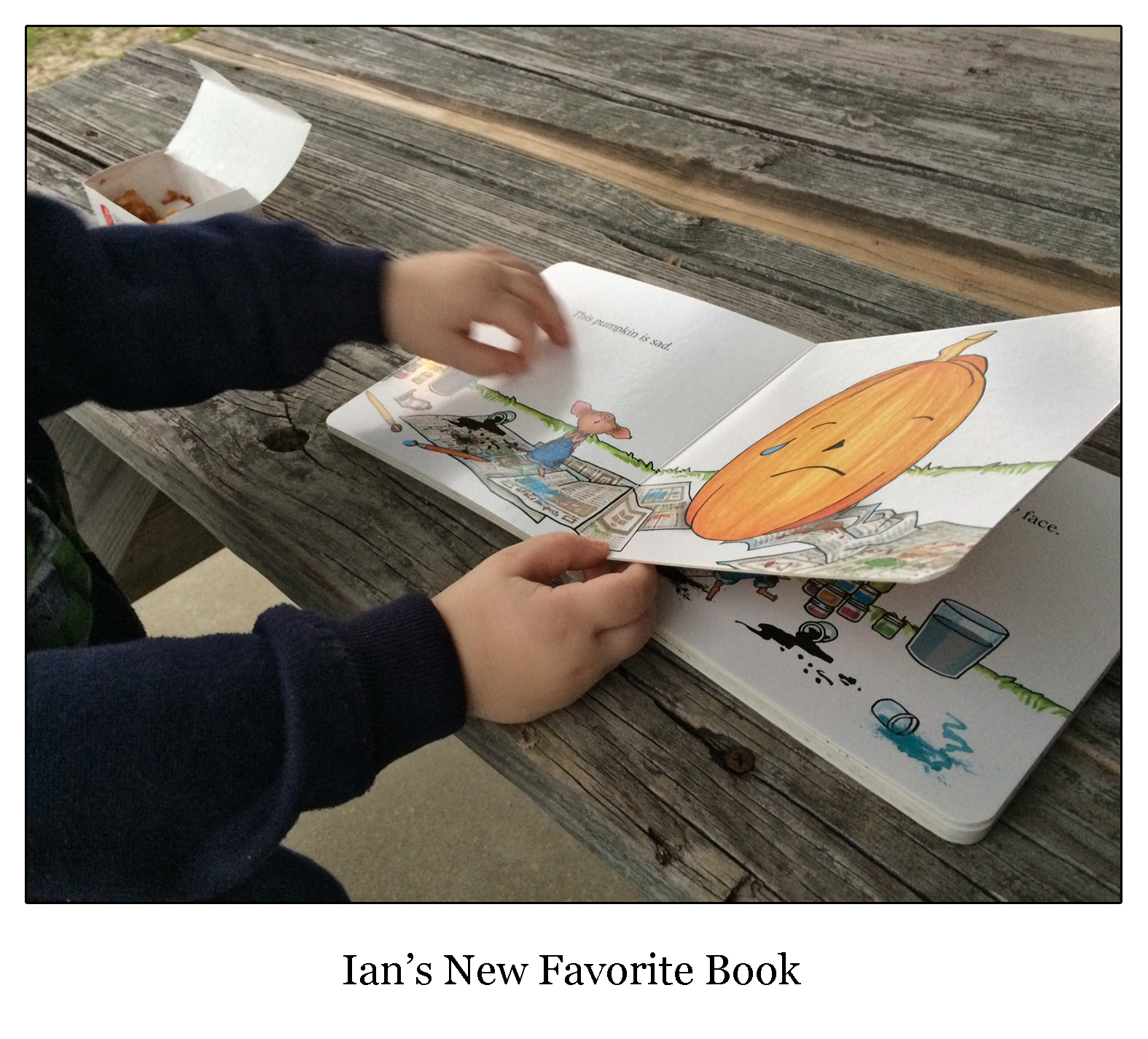
Ian ReadingWe are a reading family. There’s me, of course, the crazy-avid reader. There’s my husband, who currently has three or four books that he’s reading. There’s my first grader, who gets an ice cream party at the end of the year if he reads 100 books, so we make sure to squeeze one in every night. And there’s even my two-year-old, who took an interest late in the game (compared to his elder brother, who was re-enacting his favorite books at 18 months) and wants a new book every time we go to our local bookstore’s story time. I particularly love reading with my kids, watching them absorb so much information and the excitement when they get a new book. They are quickly becoming like their mama, getting excited every time we take a trip to a library or bookstore.

And if you follow my blog, you know that one of my biggest problems when it comes to books (aside from wanting to spend all of our money on them and then not having time to read them, in any case) is where to put them. When I ran out of room in our china-cabinet-turned-bookshelf, I started using the top of the piano. I stored large, hardback volumes in cabinets, and the little corner shelf in my bedroom was overflowing. I started looking for people who might want to borrow books, just so I could make more room.

Then something wonderful happened. My grandfather’s widow finally decided she was tired of keeping his old bookcase kicking around in her garage. This isn’t some other piece of furniture that can be converted for book shelving purposes – it was made to hold books. My parents didn’t have room for it, so that meant that it could be mine – AAAALL MIIIIINE! If only I could find a place to put it.

Now, you know that I would be cool with getting rid of our toys and even some furniture, as long as I still have a good chair to sit in. But since I don’t live alone (and I don’t want to any time soon), I have to consider the other people who live with me. We ended up scooting our little photo album shelf over a few feet and moving my mother’s lovely painting up, and – voilà! – instant bookcase space.

Bookcase


What do you think? It’s a little banged up, but after all, it is antique. And to see all (well, not quite all, but most) of our books in one place makes me realize how many we have. Yikes, that’s a lot.

But you know, there’s no such thing as too many books.
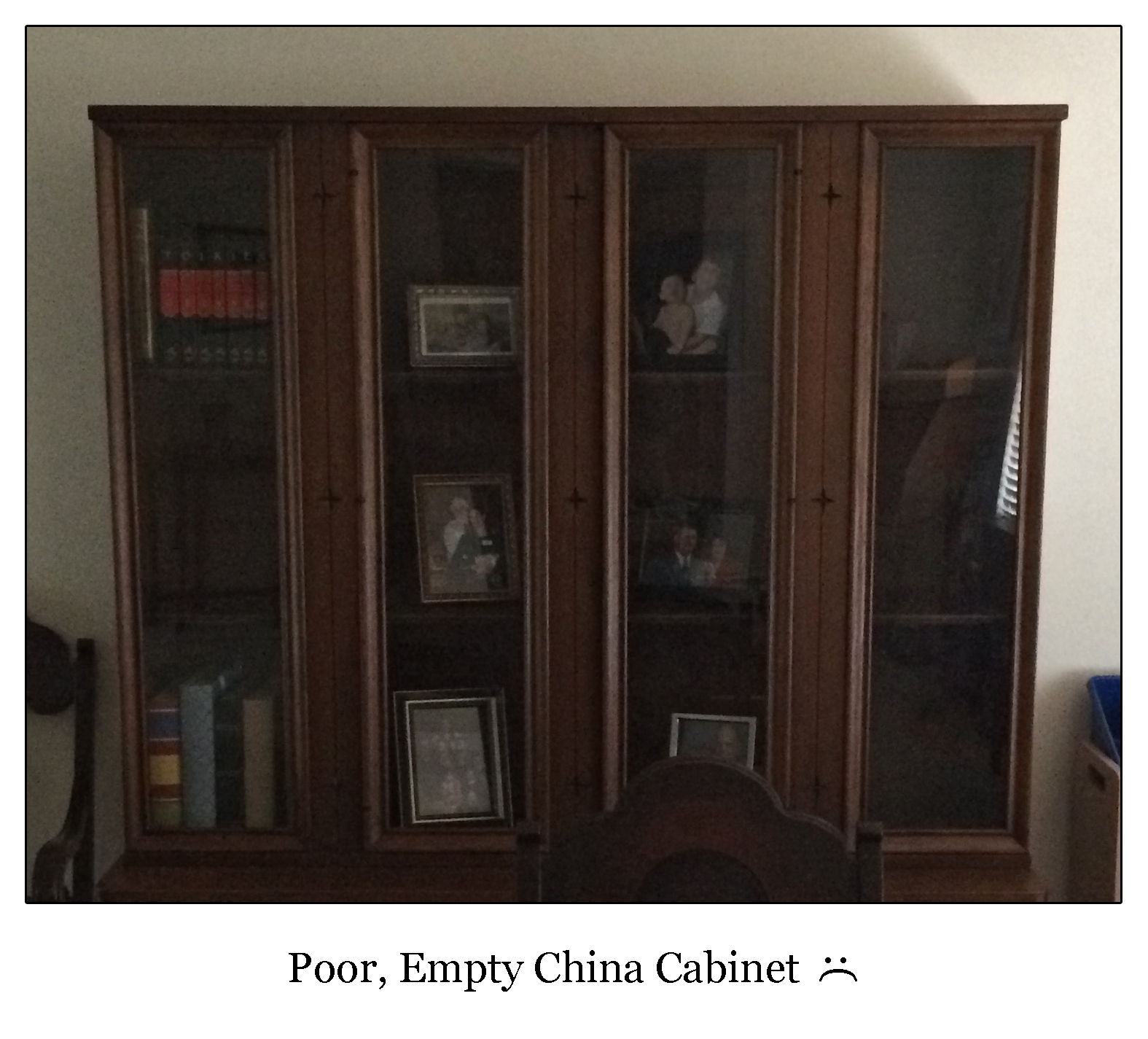
Look at our poor china cabinet. The only thing left in there is Tolkien. And photo albums. I put some in there to keep it from looking empty. Oh, and family photos. Hello, family. Love you. Just wish there were some more books behind you.

Of course, as I told my husband, we might want to consider actually pulling our china out (wherever it is) and put it in the china cabinet. I mean, it has little display lights and everything. It would be a shame not to use it for its intended purpose.

Okay, you know I’m just joking. The reason the china is packed up is because I do not intend to use it, but I do intend to buy more books. Oh yes. Picture me rubbing my hands together in glee.

Which brings me to something amazing that happened this weekend. This is the kind of thing that happens to people in books and movies, but never to us.

Remember when I said that we got books for Christmas that we haven’t bothered to crack yet? Yeah, well believe me, that’s never going to happen again. The problem is, as stated in the title, I just have too much to read. And darn it, people keep publishing new books that I want to read all the time. Or someone will tell me about an author I have yet to discover, and I have to read everything that author ever wrote – like right now. So it’s not that I won’t read those books. It’s just that it could take two or three years. I mean, my husband bought me books that I asked for in 2011, and I just read them a couple months ago. (That’s part of the reason I started compiling a list of books that I want to read every year. Even if I get sidetracked, I can at least be somewhat accountable.)
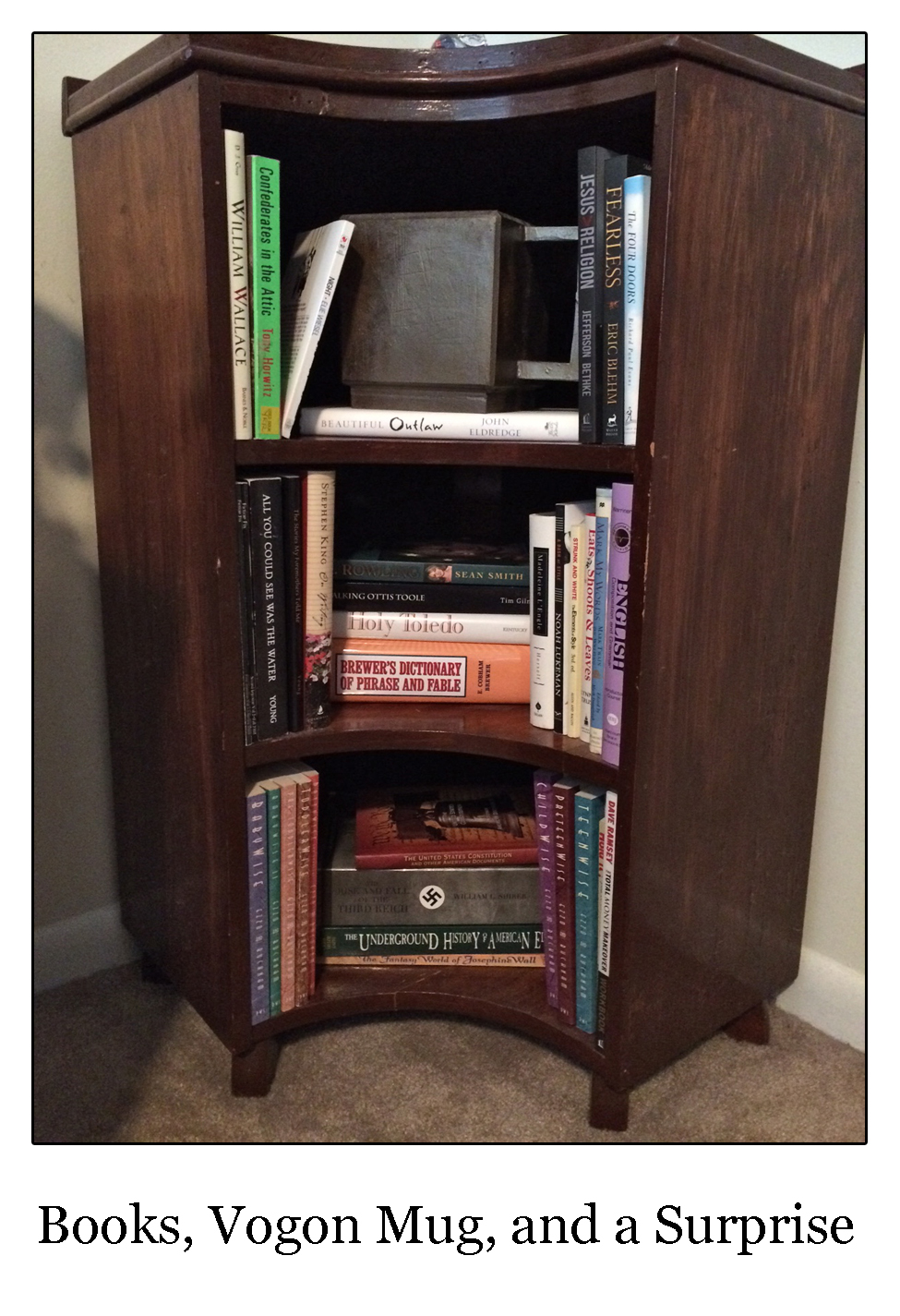
Books Vogon MugSo here’s the cute little shelf in our bedroom. Now, it’s all non-fiction, but before the big bookcase, I had even more stuff crammed in here. So when I pulled those books out to sort them onto the new (to me) bookshelves, I decided I might as well dust while I was at it because, let’s be honest, it doesn’t happen very often.

I pulled all the books out, and when I removed the ones to the right of the Vogon mug (yes, that is a Vogon mug you’re looking at on the top shelf, Hitchhiker fans), I saw some paper sticking out of one of the books we received last Christmas. And I began to have a horrible-slash-wonderful feeling. I pulled the paper out, and it was a sweet note from the relative who gave us said book. And in the note was a pile of money. I think, were I ten years older, I might have had a heart attack on the spot.

I carried the note and the money into the living room, where my husband sat oblivious to this miracle. I showed him the money. I probably said some crazy stuff. I’m really not sure because I was in shock right then. Like I said, this kind of thing never happens to us.

Maybe it’s time to start looking for agents again, if my luck continues like this.

It did not take long for me to conclude that a good portion of this money needs to stimulate our local bookstore and help fill the poor, empty china cabinet shelves. You could say that this was meant to be.

Bookshelves and dusting can lead to marvelous things. I still haven’t found more time in my day to read, but you know me: I like a challenge. And if you like morals, the moral to this story is that if someone gives you a book for a gift, open it up and make sure nothing’s lurking inside. And then, of course, add it to your book list.

Words Count


Embed from Getty Images

Back in the fifth or sixth grade, I had the option of writing a story for a contest. Creative writing has been a love of mine since I was old enough to write my name, so I was in. Write a story – no problem. But there was a problem, and it was the word count. No more than 200 words. I think the only reason this has stuck with me is because of how ridiculous the word count seemed. My classmates groaned about the seeming impossibility of creating a story, no matter the length. To me, however, the limit of 200 words shot my dream of writing a winning story dead before I could even start.

In college, when I joined my first fiction workshop, I puzzled over how to write a story that was short enough. I struggled to shrink my first one to less than 20 pages, which I knew was problematic because the instructor read each story aloud during class. The day that a woman turned in a two-page story, I wondered how in the world it would amount to anything. Surely a two-page story would hardly be worth critiquing.

It was one of the best stories submitted that semester.

Eighteen years old, and I finally learned that longer is not necessarily better.

Of course, that’s not to say that I was unaware of being brevity-challenged. I’d heard about killing your darlings. I’d also heard of taking out the proverbial axe and chisel to finesse a piece of literary art. But my approach was always to write pell-mell on the first draft, then make sure the second draft was cut down by ten percent. The problem with this technique is that my first drafts are often much too long, and cutting ten percent is not enough. And when I started writing freelance, I had to learn how to hone my skills by writing articles with word limits.

It’s one thing to write a story and know that it needs to be around a certain length. It’s another to be assigned an article and know that you will be rejected if you go over 300 or 400 words. When I started writing articles for clients, I faced this challenge. And it turns out that I can write an article, prove a point, share an idea within a small space. A good thing, too, since many people will choose not to read an article if they see it runs onto a second page.

So, what then about novels? If you read my post last week, I complained (yes, I admit it) about my latest encounter with an agent. Her assignment was to help me fix problems with my novel’s opening, but when I submitted my excerpt to her with a note about how long my young adult manuscript was, I didn’t expect her to critique the novel’s length. But that’s just what she did. Cut it down by about 40,000 words, she said.

My first reaction was to be offended. Hadn’t she heard of Twilight, EragonHarry Potter And The Order Of The Phoenix, for crying out loud? These books blow average word counts out of the water. Granted, the first Harry Potter book was closer to what is considered normal, so by book five, J.K. Rowling could do whatever she wanted. But still, I thought, how do young adult authors break into the publishing world with longer-than-average novels?

Of course, my goal needs to be to make my novel the best it can be. Length isn’t the only factor, but it could be the one that consigns me to the slush pile yet again. While making my manuscript the best it can be, maybe I need to pull out the old axe again.

When I started editing my novel, although cutting words was a secondary goal, I was more concerned with making it clean and clarifying scenes that had confused my beta readers. But with my number one critique from the agent being the length (and after all, she does sell novels for a living, so I kind of have to lean toward her expertise on this one), I became hyper-aware of every word. I should have been making sure that each one counted from the beginning.

As of this post, I have cut almost 14,000 words – and I’ve added two scenes and am not even halfway through the book. There’s hope for me yet. If I can cut 30,000 words and make my prose shine, maybe there’s a chance that I’ll catch someone’s attention.

So, for those of you who don’t know where to start, here are some specifics:

  • Choose your adverbs with great prejudice. Sometimes you can’t cut the adverb out and get your message across. Sometimes it means rewording a section to avoid adverb usage (and adjectives, too, but adverbs are the bigger culprit). As a writing exercise, write a scene with no descriptors at all. Challenging? You bet. You’re welcome.
  • KISS (keep it simple, stupid). If you can make your point in three words, why use ten? Are you trying to impress someone with your use of words like “anthropomorphism” and “juxtaposition”? Give me a break. Likely, you’re only impressing yourself. Make your point, and move on.
  • Read your prose aloud. This is especially important for dialogue. It’s also a great technique for discovering when you’re using the same word or phrase too often.
  • Express yourself through punctuation. Need help? Check out Noah Lukeman’s A Dash of Style. You will be amazed by how much you can say without using words at all.
  • If you haven’t already, buy copies of The Elements of Style, On Writing, and Anne Lamott’s Bird by Bird. There are many, many others, but these will give you a great start.
  • Kill your darlings. I’m so sorry. It could be that the line you’re most proud of is the one that needs to go. Once you start, you’ll find that it’s easier to keep cutting. If you’re afraid that you’ll regret your cuts, save each revision of your work as a separate document, so you can go back and put a line back in later if you decide you’d rather keep it.
  • If you’re writing an article, make a rough outline. Although I like to be a free spirit when it comes to fiction, when writing articles, you need to have a clear direction for your key points. Then, if space allows, you can add flourishes later.
  • Give your piece a rest. If there’s no hard deadline, take a vacation and work on something else for four to six weeks. You may find that something you thought integral to your manuscript before is unnecessary.
  • Hire an editor. I’m not just trying to get more work for myself; if you are serious about making your manuscript publication-ready and feel you’re not up to the task yourself, that’s why we’re here.

These all come down to making sure that every word counts. If it doesn’t further your story or article, it’s got to go. Only then can you write a winning story in under 200 words – or cut thousands of words from your novel without compromising important scenes. I have confidence that you can, and I’m certainly going to try to do it, too.

Does the Genre Really Matter?

All seven books in the Harry Potter series in ...

All seven books in the Harry Potter series. (Photo credit: Wikipedia)

Wanted: Good fiction.

To be more specific, fiction that draws me in right from the start. Fiction in which the characters are believable, in which I can hear the dialogue in my mind. Fiction that makes me think, raises tough questions, makes me cry, makes me emote. Fiction that makes me want to talk to someone else about it. Fiction that saddens me when it’s over.

I like to think that if I were a literary agent, that’s what I would list under my “interests.” Because, try as I might, I can’t pin down a favorite style or genre. Now, there are certain things that I definitely don’t like. Mediocre writing, inconsistency, lack of craft. Like I said, I want the characters to be believable. If the debutante protagonist has never scrambled an egg in her life, I won’t believe it when she whips a six-course meal out of thin air. (Unless she’s magic, of course – and if she is, I better have a hint of it first.) I don’t want adverbs trying to tell me how desperately someone says something. Show me the desperation with a sweaty brow and shaking hands. I don’t want plots that are so insubstantial they can be knocked over by a sneeze.  I don’t want endings that are unrealistically happy or tragedies that are unnecessary, the only point being to make the reader cry.

I really just want a good story, one in which I can forget that I’m reading at all.

This is why labels kind of bother me. Romances, for instance. Label it like that, and I don’t want to read it. Why? Because all the romance novels I saw growing up had half-naked men massaging busty women’s shoulders on their front covers, and I really don’t want to read a novel that’s connected by one sex scene after another. So I was shocked to discover a truly excellent book that is sold in the romance section. Although the story revolves around a love story (or stories, really), it’s so much more than that. I’m speaking of Diana Gabaldon’s Outlander.

Or take the case of my friend who told me that he could not stand to read fantasy. Wouldn’t give Harry Potter the time of day because of how it’s categorized. I’ve known other people who won’t read these wonderful books, not because of the fantasy and magic, but because they’re so-called “kids’ stuff.” Well, if kids’ stuff comes with a side of good beating the crap out of evil, I’m on board with it.

How about Stephen King? He’s known as the king of horror, yet while he started that way, his more recent books (and my favorites) are much more sci-fi, fantasy, and I-don’t-know-what. They’re just good stories. Not to mention that the guy knows how to write and how to instruct writers how to write. Chances are, if you call him a hack, you haven’t read much beyond Cujo or Pet Sematary.

When I looked for beta readers for my novel RIP, I decided to go the vague route. People asked, “What’s it about?” or “What genre is it?” I told them that it was young adult, and fortunately, my beta readers were kind enough to read because they know me. One actually told me he wouldn’t have usually read that kind of book, but he was glad that he did. Good thing I kept my mouth shut, right?

But, as I posted a couple weeks ago, I was able to workshop a portion of my novel with an agent, and in my introduction, I told her it was young adult. It was almost as if, by giving that tiny bit of a description, it put blinders on her. My book was much too long. She was unwilling to consider almost anything about the content until I addressed the length. Young adult novels generally have a word count, and mine exceeded it by double. (Nevermind that books like Twilight are half again as long as mine.) Now, she is right: there are many thousands of words that I can cut, but shouldn’t she be trying to sell a story, not a word count? (That’s an issue for another blog.)

This whole issue has gotten me thinking: does labeling novels with a genre help or hinder? If I had just told the agent: here’s the beginning of my novel, would she have judged me for not nailing down a genre?

I don’t go through bookstores and read book jackets or first pages until I find something I think I want, but many other people find their books by following this practice. (Or if not in a bookstore, online.) What about someone who only picks books from the Christian lit shelves? This person might never consider reading Veronica Roth’s Divergent series because it’s sold as young adult and dystopian – would completely miss the way that Roth’s Christianity colors her novels.

While talking books with a friend recently, we got onto young adult lit, specifically John Green‘s books (which are awesome, by the way – do yourself a favor, and read them). My friend said, in a semi-surprised tone, that he’d gone on a young adult lit binge lately. And he’s in his forties with no kids. I find this wonderful – that a book written “for” an audience in their teens can speak to such a wider audience.

Of course, I totally get that if there were no classifications, I could very well mistakenly shop my novel with agents who are only interested in political thrillers or erotica. And marketing is another issue. No matter what, there are people who will refuse to read anything except X, even though they would really enjoy Y, if only they would give it a chance.

But it seems, in the effort to makes genres more attractive to more people, sub-genres have to be added. You ought to check out this list from Writer’s Digest. And it’s not even complete! I just heard of a new genre called New Adult. Each genre and sub-genre has its own little specifications, and if you hope to publish, you have to try to fit the mold. Well, what if I don’t want to? What if I just want to write or read a good book? What if I want to mull it over afterward and then say, “I think I just read a really good Western. Who knew? I never thought I would enjoy a book like that.”

All I’m asking for is a little bit more of an open mind. From agents, publishers, and readers, alike. Hey, I’ll try to have one, too.

I suppose this is why I’m not a big publishing executive. The bottom line is important, I know. Believe me, I want to make a living in this business, too. But at the end of the day, piles of money aren’t going to captivate me. But a great story will every time.

Are You Too Busy Posting About How Much Fun You’re Having to Have Fun?

A woman reading SMS messages on her mobile pho...

A woman reading SMS messages on her mobile phone while standing on a bike in traffic. (Photo credit: Wikipedia)

One morning last week, I was watching the morning news and happened to see a segment with a therapist talking about social media accounts (Facebook, specifically) and how negative an impact they can have on relationships.

Now, of course, many of you, my faithful readers, read this on Facebook. So I am by no means saying we should give up this platform. But it was enough to get the old thinking juices flowing.

The therapist mentioned that many people are so busy posting updates about what they’re doing – that they’re not really doing anything. Except for updating social media, of course. There were other reasons that he went into for why Facebook can be bad for relationships – like coming across an ex and stirring up old feelings – but it made me start to think about my life and how it’s changed – not since I signed up for Facebook, necessarily, but since I got a smart phone.

Sure, there are people who only use Facebook on a home computer, and that takes them away from their family at home. But then there are others – like me – who almost always check on the phone – at a red light, in line at the grocery store, and of course, when the person you’re with is just boring you to death. Ouch. What happened to letting our minds politely wander? There’s nothing that says, I couldn’t care less what you’re saying than looking down at a phone and getting absorbed in what’s trending right now.

When did we have to start filling every “empty” moment with making sure we know what’s going on in the world of social media? There’s an appropriate time and place for it, sure, but I’m afraid that my kids and their friends will grow up without the luxury of knowing how wonderful so-called boredom can be. I fondly remember times when I had nothing to do, so I went outside and dug for rolly pollies. Or I walked laps around my bedroom, composing a new scene in my current story. Boredom is the birthplace for creativity. Of course, Pinterest is a great place for that, too, but we’re raising a generation of sharers right now. What happens when all the creators are gone?

Facebook and other social media do have their positive uses, of course. I have friends who are primarily members to promote themselves professionally. I do this myself, but I also post pictures of my kids because my out-of-town in-laws like to see what their grandkids are up to. That’s all well and good. But when smart phone and social media usage start replacing time with family, then we’ve somehow mixed up our priorities.

This therapist guy mentioned whole vacations that seem documented to-the-minute on Facebook. I’ve seen any number of them, and while I enjoy seeing some of the fun things my friends are up to, I have wondered: When do they have time to enjoy what they’re doing if they’re on Facebook updating their statuses so much?

And of course, I am guilty of this, too.

Sarah's Photo Books

Sarah’s Photo Books

Here you see a couple photo books I created of two of our most recent vacations. (Shameless plug: these aren’t cheap, copier paper photo books but high-quality, custom photo paper books made by Fuji, and you can create your own here.)

While I was creating the book on the left – a surprise Disney World trip for my kids – I noticed something that horrified me: I was paying attention to my phone instead of my kids in an embarrassing number of pictures. We were at Disney World, for crying out loud. It’s the happiest place on Earth, yet I was focused on reading updates of what my friends ate for dinner.

Now, granted, having a smart phone when you’re stuck in a two-hour line can be a great distraction. Disney also has a great app that helps you explore the park, so I could say, “Oh yeah, I was just using that.” But that would be a lie.

I’m not saying that smart phones are the devil and we should throw them all out, and neither should we do that with social media. But, as many people have noted, we need to make sure that we don’t get so sucked in to this virtual so-called “social” world that we isolate ourselves from the people that we really want and need to spend time with in the first place.

I think that sometimes, we are so self-centered, so stuck on the idea that we have to absolutely let all of our friends know what cool stuff we’re doing right now that we actually miss out on living in that moment. And what a shame that is.

Now, when I created the second photo book, a great trip with extended family in Washington State, I noticed something else. It was a bit of a letdown at first. You see, I remembered chasing my son and little niece through a mall in Washington. I remember their grins and giggles. I remember going lots of cool places and tasting great, new food. But somehow, I didn’t capture all of these moments photographically. I kind of kicked myself for missing them.

But you know what, I think that’s okay. I remembered a trip to the zoo that Thomas and I took early in our dating years. I made it a point to take a picture of all the wildlife we saw there. Why I thought this was so important, I can’t tell you. A photographer I am not. Any good pictures I’ve ever taken were completely by accident. So when I looked back at all these photos, I realized that I had no idea what I’d been trying to capture, nor could I remember enough of the day at the zoo to even take a wild guess. Why? Well, because I’d been trying so hard to get photos of the fun that I missed the fun altogether. (Thank goodness there weren’t smart phones or Facebook back then, otherwise I really would have made a fool of myself.)

I’m not saying to quit taking photos or to quit posting your events. But what I am saying is that it’s okay if your friends don’t see your kids sitting in a neat little row at the ice cream shop. I promise, your kids will enjoy their ice cream more if you don’t interrupt them.

And for those memories that you missed capturing on your phone or camera – those are likely the memories that will stick with you and your friends and loved ones the longest. Because you were too busy enjoying the moment to worry about how many likes and shares you might get on Facebook.