Thomas and I allowed our kids to have phones with data plans at the age of 14. I’ve always thought this is a reasonable age, but students seem to be getting younger and younger when they receive their first smartphone, smartwatch, Roblox account—you name it. They think that I’m an old curmudgeon when I tell them about the 14-year-old rule. I know at least one kid who had her first smartphone at the age of four.
The longer I’ve taught, the more children I’ve seen in occupational therapy because they learned how to swipe a screen well before they ever gripped a crayon. Or if they’re not actually touching the screens, they’re glued to them, unblinking, inundated by fast-moving images. Their brains have been rewired to receive immediate gratification, so forget giving more than one simple direction at a time—you’ve lost them.
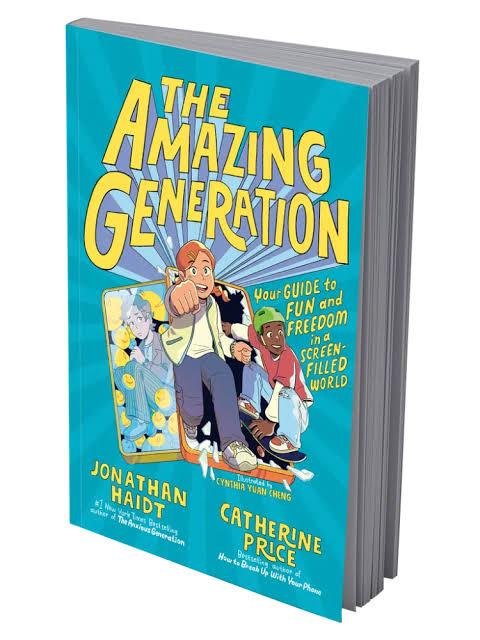
The Amazing Generation by Jonathan Haidt and Catherine Price addresses the risk of allowing children access to smart devices and social media. Written for members of Generation Alpha who are aged 9 to 12, I decided to check it out, since many of my students are in this age range, and I’m always looking for new book recs for parents.
The great thing about The Amazing Generation is that the students themselves can—and should!—read it. The format includes lots of fun graphics in the non-fiction sections, but there’s also a graphic novel that weaves throughout, telling the story of six kids (based on real kids), three of whom don’t have smartphones, and three who are absolutely addicted to them. Inspired by what I read, I have changed some of my own habits, including setting time limits for myself on certain apps to keep me from wasting hours on games and falling down time-sucking social media rabbit holes—and guess what? I’ve read more, exercised more, and spent more time doing real things in the few months since I set those limits.
Do you or your kids need a change? Keep reading for some insights from The Amazing Generation.
The Rebel Code
The Amazing Generation refers to kids rebels who have decided to use technology only as a useful tool or to abstain from it altogether as rebels. Their two-part code is to 1) “Use technology as a tool—don’t let technology use you” and 2) and to “Fill your life with real friendship, freedom, and fun” (p. 5).
The book is full of quotes from preteens to young adults in their mid-twenties who were all burned by technology and became rebels the hard way—by being consumed by tech first and discovering they didn’t like it. One such teenager, when asked what advice she would give her younger self, said she never would have downloaded TikTok, Instagram, or Snapchat. She said young kids are “entranced by their phones and social media, but a lot of them are not enjoying it and they wish they weren’t on it” (p. 9). Can you think of anyone who persistently does something he or she actually doesn’t want to do? That sounds suspiciously like an addiction to me.
The Tech Wizards’ Nefarious Scheme
All the apps that kids are attracted to are making adults rich by making them (the kids) dependent on and addicted to them. Sean Parker, the first president of Facebook, said this: “When Facebook was getting going, I had these people who came up to me and they would say, ‘I’m not on social media… I value my real-life interactions, I value the moment, I value presence, I value intimacy.’ And I would say ‘We’ll get you eventually’” (p. 33). So if you dare to actually live your life and be a rebel, the billionaires who run these companies—what Haidt and Price call “Tech Wizards”—are out to get you.
If you’ve ever done an internet search on something like a new blender, and suddenly Ninja ads are showing up in every social media app you open, this is the Tech Wizards spying on you and trying to get you to spend money—after all, they know what you like because you’ve told them with your search history. Maybe you get a nice new blender that you needed anyway, but they’re also making money off of you. It’s kind of… creepy.
Even when apps are “free,” the cost is the user’s time and attention. While wasted money can sometimes be refunded, once time and attention are used, they are gone. Time spent on an app could be much better spent doing something in real life instead of wasted on something that will soon be forgotten.
It might surprise you to hear that Netflix’s top competitor isn’t another streaming company—it’s our sleep. Binge-watching shows hurts everyone, but it’s especially harmful for teens, whose bodies not only rest and recharge but grow during the eight-to-ten (or more) hours that they sleep every night. Even for those who don’t get caught up in binge-watching, responsible use of technology should include limited (or no) use during the hour before bedtime because the blue light that screens give off suppresses the body’s ability to release melatonin, which is a chemical that helps us sleep. Both of my kids keep their phones charging in the living room at night. Thomas and I keep our phones close, mostly for emergencies, but I use Do Not Disturb between 10:00 p.m. and 6:00 a.m., so unless you’re on my list of emergency contacts, I won’t know you called or texted until the next morning.
“Persuasive design” is a fancy way of tech companies saying “brain hacking,” and they employ people whose job it is to figure out better ways to brain hack their users (p. 85). As the authors point out, hackers get computer programs to do things they weren’t supposed to do, so when our brains are hacked, we do things we’re not supposed to do—like scroll on social media for hours that we’ll never get back.
Time spent doing the same thing over and over again rewires the brain, and sometimes this can be good, such as practicing a musical instrument or a sport. But when this happens with technology, we’re, in essence, being programmed by tech, and this is not a good thing. For preteens and teenagers, their brains are being rewired or programmed to “[help” the tech wizards” (p. 108). When people are consuming media online, even if it’s labeled as something to “inspire creativity” (TikTok), this isn’t the case (p. 113). Creativity is truly inspired when the brain is allowed the “space and time to wander” (p. 113). I’ve always heard that boredom breeds creativity, and kids are allowed to be bored less and less these days—it’s all about stimulating them as much as possible so they’ll quit whining and leave us alone. That’s a personal observation, but if you think I’m exaggerating, do some people watching. The next time you hear a whiny toddler or child when you’re out and about, see how quickly a parent pulls out a phone or tablet, and said toddler/child becomes quiet, mesmerized, almost catatonic.

Adults know (or should know) that not everything we encounter online is true; a lot of it is embellished to put people in the best (or worst) light. Kids, however, are naïve and believe what they read. They also don’t have the maturity to understand when people are trying to use them, exaggerating, or outright lying. Here’s one of my favorite quotes, from Calla, age 22: “If you wait to get social media or a smartphone, you can decide who you are without other people telling you who you should be” (p. 116).
Unless you’ve been living under a rock, you’ve likely heard about all the trouble that Roblox has gotten itself into. Marketed toward kids as a world-building game, all kind of bullies and predators use this platform to exploit, extort, and sell drugs to underage users who just want to play. I have six- and seven-year-old students who play Roblox, and if no one is monitoring them, they could be talking to people who they think are other kids but are actually creepy groomers in disguise—because you can become anyone on the internet, can’t you? Roblox knows this, but “limiting user’s engagement [is] hurting our metrics,” one of their employees said (p. 122). We have to be vigilant about our usage when these companies only want to use us to make themselves wealthier. Of course, the addictive side of technology should bother us, but the safety of our children should be even more of a priority.
The authors mince no words when they say, “the tech wizards don’t care about you as a person. They think of you as a product” (p. 128). This means that tech companies need their users to spend less time in the real world and more time using their apps and racking up ad revenue, which is how they make their money. One way to fight back is to invest in basic phones instead of smartphones. Many of these even look like smartphones, but they have limited access to the internet. Some only allow for phone calls or texting, while others have apps that allow for music or maps, but they’re limited when it comes to social media, streaming, and games. And the big bonus for parents: they’re a lot cheaper. If your kids are worried about optics (and teenagers are generally worried about how they look), these phones appear just like their friends’ smartphones but won’t get them in trouble like those others.
Using Technology as a Tool—Instead of Being Used by Tech
Haidt and Price created a three-question survey to help readers decide whether tech is being helpful or harmful:
First, is technology a helpful tool? Think foreign language apps or online documentaries. Those uses are fine, but steer clear of AI that does work for you, like writing an essay. We should be doing the work ourselves “precisely because [it’s] hard. That’s how [we] learn and grow” (p. 160). Not to mention that AI doesn’t always get it right. My elder son discovered this when he tried to use AI help to him find good Shakespeare quotes; he thought it would be quicker than just flipping through the actual text. The problem is that when we put the AI side-by-side with MacBeth, we found that the AI’s quotes and the characters to whom they were attributed were more often than not incorrect.
Second, is technology creating real friendship, freedom, or fun? Watching a movie in real life with a friend makes memories. Sitting around and scrolling through TikTok does not. Something that puzzles me is the concept of AI “friends.” Are you moping around in your bedroom, lonely? AI’s got you! I even saw something in the news about a woman who wanted to marry her AI friend. This is just pathetic and sad. Go out, meet people, have real conversations and real relationships.
Third, is a particular technology addictive? If you answered “yes,” then it’s definitely harmful. Think “free” apps with lots of ads. Every time you click on an ad or download a new app that you discovered through an ad, you’re playing into the tech wizards’ hands. One particular game developer admits that “game addiction was by design” (p. 166). Believe it or not, the apps you have to pay for “are less likely to be designed to be addictive” (p. 161). In addition to opting for ad-free apps, Haidt and Price recommend playing on a computer or gaming console, which can’t be carried around everywhere (especially to bed).
Next time you scroll through social media, pay attention to how many people share something that they hope will persuade you to their way of thinking, whether it’s a video or a photo of a celebrity or politician with a quote attributed to that person. Just because it sounds legit doesn’t mean that it is, and kids aren’t the only ones who fall prey to this type of media. People who desperately want others to agree with them will post anything, and unfortunately, “no one is checking to make sure that the things people [post is] true” (p. 168). This can be damaging when people start spreading false information, assuming it’s true, and speaking of false information, how about online profiles? How many people are hiding behind a fake persona? Again, children aren’t the only ones who fall prey to these creeps, but they’re the most vulnerable. We not only have to educate them so that they don’t get taken in by online impostors, but we should be vigilant about protecting them from websites and apps that give predators access to them to begin with.
Living in Discover Mode
What’s more satisfying, viewing photos someone else took from the top of a mountain or climbing that mountain yourself and seeing the view with your own eyes? I hope it’s obvious that the latter is preferrable, and that’s what the authors refer to as “discover” mode—actually going out and finding out for yourself. The antithesis of this is “defend” mode, and this happens when people are afraid to act because someone has a phone out and could potentially make and post an embarrassing video of them. My 14-year-old (who has not read The Amazing Generation) mentioned the latter to me recently—a lot of people are afraid of doing things because everyone wants to post the next viral video, especially if it embarrasses someone else.
Some kids choose to take advantage of the “rebel reset” when they feel they’re becoming slaves to their devices (p. 174). What, exactly, is a rebel reset? It’s taking a full break for three weeks. This could vary per person. It might not mean getting rid of the smartphone altogether (although it could), but it could mean deleting all social media apps and games, at least for that three-week period. And because their brains might be addicted, this also includes withdrawal. It might be a very unpleasant three weeks, but by the end of them, the rebel should feel much better—and have some new, real life experiences that might not have happened, otherwise.
The authors provide an extensive list of things to do in real life (pp. 210-211), and these, of course, include spending time with real friends. While many people with a multitude of social media followers believe that they have numerous friends, The Amazing Generation points out that followers and friends are not one and the same. Followers may like your posts and say all the right things, but a real friend is shows up and helps you move or brings you soup when you’re sick or does any number of things that followers simply won’t (or can’t) do. And don’t even get me started on chatbots—they are not real, so they can’t do any of these things!
Choosing to Be a Rebel
Although it might seem like kids are safe when they’re in the house, “it’s usually safer to do stuff outside the house than be alone in your room chatting with strangers on social media or in a video game” (p. 206). Sadly, many of today’s kids have no idea how to make friends in real life—it’s uncomfortable—but one suggestion I love is to always carry a book or sketchbook or journal because it’s a signal to other rebels that you don’t have to be on your phone to have fun. I have always carried a book everywhere, but one place where this is (admittedly) odd is at a theme park—but odd or not, I still carry one. My family and I recently went to Disney World, and three of the four of us carried our books and read them when waiting in long lines. While reading in one such queue, I heard someone behind me say, “I love your family.” She was an English teacher, and she told me that reading is her passion. I whole-heartedly agreed and told her my passion is teaching kids with learning disabilities how to read. Maybe a book is larger and more inconvenient to carry than a phone, but if we’re carrying backpacks for water bottles, sunscreen, and ponchos anyway, what’s a book or two?
Since limiting my time on Facebook a few months ago, I’ve noticed that I’m a lot choosier about what—and when—I post. For our last big vacation, instead of trying to share a bunch of updates, I just shared an album of photos at the end, and that allowed me to enjoy the time with my family while we were making memories (like the one below), and when I was sitting at the airport with nothing else to do, I created the album. This is what the authors call living life instead of performing it. I’ve seen other people performing their lives, and the most heartbreaking are the moms with small children, taking a few Instagram-worthy photos with their kids—looking cute at the pool in their matching swimsuits—and then packing up and leaving as soon as the photoshoot is done. How frustrating is that for the poor kids who just want to swim and couldn’t care less about having their picture taken? And you know all their friends think they had a great time. I love it when people say they had so much fun that they forgot to take many photos. I love to document things through photos, but if I had to choose, I’d rather have the memories.

These are just a few of the highlights I wanted to share from Haidt and Price’s The Amazing Generation. But, in the immortal words of LeVar Burton—don’t take my word for it—please check out a copy of this book for yourself.
 It was almost one year ago when I posted about my (pre)New Year’s resolution. And since it has almost been a year, I figured I would give an update, just in case anyone remembers or cares. (Read the original post


 Full-Time Writer Mom