Customer No Service

Embed from Getty Images

It’s the stuff frustration is made of: You have trouble with your internet, and try as you might to troubleshoot the problem, you have to make the inevitable call for service.

So you listen to the all the options because the menu has recently changed. You risk dialing zero in the hopes of talking to a real person, but the phone system kicks you out, and you have to call back and listen to all the menu options again. When someone finally answers, you discover you really need to talk to someone in a different department, and you’re on hold for 20 minutes while you should be cooking supper and washing a load if towels and ten thousand other things. When you finally talk to someone qualified to send a refresh signal to your router, nothing happens. Still no internet. So they schedule a technician to come out between noon and 5:00 P.M. the next day (when you already have a doctor’s appointment, but you also have to have the internet, so what can you do?). You stay home all day. The technician calls at 5:00 to say he’s running late (you could have gone to the doctor after all), and when he finally shows up, he tells you your modem was hooked up in a place that never should have gotten service (even though it worked fine for two years), but he, the almighty technician, can fix it, so he does, and after he leaves, you have spotty service, at best, and – surprise! – you get charged an extra $80 on your next bill.

Granted, it’s not just internet, phone, cable, and satellite providers who suffer from what Clark Howard calls customer no service, although they often seem the biggest culprits. Ever since I’ve been thinking about making this a blog topic, an inordinate number of examples have popped up, from me discovering my cable company misinformed me about the cost of our new service, to a friend missing her flight because the gate was closed 18 minutes early, to another friend visiting a doctor with great hopes of finally figuring out what’s wrong with her body, only for her new doctor to treat her like she’s crazy.

It’s sad that although we dread these customer no service encounters, we’ve come to expect them. It’s almost as if it’s a prerequisite for the big companies – which makes the companies with good service stand out as the exceptions. Companies are so big that there are no individuals anymore. And I would imagine that this can be just as demeaning for the people who work there as the ones who need service.

But since when did this extend to doctors – the people we trust to take care of us? Where will it stop? I could joke and say that one day parents will start ignoring their kids – until they get annoying enough that the parents finally give in and say, “What do you want?” But wait – it’s already like that. Not for everyone, of course, but anywhere you find people, you will see that service and care no longer come first on the list.

Like my friend, I’ve also had a negative experience with a doctor. (Well, I’ve had several, but I’ll just talk about the most recent.) After an annual exam, my physician asked the standard, “Do you have any other concerns?” I have the feeling it’s a question like, “How are you?” – we ask out of politeness, expecting the answer to be, “Just fine” or “Doing great.” If it’s anything that causes concern, we really don’t want to hear it. And this time, I told my doctor that I did have concerns. She couldn’t make sense of any of my symptoms, told me I might be gaining weight while exercising and cutting back on carbs because of my age (I was 31 at the time), and finally dismissed me by ordering bloodwork (make it the lab’s problem). I received a cheerful phone call from a nurse a few weeks later. Wasn’t it great? My bloodwork was totally normal. Then why don’t I feel normal? I wondered. But I knew of a doctor of Oriental medicine from my church, and I had the hope that she would listen, that she wouldn’t just order some bloodwork and send me out of her office.

As soon as I walked in the door for my first appointment, she had my bloodwork in hand and told me that I did, in fact, have a problem. She wanted to hear about all of my symptoms, even the ones that seemed unrelated. When I asked her how my doctor could have missed all the signs, she said that most doctors work within a much larger range. For my particular problem – hypothyroidism – many people who should be treated aren’t because they fall within an artificially wide “normal” range. Most practitioners simply don’t have the time to sit down and discuss symptoms and solutions with their patients. They wait until the symptoms are much more severe, then prescribe whatever pill will solve the problem and get their patients out the door.

This is where I wax nostalgic about the good old days when towns had one doctor who knew everyone by his or her first name and, therefore, actually cared. Now, of course, I know I’m being unfair. Those doctors had hard lives. And so did the merchants and farmers and everyone else, but it seems that they took more pride in what they did. It wasn’t just a paycheck but a calling. They cared about their reputations, yes, but they also cared about the people they served. I think this could be a big reason why the “go local” movement has become popular. We can have one-on-one interactions directly with the people who make the goods or provide the services. They have a stake in their occupations, and they actually care about the end users, not just the profit.

It all comes down, I think, to relationships. There are too many people with problems, whether they be slow internet or a malfunctioning thyroid, and too few people who care about solving them. I think both sides can share some of the blame, but it’s especially sad when we no longer treat each other like humans. It’s called customer service, not customer hassling, right? One of Merriam Webster’s many definitions of “serve” is “to give the service and respect due.” Wouldn’t it be nice if we could all receive just a little respect? Maybe what’s wrong with so many people is that they’ve lived so long without respect that they care more about a paycheck or whatever game they’re playing in their lonely cubicle than the person who just needs help, who maybe also needs a little TLC.

In this digital age, where we keep up with friends via internet or text, and we’ve lost a lot of the human touch, I think that some of these “archaic” values are more important than ever. Instant connectivity is certainly convenient, but it can also isolate us. In my own interactions, it helps to remember that people aren’t just lists of names and phone numbers. They have problems and dreams just like me. It’s a good thing to remember when we interact with complete strangers, especially when we’re tempted to slip and forget what it means to be of service.

Why No One Comes First in My Family

Spending Time with One of My Precious Men

Spending Time with One of My Precious Men

Earlier this week, I read an article entitled, “Why My Husband Will Always Come Before My Kids.” (Read it here – really, please read it; I promise, it’s short.) The title evoked all kinds of nasty thoughts. It might as well have said, “Why My Children Will Never Come Before My Husband” – doesn’t sound as nice that way, does it?

But what if it’s one of those articles with a cool twist? I wondered.

So instead of continuing to judge, I read it. Then I got my husband to read it, then my mother. My husband – and this is the man who should be all for this kind of article – noted that author Amber Doty had a good point when she said parents should be good role models of what a marriage should look like. “But the rest is just crazy,” he said. (What’s he talking about? you ask. I told you to read the article.) He thought Doty was making excuses for relinquishing parental responsibility. Ouch.

My mom’s reaction was quite different. As soon as she finished it, she was full of praise for Doty, who values her relationship with her husband and has discovered that a child-centered lifestyle is not ideal for either parents or children.

I came away wondering who I put first – husband or kids? What does always putting one before the other look like? According to Doty:

With very few exceptions, you will not find our kids in our bed at night. If we can only afford one vacation a year, we take it alone, and I feel no guilt about soliciting the help of family so that we can have a date night where we talk about anything but our children.

Our household is not a child-centered one, but I can’t say that I follow Doty’s prescription, either. And I think the reason is because I don’t boil my life down to a marriage that has remained unaffected, despite the birth of our two children. Maybe this is where many people go wrong because they assume that a baby is simply another person sleeping in another room. They don’t expect the sudden wellspring of love that is born with the baby. Nor can they comprehend exactly how much care that baby will require. So there are pros and cons, and both can blindside new parents.

There’s a certain amount of preparation new parents can and should do to avoid this (although parenthood isn’t like the SAT, where you can just try again in a few months if you don’t like your results the first time). When I was pregnant with my first child, my sister-in-law gave me her copy of On Becoming Baby Wise (read my review here), and one point that authors Gary Ezzo and Robert Bucknam stress is the importance of marriage. Baby Wise parents are encouraged to welcome the new baby into an already-established family of which everyone is a contributing member. Children are raised in a household where they are loved and where they grow to learn to respect others.

So when Peter was born, even though there was that incredible insta-love that kept Thomas and me glued to his bassinet, watching in wonder as he slept, ours was not a household that centered around our new little guy. (But don’t read this to mean that we neglected his needs in order to not be child-centered – please!) We already had a structure in place that allowed us to take care of Peter while still taking care of us – the new, parental us.

Unlike Doty, who seems to think that one person must be ranked first, I’m not big into hierarchies. To use an absolute like “always” or “never” suggests that if I put Thomas before the kids, he might get a hot supper while the baby wails to be nursed. In reality, needs change from moment to moment. After changing my newborn’s diaper, I helped Thomas carry his food from kitchen to table because he was on crutches and couldn’t carry anything. (Yes, Thomas actually sprained his ankle within a few days of coming home with our first baby.) But you know what? Thomas also realized that I was sleep-deprived (so much so that, once with each baby, I referred to my new son as “her” because I was too tired to remember that I had not, in fact, delivered a healthy baby girl), and he hopped around on one foot and changed diapers in order to give me a few extra minutes’ rest.

This isn’t some sort of magic but rather how a good marriage turns into good parenting. We were and continue to be attuned to each other’s needs, as well as those of our children.

Baby Wise suggests parents have couch time every night, so the kids can see that the parents make time for each other. Couch time has never been my thing. It wasn’t before we had kids, and so I wasn’t about to contrive something to “show” our boys someone else’s idea of effective communication. Thomas and I cook together and bathe the kids together and talk as we go, and sometimes that means telling the kids not to interrupt us while we catch up. Sometimes we get away to see a movie. Even more rarely, we may go out to eat without them. And I don’t consider us martyrs because of this; I actually like spending time with my husband and my kids. It’s something I did with my parents growing up, and since it was a positive experience, it’s something I want to continue with my kids, and the way I see it, my time with them is short.

And here’s a shocking revelation: when we are away from our kids (and this isn’t often, especially on vacations – I’m a family vacation girl all the way), Thomas and I can love being together but miss the boys at the same time. Yes, we talk about them. We marvel that we made two such amazing, unique people. No one loves our kids the way we do, and that is something very special that we share.

The two main points of Doty’s article are that 1) she wants her kids to be able to have the same kind of loving marriage that she and her husband have, and 2) she doesn’t want to discover, as an empty nester, that she no longer knows her husband. Some people are so wrapped up in their kids that they lose each other. They allow their children to be the glue that holds the marriage together. This isn’t fair to anyone in the situation, and when the kids fly away, so does mom and dad’s relationship. Sometime over the years, the kids were nurtured, but the marriage wasn’t.

One commenter on this article mentioned that on airplanes, adults must secure their oxygen masks before tending to children. So in the same way, parents need to make sure that their needs are met in order to take care of the kids. This makes logical sense. Sometimes that means “me” time or time apart as a couple, but as Thomas pointed out, we can’t use this as an excuse to ditch our kids on a regular basis. What are the oxygen masks of our relationships? By all means, let your kids see you and your spouse in a stable, loving relationship, but also give them the time and attention they crave.

What makes me sad is Doty’s answer: “I love my kids and would do anything for them. But I love my husband more.”

Wait a minute. Does that mean we have to make a choice between the two?

My choice is for a healthy balance. My choice is for my family. I love my husband and chose to marry him because he’s the man I want to grow old with. And he’s also the guy I wanted to have a family with, not so we could get away from our kids, but so we could be a family and grow together. We love our kids more than we ever imagined we could love anyone. And in loving our boys, our love for each other has grown. Even though Doty seems to think so, I don’t believe that love is quantifiable. Just as I don’t love one son more than another, I don’t love Thomas more than the boys – or vice versa.

If your marriage is solid, your children will see it played out in everyday life, not just in the times when you get away to prove how much you love each other. And while Doty seems to think “sacrifice” is bad, what I thought would be sacrifices (like not being able to go out on a whim or patronize my favorite restaurants as often because diapers eat up the former entertainment budget), don’t matter to me as much now as they used to. Spending time together with one or both of my kids and as a family is precious, and when Thomas and I do get to have an evening together, it feels more special. But also, some of the sacrifices, such as spending time and money on my kids’ education rather than the latest technology and our dream home, are the kinds of things my parents did for me and that Thomas and I want to do for our kids because it’s part of being responsible for the people we brought into this world, and we want to show them what it looks like to do something special for others besides ourselves. And I guess if it’s something you want, it’s not really a sacrifice but another act of love.

I know the nest will be empty one day, and while Thomas and I will be grateful for renewed freedoms, my hope is that our boys will realize how special our family is – and they will return to the nest often.

Don’t Live for Another Day

Embed from Getty Images

I can’t count how many times I’ve heard or read that we should live in the present moment, and being a planner, a goal-oriented person, it can be easy to scoff at such a notion. I’m always preparing for the next thing, which is good, for instance, when I’m crunched for time and I already packed my lunch the night before. But it can also make it easy to ignore what’s going on around me when I’m always focused on the future.

My morning commute is 30 to 40 minutes, time that I use to think about whatever’s next in my personal inbox – doctor’s appointments, writing projects, the household budget, all the activities that I have planned for the day or week. Couple that with the fact that I’m usually very tired, and I make for a poor conversationalist. This, naturally, is when my seven-year-old gets chatty. I’m liable to snap at him (he always pipes up right when I’m trying to listen to the traffic report or extended forecast), only to chastise myself moments later. The very last thing I want is to stifle my child and make him feel like he can’t tell me what’s on his mind – or his heart. One time recently, I nearly bit his head off, and as soon as he heard that the weather report was over, he asked in a quiet voice, “Can I talk now, Mommy?”

It’s during these moments that he opens up to me about his theological quandaries or epiphanies, some of which are very deep, or he’ll tell me about something he’s excited about at school. These are precious conversations, ones that I don’t want to miss. There’s nothing earth-shattering about them. These aren’t Kodak moments that I can post on Facebook, so all my friends can go “ooh” and “ahh” over them. But they’re special, the small moments that mean nothing to anyone except us, and they’re what build our relationship as a family.

That’s not to say that there aren’t other, special times. We all enjoyed our recent trip to Disney World. We looked forward to that trip for weeks, and we’ll always remember it as a great family vacation. Life is made up of these memorable occasions, balanced with hard times – sudden losses and deep sadness. But we can’t forget the moments in between that hold them all together, the conversations in the car, the nights reading books together on the couch, the activities that are so routine that we don’t give them much thought.

It is these in-between moments that make up our lives, even if they don’t stand out. They are the background that can be easily ignored. Unfortunately, many people allow the foreground to get so crowded with mountaintops and valleys that they leave no room for anything else.

I notice this in people who trudge through their weeks, hardly able to stomach the normal routine, living completely for the distant promise of a two-week break from it all, only to become depressed at the end of the vacation with the knowledge that an unsatisfactory “real life” awaits upon their return.

I met a woman some years ago, who shared the story of the hopes and dreams she and her husband had for after his retirement. His retirement came, along with a diagnosis of terminal cancer. They spent his last weeks laughing at the dark joke of it all – he struggled and worked hard for 30 years, only to die before he was able to enjoy the fruits of decades of labor.

I’m not advocating that we throw responsibility to the wind and do whatever makes us happy right now. Nor am I saying that we should give up on long-term plans. Rather, we need to find a balance between the two, but more importantly, we need to learn to be grateful and satisfied with what we have, even as we strive for better.

To put this in perspective, a dear friend of mine recently decided that she’s done battling cancer, and she’s now under Hospice care. This friend has been on disability and unable to hold a job for a number of years, but that hasn’t kept her from making her life a blessing to others. While her means aren’t great, her heart is. She embodies the ideal of a Christian servant, yet shies from receiving service for herself. Even in great pain and with ever-waning strength, she has never ceased being faithful, thoughtful, and an inspiration, even from her hospital bed. She could easily choose to let her situation weigh her down and fill her with despair, but she refuses.

How does she do it? How must it feel to know that there may be some good days, some bad, but there will never be a recovery? Her life is in that hospital room… yet her influence still extends beyond it and into the lives of her friends and loved ones. I have a lot to learn from my friend, not the least of which is that my complaints are pretty trivial.

I will never give up creating goals for myself or trying to improve my skills or situation. I want the world for my kids, and I look forward to our vacations and special times together, like any normal person. I understand there will be disappointments and stretches of days when I’m too tired to eek much joy from the moment, but that’s not going to stop me from trying. Who was it that said it’s the not the destination but the journey? (The answer is that lots of people have said it, and it’s only because it continues to be true.) So even though the destination may be wonderful when I get there, I’m going to be more conscious of the road I take to get there and the people traveling with me.

Procrastination (I’m Writing This When I Should Be Writing Something Else)

Anne Tyler Quote

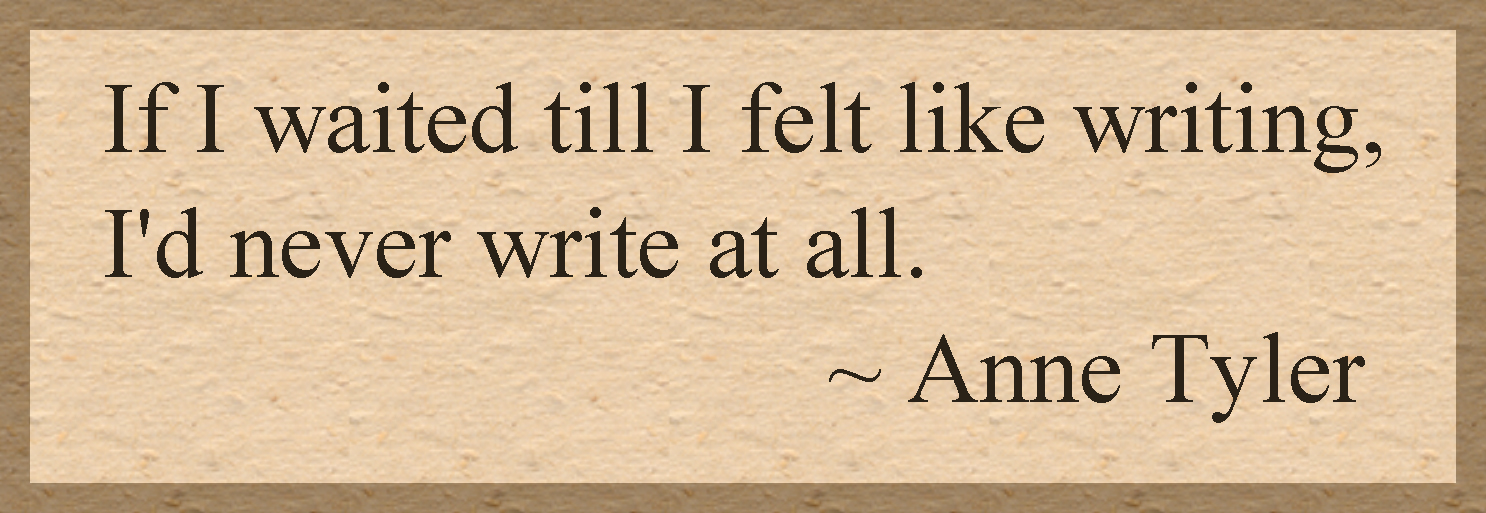
Anne Tyler might just have a point. Take this post, for instance: I’ve been thinking about writing about procrastination for a while. And what’s the best way to do this? Well, to procrastinate, of course. (I find it’s often helpful to write about things that I’ve experienced first-hand.) Granted, I did have other topics to cover first, which I did. Then I even sat down and wrote a few paragraphs. Which I let sit for five days. Then I came back and erased them all.

Sometimes I don’t write because I have other things to do. I am a very structured person, and as such, I cannot allow myself to write a blog post or edit my novel or read for pleasure when I need to pack my son’s lunch or send an important e-mail or wash a load of laundry. But sometimes I don’t write because… well, maybe I’m just wasting time on Facebook. Granted, I don’t do that too often – and I even got rid of all the games on my phone to eliminate those distractions – but there are still plenty of times when I should be writing, but I do things that could easily wait until later instead.

If such a self-disciplined person as me has a hard time staying on task, what hope is there for writers who aren’t nearly as structured to ever start the writing process?

I have a two-part answer, and the first part is that I think it’s a me thing, separate from being self-disciplined.

This isn’t something that’s just happened to me since having kids. It’s something that’s gone on as long as I’ve written. I remember spending afternoons at my parents’ business, pacing through the same four rooms, building scenes in my mind, sometimes even muttering the lines. I would hash over those same scenes ad infinitum. I still do this, although nowadays, I’m not a teenager with a bunch of free time but a mom who squeezes all of her creative thinking into stolen moments in the shower or car or while folding laundry.

The second part of my answer is that thinking is a part of the writing process – or any creative process. Now, the problem is that if you don’t ever move beyond thinking – to the actual doing part – you are not a writer or a painter or an inventor (or whatever) but merely someone who aspires to be one of those things.

Philip Pullman Quote

Thank you for making my point, Mr. Pullman. And my problem is that I don’t always take my ideas to my “desk.”

Sometimes I’ll think over a scene so much that I just assume I’ve written it. And then, as often happens, I’ll move onto something else. Months or even years later, I may look for that scene, only to discover that it was only ever in my head. Other times, I do sit down to write, but the words that were perfected in my mind have all but evaporated. Or they just don’t ring true anymore. Something has changed between the initial thinking and the writing.

Madeleine L'Engle Quote II

Well said, Ms. L’Engle – and the same thing can apply to blogs. But I don’t think it’s a totally bad thing. I think internalizing a scene or some dialogue or just an idea is all a part of the writing process. As long as I do eventually sit down and write (like I’m doing right now), it adds up to the creative whole.

Earlier this week, I discovered an incongruity in my novel. A scene hinged on my protagonist having an opinion based on a conversation she overheard. Unfortunately, I realized this conversation happened when she was three or four and would have been way over her head at the time (if she’d even been paying attention). I had to re-work the scene, keeping the content but changing how it happened. I couldn’t move on until I’d fixed the scene, and I had to think it through first. For several days.

I’ll admit, I was a little intimidated by it. When you realize that you’ve created a problem that you have to write your way out of, sometimes the easy way out is just to give up – set the manuscript aside. And I’ve done that before, but I can’t with this one because I’m shopping literary agents. I had to tackle that scene, and after letting it simmer and then reading a few scenes around it, I figured out a solution.

Madeleine L'Engle Quote

Yet again, I feel like Madeleine L’Engle is talking to me. I am that woman with children and another job – a woman who wants to write, who needs to. After all, I can only procrastinate so long before the creative dam breaks. I have legitimate distractions, but I also have stories to tell. So I will continue to fight myself but understand that sometimes it’s okay to just think – as long as I do carve out that time to take my ideas to my desk-slash-laptop.

Speaking of which, I think it’s about time to wrap this up so I can get back to it.

Overcoming Dyslexia: 10 Things You Should Know

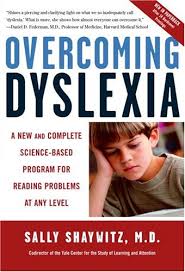
Overcoming Dyslexia by Sally Shaywitz, M.D.

Overcoming Dyslexia by Sally Shaywitz, M.D.

Right around two years ago, I realized there was a serious disconnect with my then-five-year-old son Peter. He was at the end of his second year of preschool, but this intelligent child could not learn his letters or their sounds. Today, I know that he has moderate dyslexia, and it’s been quite a journey. For my sweet boy, it’s a journey that he will continue to take for the rest of his life.

The teacher who tested Peter and helped formulate the blueprint of what the next few years will bring for him lent me her copy of Overcoming Dyslexia by Sally Shaywitz, M.D. I recommend this book to all parents and teachers. Even after I knew that Peter had dyslexia, I still didn’t fully understand what it is – certainly more than mixing up letters, which is a common misconception.

There’s no way I can boil down every point, so I’ve chosen the ten that I found most important:

  1. Dyslexia Affects More People than You Think

In a 20-year study that followed 445 children from Connecticut, Shaywitz discovered “that reading disability affects approximately one child in five” (30). Some of the personal accounts that Shaywitz shares in her book are of bright kids who were left behind because they didn’t “qualify” as students who needed help reading. One was even unfortunate enough to attend a school in which the administration didn’t believe in dyslexia. There are many more children who can benefit from reading resources than are currently receiving help. If you think you don’t know anyone with dyslexia – think again. Especially if you’re a teacher, you likely have a child who desperately needs help right in your classroom.

  1. There’s a Reason Some Smart People Can’t Read

In her chapter entitled “Why Some Smart People Can’t Read,” Shaywitz introduces the Phonologic Model. In subsequent chapters, she breaks down why this model doesn’t work for dyslexics. They have what she repeatedly refers to as a “sea of strengths” – lots of pros surrounding one big con, the inability to decode phonemes (the smallest unit of speech). While good readers can quickly decode phonemes to make the sounds k, aaaa, and t become cat, dyslexics’ brains are not wired to do this efficiently. The frustrating part is that phonology is the lowest level of the language system, followed by semantics, syntax, and discourse. While semantics, syntax, and discourse are all intact in a dyslexic person’s brain, these higher-level abilities are trapped behind the wall of un-decodable phonemes because…

  1. Dyslexics’ Brains Are Wired Differently

There are now scientific tests that show just how a dyslexic’s person’s brain is wired. Starting in the chapter “Reading the Brain,” Shaywitz goes into great detail about how our brains decode words. A dyslexic person’s brain uses a different path – one that is not automatic and therefore much slower. The functional MRI (fMRI) is the test that shows exactly how dyslexic versus non-dyslexic people read. These tests aren’t necessary to diagnose dyslexia, but they prove that dyslexics aren’t missing a part of their brain, and they’re not brain damaged; they simply read in a different way than “good” readers.

  1. Training Kids Before School Age Helps

Unfortunately, dyslexia often goes undetected in children until they reach the third grade. At this point, they are very far behind because they are still struggling to sound out words, while their peers are transitioning from learning to read to reading to learn.

One way that we can save these kids so many years of frustration is by catching it sooner. Kids enrolled in preschool are ahead of the game (which is how we were able to catch Peter’s dyslexia so early), but even if you keep your children at home, helping them differentiate beginning, middle, and ending sounds of simple words (pig and pan, hen and pet, and hen and pin are the examples Shaywitz uses) will not only help them when they learn to read, but it will also help to identify if there is a problem.

With Peter, while I could say a word like “bird” to his four- and five-year-old classmates, and they would hear b, rrr, and d, he might only be able to pick out the beginning or the ending sound – forget the middle. Peter’s dyslexia wouldn’t let him distinguish the different sounds.

  1. The Severity of Dyslexia Differs from Person to Person

While “one-quarter [to] one-half of the children born to a dyslexic parent will also be dyslexic,” the way in which dyslexia manifests itself differs from person to person (99). Shaywitz writes that “the ultimate expression of dyslexia depends on an interaction between a child’s genetic endowment and his environment.” So if your child is dyslexic, don’t throw your hands in the air and give up. Continue to read aloud to him at home; expose her to as much language as you can. This particularly helps dyslexic children develop larger vocabularies because they will not read and pick up new words as quickly as their classmates who can read fluently.

  1. Dyslexics Have High IQs

High IQ’s and difficulty in reading just don’t seem to correlate, but that’s exactly what happens with a dyslexic person. In fact, dyslexic people are often amazing problem solvers; their dyslexia forces them to be creative in order to read, and they carry this skill into other areas of life.

Dyslexia should never discourage someone from pursuing his or her dream. The last chapter of Overcoming Dyslexia is devoted to the personal accounts of highly successful people, such as author John Irving, American businessman and finance expert Charles Schwab, former West Virginia governor Gaston Caperton, and a number of others. These men and women struggled in school and failed entrance exams that could have kept them from getting higher education – yet they persevered and proved that a reading problem would not force them to give up on their dreams.

  1. Retention Does Not Help Dyslexic Children

While retention is sometimes helpful for other reasons, dyslexia should not be one of them. Not only does holding a child back a year in school avoid the problem (which is decoding words), but it can also be a psychological and emotional hindrance.

Ignoring the problem is just as bad. Waiting a month or a year to see if the problem straightens itself out only robs your child of much-needed help. When I first thought that Peter might have a problem, I hoped that a little tutoring over the summer would solve it. But that tutoring didn’t address his specific issue, and the frustration we both faced the first few weeks of his kindergarten year were enough to make me wish I’d had him tested sooner.

  1. Common Indicators of Dyslexia
  • Delay in Speech While children typically start saying words by one year and phrases by 18 to 24 months, a delay could indicate dyslexia.
  • Trouble with Pronunciation This can manifest itself as baby talk, the right syllables pronounced in the wrong order, or whole syllables (such as the beginning of words) not being pronounced at all.
  • Inability to Rhyme Because they have a hard time separating phonemes, dyslexics may not be able to ascertain what rhymes and what doesn’t because they are not able to distinguish what the last sound of a word is.
  • Talking Around a Word If your child is a regular Mrs. Malaprop, that’s another indicator. Two examples that Shaywitz uses are lotion used in place of ocean and tornado used in place of volcano. The children who made these mistakes knew exactly what they were trying to say, but they simply could not recall the proper word. (This can be very embarrassing in dyslexic adults when speaking publicly.)
  • Difficulty in Learning the Alphabet They may be able to sing their ABC’s, but when shown the actual symbols that match the sounds, dyslexics may not be able to identify them.
  • Inability to Learn by Rote While dyslexics generally have strong math skills, when it comes to rote memorization of times tables, they may suddenly have trouble. The same goes for memorizing words that don’t follow the rules, people’s names, place names, and even phone numbers. I wondered, since dyslexia is a phoneme problem, why dyslexic people often dial the wrong phone number – especially since they’re often so good at math. It’s not because they can’t see the difference between the numbers but because those seven numbers seem random. There was no logical way to arrive at them (as in the answer to a math problem).
  • Inability to Focus While Reading Especially in a noisy classroom or study hall, a dyslexic person may not be able to complete a homework task because she needs quiet to be able to concentrate. Dyslexics use a lot more brain power to get the job done, so it’s harder for them to focus.
  • Discomfort When Reading Aloud Some kids will act out or fake being sick when asked to read aloud because it’s so uncomfortable for them. They may even be misjudged as ADHD by a parent or teacher, but the problem here isn’t inattention but discomfort. Be sensitive to dyslexic people when they ask not to read aloud.
  • Misspelling Even if a dyslexic person is able to read difficult words, do not expect him to spell those same words from memory. In the same manner, if shown a new word out of context, he may not be able to read it, even if it seems simple to a non-dyslexic person.
  • Terrible Handwriting This is another tell-tale characteristic of many dyslexics. The word processor is the dyslexic person’s best friend.

A dyslexic person may exhibit only a few of the above – or may have other indicators not mentioned. But if your child or someone you know shows a number of these, it would be prudent to have him or her tested for dyslexia.

  1. Common Strengths of Dyslexic People

In addition to the individual “sea of strengths” that dyslexic people have, there are common strengths that most dyslexic people share. Many dyslexic children fly under the radar because they are extraordinary auditory learners. They can hear a passage read aloud and memorize it, therefore making their teachers believe they’re reading. They are also usually skilled at math, and they are very creative. (Now, don’t worry if your child doesn’t fit this model 100%. Peter is a poor auditory learner, but kinesthetically, he’s off the charts. And I know some dyslexics who also aren’t skilled at math.)

What marks dyslexics as different than other poor readers is their reading comprehension skills, which are intact. Let them hear a book (instead of making them struggle with decoding all those words), and then open a discussion with them, and you will find that they understand the text just as well (or better) than a fluent reader. When dyslexics are not hindered by people who misjudge them, they are able to prove themselves just as capable as fluent readers, and many successful dyslexics wouldn’t have it any other way because they can easily think outside the box, unlike colleagues who never had to struggle to read.

  1. How to Help Dyslexic People in School and Beyond

The Orton-Gillingham approach of scientifically-based instruction is what Shaywitz recommends for dyslexic children. Although she lists many different ways in which parents can help their dyslexic children at home, having one-on-one instruction with a tutor who is trained in this systematic and structured method is what really helps. (Peter’s tutor uses Barton, which utilizes Orton-Gillingham and has been very beneficial to him.)

There’s also good news for dyslexic adults who have gone undiagnosed: there are programs for adult literacy, and although they do require a commitment of time, they produce dividends that improve quality of life. Many undiagnosed adults either flunked or dropped out of school and, thus, have few options for employment because of their inability to read. It’s not that they’re unintelligent, just that they were never given the proper instruction for the way that their brains are wired.

Recording for the Blind and Dyslexic (RFB&D) of Princeton, New Jersey provides audio copies of books, so dyslexics can listen to their material and follow along with the hard copy. Requesting more time and a quiet room for multiple choice exams is also a must, although oral or essay tests are preferable. (As Shaywitz and so many others have pointed out, these multiple choice tests really only prove how proficient people are at test-taking.) Shaywitz lists a number of computer programs that help dyslexics, as well as study tips. In a world that is not very friendly to dyslexics, there are still ways in which they can excel.

In Conclusion

There are so many more points that I wish I could list, but this post is already very long. Please, if any of this rings true for your child or someone you know, get the book! It’s scientifically-based, and one of the many case studies included may remind you of someone you know. I know the first one I read almost made me cry because it sounded so much like my son and reminded me of his early struggles.

The great news is that there is help. As I said, Peter is being tutored in an Orton-Gillingham program, Barton. After not quite five months, his reading has improved more than my husband and I ever thought possible. Over the summer, I saw that one of his friends was reading at a level two, and Peter struggled to get through “My First” books. Now, he can pick up a level two or even books that aren’t leveled readers.

Last week, we took turns reading a Magic Tree House book aloud – Peter was even the one who volunteered to read. About halfway through a chapter, he said, “Chapter books are fun!” I couldn’t agree more, buddy.

What’s in a Title?

http://www.gettyimages.com/detail/88295374

Recently, when speaking with a group of kids about being an author, one of the questions was how to come up with the perfect title. Good lord, I wish I’d been able to give an adequate answer. Instead, I pointed out titles of books I knew they’d read, like John Green’s The Fault in Our Stars. It started the conversation, at least, but it didn’t give them a fool-proof formula. Such a thing doesn’t exist.

I used to keep a list of what I considered brilliant titles. The problem, of course, is that they have nothing to do with anything I’ve ever written. And even tougher than coming up with book titles was deciding what to call all those pesky chapters lurking between the covers. (It never occurred to me until recently that I could just use “Chapter One” or simply “1.”)

It’s not just the little people like me who deal with this. I’m re-reading Christopher Paolini’s Inheritance Cycle, and while the book titles are decent, the chapter titles are inconsistent and often the pits. Yes, this is opinion speaking, but whenever I read some of them, I think, This guy was trying way too hard. Other times it seems like he just gave up. The first couple times I read these books, I didn’t give the chapter titles much thought, but this time around, I’m in a pickier mood. (Recently, I heard of a scholar who criticized the Bible for using subtitles for the various sections. It gives away what’s about to happen, she says. While I discounted her argument at the start, it’s niggled me enough to make me write this post.)

Unless you’re writing cookbooks or some other form of non-fiction, in which you need chapter titles and subtitles for quick reference’s sake, why bother with fiction? At first I thought it might just be a young adult thing, but then I remembered an adult series, Diana Gabaldon’s Outlander, which uses chapter titles throughout. While these are great books, the chapter titles leave a lot to be desired. Sometimes they’re melodramatic (“I Shall Go Down to the Sea”), and sometimes they kind of act as mini spoilers (“In Which Jamie Smells a Rat”). Other chapter titles read like throw-away lines that simply reminded the author what she was writing about in this particular chunk.

What I find most helpful are chapter titles that place the reader. For instance, in Rick Riordan’s The Heroes of Olympus series (great books, by the way), the chapter titles are simply characters’ names. Although narrated completely in third person, this tells the reader whose perspective is represented in each chapter. (The only problem I see with this is when you accidentally open to the last chapter and see that it’s narrated by a character that the author wants you to believe is dead. Whoops.)

Both Stephenie Meyer and Veronica Roth used this character-name approach in books later in their series (Twilight and Divergent, respectively). This is especially helpful, considering these books are both narrated first person. Paolini tries it once in Eldest. It’s the first time he switches to a perspective other than Eragon’s. Instead, it’s his cousin Roran, and the oh-so-imaginative title of Roran’s first chapter? Right, it’s “Roran.” Which I would be fine with if other chapters weren’t titled “Requiem” or “The Beginning of Wisdom.” Like I said, sometimes he tried too hard, and others, he didn’t try hard enough.

I know, for someone who admittedly can’t write a good title unless she just lucks into it, why am I complaining? I guess I’m really not. I’m just wondering aloud (or in print). Chapter titles are convenient if you have a table of contents. And there are some brilliant ones out there. “The Boy Who Lived” comes to mind. (Please tell me you understand that reference – but just in case you don’t, it’s from Harry Potter and the Philosopher’s Stone. What a great chapter title to pull you right into an amazing series.) So I guess they can’t all be bad. I’d just like some consistency, please.

Until reading Outlander and re-reading Eragon, I never gave chapter titles much thought. Some books have them, and others don’t. But now that I’ve started thinking about them so much, I know I’m going to scrutinize everything I read. Do I make predictions when there are titles, or do I forget the titles as soon as I finish reading them? Out of curiosity, I’ve picked a few books, different genres, different time periods, a diverse range of authors, and here’s what I’ve found:

Books with Chapter Titles:

Books with Only Numbered Chapters:

Books with Part Titles but No Chapter Titles:

There are other books that defy these kinds of categorizations, such as John Green’s Looking for Alaska and Daniel Woodrell’s Winter’s Bone. To see their unique chapter distinctions, I guess you’ll just have to check them out.

After looking back at all these books, some of which I’ve enjoyed multiple times, I realize that the chapter titles (or not) aren’t what I usually take away. Only when they get in the way are they problematic, such as with Outlander and Eragon. Yet with The Heroes of Olympus and Harry Potter, they actually helped orient me in the fictional worlds I was visiting – and sometimes even encouraged me to keep turning the pages. (She’s finally going to tell us about horcruxes! Oh wait, she isn’t. Darn, I guess I’ll just have to read another chapter…)

There isn’t a right or wrong way – or even one type of book that must follow one particular format. If I could, this is what I’d tell that middle school girl who asked me about titles: write what feels natural. If coming up with a creative name for each chapter feels contrived, don’t do it. But if titles are your thing, give them a try. At the end of the day, writing your story is the most important thing; fiction titles really should be secondary.

It seems that authors pick what they deem right for whichever books they’re writing at the time. After going over all the different types of chapter designations on my shelves, it’s obvious that I can’t just throw out one or another; there are some pretty awesome books that I don’t want to miss out on just because their chapter titles might put an idea in my head about some possible outcome.

Besides, you never know when an author is trying to trick you. Sometimes they can be pretty sneaky.

Spring “Cleaning”

Inheritance Cycle

Inheritance Cycle (Photo credit: Wikipedia)

I really wish I could tell you that I spent a good chunk of spring break getting rid of toys and clothes and giving my house the overhaul that it needs. Sadly, while I did the usual laundry and daily upkeep, I didn’t spend a lot of much-needed time cleaning.

My hope for our spring break, after returning from a few days at Disney World, was to catch up on my freelance projects and recreational reading. Any cleaning that happened in addition to that was gravy.

But would you believe it? My kids actually expected to do fun stuff for spring break. I know – can you believe the nerve? Really, they were little troupers. I had a lot of not-fun-for-kids stuff packed into those five weekdays. Now, they did get to stay up later than usual and watch movies and play outside, but there was still tutoring and the dentist and grocery shopping. I finally took them to the park last Friday, where they could just be kids.

It didn’t leave a whole lot of time for all that catching up I’d planned to do. I should have known better, but when spring break is on the horizon, it looks so sweet, has so much promise.

I did make some good progress on my biggest book project (and absolutely zero on another). I edited a bunch of my novel and only had a little left when school went back into session. In all honesty, I was happy to get any of that done.

But what I didn’t do much of was read for fun. Granted, I’m reading Eldest (sequel to Eragon). Not only is it close to 700 pages, but they’re a very cumbersome almost-700 pages. There’s a reason these books are on my book list for the third year in a row – and there’s also a reason I’m tackling them early.

For the first couple months of the year, I stuck to my 2015 book list, but to get more titles under my belt and break up the pace a little, I decided to read shorter books in between the Inheritance Cycle books. Aaaaand… well, I may have fallen off my book list wagon and bought a new book.

It was a shorty, I promise, and it was a really good one – a new-to-me author with a unique style that I admire, even if I can’t emulate it. (It was Daniel Woodrell’s Winter’s Bone, in case you’re wondering.) The only problem was that I made a sort-of promise to myself that I wouldn’t buy any new books until I read through all the other new books that I already own, and this was a new book.

But after that little detour, I’m back on track again. Except…

One of the other things the kids and I did on spring break was to stop by my favorite local bookstore, and because the owner knows what a sucker I am for books, she reminded me that their 40% off spring cleaning sale was coming up.

You should be proud of me. I only bought four, two of them chosen by my elder son. But I have to say it makes me happy to know that there are more books for next year’s list if I don’t get to them this year.

New Books!

New Books!

Plus, I also have to say that sometimes you get a nice surprise where you don’t expect it. That book on the top left – The Fantastic Flying Books of Mr. Morris Lessmore – is amazing. I highly recommend it if you love books; you don’t even have to have kids to appreciate it. I likely would not have bought it on my own, but Peter was excited to see it because he’d heard it before in his school’s library. I’ll have to say I’m pretty proud of my little bibliophile.

Despite not checking one thing off on my to-do list, I’m pretty happy with my spring break. It’s the little things.

A Potty Training Miracle

The Potty Training Years 1988–1992

The Potty Training Years (Photo credit: Wikipedia)

Considering that my children couldn’t be much more different, I shouldn’t have been surprised that potty training the second one would be absolutely nothing like the first. Yet I had this idea that I’d done it before and knew what to expect.

We learned our lesson with Peter (child #1), starting too soon, and had to put potty training on hold for six months. Then it was a month of on-and-off frustration before he got it. What really helped were the incentives. We promised him that he could move out of his crib and into his big boy bed once he potty trained. But the biggest motivator was that we would use the money we saved on diapers toward a trip to Disney World.

Disney? No, problem. Peter was potty trained like that (imagine me snapping my fingers). And ever since, he’s only had one daytime accident. Ever.

With Ian (child #2), I didn’t even pull the potty chair out until he was two-and-a-half. Why cause myself more angst than necessary? I had no idea what was coming. One Saturday last June, I decided to dedicate my day to potty training, giving Ian juice and treats and sitting him on the potty until he got it, Peter-style.

Nothing happened. On the potty, that is. As soon as I put underwear on him, Ian had an accident. I was on the third or fourth pair of underwear when my husband got involved. Miracle of miracles! Ian sat on the potty, and when Thomas told him to go, Ian went.

About a minute later, he had an accident in another pair of clean underwear.

That was when we discovered that Ian knew exactly what was going on, and he simply didn’t care.

We tried everything. For nine months we tried, and we took advice from any- and everyone, and we would take two steps forward and giant leaps back. We offered him candy for keeping his pants clean and dry, but usually he just didn’t care. Other times, he would ask for candy after having an accident. There was no problem at all getting him to use the potty, but we couldn’t get him to quit wetting his pants, too. People advised us to just put him in underwear, and he would learn his lesson when he had an accident. I can’t tell you how many times we tried this and failed.

Our solution was Pull-Ups, which many people say is a potty training no-no, but he didn’t need diapers, and I didn’t want to have to wash every pair of his underwear five to six times a week. We bought Pull-Ups for eight months. I hope and pray that I’m finally on my last box.

His pediatrician assured me that we were on the right track with incentives, but I tried to explain that Ian and incentives aren’t the best of friends. The candy was hit or miss. Sometimes he got excited about moving to his bed. But when it came to visiting Mickey Mouse (whom Ian adores), he would flat out say that he didn’t want to go. Still, I persevered. I was determined to reward him with a trip to Disney before he turned three (mainly so his admission would be free).

Naturally, there was little improvement until a couple weeks after his third birthday, when Ian finally seemed to turn the corner. Although still in Pull-Ups, he would sometimes tell us when he had to go, and he even woke up dry some mornings. He even seemed willing to undress and take himself to the potty (but only if we asked him to).

I finally decided we were going to Disney World over spring break, and if Ian still wasn’t potty trained, I would just tell him we were proud of his progress.

Then last Tuesday (three days before our trip), I decided that if Ian was going to be rewarded for supposedly being potty trained, I was going to go ahead and put him in underwear. If he messed up his clothes or his car seat, oh well. Maybe if he had an accident and had to sit in it, he would learn his lesson.

So that’s exactly what I did.

There were accidents – none in the car, thank goodness. It was the panicked, “I gotta go potty, Mommy!” about two seconds too late. But at least he finally cared.

For our first day at Disney World, we decided – even though we hadn’t chanced it with Peter – that we would put Ian in underwear. We were armed with multiple changes of clothes, and I even lost sleep over it, but he was fine.

Disney fireworks

Disney fireworks – appropriate for how I felt after Ian’s success

I figured a good thing couldn’t last two days in a row, but it did. In fact, all three days that we were in the parks, Ian was 100% accident free. Every time I took him to the bathroom, I praised him, wondering if he would make it another hour. Was it giving him the reward that he hadn’t fully earned that made him finally earn it? Who knows, but I’ll have to say that it worked – and it’s still working (at least as far as #1 is concerned). He even wakes up dry from naps and overnight. I’m not going to hold out hope for only one accident ever, like his big brother, but so far so good. (#2 is still a work in progress, but for the first time in nine months, I think he’ll actually make it.)

After all this success, I’ve been beating myself up about it. If I had decided to put Ian in underwear and live through the accidents back in November or December, would we have had similar results? Would he have gotten one last free trip to Disney? Or would I have pulled my hair out even more and caused myself more frustration than was necessary? My husband thinks that, even though Ian didn’t care about Disney World until we actually go there, he had so much fun that he didn’t want to deal with the hassle of multiple wardrobe changes. I guess it will always be a mystery, but I’m glad it finally happened.

For all frustrated parents out there, please know that if someone promises there’s one proven way to potty train every single child, it’s a lie. Every child is different and will take a different method. I would love to hear other potty training stories (the good, the bad, the ugly) and encourage you to keep trying. As people have often assured me, there isn’t a kid yet who’s gone to college still in diapers. I thought we were getting close, but it seems that Ian will make it to preschool next year, after all.

Next on the agenda… how to get him to eat healthy food.

How Do You Know What to Cut?


http://www.gettyimages.com/detail/138307331

Last year I asked a number of beta readers to read my 120,000-word NaNoWriMo 2013 novel. After receiving an excellent critique from one of these beta readers, I shared with him how annoyed I was that I was somehow supposed to cut my word count in half. “What would you cut?” he asked. He understood that the novel had issues that needed to be fixed, but he didn’t think length was one of them. He couldn’t fathom how I could drastically cut yet keep the same story.

But I’ve done it. (Well, I haven’t cut it in half, but I’ve cut over 40,000 words.) When he recently offered to read the edited version of my novel, the question changed to, “How do you know what to cut?” My friend is simply curious and fascinated about the writing process, but many writers want to know the same thing. Lost, they wonder if they can cut and still keep the integrity of their stories.

It comes down to more than just correcting typos. Typos I can fix all day, and in fact, I was the queen of clean copies back before I took my first fiction workshop. Clean copies that weren’t all that great to read, as it turns out.

After my first story was critiqued, I discovered that I wasn’t the prodigy I’d always imagined myself to be. I assumed, at first, that people just didn’t get what I was trying to say. It was their problem. It was humbling to realize that they didn’t get me because my stories were a mess.

The credit goes to Ari, who led those fiction workshops. Much of how I write and edit today goes all the way back to those seven semester-long workshops that I took from 2002 to 2005.

Reading others’ stories and discussing them brought to light so many issues that are common among many writers, not to mention learning a lot of tough lessons when my own stories were critiqued. Ari has all kinds of pet peeves, and to this day, I don’t think I’ve written a sentence that starts, “As he went to the fridge” or “As she tied her shoes.” That particular type of sentence drove Ari nuts, and I guess it’s because it shows up so often. The point isn’t to avoid that one kind of sentence but to be intentional. Don’t fall into the trap of using the same sentence structure over and over again. You’ll find yourself on the slippery slope to lazy, sloppy writing.

Showing instead of telling was another biggie. (You can read more about that here.) I used to be the type of writer who had to describe the layout of every room and the outfit of every character. Was this necessary? Nope. That’s not to say that all descriptions are bad, but what you write must add to the story.

For instance, Harry Potter’s lightning scar, green eyes, and trademark glasses form a quick mental picture, and the scar and eyes have their own stories. But is it important to know what brand of jeans or what color shirt he wears? Do we need to know every single item he keeps on top of his dresser? Only the ones that may come up later. Why? Chekov explains it so well: “If you say in the first chapter that there is a rifle hanging on the wall, in the second or third chapter it absolutely must go off. If it’s not going to be fired it shouldn’t be hanging there.”

Eragon and its sequels are popular young adult novels that run to excess when it comes to descriptions and scenes that don’t move the story forward. Each book could easily be cut by tens of thousands of words. Some descriptions are helpful. We’re dealing with a fantasy world, after all. But too much bogs down the text, gives it a plodding pace. I enjoy these books, but I know I have to invest a lot of time when I want to read them. Not because they’re thick books but because there’s a lot of unneeded padding packed into those pages.

You may have heard the phrase, “Kill your darlings” (attributed to just about every well-known writer, and it’s because they all know it’s true). Does this mean that I need to cut every word, every line, every scene that I’m proud of? Well, not quite. But what it does mean is that writers often get attached to bits of prose that ought not be included in the manuscripts where they currently reside.

Ugh. But I worked so hard on that scene. The words flow beautifully. If there’s one thing I won’t cut, it’s that line…

I’ve been there and cut that. My trick to save myself from writer’s remorse is to save all major revisions as separate documents. Then I don’t feel quite as bad about nixing a line or scene when I know I can go back and paste it in again. Which I’ve done.

It takes a certain willingness to cut any- and everything that is not essential to the story. It takes a thick skin when you realize what you cut the first time wasn’t enough (even if it was a lot), and you have to go back and perform major surgery again. It also takes a certain editorial know-how, which may mean that you’ll either have to hire an editor or babysit your favorite reader’s kids for the next five years. Even if you’re a proficient editor, I highly recommend beta readers. (Just be ready to read their stories, too. It’s only fair.)

As Stephen King recommends in On Writing: A Memoir of the Craft, temporal distance also helps. Take a month off; then come back to a manuscript with fresh eyes. You’ll be surprised at the number of throw away scenes that seemed brilliant at the time but are really just filler – and conversely, the number of excellent scenes you’re surprised you actually wrote. (And while we’re talking about On Writing, which I highly recommend you get, King also gives an excellent example of a block of text before, during, and after editing, so you can see the actual process.)

You may notice, after coming back to your story after a break, that you don’t like your opening chapter. You don’t even need that first scene, in the grand scheme of things. Or maybe it belongs much later. Be open to not just cutting words out of sentences, but restructuring completely. We’re not just talking a face lift or a nose job. We’re talking vivisection. It’s going to be messy, and it’s not going to look like the story you started with, but as I reassure everyone who’s read my beta novel and liked it, I haven’t changed the content, unless I improved it.

Last, please read your text aloud. I know it’s difficult if you have a full house and little privacy, but you really need to do this. You will be surprised how good something sounds in your head but how terrible it sounds when spoken. You’ll notice where you start to bore yourself. Or if you read aloud to another person, you’ll see where you lose your audience.

In all of these ways, you can transform a story, for instance, that opens with a girl thinking about how scared she is and how much she misses her old life (and why) to a story that puts the thing she fears on her doorstep and makes her take action.

How’s Your Writing Going?


Embed from Getty Images

When I was 25, I met a friend for coffee on one of her infrequent visits home. After being inseparable as kids, we eventually drifted into our different lives. Hers seemed glamorous to me: she’s a debutante who attended an Ivy League school, then traveled abroad to pursue other degrees. She drives the most expensive sports cars and vacations all over the world. When she called and told me she was in town, I couldn’t turn down the chance to catch up with her.

I knew we wouldn’t be able to meet long because my 11-month-old son would be up from his nap soon. I was so happy to see her – and impressed with myself for losing all my baby weight and then some – that I never thought how plain I would look in my jeans and t-shirt next to her designer outfit. I never thought she’d care to know what I’d been up to. What was there to say? I’m a mom. After catching her up on baby news (which doesn’t take long when you’re talking to someone who doesn’t have kids), she asked about my writing.

Writing? What writing? Oh, wait, you mean how I thought getting a degree in English would set me on the path to bestseller-dom? While I kept up with my daily journal, my fiction had gone the way of the dinosaur. I wouldn’t call it a slump. It was just that I was busy and happy not writing. After I missed the “published author” mile marker on the highway of my life, I moved on to “starting a family” and didn’t look back. Yes, I still wrote, but it wasn’t the kind of writing that kept me up at night.

And that was so not how I had envisioned my life – to be unpublished and happy. By the time I was 13, I knew that I wanted to make a living writing novels. I had no inclination to get a regular job and write after hours. I wanted to provide for my family through my books. And I was naive enough to think that I could go to college and get an English degree, and somehow, I would be in that perfect position to fulfill my dream.

Here’s what I often imagined: a home office overlooking a fenced-in backyard, where my future, well-adjusted children would run around and play, allowing me to work in peace. And then we would go out for ice cream and a movie, and we would take vacations whenever we wanted, and if my husband decided to get a job, it would just be because he wanted to, not because we were dependent on his salary.

Obviously, I had no idea what being a parent or an adult is really like, much less how the publishing world works.

But by 25, I was well aware of the perils of the publishing world. I’d already received rejections from literary agents. I’d even gone through a period when I thought maybe I couldn’t write. Maybe I would just be an editor, but I got over that when I realized that I simply hadn’t found my voice yet. After I did, I found joy in writing again. But I still had nothing to show for it, other than the title of “Editor-in-Chief” for a fledgling literary journal.

My entire writing “career” has been full of these ups and downs. I do actually make money as a writer, but it’s certainly not enough to buy us the house with the big yard and to keep my husband from having to work. It’s my lack of steady employment that makes him have to work so hard to pick up my slack. Part of me wishes that I’d gone to work for a newspaper or local magazine or even a small publisher. I would be able to carry more of the financial load, although that’s not at all the kind of writing that feeds my soul.

Yet despite being married to a starving artist, my husband believes in me. That doesn’t mean he thinks I’ll make millions, but he’s always my first reader, and even though he protests that he never knows what to say, I can always trust him for an honest opinion. The book that I’m shopping around right now is the best thing I’ve ever written, but just because it’s the best thing I’ve produced to this point doesn’t mean it’s perfect – or anywhere close to the best thing out there.

Amidst editing and querying and doing a whole lot of work that could amount to a lot of nothing, I finally asked him if I should even bother. I’d been gearing myself up to ask for several days. He loves me, but he’s not afraid to give me the painful truth. He told me it’s a good story, and he wants me to get recognition for it (although that in no way guarantees anything about getting it published).

Then he asked me if I would quit writing, even if it wasn’t any good.

While I would certainly quit wasting both my and the literary agents’ time by querying, I would never quit writing because it’s my outlet.

I still have that dream of making a living as a novelist. I still want to have a positive answer when I meet with a friend for coffee. If she were to ask me this week how my writing is going, my answer is that it’s great. I’m editing a story I love and that I know has potential. It still needs work, but maybe someday…

Here’s a quote from Sylvia Plath that I found earlier this week:

And by the way, everything in life is writable about if you have the outgoing guts to do it, and the imagination to improvise. The worst enemy to creativity is self-doubt.

I have the guts and the imagination, but I also have self-doubt. It’s what made me ask my husband if all this was worth the effort. It’s what makes me cringe when someone looks at me expectantly, like, “Well, you wrote a novel, why isn’t it in bookstores yet?” I think self-doubt is healthy because it makes us look honestly at ourselves. It’s only harmful when it turns into a loss of confidence; then it’s apparent in your writing and your outlook and can turn into a self-fulfilling prophecy. What self-doubt should do is help us re-evaluate our goals and adjust them to be realistic.

I think the enemy of creativity is really regret. Getting to a certain point and wishing you hadn’t done what you’d done. While I sometimes wish I’d done something to augment my position, I certainly have never regretted writing. If my stories never see the light of day, at least I was happy creating them.

***

Before you go away thinking that my sweet friend didn’t understand me at all and didn’t care about my life, let me tell you her response to my lack of stellar news. She said, “But you’re a mom.”

She said it with admiration and almost reverence. Yeah, I’m a mom. And quite often a writer mom. Like I said, no regrets.