Mommy’s Summer Break

Flagler Beach

Flagler Beach (Photo credit: Wikipedia)

This summer, I’ve been more aware of the passage of time than ever before. I think part of that is due to updating the calendar with my six-year-old every day. It’s something he did in kindergarten and will continue to do in the first grade, and I figured it was an easy way to sneak in a little learning all summer long.

So when we turned to August, and I saw that the first day of school was less than three weeks away, I felt like our summer break had evaporated without me taking much notice. Then Peter asked me how many days were left, and I turned it into a quick math lesson. We counted the days of summer break up to that point, then counted the remaining days until school started, and we added them up for the total number of days.

Eighty-one. From the day after he finished kindergarten to the day before he starts first grade are 81 days. Not even three full months. I have to admit that I feel a little cheated. When I was a kid, we were out at the beginning of June and didn’t go back until the day after Labor Day.

A little past the mid-point of July, we were invited to a play date at the beach. I was talking to another mom, whom I hadn’t seen since early June, and she asked me about our summer. I was at a bit of a loss and had to admit that standing on the beach with her and our children was the first “summery” thing I’d done. Yes, my kids had occasional play dates and day camps or classes, but I hadn’t taken them to do anything that smacked of summer.

Before I had kids, I was rarely asked the “What have you done this summer?” question. After all, if you don’t have kids, you’re not in school yourself, or you’re not a teacher, summer is merely a hotter time of year. And when you live in Florida, it’s hot about eleven-and-a-half months, anyway, so it all kind of runs together.

But this summer, I’ve encountered this question a lot, and I’ve finally resorted to the, “It’s been very busy” answer. If you’re a regular reader, you know that I have completed three big projects since the end of the school year, but for every one of these projects, I’ve picked up at least one more. So my busy-ness has just shifted into other areas.

I’m not complaining. I love freelance writing and the flexibility of being able to go to the store when I need and to be available to take my sons to their various activities. Even being busy isn’t all that bad, except that I’ve had to utilize to-do lists more than ever in my life the last couple months because, otherwise, I might forget to brush my teeth or something.

I will have to say, though, that some things have suffered. Like the house. Because of my husband’s odd work hours, it seems that the only days he’s available to mow the lawn are when it rains. Consequently, our grass grows so thick and so high that we run through lawn mowers like candy. We finally gave in and hired a lawn guy (something I’d been rooting for since last fall), and when he showed up one morning this week and did what would have taken Thomas two days to accomplish, I said that my dreams had come true. Of course, that’s a gross exaggeration. He wasn’t publishing my book, cleaning the house, potty training my toddler, and mowing the lawn, but I’ll take what I can get.
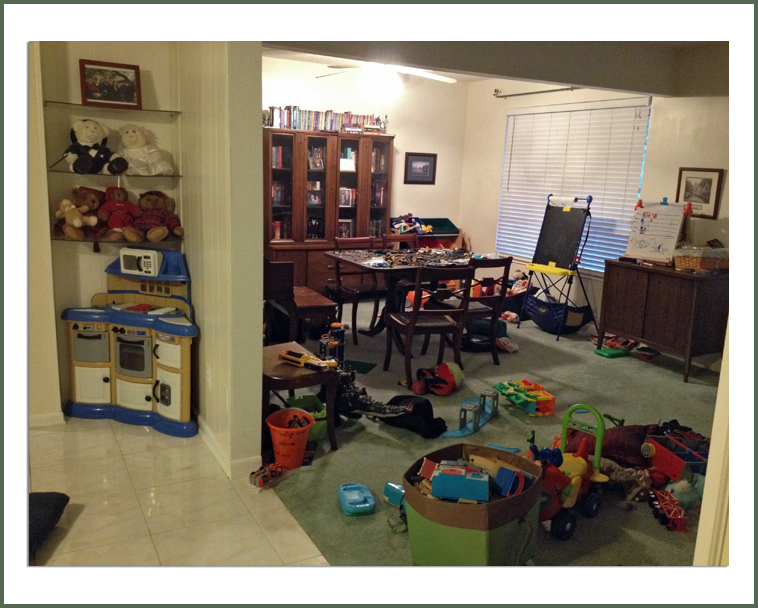
Ick – do we live like this?

Ick – do we live like this?

As for the interior of the house, it’s been the pits since before spring break, which was in March. People say that trying to clean while you have kids is like trying to shovel snow in a blizzard, which is true, but still. I have a nice little shelf with bins that will hold toys, if only the kids will use it. Then my elder son decided he wanted to sleep on the floor over eight months ago, and he’s slept there ever since. (Really – check out the picture.) So his floor is mostly taken up with a sleeping bag, which never gets picked up. Every once in a while, it gets so messed up that I straighten it, only to find a number of toys that we thought had disappeared.
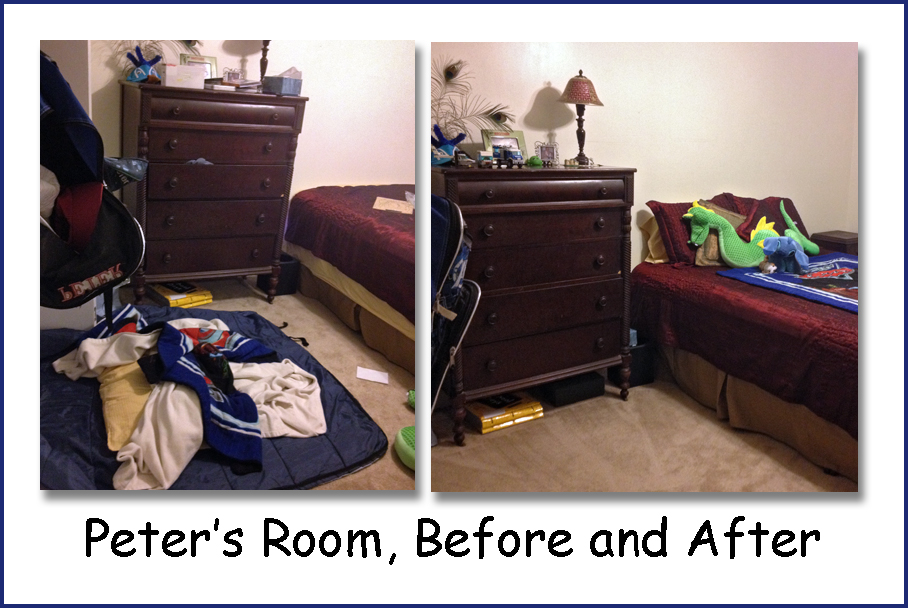
Sleeping bag… and no more sleeping bag :)

Sleeping bag… and no more sleeping bag 🙂

With my summer dwindling – and although I’ve been busy, I have more free time now than I will when I start substitute teaching again – I need to take care of my house before it gets even more out of control. So this weekend is my opportunity. My in-laws are taking the kids for a couple days, and although I swore I would clean the last time they kept the kids, I didn’t. But this time, I’m tackling the mess. I’ll tell you, there’s nothing like being able to vacuum at three in the morning and not bother anyone, except for maybe the cat. (And sleep late because no one’s going to yell, “Mommy!” at six A.M.) It’s also nice to be able to pack away toys that my boys will never miss and donate them to children who will actually play with them instead of leaving them in the middle of the foyer.

So my life has come to this: it makes my day to pay someone to mow the lawn and to get rid of my kids long enough to clean up after them. Am I nuts, or what? My mommy-cation is not glamorous, nothing to write home about (although it does make for a convenient blog topic). And after all, my six-year-old gave Thomas and me his blessing to go out and have ice cream, see a movie, and have a romantic dinner. So, who knows? We may take him up on it… and come home to a house that looks like it belongs to civilized people.
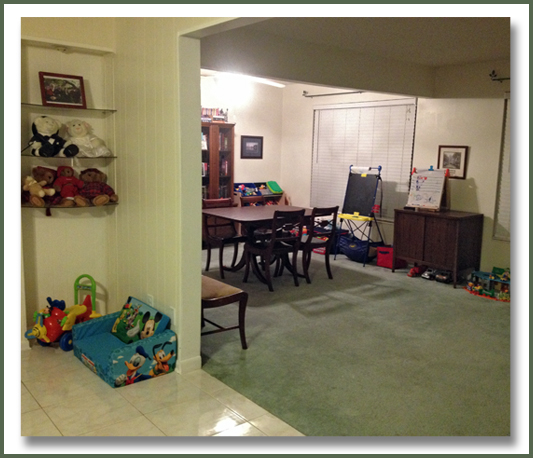
The Happy Ending

The Happy Ending

Dyslexia – A Mere Stumbling Block on the Path to Book Creation

“Peter is still getting his M’s and W’s mixed up.”

This was Peter’s kindergarten teacher four months ago. Peter is six. He should have known all of his letters a year ago. In fact, he did. So why the sudden trouble with these two? I was a bit disappointed when she told me, but I wasn’t surprised.

Peter has dyslexia. On top of that, his working memory does not function at 100%, making it difficult for him to retain everything we do to help him overcome his learning hurdles. It’s better than it was. This time last year, his working memory only functioned at about 20%, and he’s in an intensive program that’s helping, but it’s still a struggle.

So Peter and I practiced with M and W flashcards, and right about the time he got those two letters down, he slid back again and started having trouble with B and D. Peter is aware that he has a hard time reading. He knows his friends read books a couple levels beyond his capabilities. He groans whenever I make him read or do flashcards. Sometimes I’ll give him a night off and just read a book to him. The poor kid. Up until he had to start reading them himself, he had a love-love relationship with books.

I focus on Peter’s strengths. He’s good at math. He’s athletic. He can build anything, loves making inventions, and is very creative. But at the same time, I don’t want him to give up on reading, to think that it’s something a lot of people can do but is unattainable for him.

Then he happened to be watching the Disney Channel when Bella Thorne’s TTI came on. TTI’s (or “The Time I…”) are clips about some of the actors in Disney’s shows. I hadn’t seen Bella Thorne’s TTI since Peter was diagnosed.

Why does Bella Thorne’s particular TTI matter? Well, because she has dyslexia. She started talking about why reading was a challenge, and how she mixed up B and D and M and W. Peter turned to me, eyes alight, and said, “Hey! That’s just like me!”

http://www.youtube.com/watch?v=vhhSLneazQ8

It couldn’t have been more perfect.

I made sure to point out to him that she can read now, even though it’s a challenge.

I know it boggles Peter’s mind that I write. When I pulled my children’s book Hero out of mothballs earlier this year, I decided to involve Peter by using him as a first reader. I read it to him while he sat with me at my computer, looking at a screen with a bunch of symbols that he struggled to make sense of. With no illustrations to guide him, he didn’t connect with the story. I had to read passages twice and ask him questions about them to make them stick.

And then it hit me: Peter can draw. He may struggle to read Hero, but I knew if he helped illustrate it, he’d have some ownership. Even with dyslexia, he could still be a part of the book creation process.

Peter learning cursive

Peter learning cursive

If you’re a regular reader, you know that we did it (and you can read about it here). Peter is half-shy, half-proud when he helps me deliver a book. Even though he’s quick to say that it’s too tough for him to read (yet), he loves that his name is on the cover, that it’s our book. He even asked me to teach him cursive, so he can sign the inside cover.

Starting in the fall, I’m going to talk to elementary school students about writing and illustrating a picture book. I’m excited for them to know that a regular mom can make children’s books, but I’m even more excited to encourage them by telling Peter’s story. Books are for everyone – for bookworms like me, those who struggle like Peter, and everyone in between.

Don’t forget, through July 26th, all of my proceeds from Hero are going to WSB’s Care-a-Thon to benefit the Aflac Cancer and Blood Disorders Center of Children’s Healthcare of Atlanta. Click here for all the details, including where you can buy Hero in Northeast Florida. You can also get yours from Amazon.com, or message me for a signed copy.

Be a Hero by Supporting Children with Cancer

Hero Benefit poster I am very fortunate that my two boys have enjoyed good health so far. When you don’t face health issues, it’s something that’s easy to take for granted. My usual complaints fall into the categories of being too busy, not getting enough sleep, and worrying about finances. But every once in a while, I’m reminded that these “problems” are nothing compared to what many families face.

I’m talking about children who have terminal diseases. Hazel in John Green’s The Fault in Our Stars says it perfectly (and pardon her French): “There is only one thing in this world sh*ttier than biting it from cancer when you’re sixteen, and that’s having a kid who bites it from cancer.”

Harsh? You bet. But how do you think these kids and their parents feel? I can only imagine the grief, the turmoil, and the burden. I’ve seen it with aging adults, including my own grandfather, which was terrible – but for a child to be plucked from the beginning of life, without ever having the chance to blossom, and given a death sentence before life has truly begun? It’s unfair. It’s unthinkable.

It’s reality.

If you haven’t faced this within your own family, it’s likely that you know someone who has. I’ve known children who were diagnosed anywhere from one year old to their teens. I’m not sure which is worse – never being able to remember a time before becoming sick or living a seemingly normal life, only to have the rug pulled from underneath you when you thought adolescence was bad enough by itself. Either way, any time I meet one of these children or parents or siblings, I realize how strong they must be, how much different their lives are than mine, and I yearn for a way to help.

For someone like me, neither a scientist who will someday find a cure nor a medical professional who can treat and care for one of these patients, I feel pretty useless. Then several years ago, I stumbled upon News 95.5 and AM 750 WSB’s Care-a-Thon. It’s an annual event that assists funding family support services and research, as well as the fellowship program at the Aflac Cancer Center.

As I listened on the radio, I heard parents and their children share their amazing and heartbreaking stories – and triumphs. I knew that I couldn’t give much, but I also couldn’t not give. I knew that if everyone listening took a few minutes and gave a few dollars, millions could have been raised. In fact, last year, the WSB Care-a-Thon benefiting the Aflac Cancer and Blood Disorders Center of Children’s Healthcare of Atlanta raised over $1.5 million.

This year, I hope to make my portion even more than usual by giving the proceeds from my children’s book Hero to this worthy cause. From Sunday, July 13 through Saturday, July 26, 2014, I will donate 100% of my net proceeds from every Hero sold – those purchased directly from me, from any location in Northeast Florida that carries it, and from Amazon.com.
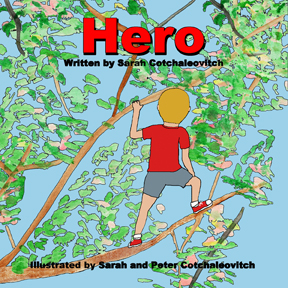
Hero by Sarah Cotchaleovitch

Hero by Sarah Cotchaleovitch

Hero is a children’s book about two regular kids and their pets. The kids who have read it so far seem to enjoy it, and I can’t think of a more appropriate way to share my profits than with other children who deserve a chance at a normal life. So here is how you can participate:

Buy a copy of Hero any time from this coming Sunday, July 13th through the following Saturday, July 26th. If you would like an autographed copy, please message me, and I will ship one to you. If you live in Northeast Florida, Hero is available at the following retail locations:

The FotoTechnika Group in St. Nicholas (my printer and the family business)

Owens Pharmacy in Riverside

Proctor Ace Hardware (all three locations)

Roberts’ South Bank Pharmacy in San Marco

• Sweetwood Books of Fleming Island

Hero is also available from Amazon.com.

If you already have a copy, why not purchase another to donate to Children’s Healthcare of Atlanta? I think the kids there would love it. Or buy one for your favorite niece, nephew, godchild, or friend. The Care-a-Thon itself will air Thursday, July 31 and Friday, August 1, 2014. Click this link to read more about it (including stories about these amazing children), or use this link to donate directly to the Care-a-Thon online.

Cancer will eventually affect everyone either directly or indirectly, but with our help, these children and their families won’t have to go it alone.

Pacing Is Everything: The Parenting Version

Alphabet Soup & Wordsearch

Alphabet Soup & Wordsearch (Photo credit: dmelchordiaz)

I never understood what people meant when they talked about the “terrible twos.” My first child, Peter, has never had that kind of behavior problem. My second one? Well, Ian is a different story. When people ask if he’s a terrible two, I’ll usually come back with, “He has been since birth.”

Peter and Ian couldn’t be any more different. From the womb until the present, Ian has made sure everyone knows he’s his own person.

Still, I couldn’t help but compare my kids. And to aid me, I keep “baby’s first” books, where I record when they cut their teeth and ate solid food and took their first steps. Both of my boys walked and said their first words about the same time, so I made the bad assumption that their development would be pretty similar.

With such opposing personalities, I should have known better. For instance, Ian is a screamer. Granted, he had a rough start with colic and reflux – but so did Peter. Yet Peter got over his colic and was a happy baby. For Ian, however, the screams never stopped. He screams in his sleep, screams when he’s happy, screams when he’s upset, screams when he meets someone new. After witnessing one of these episodes, a woman told me, “That’s because he doesn’t know how to communicate yet. When he learns how to talk, he’ll stop.”

What I wanted to tell her was that I had a whole list of words that he’d said, but as soon as Ian learned a new one, he seemed to forget it. I made an effort to teach him baby sign language (after all, it worked with Peter), but Ian only ever picked up two or three signs. For the longest time, I would talk to him and get a blank look – or he would avoid looking at me altogether.

When Ian was about eighteen months old, we pulled out an old video of eighteen-month-old Peter. The difference was striking. Peter talked in complete sentences, told us his eyes were blue, and re-enacted scenes from his favorite book. We weren’t sure Ian even knew he had eyes, much less their color, and forget trying to read him a book. Thomas and I felt we had failed him at some point.

We knew we had to make an effort. We struggled to hold Ian in one spot to read a book. I took him for walks and pointed out lizards and flowers and told him the colors of things. For the longest time, it didn’t seem like he understood that a yellow house was, in fact, a house that was yellow. He said it like a compound word: “yellow-house.” He was months and months behind Peter.

But slowly, so slowly, he started using more words. Communications improved: I could say, “It’s time to clean up,” and he would clean up. There was one-way understanding, at least, even if he sounded like the Muppets’ Swedish Chef when he talked.

After Peter was diagnosed with several learning disabilities, we expected the same for Ian. In fact, when I researched the cues for reading disabilities (slow speech, late speech, trouble speaking complete and complex sentences), Ian fit them all. If our well-adjusted child had dyslexia and a practically non-existent working memory, what other surprises were in store with the kid who had behavior and communication problems? Instead of trying to force concepts into Ian’s brain (like we did with Peter), we hoped he would absorb things via osmosis, and we crossed our fingers that something would take.

Something did. A couple months ago, Ian started to recognize shapes. And colors, too. Not all of them but enough to show me that he understood that “yellow” and “house” were two separate things. And he started counting things – usually without skipping numbers. Thomas and I admitted that he was actually ahead of Peter on that score. He was learning, just at his own pace.

Then last week, the biggie:

We have letter and number magnets on our fridge. I have to keep them out of Ian’s reach, otherwise they’ll be all over the house. In fact, I’m not sure why I never got rid of them, but now I’m glad I didn’t. Out of the blue, he pointed up and said, “Bumblebee.” I looked all over the fridge for a bumblebee but only saw the magnet letter B. I pulled it down, and that’s exactly what he wanted.

Later that week, Thomas was wearing a shirt that said “FLORIDA,” and Ian started pointing at the letters and naming them. He got them all right. Shocked, we began writing uppercase letters at random. He knew them all, including Q and Z. Well, X did trip him up a little. He called it K. But as soon as I told him the difference, he got it. Peter, who is four years older, still gets M and W and B and D mixed up. I don’t think it will be long before Ian will be able to read the easy reading books that still challenge his dyslexic big brother.

After so much frustration, we’re watching our child blossom. I don’t know what triggered this change, only that I am grateful for it – that this is the turning point I have prayed for since we came home from the hospital with an inconsolable baby.

Not only does Ian know his letters, but he’s talking more than ever. He cracks us up with “Oh my goodnets” and “heeky-boos” (peek-a-boo). He often offers a spontaneous “thank you” when someone gives him something. He’s even able to entertain himself independently, something that he could only do sporadically a couple weeks ago.

I’m sorry I let mothering Ian be a chore for so long. A lot of it was that we were just out of sync. The greater part, however, was that I wasn’t one hundred percent okay with his pace.

I am well aware that there is plenty of room for all of us to grow. He still screams. And he still has to be potty-trained. But I know he’s not Peter, and I’m done wishing that he would be more like his big brother. I am fully aware of how unfair that is to him – and the frustrations it will cause if I expect him to meet someone else’s milestones. I am ready to parent him along the unexplored and exciting Ian Way.

Sugar-Coated Broccoli Just Tastes Like Really Nasty Broccoli

English: Trophy case at Theodore Roosevelt Hig...

Trophy case at Theodore Roosevelt High School in Kent, Ohio. (Photo credit: Wikipedia)

I’ve been toying with the idea of addressing a particular issue for a few months now, but I never quite knew how to approach it. And then this week, almost as if giving me permission, I read Matt Walsh’s blog and figured it was time.

Early in his post, Walsh talks about how we give trophies for everything now, especially mediocrity. I suppose that things have been going that way since I was a kid, although I was never a recipient of the “showing up” award. The first trophy I received (one of very few) was when I was fourteen, and it took me years to achieve it. I felt underachieved, indeed, when I started dating my husband because his bedroom’s shelves were filled with trophies he’d earned for his athletic prowess.

But I don’t mind my lack of accolades. Thomas and I know that we’re worthwhile people without all that. Besides, it’s better than doing the opposite and displaying junk of no value. I know someone who wanted to frame her husband’s military discharge papers. While not a dishonorable discharge, neither was it an honorable one. Summed up, it was basically: “You served your time. Thanks and good-bye.” Was that something to be proud of and display in a place of prominence?

And while I have no problem saying these things about myself and other people, I can completely understand why the situation changes when you throw your own kids into the mix. I certainly want to applaud my children’s achievements.

But what if they don’t have any? What if they do nothing exceptional, yet are surrounded by kids that do? Wouldn’t it help their feelings, give them a morale boost, to just give them a little something for showing up?

It’s situations like this that make it very easy for people without kids to criticize those who do. But since I’m in that inner circle now, I can safely criticize – and hold myself accountable at the same time.

Good parents (notice I didn’t say “all” parents) are forced to learn a whole new meaning of sacrifice and responsibility, and still there are no guarantees. The child who receives the best education may never get the big-paying job. The child who starts taking music lessons as a toddler may never get into Julliard. The child who is involved in sports from the age of four may never win a single trophy, and it’s a struggle to be the parent and just watch this happen.

My husband is a natural athlete and is one of those kinds of people who could nap through school and still pass. I was an overachiever and earned academic scholarships without even trying in college. Neither of us had to study very hard. When I was pregnant with our first son, we focused on reading books that would help us raise a healthy and conscientious child. We weren’t worried about his academic skills. I mean, look at us. It was in the bag, baby.

Peter started school when he was three, and I put him in two days a week. I daydreamed about my first parent-teacher conference, during which his teacher would tell me that he was her brightest star, knew all of his letters, and needed a bit more of a challenge than pre-school.

Instead, she shared his assessment results, and they were on the low side of average. Nothing special, not to mention there were certain measures I needed to take to help him catch up with the other kids, some of which were close to a year younger. His behavior was fine, of course, and I know I should have been thrilled with that. But I felt distinctly like I’d done something wrong.

The next year, when he was in pre-kindergarten full-time, his teachers were concerned that he didn’t know all his letters. I knew, with a new baby, that I hadn’t been as diligent as I should, so we pulled out the flashcards and got to work. To my dismay, as soon as Peter mastered a letter that caused him trouble, he would lose a letter that had never been a problem. Like there was a file cabinet in his brain that could only hold so much.

Looking back over Peter’s early toddler years, I can see the pattern because I now know what is wrong. I would ask him to do a couple simple tasks, and he would only do one. I would get frustrated when he couldn’t name a letter that we’d just gone over. This otherwise compliant and well-behaved kid caused us both trouble when it came to following directions and academics. Extra tutoring over the summer before he started kindergarten did little to help, so I wasn’t surprised when his reading assessment at the beginning of the year placed him as one of the worst readers.

When my husband and I went for the parent-teacher conference this year, it was with no illusions. I was prepared to apologize for falling down on my most important job but was met with empathy and compassion and a great deal of love from Peter’s two teachers. What was obvious to everyone in the room was that there was a problem, but it was something we could fix, since we cared enough to face it.

My husband comes from a long line of dyslexic men, but it skipped right over him and landed on Peter instead. But the problem goes deeper than that. Peter’s working memory – what helps him remember to do two or more simple tasks at a time, among other things – only functions at about twenty percent of what is normal in a kid his age. The kid can remember trips we took when he was two, can build almost anything with blocks, and has a working vocabulary much more sophisticated than his six years, so I never would have realized it without a professional diagnosis. And there was also absolutely nothing I could have done to change this. In fact, I could have continued being in denial and berated him for being lazy, just perpetuating the problem.

So what in the world does this have to do with sugar-coated broccoli? I’m not really picking on broccoli in particular. I mean, it’s obviously a very nutritious food, and although I don’t care for it raw, I love it roasted. But sweeten it up, disguise it under a layer of sugar, and – yuck. But isn’t this what our society does in so many ways?

In the name of protection, we sugar-coat things for our kids and raise them to be adults who are ill-equipped to deal with reality. Congrats, you showed up. Think about how anticlimactic the Super Bowl would be if the losing team were also showered with confetti, awarded a trophy, and gave rings to every player? They worked hard to get there, which in itself is a reward, but they’re not the ultimate winners.

I’m not saying that we should go out of our way to suppress kids, to not give them incentives to improve and perform their best. I’m also not saying that they aren’t special. Scientifically speaking, our DNA proves that each of us is unique, and people are certainly more than a string of genetic code. But none of them is God’s gift to mankind, and to treat them as if they are does them a gross disservice.

There’s a fine line we have to walk, and although it’s difficult to do so, if we are realistic and honest about our children’s limitations and strengths, we can help them survive and even thrive in an otherwise unfair and cruel world.

At six, Peter knows that he has trouble reading and doing some of the tasks that come easily to his friends. He also knows that he’s getting help but that there are other areas in which he needs no help at all. He also has an inkling that it’s a hard world, but I hope that I am raising a person who can help brighten it, even if he mixes up his M’s and W’s.

It’s hard to admit that one of the most precious people in my world has a problem. But, although his story is nowhere near it’s end, it is moving toward a happy ending as we re-train his brain. I hope this gives other parents permission to face tough realities instead of turning a blind eye and continuing to reward average-ness and even serious issues. In Peter’s case, his rewards mark his progress toward realizing his full potential. Find your child’s strengths, and build them up to bolster the weaknesses. While a spoonful of sugar makes a great song, it does nothing to solve real problems.

Enhanced by Zemanta

Are You Happy with Your Child’s Education?

education

education (Photo credit: Sean MacEntee)

The three R’s: reading, writing, and arithmetic. Well, okay, only one of them starts with an “R,” but you get it. These are the basic skills that every child should carry away after twelve-plus years in school, right? But I’m not so sure that they’re touted or taught as much as they should be anymore. Okay, you know what? I know they’re not.

I have a friend who is a retired English teacher, and her grandson needed a little help on his essay for his college application. I don’t know what prompted him to ask her for help. After all, he’d already had a conference with his English teacher about his essay, and she signed off on it. Thank goodness something told him it wasn’t quite right. My friend was shocked when she read it. “Now, it’s not an AP English class,” she said, as if that should excuse it.

I don’t care what kind of English class it is: if you’re preparing high school seniors for entrance into college, they should at least be able to write a solid essay. His was full of platitudes and clichés. After the opening sentence, there was nothing original in it, certainly nothing that would make him stand out as exceptional. He’s a bright kid, full of excitement and energy, which he should have been able to impart – and which his teacher should have encouraged. Yet it was his grandmother’s guidance that finally helped him write a great essay.

So I’ve been mulling over that, wondering where the problem lies. I remember my first college writing course, where everyone was a freshman, and at seventeen, I was the youngest by at least a year. A week or so in, my teacher grew so frustrated with how ignorant most of the class was that she gave us a quiz on basic things that every American high school graduate should know, and not just limited to writing. Questions from the names of certain presidents to the years of the Civil War to what the color white symbolizes in our culture and on and on – and the majority of students failed. I looked around, wondering what in the world was wrong with my classmates. What made me different?

I majored in English, and many people assumed that that meant I was going to teach English. That never made sense to me; if I wanted to teach, I would have gotten a degree in education because there’s a lot more to running a classroom than knowing how to punctuate properly. In any case, I had many fellow English major classmates who planned to do just that. One girl, who was very sweet and wrote compelling stories, could not spell or punctuate her way out of a paper bag. And she told me proudly in her last semester that she had already been hired as an English teacher for the next year in a local high school. I cringed and told myself that I would never send whatever future children I had to that school.

Now, if you are a teacher, before you get your panties in a wad, I do understand that there are a great many of you who are excellent at what you do. Your vocation truly is a calling, and many children are blessed to have you in their lives. Some of you are in my family, and I know you have great gifts. You can’t help it that some of your peers have no business working alongside you.

Nor do I think this problem is only in public schools in troubled neighborhoods. There are plenty of charter or private schools or public schools with very active PTAs who turn kids out into a world for which they are grossly under-prepared. My son attends an excellent independent school, where he gets lots of individual attention, but some of the other parents assume that if they’re paying so much for their children’s educations, they don’t need to do anything at home.

It’s complacency that we’re fighting here, folks. Although the schools that hire the unqualified teachers and the schools that gave them their sub-par education to begin with share a lot of the blame, education has to start at home. Think about the days before school was compulsory. Read some of the writings of people in our nation’s infancy. These were people who had to help their parents run a farm or a general store, but those same parents knew that, if nothing else, their children had to be able to read, write, and know at least the basics of math to get by in the world. Think about Abraham Lincoln, who had little opportunity for a formal education. Yet every child in the US now has access to full-time education, and more of them than ever are leaving the system ill-prepared for the most basic tasks.

As a writer, it is painful for me to see how poorly other people write. Shouldn’t this be one of the first things we learn? Why are we bothering with all these ridiculous standardized tests, when the focus should be elsewhere? I take on a number of paid projects (which I appreciate, don’t get me wrong) that anyone with a high school diploma should be able to accomplish. And as a bookkeeper, the math end of it bothers me, too. When I go to the store and owe $19.26, then pay $20.26 so I can get a one-dollar bill back, you would be surprised at how many cashiers scratch their heads. Really? This is about as easy as it gets. What would they do if their cash registers broke?

So this has turned into a rant. Sorry about that, but I am passionate about raising a nation of competent people. You may be wondering if I’m going to go on all day or if I might actually have some practical solutions. Well, I do. If you care as much as I do, read on.

• Read to your kids. This isn’t hard. Even for busy, working parents, picking a short book to read before bed every night is an easy habit to get into and one that brings the whole family together, even if only for five minutes.

• Read road signs. Even if your child just knows the basics of the alphabet, it will be a fun game to find every letter A or B or Q on the way to and from wherever it is you have to go.

• Write with your children. It is never too early to teach grammar, punctuation, and syntax. My kindergartener can write simple sentences. He has a few sight words that he already knows. For instance, he can write “I see a” and then sound out the rest. Last night he wrote, “I see a truck,” and we sounded out “truck” together. Once little things like these click, you will be surprised how quickly they pick up the rest. And when they succeed at something, they enjoy doing it.

• Teach your kids how to count money. I do this with my son when he has his own money and wants to buy something. It’s also a great lesson for when your kids have a little spending money and need to learn limits. Show them how to read price tags and figure out what they can afford.

• Volunteer in a local school. This is a great one because anyone can do it. You may not have kids, or your kids may be grown and out of the house. Wherever you live, I am sure there is a local school full of kids who are hungry for that one-on-one attention. Just giving emotional support can help boost their performance in class, and then you can move on to the academics.

•Check out Starfall.com. I absolutely love this site, and your kids will think they’re just playing computer games. It has everything: colors, numbers, letters, vowels, spelling games, and all sorts of activities that teachers use in the classroom. And unlike a lot of pre-school sites, you don’t have to pay to use it. If you buy a year-long subscription, you will have access to more, but there’s plenty to do there for free.

• For older kids, encourage them to start a writer’s group. And this isn’t just for future writers. I grew up with a kid who thought it was fun to research and write about different countries. That was his thing. He was interested in different cultures, so although he wasn’t writing for the sake of writing, he wrote because it was about something that interested him. They could focus on reptiles or earth science or even sports. Then have a parent or older friend read over the reports or stories to give constructive criticism. And guess what? There are excellent publications written for and by kids out there. They can submit their writings or art Highlights (any age) or CRICKET Magazine (age 14 and up). Think of the boost it would give your child to see his or her hard work printed in an actual magazine.

See? It’s not all negative after all. But if we don’t take these small steps to encourage our kids, we’re letting them down, and they’ll miss so much. Don’t sit back and wait for school to do its magic – the magic begins with a little push from you.

Communication Is More Than Maintenance Talk

Communication

Communication (Photo credit: P Shanks)

Talking to my husband has always been easy. As his side of the story goes, he “fell” for me on a high school chorus trip to New York City. On the bus ride home to Florida, we sat together and talked almost all night. It had never been so natural for him to talk to a girl before. I certainly didn’t think at the time that I was making waves, but I guess my conversational charms won him over. I have my parents to thank, who work together and communicate very well, and who also have always treated me like I deserve respect for what I say. Even when I was a child, they conversed with me like I was a human being, not a sweet little darling who says cute stuff. That means that they’ve listened to a lot of dreams and ideas that they knew were naive or unrealistic. It also means they’ve had to set me straight a time or two. Although I didn’t particularly appreciate my dad telling me, when I was an adolescent, that pursuing a career in acting was not the way to go, I’m glad for the candor and that we shared the kind of trust that allowed me to lay out my dreams.

I look at my own kids and hope that the lines will be open for us as well. Communication truly starts in the womb, which is why I listened to music that I wanted my babies to hear and talked to my pregnant belly. When I was expecting baby number two, I encouraged Peter to talk to him. He would put his mouth up to my belly and say, “I love you, Baby Ian. I can’t wait to see you. I’m your big brother.” I think that has a lot to do with why Peter is Ian’s absolute favorite person in the world. It’s also sweet to me that Peter often says he can’t wait until Ian can talk (more than the baby talk he is capable of now).

Some people’s idea of “quality time” with their kids is to hover and be overprotective. Others feel guilty for not being able to spend as much time as they would like and create events that are supposed to equal that imagined quality. But do whirlwind trips to amusement parks, occasional weeknight baseball games, or other activities that wear us out and wear us thin make up for the everyday interactions that should be natural and lead to life-long trust and closeness? I’m not saying that doing those things is bad, but they don’t make up for lack of communication. A good friend once observed that every time she saw a marriage deteriorate to the point that maintenance talk was the only communication between husband and wife, divorce was usually around the corner. It happens to parents and children, too, who find they have no reason to talk after the nest is empty.

But maintenance talk is necessary, isn’t it? Thomas and I keep very busy schedules and are often like ships passing in the night. “What time is your meeting?” “Will you be able to watch the kids?” “I need more creamer when you go to the store.” “We need to run by Target to pick up school supplies.” When the necessary becomes the only conversation in a household, however, relationships become fragmented. My favorite parenting book, On Becoming Baby Wise: Giving Your Infant the GIFT of Nighttime Sleep, recommends that parents have “couch time.” (Read more about my Babywise experience here.) If there is no other time in their busy day when parents can talk, at least they’ll have fifteen precious minutes to catch upon more than the grocery list. And the key is to have couch time around the kids, so they can see that their parents are important to each other.

I remember my college days, when I thought my life couldn’t get any busier (ha). I always took five courses at a time, and I attended summer semesters, too. I worked twenty to thirty hours a week, sang in the church choir, sang with a community chorus, helped found and edited the journal Fiction Fix, attended numerous workshops and events for that same journal, and drove almost thirty minutes one-way to Thomas’s house four or five times a week. It was all a part of my plan to get my degree as quickly as possible while continuing to stay active in all the activities that were important in my life. I could have made things much easier on myself if I hadn’t gone to school over the summer, if I’d taken four classes instead of five. What was the big hurry to graduate, anyway? Well, Thomas and I were getting married, and we knew that one of us had to be out of college and working to support the other. Since I started a year before him, the pressure was on me: the sooner I finished, the sooner we could move on to the next stage of our life together. We planned a summer wedding, so he could continue to go to school without interrupting his spring or fall semesters.

Except that things didn’t turn out that way. Although I adored a few professors and enjoy some of my classes, I had no great love of college; it was an obstacle, something I had to conquer. But Thomas absolutely loathed it. College was something he could barely stomach, especially when a professor showed up and told his class to dress professionally – all while she was wearing sweats. I don’t know if that was the last straw, but it was certainly bad timing on that professor’s part. It was during that first week in the fall of 2003 that he met me after an evening class, and he just had that look. I took a deep breath, knowing what was coming. He had spent all evening thinking about what he was going to do and how in the world he was going to break it to me and his parents. I knew he was miserable in his classes, and I also knew that it in no way helped that it was my last semester, and he still had two years to go. I listened and tried to be sympathetic, encouraging. And then we moved on because talking through problems is what we do. And although we were creating a future together, he had to be at peace with his half of the deal. Fortunately, his chosen career wasn’t dependent on a four-year degree, and he did eventually (very eventually) graduate.

But there are couples out there who are sorely disappointed – even surprised – when they find out their relationships can’t survive on date nights and diamond rings alone. There are parents who think they can keep their kids busy with sports and camps and buy them cars, and those same kids will, in return, go to the colleges and pick the careers their parents prefer. And it’s not just parents and children. Everywhere you find relationships, you find people who expect things from others that are unrealistic, unfair even; you’ll find little respect for each other’s time and thoughts; you’ll find misunderstandings that could have been easily fixed. You’ll find broken communication. But when you see people really talking to each other – and listening – you witness a truly beautiful thing.

Sometimes our family has to drive somewhere in separate vehicles, and on those occasions, when Thomas can drive home and have Peter with him, I know he cherishes those rides. With the radio off and phones put away, they just talk. Peter asks questions, and Thomas answers. And Peter tells what he thinks about the world, and those are priceless (and often hilarious) moments. Thomas always seems to glow afterward, as if our five-year-old has just recharged him.

I watch parents who seem to care more about their phones or cars or any number of other distractions than their kids. Perhaps a big reason that young people have an increasing disrespect for their elders has a lot to do with the way we treat them, and often, I am convicted. I have to remember that I was once their age, too, yearning for answers, for information, for attention. And when I spend the time with my kids that they desire and deserve, I not only have hope for surviving the distant teenage years, but turning two men out into the world who will make it a better place.

I hope, if I have the chance to look back over my parenting experience some day in the distant future, I will see much improvement on my part and be proud of myself for hanging in there. And I hope that my kids will still want to talk to me then, to ask questions, to share their joys and concerns. But it won’t happen on its own; I have to work on it today – and always – to create that kind of a future.

The Baby’s Crying? No, Really, I Hadn’t Noticed

baby gull screaming feed me

Baby Gull Screaming, “Feed Me!” (Photo credit: minicooper93402)


Sometimes being a mother is the most wonderful thing in the world. Sometimes it’s a minute-by-minute battle, and I’m surprised at the end that there aren’t any casualties. Sometimes it’s just plain boring, and I can’t help but feeling slightly jealous of the footloose and fancy-free folks, going to the movies or even on a quick road trip on a whim, while I’m stuck at home. But after a particularly trying evening recently, when I felt like admitting defeat, I stopped myself in the middle of wishing for a mommy vacation. It’s the whole be careful what you wish for thing. I will take a trying evening with my children any night over the empty, nightmarish nothingness of not having them at all.

Right now, my thirteen-month-old, who is a challenge on a good day, is cutting five teeth, three of which are molars. Now, this kid doesn’t sit quietly by and let things happen to him. When he is in pain, he lets you know about it. He lets the guy down the street know. I’m pretty sure he’s trying to let our family in Colorado know. This is all new to me. With my elder son, cutting teeth was not fun. With Ian, it’s unbearable. I am pretty sure that hell is full of poorly written fan fiction, burnt popcorn, and a never-ending soundtrack of Ian cutting teeth.

I am not a stay-at-home mom. I’m a part-time-work-velcro-baby-on-the-hip mom. It worked really well with my first child, and it’s not that it doesn’t work this time, just that, when you bring your kid with you to work, it’s distracting when he starts to scream. And the screaming isn’t limited to teething.  It’s Ian’s mode of communication, and has been since he left the womb. Happy screams, sad screams, mad screams, screams when he’s hungry, screams when he’s thirsty, screams when he’s tired, screams when he wants attention, screams when he’s excited, even screams while he is sound asleep. But the teething screams are the worst.

Someone once told me, “I had a child like that; it was so hard until he learned to talk.” Granted, Ian’s vocabulary is limited, but he knows sign language and can communicate that way—when he chooses. That’s my problem, I know, because I haven’t enforced it like I did with Peter. But even if I were more vigilant, how much would it help? When he was only a week old, his pediatrician said (as Ian turned purple in the face and wailed at the top of his lungs), “Oh, this one likes to be held.” And I thought, Have we already ruined him? Is he dependent on another person to make him happy? What a terrible thought that he might not be able to self-soothe. At two months, when he would only go down in his crib if he was nursed or rocked to sleep, I called his doctor in desperation and finally got permission to let him cry it out. It was excruciating, but he eventually slept.

So at work earlier this week, Ian had one of his screaming moments when a little eighty-five-year-old lady came in. I cannot count how many times I’ve apologized to customers for how loud he is. Usually he’s just happy-loud, but it’s still distracting. Or with the teething, I get a lot of understanding nods and sympathy. But this particular time, this lady actually asked me to take him away. She said she’d never heard anything like it in her life and didn’t want any chance of hearing it again. And I thought, Really? Have you never been in a restaurant when a kid had a meltdown? Have you never been to the grocery store or a park or any place where children go? (Turns out she used to be a stewardess, which makes the whole thing even more baffling.)

I in no way condone parents ignoring their children when they throw tantrums or reenforcing bad behaviors by giving in, but there’s a big difference between the kind of public meltdown that children use to get what they want and real crying. It bothers and embarrasses me when Ian acts out in public (Peter, too, but nine-point-five times out of ten, it’s Ian), and if the normal methods of soothing don’t work, my husband or I take him out. It’s the polite thing to do and what I expect of other parents.

I guess what drives me nuts about the other day is that I fixed the problem; he was already quiet. I wanted to say, Lady, do you have to continue to make me feel like an inadequate parent? I know that I’m not doing as good a job with him as I did with his brother; you don’t have to remind me by covering your ears and looking at him like he has a third eye. I clung to Ian, feeling for him because I knew he was in pain. At the same time, I wanted to tell the woman that at least she could leave, while I was stuck.

But there I go again, thinking the wrong thing. I don’t want to be away from my baby, really. I want him to be well-behaved, a joy to others. But I also want him to be himself, and if that means he’s more spirited than his brother, I just need to work a little harder. I also need to work on myself, and my patience, in particular. And maybe, if I live to see eighty-five, instead of being judgmental and hurtful by saying, “Please, take him away. I can’t handle that. How can you stand it?”, I’ll remember my own trials (all water under the bridge by then, right?) and show compassion to harried young mothers.

Five Years of Blessing

Peter Patter – November 6, 2007

The morning I decided to write this, I walked out the door ten minutes late, forgetting the baby’s blanket and leaving a sink full of dirty dishes for my sleep-deprived husband to deal with. I wondered if I really wanted to write this when my life felt more like “Five Years of Frustration and Disappointment.” When I allow something like running late to get to me, I turn into a mommy monster, complete with devil horns, forked tongue, and yellow eyes. While Peter, my elder son, moved at the speed of molasses, I frantically did everything that I had already asked him to do, and with my hands full, I saw that the baby had kicked off his shoes. I almost threw the things I was holding on the floor but caught myself and resorted to disgruntled muttering. Then Peter said, “But you know you still love us.” That’s his go-to line whenever I lose my temper, and it did the trick, yet again. I calmly replaced the shoes on the baby’s feet while Peter waxed eloquent about how adorable his little brother is and how much he loves him.

“Blessing” won. Let’s be honest, I was going to write this anyway, but making myself go through the exercise has made me hyper-aware of how I choose to live every moment. You see, five years ago today, I became a mother, and even with those many moments when my patience is tried to the limit, it is no exaggeration to say that these have been the best five years of my life.

When Peter was born on November 6, 2007, I understood what a friend meant when she said she fell in love with her daughter. During pregnancy, I knew I loved my baby, but until he was born, I really had no idea how much love was in me. I in no way imagined what becoming a mother would do to me. Those first few days, my husband and I just stared at Peter in wonder while he did nothing more than just lie there–asleep, awake, cranky, it didn’t matter to us. Everything Peter did was (and still is) art.

Now, don’t misunderstand, I loved my life before children. Thomas and I had a great time going to movies on weeknights if we wanted or going across town on a whim, not tied down by nap times or the endless chores that come with child-rearing. And if I didn’t get my coveted eight hours of sleep per night, I only had myself to blame. But when I had Peter, it finally made sense how my parents could love me so much, could sacrifice everything for my well-being. I never could understand how, when Mama’s mother died, she was able to cope, to seemingly love me so deeply when she no longer had a mother for comfort. I know now. When my boys need their mommy, I only pray that I can be as good a mother as the women before me.

I am not overstating it when I say that Peter’s a good kid, but he does have his moments when he tries me past my last nerve (throwing a shoe at me, for instance, then not understanding why I’m irate). And as stupid as I’m sure I look and sound, doing silly things just to hear Ian laugh, there are those dark times that I hope to never relive. Parenting is not all rainbows and unicorns, folks, although it’s my choice to either keep going or to throw my hands in the air and give up. With Peter, the bad moments were just that—moments. And they weren’t often. Since Ian’s birth, there have been much longer stretches of time when I have felt like a miserable failure. For the first five or six weeks of his life, if I slept at all, it was usually on the couch, holding a pacifier in his mouth while he screamed. There were times when I had to put him down, close the door, and walk away–for his sake as much as my own. Of course, it’s not his fault that he had colic and reflux–but so did Peter, who didn’t seem to cry nearly as much, nor spit nearly as projectile-y.

But there are those moments of peace, when both boys are happy (if not quiet), and moments of triumph (like when potty-training finally clicked for Peter or Ian started taking naps without screaming himself to sleep). And when those rough times come, they still somehow love me, even when I’m in the midst of a Sigourney Weaver-turned-Zuul type tantrum (minus the levitation, of course).

What did I ever do to deserve such love? No, what did I do to deserve them at all? There are women who have lost babies late in pregnancy, due to no fault of their own. There are children who have leukemia or other rare diseases, but the worst either of mine has had so far is reflux and the occasional ear infection. There are so many women out there who would do almost anything to just have one child, yet I have two. Sometimes my husband and I joke that people will look at us and say, “Who let them have two kids?” and whisk our boys away. Because there is no good answer as to why we have this double blessing.

Five years ago, almost to the very day, the recession hit my parents’ small business, where I am the bookkeeper. If I hadn’t gone on a two-month maternity leave and come back with a severe cut in salary, I would have lost my job completely. It’s been tough on our family, even tougher with the second child. If we’d been strictly logical about it, Thomas and I would have waited (might still be waiting now) and then probably only had one child. I could have bettered my job situation at a time when it still would have been possible, and today, I might look back on five years of financial blessing. Instead, I am a statistic, but the trade off is that I see my parents every day and can bring my children with me to work. And, of course, I’m struggling to do something with this writing career that has been taxiing on the runway since I graduated from college. Maybe it will take off someday. But if it doesn’t, I’m enjoying myself, even if I’m not raking in the cash. I’m glad that we risked it all to become parents. I would never trade a chorus of “Ian’s a Rockstar” (that’s a Peter original) or “Albuquerque Turkey” (accompanied by Ian’s squeals and “bluh-bluh-bluh” in place of the lyrics Peter can’t remember) for a career.

I hope for many more years with my boys. In the moments when Peter feels the need to remind me that I love him, I can be thankful that I have fodder for my blog–but most of all, thankful that, as my grandfather always used to say, “I am blessed beyond belief.”

My Babies Slept with the Help of Babywise

There is a reason On Becoming Baby Wise: Giving Your Infant the Gift of Nighttime Sleep is my favorite gift to give new parents; it is the number one parenting book in my own collection. Authors Gary Ezzo and Dr. Robert Bucknam not only offer advice on how to get infants to sleep through the night, but they also cover a wide range of issues from how to raise multiples to what to do about colicky and reflux babies to fitting baby in with an older sibling or siblings to which baby products to buy and beyond.

I was very skeptical when a family member recommended Babywise, but she swore that it was the main reason all of her babies slept through the night by eight weeks. I had many other books in my maternity collection, but even the book that was specifically about breastfeeding didn’t give me nearly as helpful advice as Babywise did about the pros and cons of breast versus bottle, when to feed, and most importantly, why to feed (or not feed) at certain times.

Both of my sons had colic and reflux. Not only is there a chapter dedicated to these specific issues, but it also encourages parents like me to stay on the Babywise plan, with necessary modifications. Instead of giving up because my children had a few early problems, sticking with it helped them regulate and sleep through the night at seven and eight weeks, respectively.

So what is it that Babywise recommends? It’s called parent-directed feeding (PDF). Someone asked me, “Is it one of those books where it tells you not to feed your baby?” Absolutely not! Rather, it teaches parents how to recognize when the baby actually needs nourishment versus a diaper change or some other form of care. Just because the baby cries doesn’t mean he needs the breast or bottle, in other words. Many people of the attachment persuasion are opposed to this method, but think of it this way: You wouldn’t eat when you had a stomach ache or just needed to get some rest, so why would you put food in your baby’s upset tummy or try to pacify him by nursing when what he really needs is a nap?

Ezzo and Bucknam explore the history of parenting theories and explain the extremes of hyperscheduling (the baby must eat every X hours—no flexibility!) to no schedule at all. PDF is a happy medium, creating a predictable, flexible routine, which babies and children crave. They will be happy, well-rested, self-assured babies with equally well-rested and satisfied parents.