Just When I Thought I Was Done…

Edit your manuscript until your fingers bleed and you have memorized every last word. Then, when you are certain you are on the verge of insanity… edit one more time!           –C.K. Webb


English: Manuscript fragment from Chapter 14 o...

Editing (manuscript fragment from chapter 14 of Herman Melville’s The Confidence-Man/photo credit: Wikipedia)


You guessed it. In the midst of querying, when I’m supposed to be done editing, I’m still editing. As a friend once told me (and I’ve heard it echoed by numerous other writers), you will always find something you want to fix with your manuscript.

I thought I was done; truly, I did. After all, I put my novel through a lot. Before I let anyone lay eyes on it, I edited out the embarrassing first draft kind of garbage that no one needs to see. Then I distributed it to beta readers. The feedback was incredible, allowing me to make more much-needed changes.

Amidst these changes, I signed up for a workshop with a team of literary agents, in which I had the opportunity to really work on the first 10 pages. After all, the first 10 pages may be all anyone ever sees if they don’t compel people to keep reading.

So I got my criticism, swallowed it even though it tasted bad, and I changed my book some more. One comment was that my manuscript was much too long, so I cut over 30,000 words. With a new ending and lots of proofreading under my belt, I figured I should quit procrastinating and start querying.

Nowadays, the majority of literary agents ask for a sample of the manuscript. The most common request I’ve seen is for the first 10 pages, although the odd agent wants 20 or the first three chapters. (Some even ask for the entire manuscript, bless their hearts.) The theme seems to be that they want to see a significant enough chunk to get a good feel for how the rest of the book will (or won’t) flow.

I was a little stumped when I found an agent who only asked for the first chapter. After I cut and pasted that one lonely chapter into my e-mail query, I realized that it wasn’t an adequate representation of my story. Without the next few pages to go with it, the pacing was too slow, and it ended in a bad place. I had edited it down from a much longer first chapter. Also, when I was concentrating on 10 pages, I didn’t pay much attention to how the first chapter ended because the first 10 pages went well into chapter two. I should have made sure that chapter one had an enticing ending. You know what the last word of that chapter was? “Okay.” Which is not okay, unless you’re John Green.

Thus began revision number four.

A couple years ago, while querying a different novel, I decided that I would make absolutely no changes (unless I found a typo) on my manuscript during the querying phase. I sent out 10 at a time, and it wasn’t until after each round of rejections that I looked over my query letter and manuscript for ways to improve.

This time, I’m making corrections as I go. Never have I made so many changes from one query to the next. If an agent happens to like the version of my book with an anticlimactic ending to the first chapter, I have that version saved. But I’m not going with the status quo anymore. I will not sit around and say, “Oh, it can wait.” It could be that the agent who’s right for me is the next one I query, and if that’s the case, I don’t want to send a chunk of my book that I know I can improve.

Painful? Yes. And I love editing. But it’s hard to think, I’ve done all I can do, only to look back and see that you didn’t.

This likely means more drastic cuts for my book. I’ve already come to the realization that I may have to trim it by another 10,000 words-plus in order for anyone to even give it a serious look. Do I think the word count alone should be the deciding factor over whether my manuscript it rejected or accepted? Absolutely not. (And I’ve climbed on that soapbox before.) But I also think that it would be a mistake to grow complacent.

So it’s time to continue cutting, revising, and searching. The right agent is out there, I know it. It will just take a more vigilant search than last time, and I have to be willing to do my part to earn a contract.

How to Choose Your Future Literary Agent


Embed from Getty Images

I wish it were as easy as reading a list of potential agents and picking out your favorite. Unfortunately, the agent has to pick you back. But if that happy day of acceptance ever does come, you don’t want to have that sinking feeling that of all the agents you queried, this really wasn’t the one you wanted. You want to be excited about everyone you’re querying, and it’s a lot easier to achieve this goal now than ever before.

Back when I first started querying, it was a lot harder to research potential agents because many of the agencies didn’t have websites. I would buy a copy of Writer’s Market and look for the agents that were interested in young adult, juvenile, or children’s lit (middle grade didn’t even exist back then). Some of the well-known agencies listed their big-name clients, although most didn’t. And often the list of agents was far from complete. I would just have to take a stab at it, with no idea if my story was at all appropriate for the person I picked. Those days, I figured that if I stirred up any kind of interest, I would be happy and call it a day with my search.

I think that’s why I was so eager to sign on with my former scammer agent. I never considered that an agent might not be right for me. But after ditching the scammer and looking for legitimate representation again, I decided that I might want to research the next steps. If I were to luck out and land a real agent, what would I expect? What I found kind of surprised me. Not about the publication process but about the courting process.

You see, rarely does an agent send a “Sign on the dotted line – I’ll represent you, and we’ll make millions!” response to a query. I’m not saying it hasn’t happened (although if it does, beware). I’m just saying that an agent may want to see more of your manuscript but then get cold feet. Or – Lord help us – several agents may be interested, and then you’re faced with the daunting job of choosing. Although a positive response is a great alternative to an outright rejection, it doesn’t mean you’re done with the querying process. Only now, the ball’s in your court. It may turn out that only one of these people you thought you liked is really the right fit. It might be that you don’t like any of them and have to keep looking. Kind of depressing, but you don’t want the wrong person representing the fictional world you’ve worked so hard to create.

If you’re building a list of agents to query, the tools are out there to help you find a great match, and I’m going to give you a couple examples of how I’ve used this information to narrow my search. I am strictly giving my opinions of the following agencies. What looks good to me may look horrible to you, but I’ll try to explain as best I can, so you can make an equally informed decision.

First, check out The Bent Agency’s website (click here). Simple but appealing (to me, at least) with bright colors and a stack of books. But the copy is what shines; it certainly sounds as if they’re enthusiastic about their authors. And not only that – enthusiastic for submissions, too. Each agent has her or his own page, and of all the sites I’ve checked out recently, these have the most personable bios. I know exactly which of these agents I would like to have a cup of coffee with. One even has an invitation to her blog. These aren’t people sitting in a tower, looking down on the masses of unpublished wannabes. They’re real people, and they’re not afraid to mingle with us other real folks.

Contrast this with Sterling Lord Literistic (click here). Sterling Lord is the actual name of one of the agents. His parents must have known he would go on to have an agency that would represent the likes of Jack Kerouac and Ken Kesey, not to mention famous children’s books, such as Corduroy, The Berenstain Bears, and Fancy Nancy. SLL has a gorgeous website. It screams, “Professional! We know what we’re doing! We’ve spent big bucks on our marketing, and you’ll see why when you read our author list!”, but it can also be a little off-putting. From their submissions page: “Sterling Lord Literistic is highly selective in offering representation to writers. We receive an extraordinarily large number of unsolicited submissions and can seriously consider only those with merit.” Sounds kind of like, “You’d better think twice before you waste our time.”

Okay, maybe that’s a little harsh. Maybe I was also a little bit rejected by them two years ago. (But I do give them props for actually mailing my rejection via SASE rather than making me guess.) That didn’t stop me from looking at them again. After all, they have new agents on staff, and if you’re seriously looking for an agent, then you know that your best bet to get your foot in the door is usually with an agent who is trying to build his or her client list.

The problem is that while The Bent Agency’s list of agents made me feel all cozy and warm and encouraged, the deeper I looked into Sterling Lord Literistic, the more I realized I was out of my league. Sure, to be represented by them would be amazing, but none of their bios really spoke to me. I may be able to put on a good front, but I’ll always feel like a toddler walking in my mom’s big-girl shoes with these kinds of people. Maybe they speak to other authors who will go on to sell millions of books, but not this girl.

I would still love to sell millions of books, by the way, but if I ever do, I want my agent to be someone that I feel I can be myself with. It’s one of those trust your gut instinct kinds of things, and I’m at the point where I don’t want to waste my time querying someone who doesn’t excite me.

So I’m being picky. I’m using the internet as a tool to delve deeper and deeper and find the agents with whom I hope to connect. (I’m also vetting them on Preditors & Editors – don’t worry! Do yourself a favor, and always check reviews of literary agents before querying them.) Instead of looking for agencies that sell big name authors, I’m looking at agents who are enthusiastic about what I write. I’m looking at agents who are maybe a little quirky and have a sense of humor and who don’t know exactly what they want because they’re willing to have their minds blown by something totally unexpected. (Not saying that’ll be my story, but I do like that kind of agent.) I’m looking for agencies who take a chance on new authors that I’ve never heard of before. Who knows – maybe one day I’ll be one of those authors.

It’s liberating to feel that I have this choice. It’s also nerve-wracking and scary to put myself out there and not know if what I’ve done is good enough. But it makes me feel like I’m doing the right thing for my story, which at the end of the day, is finding someone who cares about it as much as I do. For everyone who is looking for representation, I suggest that you settle for nothing less.


Embed from Getty Images

For a great place to start, check out Writer’s Digest‘s Editor Blogs/Guide to Literary Agents (click here). You’ll find all kinds of helpful articles, as well as the bios and submission info for new literary agents.

It’s Query Time


Embed from Getty Images

Sometime between 2004 (when I first started querying literary agents) and now, there have been drastic changes in the publishing industry. When I first started, e-queries were a no-no. In fact, they were hardly mentioned on agents’ websites (if they had websites). I snail mailed every query with an SASE, which I wasn’t guaranteed to see for months, if at all (which always drove me nuts – I paid for the stamp, so please send it back). Very few agents accepted simultaneous submissions, and every query how-to that I read stressed the author bio part. Like the more creditability you have, the better your chance of landing an agent. So if you’re unpublished, good luck.

For a while, I didn’t change anything about the way I queried. I took time off to have a baby. Then I wasted almost two years with a scam artist for an agent (read about that here). After that, I didn’t much care for agents for a while and quit looking.

Then I immersed myself in the world of e-publishing – writing articles online for people I’ll never meet in person, publishing e-books that will never be printed. I felt up to braving the sea of rejections again and began researching query letters, figuring that I had to do something different than before.

Lo and behold, many of the “standards” of query submission from ten-plus years ago are now the exception rather than the rule. Most agents prefer e-mail submissions, and only a handful ask for exclusive submissions. In fact, more than one agent I’ve read about has said exclusive submissions are ridiculous because you could easily spend years and never get anywhere. Well, I’ve been there and done that.

With all this talk about querying, you can guess what I’ve been up to lately. Yep, I finished editing my 2013 NaNoWriMo novel (again), and I began looking into agents this week. Querying is one of the most challenging aspects of the writing process. Don’t get me wrong, I love reading about the agents and imagining how great it would be to work with this or that one. Except that imagining is as far as it’s ever gone. (The scammer that I had met exactly zero of my expectations, but I was so enthralled with the idea that I HAVE AN AGENT that I kind of pushed all that aside.)

As I’ve heard various agents say numerous times, it’s not the query that wins the contract but the book. The problem is, of course, that if you bomb on the query, your book may never even get a cursory glance. So I’ve always felt that pressure to write the perfect query letter. I’ve done my best to make them personal. But not only did I have exactly zero positive responses last time I queried (no surprise), I didn’t even get responses from the majority of them. One was an agent with whom I’d worked before. I queried her twice. Nada.

So this time, after stressing more than I should have about what to write and how to write it (and coming up with a great hook but forgetting to write it down), I went online to brush up on Query Writing 101. There are more good resources out there than I can count. Many of them agree on the basics (like the order of the paragraphs doesn’t matter, but when you do talk about your story, it better have a great hook), and they usually give examples of both good and bad queries. The bad ones are great (read one here). Not only will you laugh at the sheer stupidity of some writers, but the number of real, terrible queries gives me hope that one of these days, I may stand out from the masses.

The problem is that it doesn’t matter how many good queries you read, you can’t just switch out the words that apply to your book and call it good. Every writer and every story is different. I remember feeling hopeful when I read Stephen King’s On Writing because he uses a great query example, but I could never make that format work for me.

The absolute best resource I have found for writing queries is in literary agent Mary Kole’s book Writing Irresistible Kidlit. As the title suggests, it’s mostly about the writing process for middle grade and young adult writers. But as an agent herself, Kole does her readers a favor and devotes an entire chapter to query do’s and don’t’s. She also gives an example of a real query letter that worked, with lots of commentary about why.
The part that helped me the most is the section in which she boils down how to write the novel summary by answering five questions. I’ve done this exercise with two novels now, and not only does it show where your story has holes (if you can’t answer the questions easily), but it also gives you an easy way to summarize and not go on for pages and pages. Even if you don’t write kidlit, I would recommend this book just for the query chapter.

So I wrote a basic query for my novel that I will customize according to the agents I choose. I cannot stress enough that reading submission guidelines is an absolute must. Not only do you want to make sure you send exactly what the agent wants, but sometimes one agency may want you to include something in your query that you haven’t used before. This happened on my latest query. The agency wants to know why I’m the best writer for this book. It gave me the opportunity (although a very brief one) to explain how my story came to me.

It also seems that literary agents are less concerned with your credentials (for instance, some say that you should minimize publications that aren’t related to what you’re querying). Of course, if you’ve won an award, that’s always good information to have on your side. What they would rather hear is that you have a good grasp of your market. Although they don’t come out and say it, I believe this is because writers are expected to do more marketing than ever before. And if you don’t know your audience and what they like to read, you have little chance of selling your novel.

At the same time, it’s an absolute no-no to write a wizard book and then send a query saying you’re the J.K. Rowling of the next generation. I scanned my bookshelves and was surprised to find a number of non-Harry Potter books that had elements similar to my own story. My husband even made a great suggestion about a book with a character who shares some of my protagonist’s strengths. More than ever, the idea that you need to read voraciously in order to write is very important.

So that’s what I’m going to do: read, write, edit… and query. Wish me luck!

Maybe I Am Meant for This Line of Work

My Books!

My Books!

This week I had two wonderful opportunities to talk to kids about my books and being an author. In all my dreams of making it big and whatnot (ha), I have never really thought much about interacting with my audiences. If I ever think about it at all, it’s usually about book signings and how miserable they are if no one shows up to buy the books.

Despite not having a household name or a bestseller under my belt, I was chosen to speak at two schools. One was a preschool, the other a junior high school – quite a difference. It just so happens that I write for both age groups.

Pre-school, I figured, would be easy. I’m most comfortable with this age because 1. they’re a lot smaller than me; 2. they’re still huggable; and 3. I teach that age all the time. I knew pretty much what to expect when walking in. They might be unruly, and I may not be able to understand everything they say, but at the end of the day, they think people who write books are cool. Plus, I did this event with my co-author and friend Karen Saltmarsh, and we ad-libbed a very over-the-top version of the moment we decided to write a book together. Even the adults loved it.

Karen and I wrote a non-fiction book for ages K through 12. It’s not a sit-down-and-read-it-during-circle-time kind of book; it’s all about encouraging the creative writing spark to thrive and spread. And even though I wasn’t sure if the older preschoolers would get it, the four- and five-year-olds we visited wanted to write their own books right then and there. Then I read my book to them, and they were the perfect audience. Even the little three-year-olds listened and interacted with me. I left feeling energized and wondering why I don’t do more of this kind of thing.

OPJH literacy week cardAs for the junior high, it was their literacy week. They had a book fair and everything, and I was the guest author. Kids who were interested in talking to me spent their lunch period in the library, listening to this nothing author talk about books and the writing/publishing process. I’d had it on my calendar for a couple months, and every time I thought about it, I reminded myself that there was no reason to worry yet. Just save that for the night before, and go about life as normal.

Of course, I was still nervous. Not incapacitated or sick to my stomach, but it was the kind of thing I couldn’t dwell on much because then it would make me sick. Despite writing for this age, I don’t spend all that much time with 12- to 14-year-olds. To be honest, when I was that age, I didn’t want to be that age. I interact with them from afar, usually from the pages of adolescent fiction.

I couldn’t have been more pleasantly surprised when the kids were very receptive to what I had to say. They loved it when I talked to them about how they can publish books on-demand (and without waiting for a major publishing house to discover them). And when we talked about the books (and books-made-movies) that we like to read, I had a wonderful moment of wow-we-actually-get-each-other. They were even polite enough to listen to me read my children’s book, although the reactions (as expected) were much different than what I get from little kids.

There weren’t many silences at all – and when there were, it was because the kids were nervous about talking to me. Afterward, when we had some one-on-one time, several kids hung around long enough that they were late to their next class; we could’ve talked all day. In fact, I wished that they didn’t have to go so soon.

Two completely different groups of kids, two completely different situations, two great experiences. I still don’t know if my books will ever attract the interest of a so-called “real” publisher or any of those lists that seem to matter so much. And I would be lying if I said I didn’t care. But still, what I found was respect and joy – and gratitude for myself that I haven’t given up, that I keep writing when publishing and promotion are so difficult. I’m doing what I love, and it turns out that part of what this introverted author loves is spending time with her audiences.

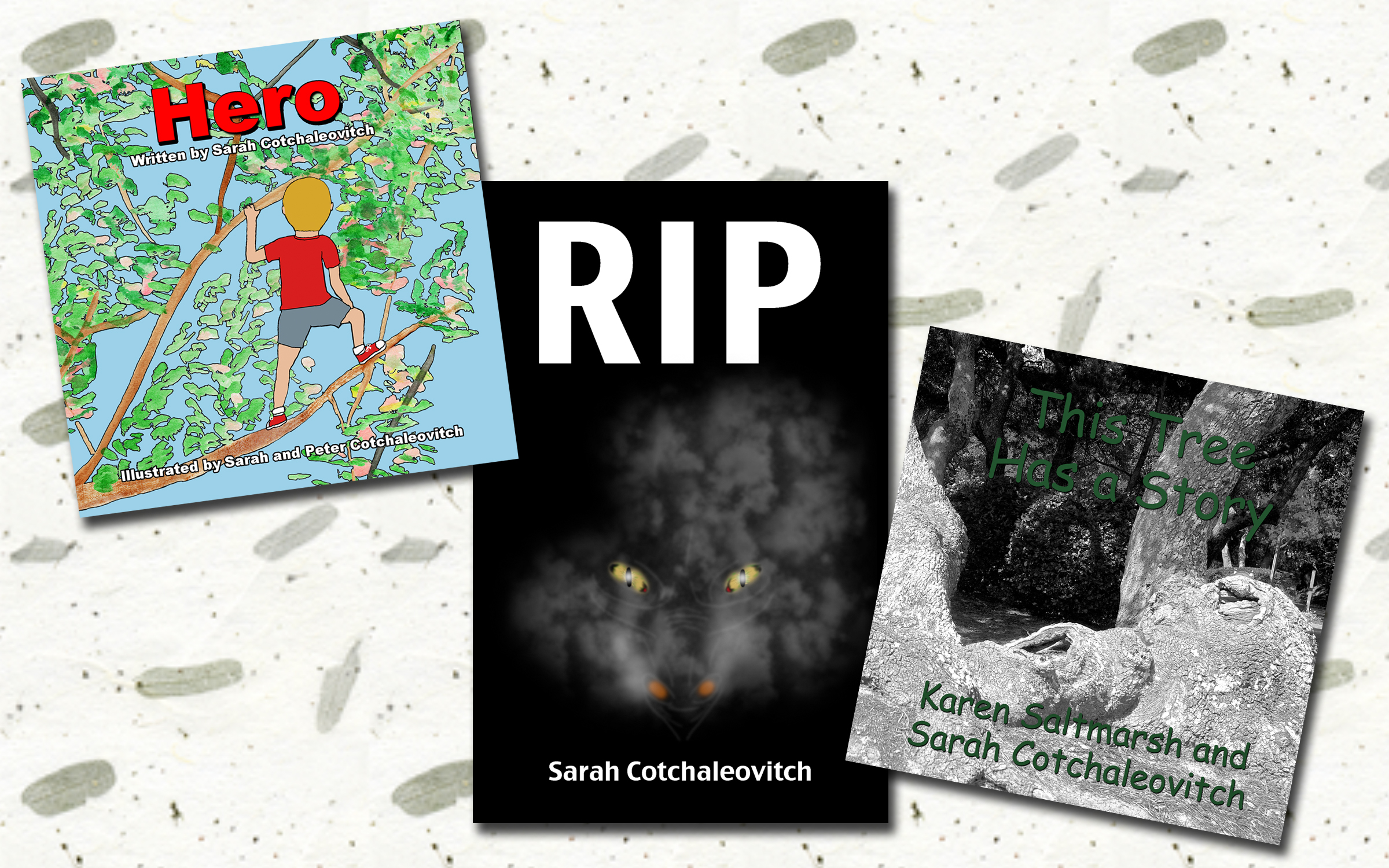
Check out my children’s book Hero here.

Done!

The setup for NaNoWriMo at home, if I need to ...

Ready to Write (Photo credit: Wikipedia)

Have you ever had a goal that seems to hover just out of reach? I’m talking about those last five pounds that you can’t shed, that last $1000 of debt that hangs over your head, that last month of pregnancy when everyone assumes you should’ve had the baby, yet you feel like it’s never going to happen.

I’ve been through all of those and more, but that’s not what I’m talking about this time. Nope, I’m talking about a writing goal.

That’s right, it’s the end of NaNoWriMo for Sarah!

If you happen to know what NaNoWriMo (National Novel Writing Month) is, you’re likely thinking, Aren’t you a couple months late, Sarah?

Yeah, yeah. I know that NaNoWriMo was officially over when the clock struck midnight, marking the end of November and the beginning of December. And I’d already “won,” which means that I wrote a 50,000-word novel in the month of November. (Actually, I wrote just over 61K.) But that didn’t mean I was done telling the story.

Last year, I also didn’t “finish” in November. I was certainly on a roll, writing 80,000 words in 30 days, but it took me 10 days into February to finish the first draft. I never slowed down the whole time; there was just so much story to tell.

This year’s NaNo was the sequel to last year’s. For months, I looked forward to continuing the story, but when it came to November, I struggled. I had the initial outpouring, which lasted for several thousand words, but after that, it was as if my muse had gone on vacation and at precisely the worst time.

So I “won” because I won’t sign up for something and then give up. But it was hard. I felt like the majority of what I wrote was just crap that would end up on the cutting room floor. I knew that if this were just any old novel, I would let it sit on the back burner and wait for my inspiration to return. I’m the queen of unfinished novels; I have more half-done manuscripts than I care to think about, and although I hate to admit it, I know that many of them will remain incomplete.

The difference with NaNoWriMo is that, after working so hard to get 50,000 words out, it seems like such a waste to just let the manuscript sit, unfinished. Even though it took two-plus extra months last year, I finished, and I think it’s the best novel I’ve ever written. And since this year’s novel was the sequel, I had to keep going.

Since it was such a tough book to write, I figured it would wrap up quickly and likely well under 100,000 words. Then I could sit back for a month, let it percolate a little, then return and make it worth reading after a hefty revision. To my surprise, a number of brainwaves hijacked my story when I thought I should be long done. The muse was back, although a month late. I continued writing and could see the end, but I couldn’t seem to reach it.

This past week, I had a couple 3000-word nights. My word count raced past 100,000 and didn’t look back. But still, I wasn’t done. I’d already told myself that I would absolutely finish this week. January is the month I had set aside to finish editing 2013’s novel and start querying agents, and here it is the 24th. I couldn’t let the 2014 novel hang over my head any longer. (Plus, I needed something to blog about.)

So last night, after the kids got to bed, I sat down and did some serious writing – 7000 words, to be exact. I’d joked with my husband that it would likely be a 2:00 A.M. bedtime. In reality, it was after 3:30. But I finished! I am worn out but feel so accomplished. I finally caught up to my goal, and I haven’t quite wrapped my head around it yet.

Now I get a month off from that book. And at the end of that month, I’ll go back and do a lot of cringing and cutting, and hopefully I’ll end up with a manuscript that’s at least 20,000 words shorter and worth sharing.

And in the meantime… I need a nap.

“He Has a Tutor? But I Thought He Was an Honors Student!”

This is a line that I heard in a commercial for a local tutoring center earlier this week. I’d seen the commercial before, but I guess it had been a while. Since, let’s say, my own son, Peter, started going to a tutor after school. Whereas I never gave this commercial a second thought before, it really bothers me now.

Of course, I’m glad that the tutoring center is there, doing what it’s doing to help kids. What bothers me is that it has to fight the assumption that smart kids couldn’t possibly need to be tutored.


Embed from Getty Images

And I have to admit, I used to be one of the parents this statement targets. I’m an overachiever. I skipped the 8th grade. I got my BA when I was 20. While I’m not one of these geniuses who gets a PhD at 15, if I ever got a B, that meant I was doing poorly. I was always embarrassed for the kids who tripped over words when we had to read aloud. I often thought they were stupid. I mean, how hard is it to read?

After Thomas and I admitted that, despite all our efforts, Peter needed help, we saw a child psychologist. We answered all of the usual questions, like if I had a normal pregnancy, if he often gets distracted, if he can keep eye contact, etc., etc. I could see that the answers to many of these questions could point to children with attention deficit problems, but our answers did not lead down that path at all. When we got done, the doctor asked us why we’d come to see him.

It was because Peter was almost six, and he still couldn’t identify all of his letters. He’d been in preschool two days a week for one year and five days a week for another. Yet kids who’d never had any kind of schooling before kindergarten were already running circles around him. They knew the alphabet and all the sounds that the different letters made. What was wrong with my child? I felt like I’d completely failed as a mother.

It was after Peter’s diagnosis that, with a shock, Thomas and I realized that his was an inherited problem. Neither of us has a learning disability, but the more we asked around, the more we realized that people in Thomas’s family have the same problem – and have been trying to cope with it all of their lives. Many hate to read because the task of decoding words is just so difficult.

I’m a reader. I carry at least one book with me everywhere. I didn’t want my child to grow up to hate books. It didn’t help that other well-meaning parents would say, “Did you hear about So-and-So? She’s being tested today. I knew something was wrong with her.” Oh the horror of being tested! I was embarrassed to say that Peter had been through the same battery of tests.

But I got over it soon enough. The problem wasn’t anything to do with how we’d parented our child. It’s all genetics. But even if it weren’t something he’d been born with, I still couldn’t just ignore the problem. When you’re a parent, your ultimate job is to help your child, and sometimes that means – gasp! – hiring a tutor.

Unfortunately, many parents of dyslexic children continue to ignore the problem, or sometimes they don’t even know it exists. This is because most dyslexic children have an extraordinary auditory capacity and are able to memorize, skating by for years when they could really use some one-on-one help.

In Peter’s case, his weakest area of learning is auditory, and he also has a deficient working memory. For years, I got mad at him for only completing one task, when I would ask him to do two or three. Imagine how terrible I felt when I realized he simply couldn’t complete more than one task because couldn’t remember what I’d asked. But this additional problem carried with it a huge advantage: I knew something was wrong much earlier than most parents, and we were able to get him help.

As soon as Peter was diagnosed, some people told us how shocked they were that he has a problem. He talked early and well. He’s a great problem solver and extremely creative. And while letters are his nemesis, he excels at math. Many of these are common traits among dyslexic people, some of them developed in order to survive in a world that is not very dyslexia-friendly.

One good thing, though, was that I was no longer afraid to talk about it. I started asking around about tutors and tutoring centers, and parents came out of the woodwork. Parents who do not have the mistaken idea that tutoring equals stupidity.


Embed from Getty Images

The improvement, the confidence in my child, has been amazing to watch. I am so grateful for the people in my life who have helped Peter, who continue to point out his great strengths (math and anything art-related). I am a little confused, however, by the people who continue to insist that I shouldn’t talk about Peter’s learning disabilities. Like it’s a shameful venereal disease or something. The more Peter understands about what we’re doing for him, the more compliant he is. He loves books and wants to be able to read them fluently. He knows that his tutoring will help him achieve this, and he also knows how to defend himself, if ever a kid (like I used to be) dares to make fun of him.

Sadly, many children are not diagnosed until the third grade or beyond. Many people slide through until adulthood and struggle all their lives with no help. If you are a parent or a teacher, pay attention. I hope your kids don’t have any problems, but if they do, don’t do them the disservice of acting like they can’t achieve great things if they need a tutor.

For further resources, check out Overcoming Dyslexia by Sally Shaywitz, M.D. and Barton Reading & Spelling System.

I Still Don’t Make New Year’s Resolutions

I first posted “I Don’t Make New Year’s Resolutions” at the end of 2012, a post about all the books I hoped to read in 2013 (four of which are still on my current list). And aside from the title, I didn’t go into an explanation of why I don’t make New Year’s resolutions. So here I am again, and this time I’ll try not to leave you hanging.

It seems that we can thank the Puritans for New Year’s resolutions. Abstaining from the revelry of the pagans, they instead reflected on the year past and the year to come. If you’re the introspective type, this could be a very constructive exercise. For instance, if you look over a year and see a lot of wasted spending, you could resolve to spend money more wisely, thus saving to buy a car or put a down payment on a house. And considering that Christmas is exactly one week before New Year’s Day, there are the ever-popular gym and diet resolutions. Many people take these seriously at first, only to fail when they realize that a month in the gym does not a truly fit person make or that getting up at 4:30 during the week is a tough commitment to keep.

So instead of using resolutions for their original, thoughtful purpose, we’ve turned them into a mockery. If you follow social media at all, you’ve likely read a number of resolutions from the snarky to the absurd:

Resolution 01

Resolution 02


Resolution 05

Resolution 07

And I just couldn’t resist this one (it’s for you, Thomas):

Resolution 08

And then there are just the sad ones. You know the ones: they’re the same resolutions that get made over and over again every year, as if this time they will actually happen – except they never do:

Resolution 03

So I’ve never made New Year’s resolutions. That isn’t to say that I don’t make resolutions at all. If you know me, I’m extremely goal-oriented, so it would seem that this kind of thing is right up my alley. Not so. I have enough of a hard time keeping up with the stuff that I want to do throughout the year.

For example, when my kids spent a weekend at their grandparents’ house over the summer, I stayed up past three A.M. cleaning up their messes (check out the before and after photos here). And after that, I resolved that the house would be clean (well, mess-free, not necessarily dusted and vacuumed) every night before I went to bed. It was something I stuck with until Christmas (read about that here). But one week later, I was on the wagon again (so to speak) and cleaned the house. The only clue that Christmas even happened is that our dining room table is now a Lego train station.

I’ve also made lifestyle resolutions before, although never at New Year’s. The original resolution: to lose weight by exercising. Hey, it worked, but I had to keep it up in order to stay in shape. I did this through two pregnancies. I continued when my elder son started school, even though it meant waking up at 4:30 in order to get a workout in.

For the longest time, I could blame any weight gain on terrible dietary choices. I would eat healthier and lose weight, but unlike my exercise-all-the-time resolution, the eating healthier thing was on-again, off-again until I decided to go wheat free.

But it wasn’t the antidote to my problem. Sure, I lost weight but gained it all back, plus 10 pounds. I gained weight on carrot sticks, for crying out loud, so why not just eat pizza? I allowed myself to get sucked into the resolution black hole that consumes so many well-meaning individuals early every year.

It wasn’t until my doctor told me that there was a very good reason (hypothyroidism) for gaining weight while eating carrots that I realized that I needed help to keep my resolution. After hearing two hours’ worth of dietary history, she put forth a plan to get my body back to equilibrium without living on a prescription, and the first step was to go gluten-free again. Now, however, I am accountable to someone other than myself, and although it may sound backwards, I finally feel the wonderful liberation of being able to share responsibility for my resolution.

The gluten-free thing was for December. But after Christmas, when there would be fewer tempting foods hanging around the house, I had to go totally grain free, as well as dairy free (or very limited dairy). Sounds kind of like a New Year’s resolution, doesn’t it? Except that it took three or four days after New Year’s to eat all the gluten-free pizza and drink my fill of Coolattas. I felt a bit like:

Resolution 06

I’ve never considered going fully Paleo before. After all, I love dairy. This isn’t even a resolution I would adopt, even if I did New Year’s resolutions. But because it’s what my doctor thinks will fix my problem, I’ve dropped grains and had almost no dairy to speak of for the past five days. This will be my lifestyle for at least three to six months, at which point my body may have healed itself enough to add a few of those prohibited foods back into my diet upon occasion.

Although it is certainly not always the case, many of the people whom I’ve seen keep their own resolutions (no matter when they’re made) are the ones who must make a change or face unpleasant physical consequences. Having hypothyroidism is no picnic, but in less than a week of living this resolution-like lifestyle, I have lost over two pounds that I could not shed before, and miraculously, I only crave food that I’m actually allowed to eat. If things keep progressing like this, it may not take much will power at all to keep myself on track.

I hope that whenever we seriously resolve to do something, we all make our best efforts and stay accountable. That way, if we do actually decide to take a step back in eleven-and-a-half months and see what we did with our year, we won’t say:

Resolution 04

Instead, we can pat ourselves on the back, say, “Job well done,” and not have any regrets so dire that they require nearly-impossible resolutions to fix.

Oh, and if you just want more beard, more power to you.

Happy 2015 Book List!

Score! Christmas Books

Score! Christmas Books

The past two years, I’ve created lists of books that I hoped to read in the upcoming year, and here I am, doing it again. 2014’s list was much more ambitious than 2013’s (23 books versus 14), and I am proud to say that I finished 17 of them. And I even got way sidetracked for a while. (Some of the books that sidetracked me I won’t ever read again, but at least they gave me blog fodder.)

I enjoy making this list just after Christmas because this is the time of year when people get generous and give me books, gift cards to bookstores, or both. This year being no exception, I am prepared to meet 2015 with lots of new fiction.

New Books!

New Books!

First of all, I am going to vow right now that 2015 will be the year that I finish Christopher Paolini’s Inheritance Cycle. It’s been on my list two years now, and I just can’t leave those books hanging any longer. The first three are slow-paced, but my husband assures me that the last one really picks up, so I’m just going to knuckle down and read them.

A wonderful thing that’s happened in the past few months is that my first grader has gotten into chapter books. It wasn’t until he was almost six that we realized that he has several learning disabilities, and he’s a poor audio learner, so reading books without pictures went right over his head. But since we’ve been helping him with his working memory and dyslexia, I’ve noticed a huge improvement in his reading ability and comprehension. This summer, I plan to start reading Harry Potter to Peter, and I hope he gets as much joy out of that series as I do.

If you’re interested in reading my previous years’ fiction lists, here are 2013 and 2014, and here are the books that I actually finished in 2014:

The Rim of the Prairie by Bess Streeter Aldrich

The Hunger Games by Suzanne Collins

Catching Fire by Suzanne Collins

Mockingjay by Suzanne Collins

The Maze Runner by James Dashner

The Scorch Trials by James Dashner

The Death Cure by James Dashner

The Kill Order by James Dashner

An Echo in the Bone by Diana Gabaldon

Outlander by Diana Gabaldon

The Graveyard Book by Neil Gaiman

An Abundance of Katherines by John Green

The Fault in Our Stars by John Green

Looking for Alaska by John Green

11/22/63 by Stephen King

The Girl with the Dragon Tattoo by Stieg Larsson

The Girl Who Played with Fire by Stieg Larsson

The Girl Who Kicked the Hornet’s Nest by Stieg Larsson

The Host by Stephenie Meyer

The Lost Hero (Heroes of Olympus, Book 1) by Rick Riordan

The Son of Neptune (Heroes of Olympus, Book 2) by Rick Riordan

The Mark of Athena (Heroes of Olympus, Book Three)
by Rick Riordan

Insurgent by Veronica Roth

Allegiant by Veronica Roth

The Casual Vacancy by J.K Rowling

Mark My Words: Mark Twain on Writing by Mark Twain

And here are the books I plan to read this year:

And Another Thing… Douglas Adams`s Hitchhiker`s Guide to the Galaxy Part Six of Three by Eoin Colfer

The Hunger Games by Suzanne Collins

Catching Fire by Suzanne Collins

Mockingjay by Suzanne Collins

Written in My Own Heart’s Blood by Diana Gabaldon

The Cuckoo’s Calling by Robert Galbraith (aka J.K. Rowling)

Let It Snow: Three Holiday Romances by John Green, Maureen Johnson, and Lauren Myracle

Paper Towns by John Green

Will Grayson, Will Grayson by John Green and David Levithan

Lisey’s Story by Stephen King

The Giver by Lois Lowry

Gathering Blue by Lois Lowry

Messenger by Lois Lowry

Son by Lois Lowry

Eragon (Inheritance, Book 1)by Christopher Paolini

Eldest (Inheritance Cycle, Book 2) by Christoopher Paolini

Brisingr (Inheritance Cycle, Book 3) by Christopher Paolini

Inheritance (Inheritance Cycle, Book 4) by Christoopher Paolini

The House of Hades (Heroes of Olympus, Book 4) by Rick Riordan

The Blood of Olympus (Heroes of Olympus, Book 5) by Rick Riordan

Divergent by Veronica Roth

Insurgent by Veronica Roth

Allegiant by Veronica Roth

Four: A Divergent Collection by Veronica Roth

Harry Potter and the Philosopher’s Stone by J.K. Rowling

The Hobbit by J.R.R. Tolkien

The Book Thief by Markus Zusak

I know it’s a long list, but I have lots of hope to finish a good number of these. Some are brand new, some beloved repeats. And I hope to be interrupted by books as yet undiscovered. (I’m always up for suggestions!)

Happy reading in 2015!

Post-Christmas Survival

Where in the world are we going to put that tent?

Where in the world are we going to put that tent?

At my parents’ business, we’ve just survived the busiest season of the year. From Thanksgiving to Christmas, we just have to hold on and pray we make it. As Christmas draws closer and closer, my mom starts to panic a little because there’s still so much to do and not enough time to do it. Last year, she worked so hard that got very sick when she had her first chance to slow down, and it was weeks before her body recovered.

As for me, I savor the days leading up to Christmas. There’s the anticipation of the day, of course, but I love the music, the lights, my collection of Christmas socks. It’s after Christmas that becomes a little much for me to handle.

Why would we need to eat at the dining room table, anyway?

Why would we need to eat at the dining room table, anyway?

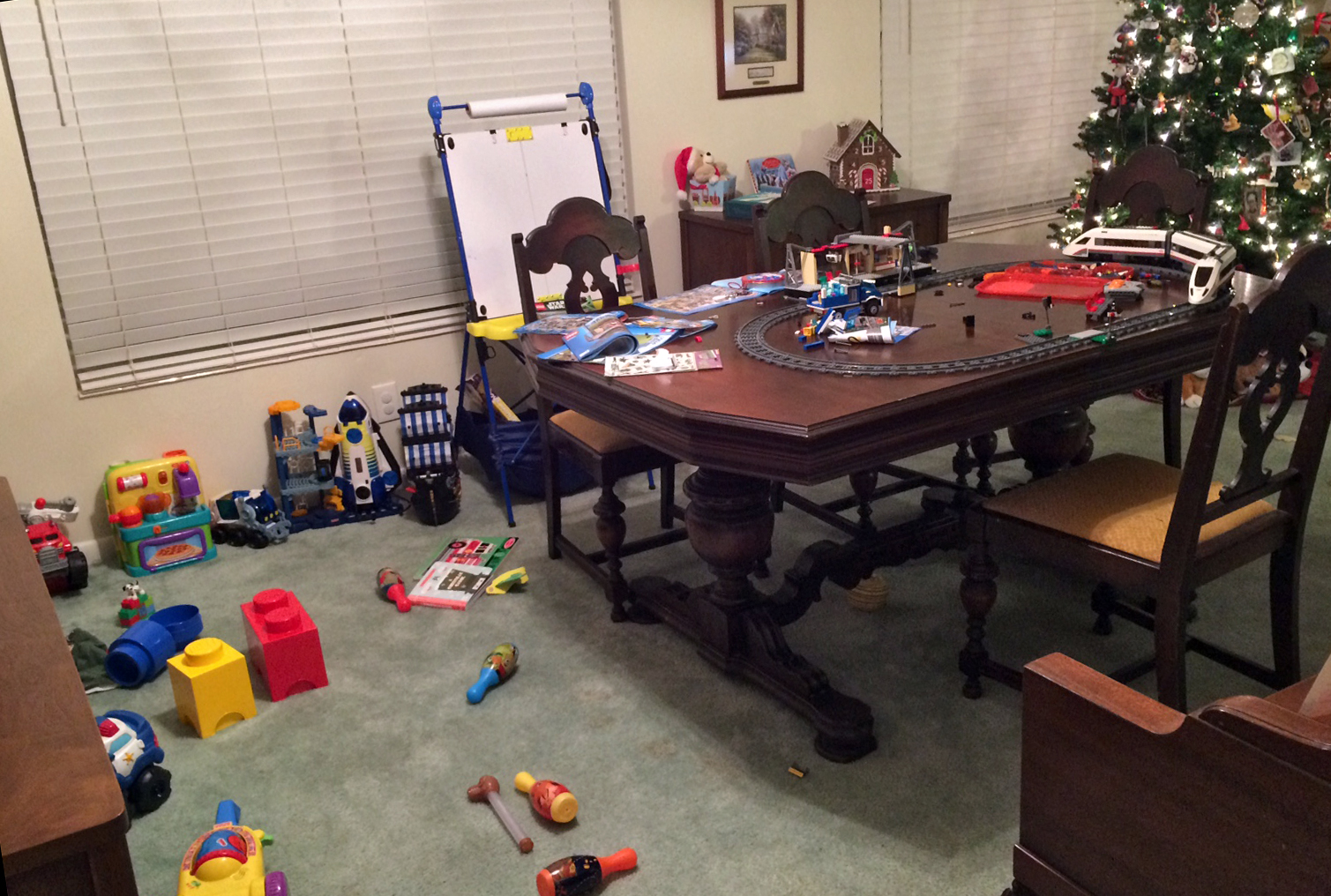
As I look around my house, I think it looks rather like Santa’s bag of toys threw up all over the place. My elder son, who is into everything Lego, received umpteen million sets of Legos this year, and he builds them so quickly that he just wants more and more. We had to clear the dining room table to hold his new Lego train track, and as I surveyed the carnage, I thought that all I want for Christmas is a container to hold all the pieces.

You may be thinking, Sarah this is nothing. My house is ten times worse. But this is how my house looked after I cleaned up. Things will get slightly better after we put away all the Christmas decorations, but the new normal will still include a lot more stuff than before. And I worked so hard to clean our house this summer. Until Christmas, I was able to keep up. The OCD part of me loves “a place for everything and everything in its place.” Well, there’s not a place for everything anymore.

I finally said to my husband that something has to change next year, and although I would love a larger house, that’s not the solution to this particular problem. I love buying gifts for my kids and watching the joy as they open them as much as everyone else, but then we parents are left to deal with it all. We can’t get away with asking for nothing but clothes and diapers anymore. Those were the good old days, weren’t they? Now, the kids actually have expectations, and no one would want to let them down, would they? My goodness, they might feel like they’re not loved. I can’t help but think of Dudley Dursley counting his birthday presents in Harry Potter and the Philosopher’s Stone.

I had to lecture my seven-year-old a few too many times this past week about Christmas being Jesus’ birthday first and foremost. He was begging to open presents days in advance, and even after letting each of the boys open a book on Christmas Eve, they wanted more when we went to story time at the local bookstore later that morning. It continued after Christmas. They got everything they wanted from Santa, plus a roomful of bigger and better toys from everyone else, but they still wanted more.

I know I’m partially to blame. I love the sacred aspects of Christmas; every morning from December first through Christmas Day, my kids and I read part of the Christmas story from the Bible, and it doesn’t feel like Christmas for me until my church’s candlelight service on Christmas Eve. But a few short hours later, it’s on to the secular: my husband and I are arranging presents under the tree, and I’m the one who’s too excited to sleep because I can’t wait to see my kids’ excitement as soon as they get up.

I don’t think I’m alone in this. Well, maybe other parents sleep better than I do on Christmas Eve, but I think they have just as much fun watching their kids on Christmas morning as I do. And so they go crazy. They spend thousands because it’s only once a year, right? Then they post pictures on Facebook and Twitter, and it’s like keeping up with the Joneses, kid-style. We can’t let someone else’s children have a better Christmas, can we?

At least at my house we didn’t go crazy with our spending – and thank goodness because after all the presents were opened, it wasn’t even the things that Peter asked for that he liked the most. So we have a house full of toys that may not all get played with. Peter knows we’re running out of room, and he’s offered to give away some of his old toys, but I know it will take me combing through all the kids’ stuff when they’re not looking to a make a dent. And when I do that, of course, it’s like flushing money down the toilet. (I do donate the toys, but still.)

I read a blog a few weeks ago about non-toy gifts for kids like books, trips to the movies, museum or zoo memberships. Aside from the books, these aren’t things that kids can open and use on Christmas day. But isn’t that okay? Wouldn’t it be great to get more than a few minutes’ or hours’ enjoyment from our presents? This year, I already started doing this for birthdays by not giving my kids a party but taking them to the zoo instead – why not extend this idea to Christmas, too?

I’m not nixing all presents, but it would be nice to have a Christmas when we can come home and not feel overwhelmed with piles of stuff. The most fun we’ve had this past week was going out to buy our own gifts with gift cards. My mother-in-law, who usually gets us great gifts, was focused on helping my father-in-law recover from back surgery this year. And although a gift card isn’t all that exciting to play with, my kids certainly enjoyed going to the store and picking out their own toys. They’ve also enjoyed reading and making puzzles together, not to mention listening to all the new music we downloaded and watching the movies we bought with our iTunes gift card. The whole Christmas season has been a lot of fun, of course, but I still think I feel a change in the wind.

Maybe 2015 will be our trial run. It will mean retraining my family. It will mean working harder with my kids to focus on what really matters. It will mean taking time to be with them – instead of cleaning up their stuff.

Hey, I think I could live with that.

My Gift

Embed from Getty Images

Have you ever had a dream that seems a little silly, but you can’t help but hold onto it anyway? Like driving by a beautiful house every day that you know you’ll never be able to afford but imagining yourself living there anyway?

Well… but who says you won’t live ever there? So many people give up on dreams that aren’t necessarily impossible, just difficult to attain. Sometimes life makes it very difficult to hold onto our dreams. Sometimes we get bitter, assuming that those who do achieve their dreams have some secret inner track that is unavailable for the rest of us “normal” people. Sometimes we give up.

Probably my longest-held unfulfilled dream is that of becoming a published author. Well, let me rephrase: an author who is published in the traditional sense. I do have books under my belt, and I do make a (tiny) income freelance writing, but back in high school, I thought that I could go to college, major in English, improve my writing skills, and somehow earn an annual income as a novelist equal to (or more than) what my husband makes.

Not only did majoring in English do absolutely nothing to further my writing career, but the idea that becoming a novelist can bring a steady income is one that seems less likely every day. It’s harder than ever to find a literary agent and then a publisher, and even they can’t promise positive or lasting results. Books get remaindered all the time, and there go the hopes of more starving artists.

In the face of this and many more discouraging statistics, it would be logical to give up on my dream. And to be honest, this dream does come and go. When my first son was a baby, I wrote very little. It suddenly wasn’t very important to me, both because I was tired and focused on new motherhood. I wrote when I wanted to, and I wrote what moved me, but as far as a career, I almost let go of the dream completely, unless someone reminded me by asking how my writing was going.

Other times, I’ve wanted my dream so much that it almost caused physical pain – and I guess that is possible, if you consider the toll anxiety can take. It’s not fun trying so hard and being rejected over and over and over and over… need I go on?

But most of the time, I live in a cycle of writing with pure joy and energy and plowing on because I know that joy is just around the corner, if only I can stick with it. That’s how this last year has been, starting with my first NaNoWriMo experience in November 2013.

If you follow my blog, you know that last year’s NaNoWriMo was the joy and energy, and this year’s I just had to plow through. Although I won (by writing more than 50,000 words in the month of November), I’m still chipping away at my novel. I would love to finish the first draft by the end of the month, but things really have to change if I want that to happen: I don’t think I’ve ever procrastinated so much when it comes to writing.

This isn’t writer’s block. I’ve had that before, don’t care for it much, but understand that it’s a normal part of the writing process. What this is is writer’s exhaustion. Three days in the past week, I neglected to write at all. I was so busy that I forgot, and I was too tired to even care all that much.

Except.

Except that I realized that I missed it. I make time for all kinds of other things during the day, all of which are important, but why is it that my novel gets shoved to the side? No, it’s not paying the bills, but since when did that become the sole criteria of what’s important to me? If I have to dedicate five minutes at a time to get it done, at least I can go to sleep at night feeling like I haven’t let myself – and my dream – down.

My dream will never have the chance of becoming reality if I don’t do my part. Which means I have to start querying again. Which means editing last year’s novel and finishing this year’s. After all, my books won’t write themselves, and I can’t expect an agent to just stumble across my blog and send me an email – “Hey, Sarah. You sound talented. Do you happen to have a novel I could represent?” Yeah right.

Stranger things have happened, I suppose, but this girl isn’t going to sit around and wait for a miracle to happen. Writing may present a challenge, but it can also fill my tank when it’s empty. I owe myself this gift. The gift of five minutes a day, the gift of keeping my dream alive, the gift of trying to make it become reality.

And if it doesn’t work… well, I’ve always loved dreaming.