Did October Come out of Nowhere or What?


Embed from Getty Images

With so many big projects from late May through early July, I almost felt like the summer months didn’t happen. I was busy enough that I always felt like I was on the brink of falling behind. And although this has been a great school year for my first grader, I feel the press of responsibilities and obligations getting ready to pull me under again.

Whenever I see my grandmother, she asks how I’m doing, and the inevitable reply is, “Busy.” I recount to her my projects – currently, a memoir for one client, an eBook for another, and a book I’m co-writing with a friend – and she asks me how I’ve gotten myself into this. “Well, I’m getting paid,” I tell her. It’s not like I’m giving my time away.

Finishing my first set of three big projects at the end of June wasn’t good enough; I immediately picked up a bunch more. It was great for the summer because the number of paying projects I took on more than made up for the substitute teaching jobs that I only get during the school year. My days were full, but I didn’t have to get up hours before dawn, didn’t have as many pressing deadlines, and could block off time for myself and still get things done.

When school started back, though, the early alarm clock became part of my routine again, as well as lots of substitute teaching, karate and t-ball practices for my elder son, preschool Sunday school, my Education for Ministry class (which comes with a 1000-page history book this year), and my recent move to assistant editor for Fiction Fix. I warned all of my clients that, while I would have plenty of time during the summer, everything would slow down once school started again. “Does that mean that I need to find someone else?” one of these clients asked. Of course not! I need the work, and I can’t leave her with her project half-done.

Even so, I’ve had less time than I thought I would. Whole weeks have slipped by without me touching some of my work, and when it was August, it was all well and good, but somehow October snuck up on me.

It comes down to time management, as usual. There are only so many hours in a day, and sometimes I don’t have more than five or ten minutes to devote to one person, in order to give time to everyone. A few days ago, I started to feel the pressure when I realized that the book I’m co-writing needs to go to the printer the last week of the month, and I still don’t have all of the material. The memoir needs to be finished before Christmas, and the eBook is set to publish in mid-December, but we’re having all kinds of technical issues with the conversion for e-devices. To get all of these things done, the only solution that I can think of is to give up some of the weekend time that I’ve tried to set aside to read and edit for myself – you know, for my sanity.

And I made this decision on a weekend when we were going out of town for a mini vacation, naturally.

On Friday afternoon, I spent an hour hunched over my MacBook, bound and determined to finish the latest chunk of the memoir. My husband took care of all the last minute details, as well as our two-year-old. I finished and called my client from the car, promising to get the material to her next week.

One of the wonderful things about freelance work is that you can do things like this – type from your house right before leaving town – but if you don’t have the discipline to do it, you could easily get sucked into your favorite TV show or lose an hour on Facebook. There’s no boss looking over your shoulder to tell you off or remind you that October, in fact, started four days ago.

And if you’re married and working freelance, it also takes an understanding spouse. Sure, it looks like I’m having a great time, sitting in my comfy glider and typing away in my bedroom slippers, but I really am working, and there is a client who is counting on me to give my best. But that understanding only stretches so far. The free time that I afford myself on weekends needs to include my husband and kids.

Cinderella's Palace at Disney World

Cinderella’s Palace at Disney World

As I write, I'm out of town with my family. My in-laws offered to take us to Mickey's Not-So-Scary Halloween Party at Disney World. The kids knew we were going to visit their grandparents for the weekend, but Disney was a surprise. And so worth it. It's what I consider the last hurrah before I knuckle down and get serious.


And, of course, I have another motivating factor (aside from keeping my clients happy): NaNoWriMo starts in less than a month, and I can’t wait to write the sequel to last year’s NaNo book. I can’t do that with all these looming projects, so October, look out! There’s going to be a whole lot of productivity going on around here.

I’ve Got Too Much to Read, Dude

This (the title) is what I told my husband mere minutes ago, after watching the new trailer for The Hunger Games: Mockingjay Part I. Even though I just re-read the entire Hunger Games trilogy earlier this year, seeing the trailer made me eager to do it again.

So let’s see, if the movie comes out in November, and it’s late September now, and I haven’t nearly caught up with my 2014 reading list, and I’ve bought more new books since creating the list, and I received a bunch of books for Christmas that I have yet to crack (more on that at the end), and I have a 1000+ page history book I’m supposed to be reading right now…

I’ve got too much to read, dude.

Now, this is a good problem to have. It’s just the kind of problem that I like. Not always easily solved, but it’s fun to try, anyway. There was a point in my life when I was disciplined enough to read every book in the house before buying anything new, but that was in 2007, and let’s be honest: a lot of good books have been published since then.

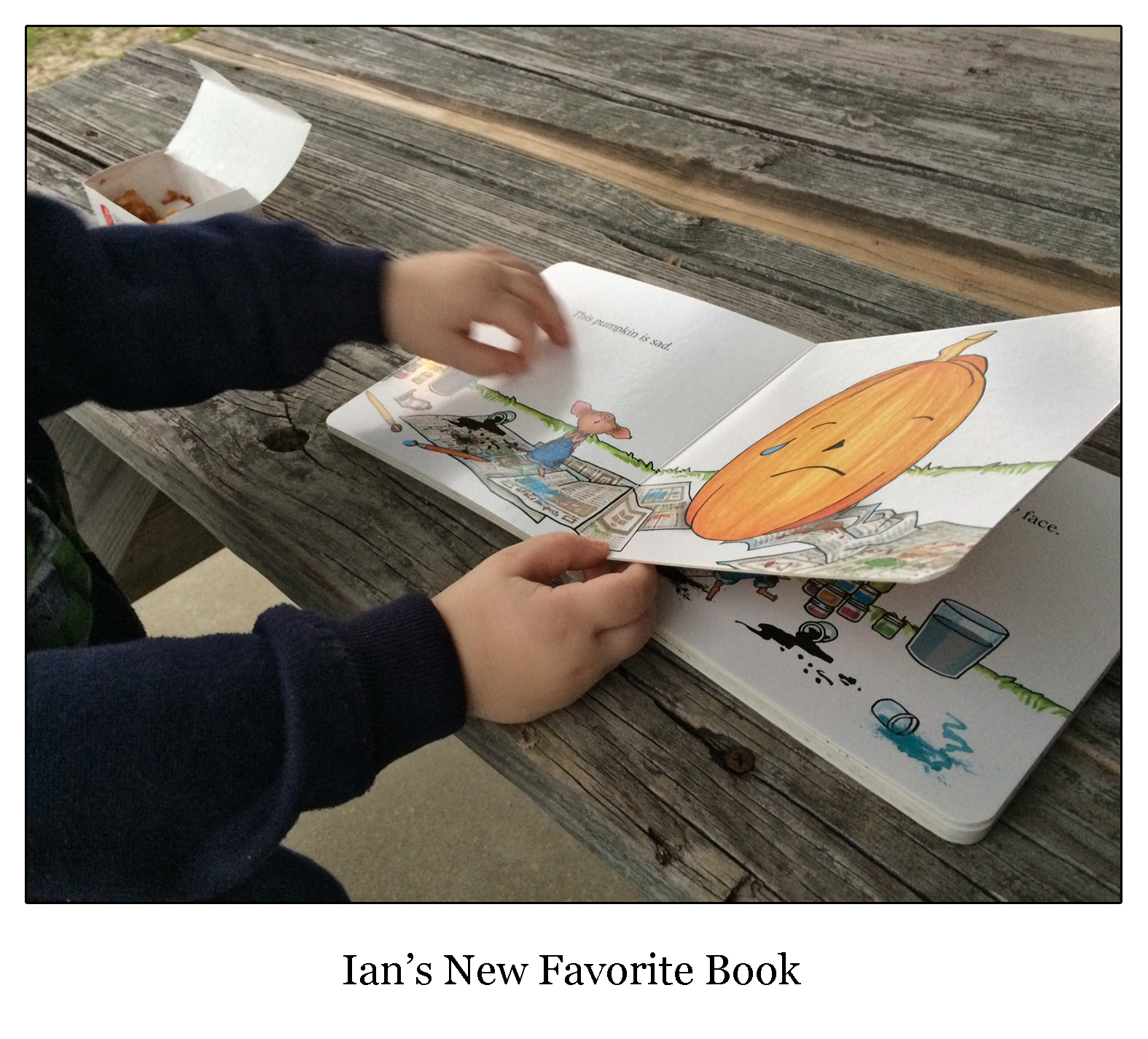
Ian ReadingWe are a reading family. There’s me, of course, the crazy-avid reader. There’s my husband, who currently has three or four books that he’s reading. There’s my first grader, who gets an ice cream party at the end of the year if he reads 100 books, so we make sure to squeeze one in every night. And there’s even my two-year-old, who took an interest late in the game (compared to his elder brother, who was re-enacting his favorite books at 18 months) and wants a new book every time we go to our local bookstore’s story time. I particularly love reading with my kids, watching them absorb so much information and the excitement when they get a new book. They are quickly becoming like their mama, getting excited every time we take a trip to a library or bookstore.

And if you follow my blog, you know that one of my biggest problems when it comes to books (aside from wanting to spend all of our money on them and then not having time to read them, in any case) is where to put them. When I ran out of room in our china-cabinet-turned-bookshelf, I started using the top of the piano. I stored large, hardback volumes in cabinets, and the little corner shelf in my bedroom was overflowing. I started looking for people who might want to borrow books, just so I could make more room.

Then something wonderful happened. My grandfather’s widow finally decided she was tired of keeping his old bookcase kicking around in her garage. This isn’t some other piece of furniture that can be converted for book shelving purposes – it was made to hold books. My parents didn’t have room for it, so that meant that it could be mine – AAAALL MIIIIINE! If only I could find a place to put it.

Now, you know that I would be cool with getting rid of our toys and even some furniture, as long as I still have a good chair to sit in. But since I don’t live alone (and I don’t want to any time soon), I have to consider the other people who live with me. We ended up scooting our little photo album shelf over a few feet and moving my mother’s lovely painting up, and – voilà! – instant bookcase space.

Bookcase


What do you think? It’s a little banged up, but after all, it is antique. And to see all (well, not quite all, but most) of our books in one place makes me realize how many we have. Yikes, that’s a lot.

But you know, there’s no such thing as too many books.

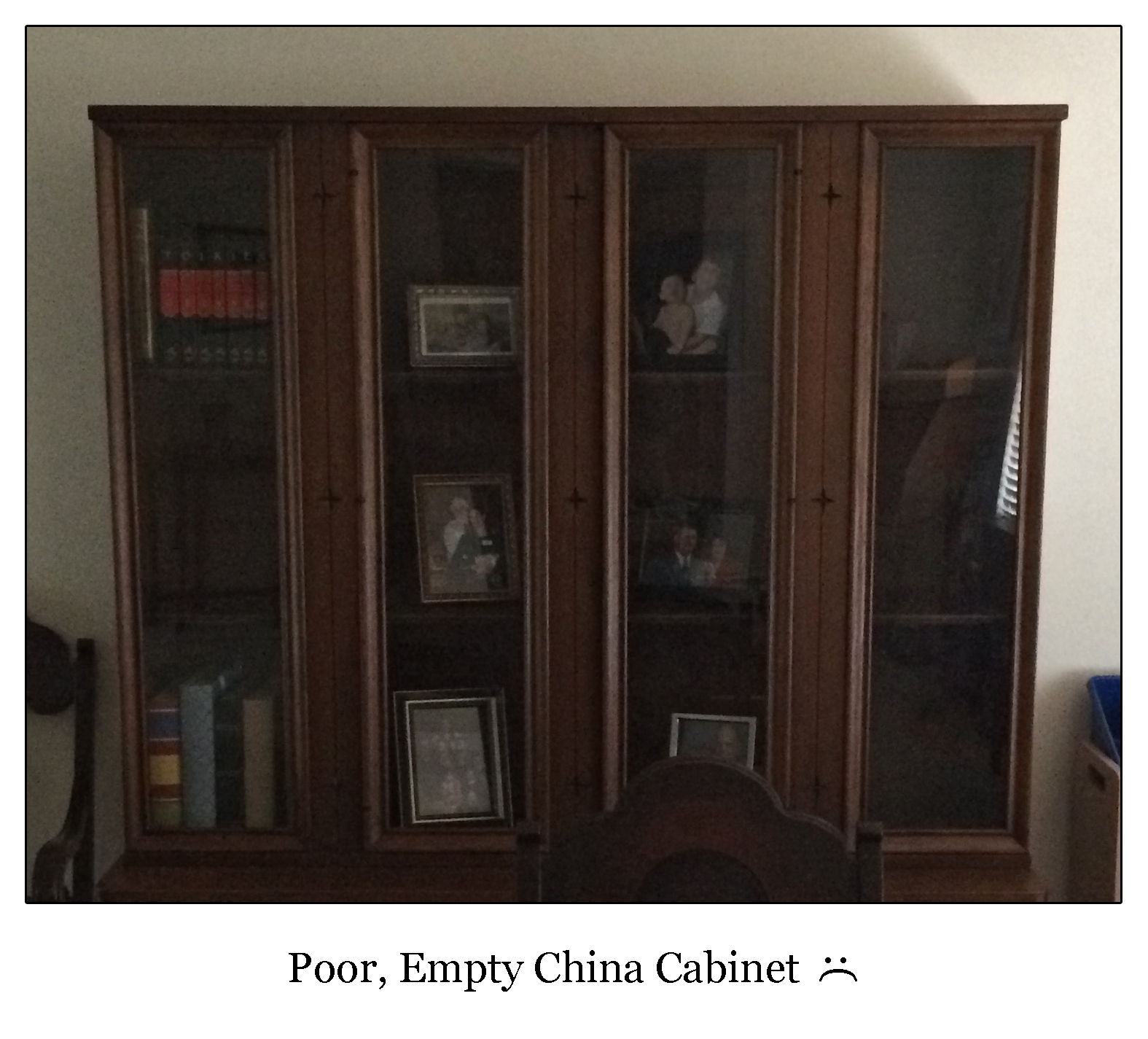
Look at our poor china cabinet. The only thing left in there is Tolkien. And photo albums. I put some in there to keep it from looking empty. Oh, and family photos. Hello, family. Love you. Just wish there were some more books behind you.

Of course, as I told my husband, we might want to consider actually pulling our china out (wherever it is) and put it in the china cabinet. I mean, it has little display lights and everything. It would be a shame not to use it for its intended purpose.

Okay, you know I’m just joking. The reason the china is packed up is because I do not intend to use it, but I do intend to buy more books. Oh yes. Picture me rubbing my hands together in glee.

Which brings me to something amazing that happened this weekend. This is the kind of thing that happens to people in books and movies, but never to us.

Remember when I said that we got books for Christmas that we haven’t bothered to crack yet? Yeah, well believe me, that’s never going to happen again. The problem is, as stated in the title, I just have too much to read. And darn it, people keep publishing new books that I want to read all the time. Or someone will tell me about an author I have yet to discover, and I have to read everything that author ever wrote – like right now. So it’s not that I won’t read those books. It’s just that it could take two or three years. I mean, my husband bought me books that I asked for in 2011, and I just read them a couple months ago. (That’s part of the reason I started compiling a list of books that I want to read every year. Even if I get sidetracked, I can at least be somewhat accountable.)

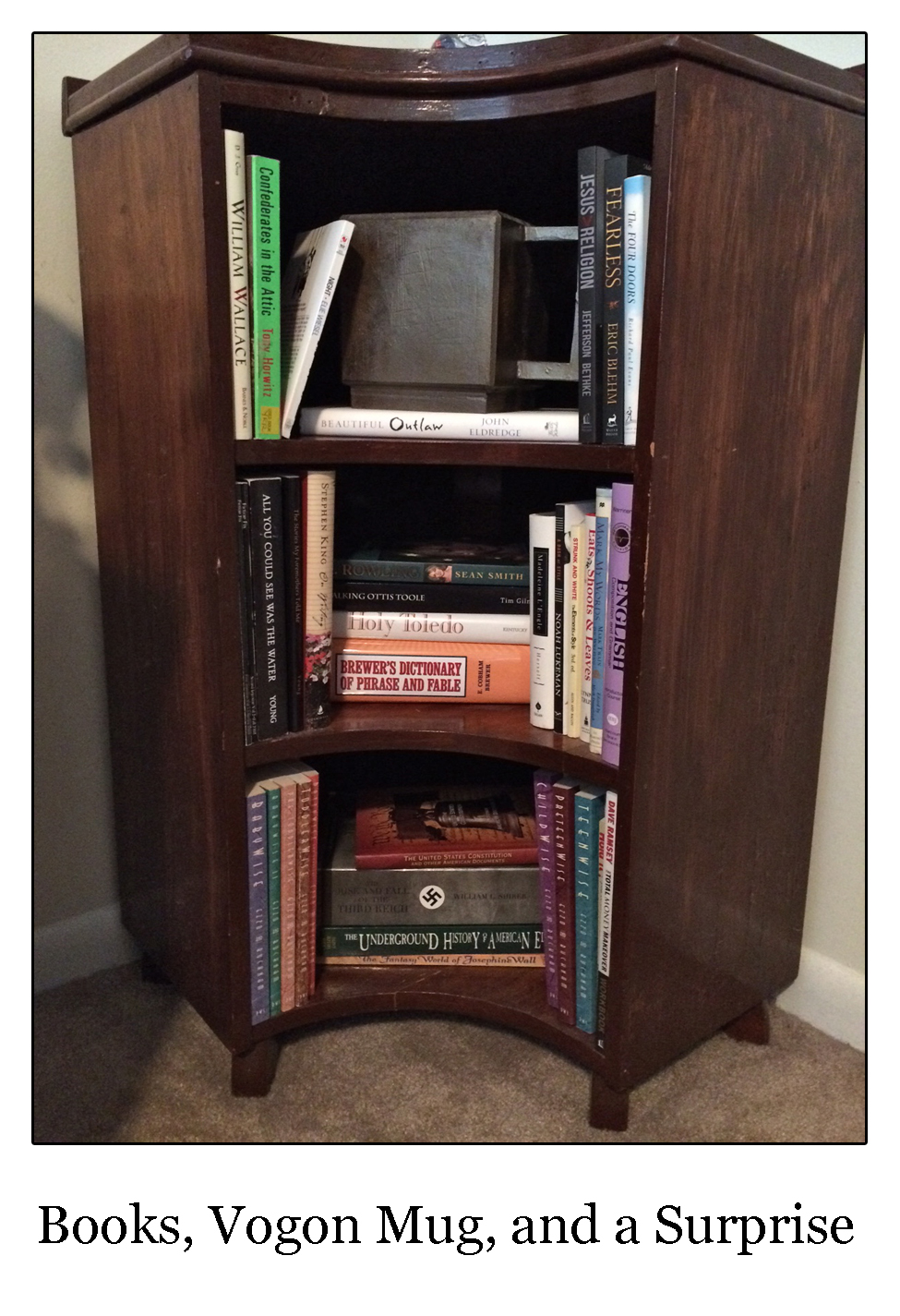
Books Vogon MugSo here’s the cute little shelf in our bedroom. Now, it’s all non-fiction, but before the big bookcase, I had even more stuff crammed in here. So when I pulled those books out to sort them onto the new (to me) bookshelves, I decided I might as well dust while I was at it because, let’s be honest, it doesn’t happen very often.

I pulled all the books out, and when I removed the ones to the right of the Vogon mug (yes, that is a Vogon mug you’re looking at on the top shelf, Hitchhiker fans), I saw some paper sticking out of one of the books we received last Christmas. And I began to have a horrible-slash-wonderful feeling. I pulled the paper out, and it was a sweet note from the relative who gave us said book. And in the note was a pile of money. I think, were I ten years older, I might have had a heart attack on the spot.

I carried the note and the money into the living room, where my husband sat oblivious to this miracle. I showed him the money. I probably said some crazy stuff. I’m really not sure because I was in shock right then. Like I said, this kind of thing never happens to us.

Maybe it’s time to start looking for agents again, if my luck continues like this.

It did not take long for me to conclude that a good portion of this money needs to stimulate our local bookstore and help fill the poor, empty china cabinet shelves. You could say that this was meant to be.

Bookshelves and dusting can lead to marvelous things. I still haven’t found more time in my day to read, but you know me: I like a challenge. And if you like morals, the moral to this story is that if someone gives you a book for a gift, open it up and make sure nothing’s lurking inside. And then, of course, add it to your book list.

Words Count


Embed from Getty Images

Back in the fifth or sixth grade, I had the option of writing a story for a contest. Creative writing has been a love of mine since I was old enough to write my name, so I was in. Write a story – no problem. But there was a problem, and it was the word count. No more than 200 words. I think the only reason this has stuck with me is because of how ridiculous the word count seemed. My classmates groaned about the seeming impossibility of creating a story, no matter the length. To me, however, the limit of 200 words shot my dream of writing a winning story dead before I could even start.

In college, when I joined my first fiction workshop, I puzzled over how to write a story that was short enough. I struggled to shrink my first one to less than 20 pages, which I knew was problematic because the instructor read each story aloud during class. The day that a woman turned in a two-page story, I wondered how in the world it would amount to anything. Surely a two-page story would hardly be worth critiquing.

It was one of the best stories submitted that semester.

Eighteen years old, and I finally learned that longer is not necessarily better.

Of course, that’s not to say that I was unaware of being brevity-challenged. I’d heard about killing your darlings. I’d also heard of taking out the proverbial axe and chisel to finesse a piece of literary art. But my approach was always to write pell-mell on the first draft, then make sure the second draft was cut down by ten percent. The problem with this technique is that my first drafts are often much too long, and cutting ten percent is not enough. And when I started writing freelance, I had to learn how to hone my skills by writing articles with word limits.

It’s one thing to write a story and know that it needs to be around a certain length. It’s another to be assigned an article and know that you will be rejected if you go over 300 or 400 words. When I started writing articles for clients, I faced this challenge. And it turns out that I can write an article, prove a point, share an idea within a small space. A good thing, too, since many people will choose not to read an article if they see it runs onto a second page.

So, what then about novels? If you read my post last week, I complained (yes, I admit it) about my latest encounter with an agent. Her assignment was to help me fix problems with my novel’s opening, but when I submitted my excerpt to her with a note about how long my young adult manuscript was, I didn’t expect her to critique the novel’s length. But that’s just what she did. Cut it down by about 40,000 words, she said.

My first reaction was to be offended. Hadn’t she heard of Twilight, EragonHarry Potter And The Order Of The Phoenix, for crying out loud? These books blow average word counts out of the water. Granted, the first Harry Potter book was closer to what is considered normal, so by book five, J.K. Rowling could do whatever she wanted. But still, I thought, how do young adult authors break into the publishing world with longer-than-average novels?

Of course, my goal needs to be to make my novel the best it can be. Length isn’t the only factor, but it could be the one that consigns me to the slush pile yet again. While making my manuscript the best it can be, maybe I need to pull out the old axe again.

When I started editing my novel, although cutting words was a secondary goal, I was more concerned with making it clean and clarifying scenes that had confused my beta readers. But with my number one critique from the agent being the length (and after all, she does sell novels for a living, so I kind of have to lean toward her expertise on this one), I became hyper-aware of every word. I should have been making sure that each one counted from the beginning.

As of this post, I have cut almost 14,000 words – and I’ve added two scenes and am not even halfway through the book. There’s hope for me yet. If I can cut 30,000 words and make my prose shine, maybe there’s a chance that I’ll catch someone’s attention.

So, for those of you who don’t know where to start, here are some specifics:

  • Choose your adverbs with great prejudice. Sometimes you can’t cut the adverb out and get your message across. Sometimes it means rewording a section to avoid adverb usage (and adjectives, too, but adverbs are the bigger culprit). As a writing exercise, write a scene with no descriptors at all. Challenging? You bet. You’re welcome.
  • KISS (keep it simple, stupid). If you can make your point in three words, why use ten? Are you trying to impress someone with your use of words like “anthropomorphism” and “juxtaposition”? Give me a break. Likely, you’re only impressing yourself. Make your point, and move on.
  • Read your prose aloud. This is especially important for dialogue. It’s also a great technique for discovering when you’re using the same word or phrase too often.
  • Express yourself through punctuation. Need help? Check out Noah Lukeman’s A Dash of Style. You will be amazed by how much you can say without using words at all.
  • If you haven’t already, buy copies of The Elements of Style, On Writing, and Anne Lamott’s Bird by Bird. There are many, many others, but these will give you a great start.
  • Kill your darlings. I’m so sorry. It could be that the line you’re most proud of is the one that needs to go. Once you start, you’ll find that it’s easier to keep cutting. If you’re afraid that you’ll regret your cuts, save each revision of your work as a separate document, so you can go back and put a line back in later if you decide you’d rather keep it.
  • If you’re writing an article, make a rough outline. Although I like to be a free spirit when it comes to fiction, when writing articles, you need to have a clear direction for your key points. Then, if space allows, you can add flourishes later.
  • Give your piece a rest. If there’s no hard deadline, take a vacation and work on something else for four to six weeks. You may find that something you thought integral to your manuscript before is unnecessary.
  • Hire an editor. I’m not just trying to get more work for myself; if you are serious about making your manuscript publication-ready and feel you’re not up to the task yourself, that’s why we’re here.

These all come down to making sure that every word counts. If it doesn’t further your story or article, it’s got to go. Only then can you write a winning story in under 200 words – or cut thousands of words from your novel without compromising important scenes. I have confidence that you can, and I’m certainly going to try to do it, too.

Does the Genre Really Matter?

All seven books in the Harry Potter series in ...

All seven books in the Harry Potter series. (Photo credit: Wikipedia)

Wanted: Good fiction.

To be more specific, fiction that draws me in right from the start. Fiction in which the characters are believable, in which I can hear the dialogue in my mind. Fiction that makes me think, raises tough questions, makes me cry, makes me emote. Fiction that makes me want to talk to someone else about it. Fiction that saddens me when it’s over.

I like to think that if I were a literary agent, that’s what I would list under my “interests.” Because, try as I might, I can’t pin down a favorite style or genre. Now, there are certain things that I definitely don’t like. Mediocre writing, inconsistency, lack of craft. Like I said, I want the characters to be believable. If the debutante protagonist has never scrambled an egg in her life, I won’t believe it when she whips a six-course meal out of thin air. (Unless she’s magic, of course – and if she is, I better have a hint of it first.) I don’t want adverbs trying to tell me how desperately someone says something. Show me the desperation with a sweaty brow and shaking hands. I don’t want plots that are so insubstantial they can be knocked over by a sneeze.  I don’t want endings that are unrealistically happy or tragedies that are unnecessary, the only point being to make the reader cry.

I really just want a good story, one in which I can forget that I’m reading at all.

This is why labels kind of bother me. Romances, for instance. Label it like that, and I don’t want to read it. Why? Because all the romance novels I saw growing up had half-naked men massaging busty women’s shoulders on their front covers, and I really don’t want to read a novel that’s connected by one sex scene after another. So I was shocked to discover a truly excellent book that is sold in the romance section. Although the story revolves around a love story (or stories, really), it’s so much more than that. I’m speaking of Diana Gabaldon’s Outlander.

Or take the case of my friend who told me that he could not stand to read fantasy. Wouldn’t give Harry Potter the time of day because of how it’s categorized. I’ve known other people who won’t read these wonderful books, not because of the fantasy and magic, but because they’re so-called “kids’ stuff.” Well, if kids’ stuff comes with a side of good beating the crap out of evil, I’m on board with it.

How about Stephen King? He’s known as the king of horror, yet while he started that way, his more recent books (and my favorites) are much more sci-fi, fantasy, and I-don’t-know-what. They’re just good stories. Not to mention that the guy knows how to write and how to instruct writers how to write. Chances are, if you call him a hack, you haven’t read much beyond Cujo or Pet Sematary.

When I looked for beta readers for my novel RIP, I decided to go the vague route. People asked, “What’s it about?” or “What genre is it?” I told them that it was young adult, and fortunately, my beta readers were kind enough to read because they know me. One actually told me he wouldn’t have usually read that kind of book, but he was glad that he did. Good thing I kept my mouth shut, right?

But, as I posted a couple weeks ago, I was able to workshop a portion of my novel with an agent, and in my introduction, I told her it was young adult. It was almost as if, by giving that tiny bit of a description, it put blinders on her. My book was much too long. She was unwilling to consider almost anything about the content until I addressed the length. Young adult novels generally have a word count, and mine exceeded it by double. (Nevermind that books like Twilight are half again as long as mine.) Now, she is right: there are many thousands of words that I can cut, but shouldn’t she be trying to sell a story, not a word count? (That’s an issue for another blog.)

This whole issue has gotten me thinking: does labeling novels with a genre help or hinder? If I had just told the agent: here’s the beginning of my novel, would she have judged me for not nailing down a genre?

I don’t go through bookstores and read book jackets or first pages until I find something I think I want, but many other people find their books by following this practice. (Or if not in a bookstore, online.) What about someone who only picks books from the Christian lit shelves? This person might never consider reading Veronica Roth’s Divergent series because it’s sold as young adult and dystopian – would completely miss the way that Roth’s Christianity colors her novels.

While talking books with a friend recently, we got onto young adult lit, specifically John Green‘s books (which are awesome, by the way – do yourself a favor, and read them). My friend said, in a semi-surprised tone, that he’d gone on a young adult lit binge lately. And he’s in his forties with no kids. I find this wonderful – that a book written “for” an audience in their teens can speak to such a wider audience.

Of course, I totally get that if there were no classifications, I could very well mistakenly shop my novel with agents who are only interested in political thrillers or erotica. And marketing is another issue. No matter what, there are people who will refuse to read anything except X, even though they would really enjoy Y, if only they would give it a chance.

But it seems, in the effort to makes genres more attractive to more people, sub-genres have to be added. You ought to check out this list from Writer’s Digest. And it’s not even complete! I just heard of a new genre called New Adult. Each genre and sub-genre has its own little specifications, and if you hope to publish, you have to try to fit the mold. Well, what if I don’t want to? What if I just want to write or read a good book? What if I want to mull it over afterward and then say, “I think I just read a really good Western. Who knew? I never thought I would enjoy a book like that.”

All I’m asking for is a little bit more of an open mind. From agents, publishers, and readers, alike. Hey, I’ll try to have one, too.

I suppose this is why I’m not a big publishing executive. The bottom line is important, I know. Believe me, I want to make a living in this business, too. But at the end of the day, piles of money aren’t going to captivate me. But a great story will every time.

Are You Too Busy Posting About How Much Fun You’re Having to Have Fun?

A woman reading SMS messages on her mobile pho...

A woman reading SMS messages on her mobile phone while standing on a bike in traffic. (Photo credit: Wikipedia)

One morning last week, I was watching the morning news and happened to see a segment with a therapist talking about social media accounts (Facebook, specifically) and how negative an impact they can have on relationships.

Now, of course, many of you, my faithful readers, read this on Facebook. So I am by no means saying we should give up this platform. But it was enough to get the old thinking juices flowing.

The therapist mentioned that many people are so busy posting updates about what they’re doing – that they’re not really doing anything. Except for updating social media, of course. There were other reasons that he went into for why Facebook can be bad for relationships – like coming across an ex and stirring up old feelings – but it made me start to think about my life and how it’s changed – not since I signed up for Facebook, necessarily, but since I got a smart phone.

Sure, there are people who only use Facebook on a home computer, and that takes them away from their family at home. But then there are others – like me – who almost always check on the phone – at a red light, in line at the grocery store, and of course, when the person you’re with is just boring you to death. Ouch. What happened to letting our minds politely wander? There’s nothing that says, I couldn’t care less what you’re saying than looking down at a phone and getting absorbed in what’s trending right now.

When did we have to start filling every “empty” moment with making sure we know what’s going on in the world of social media? There’s an appropriate time and place for it, sure, but I’m afraid that my kids and their friends will grow up without the luxury of knowing how wonderful so-called boredom can be. I fondly remember times when I had nothing to do, so I went outside and dug for rolly pollies. Or I walked laps around my bedroom, composing a new scene in my current story. Boredom is the birthplace for creativity. Of course, Pinterest is a great place for that, too, but we’re raising a generation of sharers right now. What happens when all the creators are gone?

Facebook and other social media do have their positive uses, of course. I have friends who are primarily members to promote themselves professionally. I do this myself, but I also post pictures of my kids because my out-of-town in-laws like to see what their grandkids are up to. That’s all well and good. But when smart phone and social media usage start replacing time with family, then we’ve somehow mixed up our priorities.

This therapist guy mentioned whole vacations that seem documented to-the-minute on Facebook. I’ve seen any number of them, and while I enjoy seeing some of the fun things my friends are up to, I have wondered: When do they have time to enjoy what they’re doing if they’re on Facebook updating their statuses so much?

And of course, I am guilty of this, too.

Sarah's Photo Books

Sarah’s Photo Books

Here you see a couple photo books I created of two of our most recent vacations. (Shameless plug: these aren’t cheap, copier paper photo books but high-quality, custom photo paper books made by Fuji, and you can create your own here.)

While I was creating the book on the left – a surprise Disney World trip for my kids – I noticed something that horrified me: I was paying attention to my phone instead of my kids in an embarrassing number of pictures. We were at Disney World, for crying out loud. It’s the happiest place on Earth, yet I was focused on reading updates of what my friends ate for dinner.

Now, granted, having a smart phone when you’re stuck in a two-hour line can be a great distraction. Disney also has a great app that helps you explore the park, so I could say, “Oh yeah, I was just using that.” But that would be a lie.

I’m not saying that smart phones are the devil and we should throw them all out, and neither should we do that with social media. But, as many people have noted, we need to make sure that we don’t get so sucked in to this virtual so-called “social” world that we isolate ourselves from the people that we really want and need to spend time with in the first place.

I think that sometimes, we are so self-centered, so stuck on the idea that we have to absolutely let all of our friends know what cool stuff we’re doing right now that we actually miss out on living in that moment. And what a shame that is.

Now, when I created the second photo book, a great trip with extended family in Washington State, I noticed something else. It was a bit of a letdown at first. You see, I remembered chasing my son and little niece through a mall in Washington. I remember their grins and giggles. I remember going lots of cool places and tasting great, new food. But somehow, I didn’t capture all of these moments photographically. I kind of kicked myself for missing them.

But you know what, I think that’s okay. I remembered a trip to the zoo that Thomas and I took early in our dating years. I made it a point to take a picture of all the wildlife we saw there. Why I thought this was so important, I can’t tell you. A photographer I am not. Any good pictures I’ve ever taken were completely by accident. So when I looked back at all these photos, I realized that I had no idea what I’d been trying to capture, nor could I remember enough of the day at the zoo to even take a wild guess. Why? Well, because I’d been trying so hard to get photos of the fun that I missed the fun altogether. (Thank goodness there weren’t smart phones or Facebook back then, otherwise I really would have made a fool of myself.)

I’m not saying to quit taking photos or to quit posting your events. But what I am saying is that it’s okay if your friends don’t see your kids sitting in a neat little row at the ice cream shop. I promise, your kids will enjoy their ice cream more if you don’t interrupt them.

And for those memories that you missed capturing on your phone or camera – those are likely the memories that will stick with you and your friends and loved ones the longest. Because you were too busy enjoying the moment to worry about how many likes and shares you might get on Facebook.

Step One: Write Without Barriers; Step Two: Cut, Cut, Cut!

The Editing Pen

The Editing Pen

Last week I mentioned that this week’s topic would be about “the last time you could write about whatever you wanted and not care a bit what anyone else thought about it.”

Now, unless you keep a diary that’s locked and hidden somewhere very secure – or, I suppose, if you do the same with a manuscript that you never plan to see the light of day – it is nearly impossible to write without worrying about anyone else’s opinion. I have to admit, it was a bit of a trick question.

Of course, I have attended workshops with so-called writers who were arrogant enough to think that they could write whatever and however they wanted, and any criticism from their fellow workshoppers was not worth heeding. Which made me wonder why these people signed up to begin with. To bestow their writerly beneficence on other, less gifted souls? Or to receive lots of praise and pats on the back?

As you can likely imagine, these writers got a rude awakening when they found out that their prose, in fact, was not a gift from God to the rest of us. And they had a very difficult time ever taking the well-meant critiques and applying them to the manuscripts that they thought were already perfect.

Most writers (or those of us who are realistic about our chances of publishing and actually being read) know that we have to quit thinking about ourselves at some point and consider the readers. Of course, these audiences are varied. Some may be very narrow, others broad, even all-encompassing. And though we may hate the idea of “selling out” or writing to be marketable, the fact is that if you write a young adult novel with a 60-year-old narrator – and a cast full of geriatrics with not an adolescent in sight – you likely won’t have many young adult readers. Sure, write that book if it floats your boat, but don’t expect it to find a publisher.

Now, there are always rule breakers, many of them quite famous. Elmore Leonard’s number one rule for good writing is to never open a book with the weather. So what did he do in his novel, Get Shorty? He opened with the weather (read that opening and others here.)

There are writers who break the rules because they know what they’re doing, and people applaud them for having the guts to do it – and do it well. There are others who don’t know the rules or ignore them, thinking that rules are for those unfortunate writers who don’t have “it” – you know, that mysterious something that puts some writers on bestseller lists.

These others – the ones who think that the golden prose that flows from their fingertips should never be sullied by an editor’s red pen – hamper themselves by not moving (or not moving very far, anyway) beyond the first draft. And if you read my post last November about first drafts, you know that they’re necessary, of course, in the writing process, but there is a reason they’re called “first” – you’re supposed to move on to a second and a third and however many it takes to get the job done right.

When I wrote my first drafts post, I was a little over a week into NaNoWriMo. (And if you don’t know what that is, read all about it at www.nanowrimo.org – and then participate this November!) During November, I wrote over 80,000 words and edited very little, except for those few times when I needed to go back and re-read something, and I caught an error.

I continued writing through December and January and into the first part of February, when I finally wrapped up my novel – at about 148,000 words. I knew it was on the wordy side. With a first draft, you write without barriers; it’s just you and the manuscript. I liken it to writing an email that you never plan to send. If you want to let someone know a piece of your mind, compose an email full of all the vitriol it will hold, but instead of sending it, sleep on it, and you will often find that your original email doesn’t need to be sent at all or can be toned down. The same goes for manuscripts. Much of what authors include in a first draft is backstory or info-dumping that is more for the author’s benefit than any use to the readers. When you start to edit, save your first draft in case you need to go and use some of that info later, but likely, a good portion of it will get cut.

In my first draft, my first person narrator contributed all kinds of thoughts and snarky asides that do not belong in the final version. Since the style is largely conversational, I let quite a bit of it pass, even after a couple rounds of edits. I did cut almost 20,000 words, after all, so I felt like my novel was ready to move to the next stage and be dispersed to some beta readers.

Then, last weekend, I had an unexpected opportunity. Writer’s Digest was offering what they called a bootcamp with a literary agency, focusing on the first 10 pages of a novel. All I had to do was really polish those first 10 pages and get some professional advice on how to make them even better.

When I posted my excuse of a blog last week, I had just sent off the final, revised-again 10 pages to the agent I was working with, and I felt like I had been somewhat mentally flogged. Her first assessment had been short, with one positive: I had a good handle on the language. The negatives: too much dialogue, too long (I had given her the word count for the whole novel), and too much telling instead of showing.

Well, crap, I thought. My beta readers haven’t give me any complaints like that (yet). They helped me with pacing and big content issues, but then again, they weren’t pulling a magnifying glass out on the first 10 pages only. My beta readers went in knowing that they were going to finish the book. While I can tell agents all day long that they’ll like it if they just read to the end, they know that prospective readers will likely only read a page or a paragraph or even just the opening line before they decide to buy the book – or not.

I won’t say the agent’s comments were a blow, but they were a wake up call. After getting clarification on the negatives, I saw my book through new eyes – someone’s else’s – and realized that there is a lot more work to be done. And since I love a challenge, I’m having a fun time editing – again.

So to address my own topic that I presented last week and again at the beginning of this post, the last time I wrote something without caring about what anyone else thinks was when I wrote that first draft – and every time I write a first draft. What a relief to get it all off my chest (or out of my head, as the case may be).

And, yes, I need to be true to myself and write the book that I want to write, but sometimes the book that wants to be written needs me to move out of the way a little. I need to quit thinking about what an impact the end of Part One will make and weigh every word up to that point. Maybe some (or a few thousand) of those words need to go.

And to paraphrase another agent who was so right (although it’s hard advice to swallow): sometimes that line you keep coming back to – you know, your favorite – is the line that you absolutely must cut.

Writer at Work

It has been a busy weekend. Of course, it’s my mom’s birthday, and I’m copy editing the sixteenth volume of Fiction Fix, and I’m taking a Writer’s Digest bootcamp all at once. Life is full and wonderful like that sometimes.

I have a lot to say about my writing experience this weekend, but I’m too wiped out right now to even put together a coherent thought.

So while I leave you in suspense, talk amongst yourselves about the last time you could write about whatever you wanted and not care a bit what anyone else thought about it. That’s next week’s topic.

Oh, and of course, happy birthday to the best mama in the world. Better to celebrate with her than worry about deadlines, anyway.

IMG_2818.JPG

My Own Gratitude Blog

I say, beware of all enterprises that require new clothes, and not rather a new wearer of the clothes.

                                                  – Henry David Thoreau, Walden


Earlier this week, I read an interesting post on Facebook, entitled “Give Me Gratitude or Give Me Debt.” It’s from Glennon Doyle Melton’s blog Momastery. I even borrowed the above epigraph from this post because it really struck a chord with me.

Although I recommend you read Melton’s original post, I can boil it down to this: one of her posts included a picture of herself in her kitchen. While Melton thought little of this, her readers began messaging her with tips and advice on updating her kitchen. Melton’s response? An outpouring of gratitude for her shamelessly outdated kitchen and all the wonders it provides for her family.

Melton’s “Gratitude” blog was a great reminder. I don’t think often enough about how grateful I should be for what I have. Sometimes it’s all too easy to get caught up in wanting to “have” because someone else already does. It’s easy to fall into the entitlement mentality.

Just last week, for instance, I wrote about how happy I was that we finally have a lawn guy. Wow, how fortunate are we? We can afford to pay someone else to make our lawn look nice. What kind of a luxury is that? And I grumble about the house’s interior, too, and get onto my kids when their toys are all over the place, but I have to remember a time, not too long ago, when we didn’t have a house to mess up or a big lawn to mow.

Years ago, my husband and I got caught up in the idea that home ownership was the end-all-be-all. We simply wouldn’t be anyone if we remained renters. Well, maybe I shouldn’t drag Thomas into this, but I know that I certainly felt that way. When we were first married, we lived in a tiny apartment. It was literally smaller than my bedroom where I grew up (although, admittedly, that bedroom was huge). We tried to entertain family for a surprise birthday party for my mom and then for Christmas, and to say that it was tight would be a gross understatement. Sure, we were happy and have some great memories of our first place together, but our time there was tainted with the idea that we wanted more.

Why? Why couldn’t we just enjoy what we had and stay? But no. We wanted that fabled “starter” home. Too bad we bought in 2006. On the budget of a couple 23-year-olds, we could either afford a shabby house on a not-so-great side of town, or we could afford a condo in a developing neighborhood at pre-construction prices. We were sold on the idea that lots of shops were coming in. Thomas and I loved to walk everywhere, and we envisioned ourselves walking to the Starbucks next door whenever the mood struck.

Except that the housing market crash happened, and no Starbucks was ever built. The condo that we thought we would sell for a great profit after three years – max – became our home for almost seven years. We had two babies there, and they shared the same bedroom. If you’d told us that in 2006, we would have turned and run. We would have let them keep our $4000 deposit. But we didn’t know, and so we made the best we could out of it.

You know what? Despite complaining about the condo (our running joke was that every time Thomas met someone he hadn’t seen in a while, he’d say, “Want to buy a condo?”), I reminded myself from time to time that we did have a roof over our heads. We did have a huge closet. We never had to worry about taking care of the lawn or the roof or the paint job. We were on the ground floor and surrounded by trees, so our electricity bill was super low.

But we also had some of our bedroom furniture in the dining room because it wouldn’t fit in our room. Our exercise bike was right there in the living room. If you weren’t careful when you came in at night, you’d run right over my sons’ Little Tikes workbench. The carpet had spots in it when we moved in – and we were the first people to live there. That only became more pronounced with a cat and two kids.

About a year-and-a-half ago, we finally left the condo years behind us. One thing we knew for sure: we didn’t want to get stuck again, so we found a rental house, knowing that if it was horrible, we could get out at any time.

So we now have a huge lawn, where the kids can play. We have a garage, where we can store things like the exercise bike and all the stuff we kept in storage – and even a car. We have a bedroom for each kid. Our furniture is all where it belongs.

We also have a tile floor that’s awful in different ways than our old, spotty carpet. We only have one tree, and it doesn’t provide any shade for the house, so the A/C runs constantly in the summer. Plus no ceiling fan in our room. The kids have fans – why can’t we? The house is older, so our kitchen (like Melton’s) is outdated. Our fridge is smaller and doesn’t have an ice maker. I mean, I have to fill ice trays and put them in the freezer myself – we’re talking prehistoric, here.

My lovely fridge.

My lovely fridge.

But you know what? I kind of like our fridge. It has pictures of our family all over it. It displays my six-year-old’s latest artwork. It’s covered in magnetic letters that my two-year-old identifies every time he gets a Gogurt.

Our grass is thick and green, even in winter, and we’ve had two beautiful hawks visit our backyard, plus dozens of smaller birds, squirrels, and even a little snake that keeps us rodent-free. Wildlife is not something my kids got to enjoy at the condo. And the lizards – oh my gosh, you’d think that my cat was in heaven. She sits by the sliding glass door and tracks them all day long.

Although there were times that I thought I would somehow be fulfilled if we got a bigger place – and I do appreciate that aspect of where we live now – it took moving out to appreciate the positive attributes of each of our previous homes. Just because we lived in a little condo through most of our 20s doesn’t mean our 20s were somehow lesser because of it.

As I look around my house, much as Melton looked around her kitchen, I see that we not only have enough, but we have more than enough to live and to thrive. Sure, I still dream about another house. Nothing specific, just bigger than what we have now – but do you know why? Not because I want to have one of those HGTV dream kitchens or an in-house theatre or any of that. I would love a bigger kitchen, where we can cook and bake without tripping over each other. And an extra bedroom or two would be nice, so we can host our out-of-town family. And bookshelves, of course. I would love to have a place for our books, where someone can see all the titles and say, “This is a great book!” or “Can I borrow this one?”

Biltmore Estate

We do NOT live here 🙂 (Photo credit: Wikipedia)

But you know what? Say that dream home never happens. Say that we are “stuck” here for seven, ten, twenty years…

Although not ideal, if this is the last place I live, I don’t think I’m going to go to my grave feeling cheated. Because it’s not a new fridge or a bonus room that will make me happy at the end of the day. I hope that I’ll be able to look back on my life and remember the relationships and the silliness and the joy rather than the headaches and stress that come with always trying to upgrade, to keep up, to become whatever it is that the commercials and TV shows would have you believe gives true happiness.

If I’m not happy as I am now, it’s the me that needs to change, not the accessories that come with the me.

As for Robin Williams – if I’m ever going to mention him, it might as well be this week – after getting over the initial shock, my next thought was, But he had it all. Of course, only he knew what it was like to be in his head, to feel what he felt. Depression is nothing to mess around with, and I’m speaking from experience – the terrible, postpartum kind that steals joy from moments that should be precious and forever cherished.

Of course, depression is a different thing entirely, although it certainly can come along with the feeling of never having enough, never being enough, never being fulfilled. But the point is that if a famous man, a wealthy man, a man with supposedly “everything” a person could want still didn’t have “it” (that lasting joy, that sense of being fulfilled in life), then who can? Will any of the things or ideals that we as people chase ever be more than a disappointment?

Now, before you get your panties in a wad, I’m not putting down celebrities or people who want to remodel their houses. But many of the “haves” are notoriously unhappy – along with many of the “have nots” who concentrate all their energies on attaining the lifestyle of the “haves,” thinking that’s where life can finally start. If you’re chasing something that you think you must have – be it a new car, a trendier wardrobe, a $1000 handbag, an Ivy League education, a set of initials behind your name – remember that these things do not a fulfilled person make. They are fancy dressings, so much fluff that often masks a great vacuum beneath.

If today were my last day to live, I wouldn’t die thinking, Well, I didn’t get my dream home. I never had my fifteen minutes of fame. I just wasted my life. Nor would having those things make my death easier to cope with for my husband and children. I would hate to die with the regret that I spent so much time going after things or ideals that I missed out on watching my kids be their goofy selves and cooking with my husband in our outdated kitchen.

If I wake up tomorrow, I’ll play with my kids some more, and we’ll spend some more time in the kitchen. My life is pretty simple but full, and for that I am forever grateful. The cake – the substance – has already been measured and mixed and baked to perfection.

The rest is icing – unnecessary but sweet if savored in small doses.

English: A layered pound cake, with alternatin...

Photo credit: Wikipedia

Mommy’s Summer Break

Flagler Beach

Flagler Beach (Photo credit: Wikipedia)

This summer, I’ve been more aware of the passage of time than ever before. I think part of that is due to updating the calendar with my six-year-old every day. It’s something he did in kindergarten and will continue to do in the first grade, and I figured it was an easy way to sneak in a little learning all summer long.

So when we turned to August, and I saw that the first day of school was less than three weeks away, I felt like our summer break had evaporated without me taking much notice. Then Peter asked me how many days were left, and I turned it into a quick math lesson. We counted the days of summer break up to that point, then counted the remaining days until school started, and we added them up for the total number of days.

Eighty-one. From the day after he finished kindergarten to the day before he starts first grade are 81 days. Not even three full months. I have to admit that I feel a little cheated. When I was a kid, we were out at the beginning of June and didn’t go back until the day after Labor Day.

A little past the mid-point of July, we were invited to a play date at the beach. I was talking to another mom, whom I hadn’t seen since early June, and she asked me about our summer. I was at a bit of a loss and had to admit that standing on the beach with her and our children was the first “summery” thing I’d done. Yes, my kids had occasional play dates and day camps or classes, but I hadn’t taken them to do anything that smacked of summer.

Before I had kids, I was rarely asked the “What have you done this summer?” question. After all, if you don’t have kids, you’re not in school yourself, or you’re not a teacher, summer is merely a hotter time of year. And when you live in Florida, it’s hot about eleven-and-a-half months, anyway, so it all kind of runs together.

But this summer, I’ve encountered this question a lot, and I’ve finally resorted to the, “It’s been very busy” answer. If you’re a regular reader, you know that I have completed three big projects since the end of the school year, but for every one of these projects, I’ve picked up at least one more. So my busy-ness has just shifted into other areas.

I’m not complaining. I love freelance writing and the flexibility of being able to go to the store when I need and to be available to take my sons to their various activities. Even being busy isn’t all that bad, except that I’ve had to utilize to-do lists more than ever in my life the last couple months because, otherwise, I might forget to brush my teeth or something.

I will have to say, though, that some things have suffered. Like the house. Because of my husband’s odd work hours, it seems that the only days he’s available to mow the lawn are when it rains. Consequently, our grass grows so thick and so high that we run through lawn mowers like candy. We finally gave in and hired a lawn guy (something I’d been rooting for since last fall), and when he showed up one morning this week and did what would have taken Thomas two days to accomplish, I said that my dreams had come true. Of course, that’s a gross exaggeration. He wasn’t publishing my book, cleaning the house, potty training my toddler, and mowing the lawn, but I’ll take what I can get.

Ick – do we live like this?

Ick – do we live like this?

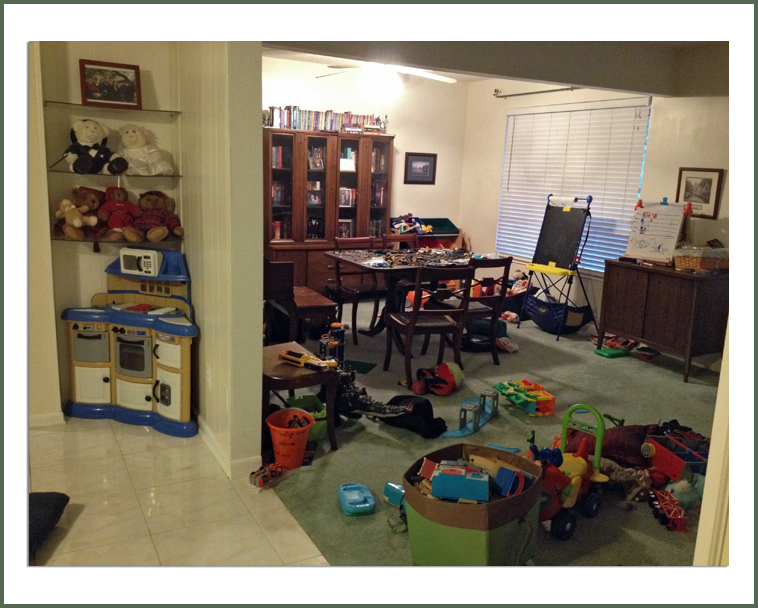
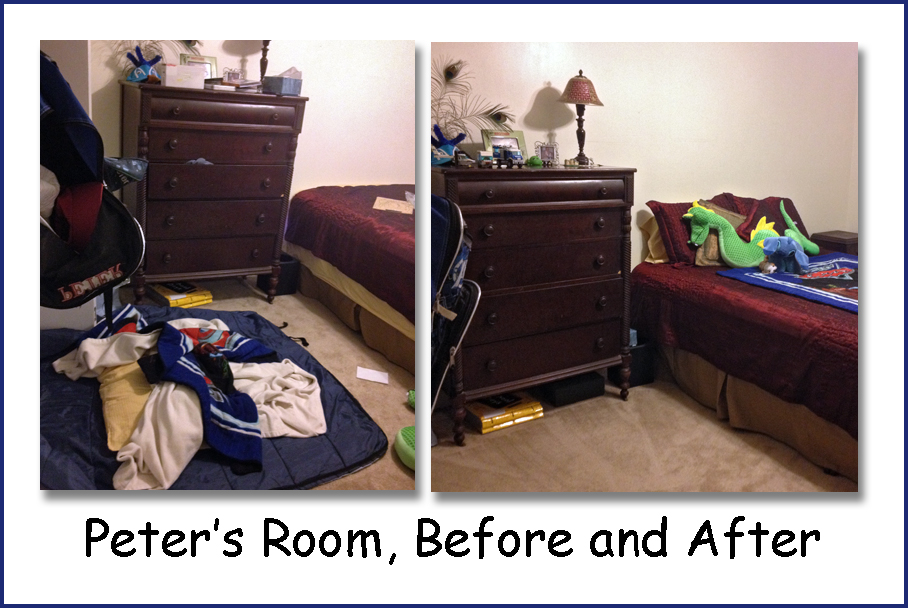
As for the interior of the house, it’s been the pits since before spring break, which was in March. People say that trying to clean while you have kids is like trying to shovel snow in a blizzard, which is true, but still. I have a nice little shelf with bins that will hold toys, if only the kids will use it. Then my elder son decided he wanted to sleep on the floor over eight months ago, and he’s slept there ever since. (Really – check out the picture.) So his floor is mostly taken up with a sleeping bag, which never gets picked up. Every once in a while, it gets so messed up that I straighten it, only to find a number of toys that we thought had disappeared.

Sleeping bag… and no more sleeping bag :)

Sleeping bag… and no more sleeping bag 🙂

With my summer dwindling – and although I’ve been busy, I have more free time now than I will when I start substitute teaching again – I need to take care of my house before it gets even more out of control. So this weekend is my opportunity. My in-laws are taking the kids for a couple days, and although I swore I would clean the last time they kept the kids, I didn’t. But this time, I’m tackling the mess. I’ll tell you, there’s nothing like being able to vacuum at three in the morning and not bother anyone, except for maybe the cat. (And sleep late because no one’s going to yell, “Mommy!” at six A.M.) It’s also nice to be able to pack away toys that my boys will never miss and donate them to children who will actually play with them instead of leaving them in the middle of the foyer.

So my life has come to this: it makes my day to pay someone to mow the lawn and to get rid of my kids long enough to clean up after them. Am I nuts, or what? My mommy-cation is not glamorous, nothing to write home about (although it does make for a convenient blog topic). And after all, my six-year-old gave Thomas and me his blessing to go out and have ice cream, see a movie, and have a romantic dinner. So, who knows? We may take him up on it… and come home to a house that looks like it belongs to civilized people.

The Happy Ending

The Happy Ending

So You Want to Write a Book – Well, Now What?

William Faulkner's Underwood Universal Portabl...

William Faulkner’s Underwood Universal Portable (Photo credit: Wikipedia)


Has this ever happened to you? You’re with a group of people – let’s say a moms’ group, with everyone exchanging tips and anecdotes – and someone says, “We could write a book.”

“We really could!” someone else chimes in.

Another mom even throws in a title: “Temper Tantrum on Aisle Four – How to Survive the Toddler Years!”

Everyone laughs, and they go about their lives and forget about it. But you linger on the thought that maybe you could write a book. Then again, the idea that you don’t know how to start – and what would make your book any more special than any other, any more worthy of the New York Times Bestseller List? – is intimidating, so your idea stays an idea and no more.

On the one hand, you might be right. Everyone does have a story (or three), and some of them aren’t worth telling (and those are the ones that seem to be repeated the most). But any time you impart a nugget of knowledge to someone else who seems to get something out of it, you feel that I-should-really-write-this tug.

Nowadays, blogs (much like this one) pick up the slack. A mom blogs about potty-training her strong-willed toddler, and other moms unite behind her or take comfort that they aren’t alone in the struggle. A man loses his job but figures out how to make a living from home – and writes a great how-to post. Someone with an incredible weight-loss story posts a menu and workout routine online to help others in the same situation. Blogs are great resources, and the topics they cover are endless.

But still, there are those for whom blogging and swapping stories around the water cooler aren’t enough. The problem is that they aren’t necessarily writers and don’t know what to do. The idea persists, won’t let them go.

Sometimes for decades.

I get all kinds of mixed reactions when people find out that I’m a writer. They want to know what I write. (“Novels? How can you write so much?”) They want to know how much freelance work I can handle. (“How do you manage it with two kids?”) They marvel that I’ve actually made an occupation out of this – you know, it’s not just a cute hobby. (“You mean you edit and write for a living?”)

And sometimes they ask me, kind of sheepishly, if I can help them with something they’ve been wanting to do for years.

One such person is a client of my parents’ business and happened to mention to my mom that she had a writing project. My mother said that I’m a writer, and the next time the woman came in, I was there. I gave her my business card and promptly forgot about it. I talk to a lot of people about my services, but that doesn’t necessarily mean they’re going to hire me.

A few weeks later, to my surprise, she called. She went into great detail about this project, one that she started over ten years ago. Her kids have been encouraging her to write a memoir because she’s led such an interesting life, but she doesn’t use computers, and the woman who helped her start it has been too busy to continue.

As I talked to this woman and learned her story, I realized that there are so many people who lead amazing lives, but some of the best details will die with them. They may not have a great command of the English language, but they have stories worth passing on. It would be a shame for this woman to never see her dream fulfilled just because she’s not a “writer.” I feel privileged to help her share her bit of history with her family.

Another opportunity arose in late May. I had just published my children’s book Hero (shameless plug – buy it here!), and Peter shared it with his kindergarten class. Afterward, one of his teachers mentioned that she has always wanted to write a book but needs help.

“Sure, let’s do it,” I said before I even knew what she wanted. Hey, I had just illustrated and published my first children’s book – I was flying high and felt like I could do anything.

Her face lit up as she described her 20-year dream. She used to take her children for bike rides around Amelia Island. They would stop at interesting trees, and she would make them create stories about how those trees came to look like that. Combining her love of nature with her interest in developing writing skills in children, she wants to create a book with photos of interesting trees and writing prompts. As with her own children, kids will “Look at this tree” and be encouraged to write a story about it.

It’s right up my alley. Although I’ve never created a book like this, I must admit that I love writing prompts. I love anything that starts with a tiny seed and blossoms into a beautiful story.

I really feel that I could give her a push – much like with a child on a bike with the training wheels removed for the first time – and watch her go, but I also understand that I’ve been in the publishing world for a while now, and it’s no longer mysterious to me. If you’re not right in the middle of it, though, you might think writing a book is unattainable.

I was there once. I’ve talked about my college fiction workshop before, and the second time I signed up, our instructor Ari pulled a group of us together (the ones who were serious about getting published) and gave us the low-down on publishing. 1) It’s a competitive market that’s difficult to break into, and 2) it’s still not guaranteed to be everything you hoped and dreamed even if you do get published. What Ari suggested was that we pull our best stories together and create our own publication. And so Fiction Fix was born. With his direction, we figured out what we were supposed to do, and more than 11 years later, Fiction Fix is going strong as an online fiction journal. We’ve grown quite a bit from that group of desperate writers who just wanted to see our stories in print; now we receive submissions from all over the world.

We were lucky in that we had someone who saw our desire to write and be read and who knew just when to push us. But for those out there with the desire but no direction, no help, no idea except THE IDEA for a story or book, the task can seem daunting. But here’s the thing: if you have a book that you want to write, the only thing in your way is your own indecision. Instead of dreaming or joking about maybe writing a book some day, you need to take action.

Indie (self-published) authors are more prevalent than ever. The internet has done many wonderful things for writers, on-demand and e-publishing being two of them. And even if you don’t write, these tools and their practitioners have made publishing a much more attainable reality than it used to be.

An internet search can give you everything you need, from writers’ support groups and social networks to online book publishing to lists of freelance editors (like me!). Don’t ever assume that the person you’ve just looked up is the real deal until you’ve done some research. (I learned this the hard way, regarding literary agents – read my story here.) Also don’t assume that the big companies are your only choice. Everywhere you look, you will find writers and editors with different levels of expertise. You’ll even find local printing companies, graphic designers, and illustrators who can all help bring your book to life. These are real people with whom you can share a cup of coffee – and your dream.

But if you’d like some resources, here are some websites to check out:

  • Kindle Direct Publishing and CreateSpace (Amazon.com’s answers to e-publishing and on demand publishing)
  • Smashwords.com (distributor of eBooks to every conceivable e-format)
  • Writer’s Digest and Writer’s Market (tips for writing and publishing)
  • LinkedIn (where professionals go to network – Facebook and Twitter are great, but if you want to connect with writers who can help you get started, I can’t think of a better place)
  • NaNoWriMo.org (Ever wonder if you could write a novel in a month? If you’re serious about this, I promise that you will have the writing experience of a lifetime.

So… do you have a story to tell?

Want to help with the writing prompt book?

Look at This Tree

Look at This Tree

The writing prompt book I mentioned is the brain-child of my friend Karen Saltmarsh. We’re going to title it Look at This Tree, and we’re looking for high-quality photos of interesting trees that could tell a story. To the left is an example from a park that I visited in Washington State. (Don’t you think there could be a secret hideout for some mythical, woodland creature under the roots?) If you have something you’d like to submit, please fill out the contact form on my Writing Services page, and Karen and I will consider your photo for her book.