The NaNoWriMo Loophole that Could Solve Your Early Inspiration Problem

Gearing up for NaNoWriMo.

Gearing up for NaNoWriMo (Photo credit: This Year’s Love)

Okay, I know I said “loophole,” but the solution I’m about to address isn’t really in the fine print. Anyone who cares to know what it is can just go to NaNoWriMo.org and read their FAQ. (Thank goodness for an organization that gives clear and concise answers.)

So what is this “loophole” that I’ve discovered, and what does it address? Well, excuse me if I digress by way of explaining…

Readers who have stuck with me since the beginning know that in 2012, I thought people were crazy to participate in NaNoWriMo (writing a 50,000-word novel from scratch, all in the month of November). Then in 2013, I had a change of heart. Or, that is, mere days (like two) before November, a story idea popped into my head, and I realized that I could wait a couple days to write and hope that magic would follow.

It did, and I am glad to say that it’s been the most fun I’ve ever had writing. Not only did I finish my novel, but I’ve edited it once and am currently putting the finishing touches on it, so I can send off to CreateSpace for my two free print versions, which I will then distribute to beta readers.

After participating once, I sometimes wonder what this November will bring. Will another idea come out of nowhere in the nick of time and make it possible for me to enjoy the same success as last year? Or could I possibly write a sequel to one of the other novels I’ve written, waiting until November to start? (This is what I consider a fallback option – but at least I do have a sequel that I’ve considered writing.)

I received an unexpected answer to these ponderings this past week. It hit me as inspiration almost always does – unexpected, uninvited. It’s not that I don’t like inspiration, but why can’t I be inspired at times when it’s a little more convenient?

I was driving across town when an image popped into my head. Two characters. And then a scene began to form. From there, it was a novel-size idea. And I was on my way to teach four- and five-year-olds in Sunday school, with no time to even jot down my idea.

I realized that this could be the idea I’d hoped for, except that it had arrived six months too early. I didn’t dare write anything except notes – character’s names and ages and little bits of backstory. If I wrote an actual scene or dialogue, that was it; I could forget using it for NaNo and would have to hope that either I could make the sequel idea work or that another novel-size idea would be born in the intervening months.

As it happens, I have several big projects in the works, and a new novel does not fit into my busy schedule. I barely had time to capture the scope of my idea in writing, much less sit down and let the prose flow. I figured that if I could stall long enough to finish these projects, maybe I could endure until November.

Being extremely busy, however, does not mean that I’ve quit thinking about this new, unwritten story. I’ve been walking around in a daze of possible scenes, sometimes whispering lines – maybe if I do this, I can make them stick. I’m sure anyone who catches me at it will think I’m nuts.

And in stolen moments, I’ve written loose descriptions of these scenes, where and when they happen in the flow of the story, creating – ugh – a sort of outline. Despite being a planner, I like to outline as little as possible when writing fiction. Yes, it’s great to know where a story is going and even some destinations along the way, but during the writing, the adventure is letting the story and characters dictate, day by day and scene by scene, what happens next. So waiting until November to write, allowing myself to put down bullet points and thus possibly boxing my story into a particular shape, isn’t sitting too well.

It’s gotten to the point that I’ve realized I can’t let this go on much longer. Once these projects are no longer occupying my time, and especially once school is out and the kids and I are spending a lot less time commuting and a lot more time at home, it’s going to be hard not to write.

I decided to check out the NaNoWriMo FAQ again, thinking that I would have to use the sequel idea if I wanted to be able to participate this year. I was sure that was one of the questions I saw listed before, but I wasn’t worried about it at the time and didn’t read the answer. Upon checking the site, I didn’t see the sequel question after all, but I did find something else. From their website:

We think NaNoWriMo works best when you start a brand-new project. However, what’s most important is being excited about what you’re writing. If you want to work on a pre-existing project, you have our full support!

Outlines, character sketches, and other planning steps are encouraged. Just be sure to only count words written during the month.

Here’s the loophole, people! Not only are sequels okay, but I could pull out something I started five years ago and pick up where I left off. The only words that count, however, are the ones I write in November, of which there must be a minimum of 50,000.

Hmm… This is very tempting. I can go ahead and write the scene that keeps popping in my head and won’t leave me alone – that way I don’t have to continue whispering it to myself like a crazy person. What I’m afraid of, though, is that once a little fissure opens in the dam, I’m going to invite the whole flood, and I won’t have 50,000 words left to write, come November.

It’s a risk I’m willing to take. After all, I have that sequel that could still work if this new idea takes off. And I think the NaNo people would agree that it’s wonderful that new ideas are still occurring to me and begging to be written. So I’ll hold off as long as I can, but when I can’t keep the creativity in any longer, watch out.

Related articles

Enhanced by Zemanta

Five Signs You Might Need a Book Intervention

Birthday Books

Birthday Books

When creating my list of books to read in 2014, I thought, I should be able to do this. I was determined to read more from this year’s list than I did in 2013. After all, there were quite a few books that I was excited to read; I was motivated. I did well at first, even reporting my numbers a few short weeks ago.

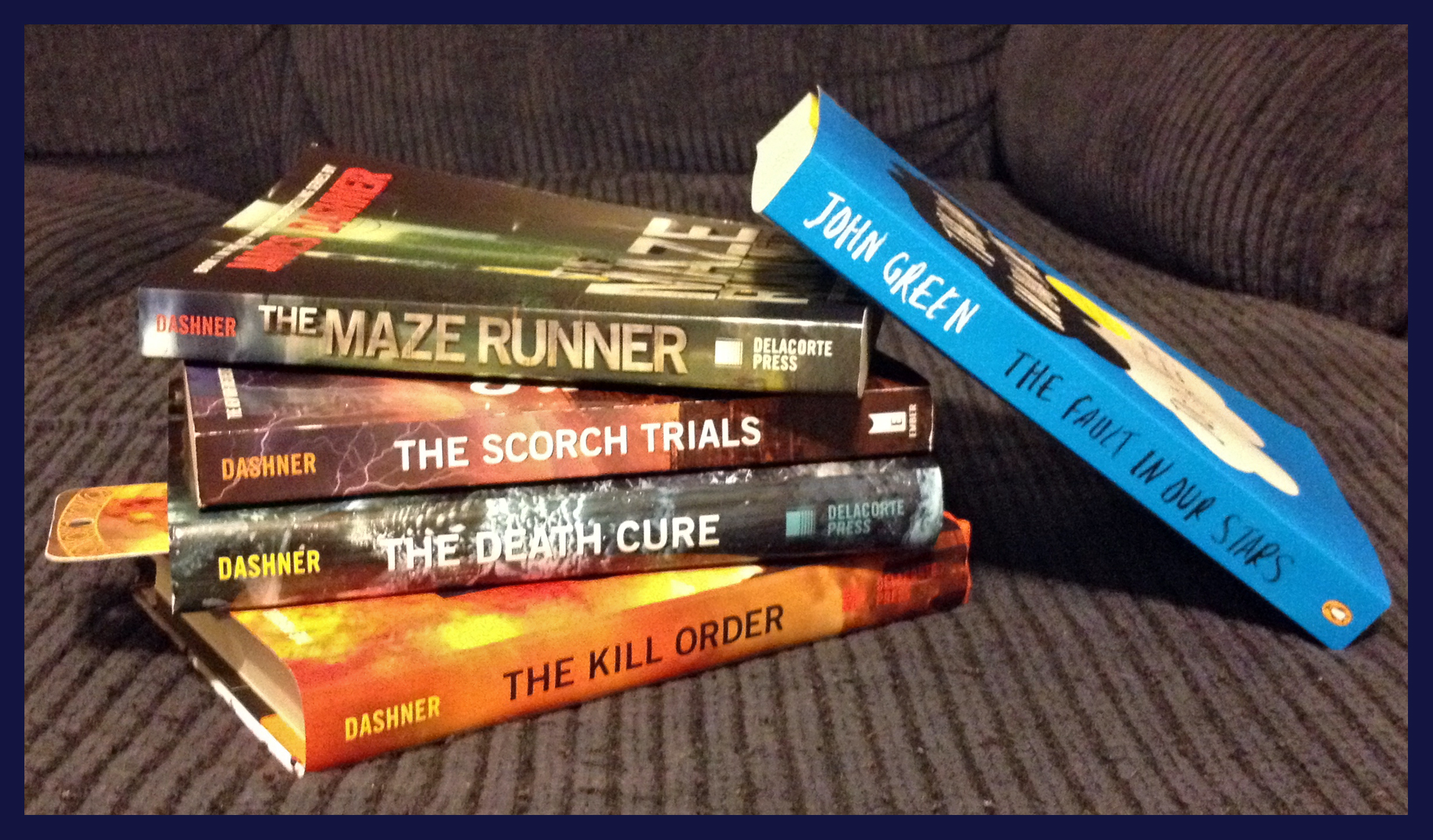
Then it happened. My husband, eldest niece, and I went to see Divergent, all having read and loved the series. And we got more than we bargained for while there: we were introduced to a book we hadn’t heard of, soon to be released in movie form, The Maze Runner.

I couldn’t help myself; I started researching it while still sitting in the theatre. Who was the author? When was it published? Is there more than one book? Why hadn’t I heard of it?

James Dashner, 2009, two sequels and one prequel – these were the easy answers. As for why I hadn’t heard of it, well, there are just so many books out there. Each new discovery adds another star or constellation to my reader’s night sky, and the funny thing is that I am never satisfied. Give me a good book, and it only makes me want more.

A few weeks later, when my husband asked what I wanted for my birthday, I got the bright idea that I could kill two birds if he got The Maze Runner for me. Since I knew he wanted to read it, too, he went ahead and bought it a few days early. I was dutifully reading another book from my list with the full knowledge that I would completely derail if Thomas said the book was any good.

Thomas pronounced The Maze Runner worthy, so I took the cash a few relatives gave me for my birthday and went to pick up the rest of the series. The cashier told me that if I didn’t care about them being a matched set, I could buy all three from the bargain section. Which saved me enough money to buy a fourth book, John Green’s The Fault in Our Stars.

That silly movie trailer, aided by a little extra cash, just made my original 2014 book list a lot harder to finish. I might need a…

Book Intervention

Here are five signs that you might need one, too:

1. You always have a book in the car, just in case you get stuck in traffic.

No, I don’t read or text while driving, but I do when stopped at a light. Hey, I have a very stop-and-go commute, and I get tired of listening to the radio. And if I’m not the driver, you better believe I have a book with me. I feel bad for people who get carsick – such a great reading opportunity missed.

2. You panic when you forget your book.

It’s one thing if you’re just going to the store, but it’s full-scale panic mode when you are stuck at a social event with nothing to do except make small-talk with people you hardly know. Or even people you do know. It’s kind of a joke among my family that I’m often in the background of photos, oblivious to my surroundings, absorbed in a book. Everyone’s opening Christmas presents, and I’m reading. Or I sneak a book into a movie to read before the lights go down.

3. You can never read all the books on your to-do list because you keep adding more.

When I was pregnant with my first son, I was determined to read every book in the house. I figured that I might never have the chance to read after my little bundle of joy came into the world. I’m happy to report that not only did I finish all the books in the house, but reading does continue post-baby. And ever since making that discovery, I’ve been buying more books than I can read again.

4. You spend your disposable income on purses big enough to hold a good-sized hardback.

Okay, maybe men don’t have this problem, but I certainly do. I also carry my laptop, so my poor purse was begging to be replaced. I’m happy to report that my new purse holds the laptop and a novel quite comfortably. Could I get a Kindle or just read on my iPhone? Sure, and I have. But I just love actual books (read more about that here), and I love owning them. The book fair is in town this week, and I think there’s going to be more backsliding, which means…

5. You forego putting your china out in favor of shelving your books in the china cabinet.

Or on top of the piano. Or in stacks around the house. I’m doing a pretty good job of keeping them neat (at least, I did until my latest quadruple purchase). But although I’ve dreamed of having a house with a proper library, I somehow think it still wouldn’t be enough. Give me shelves, and I will gladly fill them, then continue getting more.

You know, if this is a vice, I’m not sure I want to give it up. Please tell me I’m not alone. If this sounds like you, too, do we need an intervention, or just some uninterrupted reading time? Methinks the latter.

Happy reading.

Enhanced by Zemanta

When Easter Seems Far Away

Storm clouds over swifts creek

Storm Clouds (Photo credit: Wikipedia)

Easter is coming, one of my favorite times of year. I love both the sacred and secular aspects. I get a kick out of watching my kids hunt eggs, and every year, I look forward to preparing myself for Easter joy by first attending my church’s Maundy Thursday service. It doesn’t just commemorate the Last Supper but the events of Good Friday in the form of a service of tenebrae (darkness).

For me to truly appreciate Easter, I must first immerse myself in the grief of the disciples during Jesus’ last hours. No matter what you think or believe about him, Jesus was certainly real and suffered a terrible death. Imagine how his followers felt – people who had hope that he would put the Romans in their place and bring God’s kingdom as only a holy monarch could do – watching him be mocked and put to death in such a humiliating fashion. They must have lost all hope, unaware that Easter was coming.

Holy Week encompasses the lows and highs of humanity, much as some days or weeks stand out in our own lives. Life doesn’t wait for a time when you can handle it to fling you off your mountaintop into the valley. It’s only appropriate that I had one of those “stand out” days on Maundy Thursday.

It was a busy day. My kindergartner had his school egg hunt and Easter party, and his school day ended on a high. In the afternoon, I had to rush to get all my grocery shopping done and get through my usual chores, so I could go to church. As my children were splashing and giggling in the bathtub, I received the unexpected and numbing news that our family, with whom we just spent a wonderful vacation, had experienced a terrible loss. My heart ached, and I wished I could be across the country to comfort them. I felt helpless, confused. How could this happen? And during Easter week, of all times.

Because life goes on amidst tragedy, I went to church as planned, reminded that there are many people for whom Easter never seems to arrive – or is pulled right out from under them. I don’t mean the specific Christian celebration of Easter; I mean the rainbow that follows that storm, the light that banishes the shadows. Hope.

Everyone spends time in the valley, whether it’s losing a loved one, going in for a routine check up and leaving with the knowledge of a mortal illness, or being knocked flat by a sudden life change. During these times, our Easters are slow in arriving. We can become lost in the whys and trying to make sense out of something senseless.

As a writer, I often explore my feelings or try to work through a difficult situation by writing. Painters may lose themselves in acrylics and a blank canvas. Songwriters create some of the most moving melodies and lyrics. I’m thinking in particular of the stories behind the hymns Precious Lord and It Is Well with My Soul. These songs have brought comfort to generations of Christians, even though they were written from the depths of grief.

Enjoy your Easters, your mountaintop experiences. Unexpected joy is a gift that balances the dark times, the tenebrae of our lives. But don’t get so high in the clouds that you become deaf and blind to the darkness that still consumes others. Your own valley experiences can help you be the quiet listener, the compassionate friend, the comforter for someone else in need. You may not even realize that working through your own grief has helped the sun rise for someone who is still lost in the valley.


Precious Lord, take my hand.

Easter Lily (Animated)

Easter Lily (Photo credit: ClaraDon)

Lead me on, let me stand.

I am tired, I am weak, I am worn.

Through the storm, through the night,

Lead me on to the light.

Take my hand, Lord. Lead me home.

                                                                 – Thomas A. Dorsey

Enhanced by Zemanta

5 Reasons You Should Join a Writers’ Workshop (and One Reason You Shouldn’t)

English: Tessa Laird writing workshop

Writing Workshop (Photo credit: Wikipedia)

A common flaw among many new writers is the idea that criticism is bad, and any corrections made to their golden prose mars the original genius.

With the right attitude, however, this can be overcome in the workshop setting.

Yes, I was a new writer at one time – or at least new on the workshop scene. I was in my late teens and had been writing for years, but as for my serious attempts at fiction, the only people who had read it were teachers or family members, none of them writers. My mother can proofread like a fiend, and my teachers could tell me all day long what was wrong with my grammar, but as far as improving my stories, I was kind of on my own.

So I wrote grammatically correct, typo-free stories that just weren’t all that easy or fun to read.

I thought I knew how to write a bestseller. After all, I’d subscribed to Writer’s Digest from the time I was old enough to afford a subscription, and I read anything about the craft that I could get my hands on.

After visiting one fiction workshop, just to test the waters, I realized how much I could benefit from not just knowing how I should write but receiving critiques and criticism from other writers.


The Workshop Format

Not all fiction workshops are created equal. I’ve attended anywhere between 120 and 150 individual sessions, the majority in person (usually in a classroom setting) but a few online. Anyone who tells you online is preferable either has only experienced this version and doesn’t know better or hasn’t attended a live workshop with a successful format. Dialogue between the critique-ers is such an important element, and in my opinion, it’s hard to capture that online.

There are workshops for creative non-fiction and fiction alike. Choose whichever best fits your needs. I chose fiction, and I took my friend Ari’s semester-long workshop seven times, four for credit and three post baccalaureate. Workshops are available at colleges at the undergrad and grad levels, but I’ve attended others put on by small groups of writers who couldn’t commit to an entire semester or weekly meeting. The Internet is a great resource for finding one in your area.

Ari’s format was pretty straight forward. We almost always received stories a week in advance, read them and marked them with edits and critiques, and when we met for the workshop itself, we sat in a circle, and he read the story aloud. Then we started in with our comments and critiques, in no particular order, and we kept going until Ari felt we were done. The author sat among us the whole time but was not allowed to say one word or make any kind of gesture or facial expression to “help” the conversation. Authors were merely flies on the wall.

It’s tough being the author in this situation, especially those times when it’s obvious that no one gets it. But as Ari pointed out, the majority is often – although not always – right. If an entire room of people can’t make sense of the story, chances are that changes need to be made. How to implement those changes is up to the author, often based on suggestions from the other participants.

I’ve heard of other workshops in which the author is allowed to respond or engage in the dialogue, but as hard as it is to just sit there and take it, it really is beneficial to be silent. For one, the workshop is full of other writers who will all be in the hot seat at some point, and if you can’t respect one another, you don’t need to be there. The workshop is not a place for personal attacks but a place of learning and growth. It’s a place of safety, although not necessarily comfort. By not being able to respond, the author can learn where the story falls short because other readers are allowed to express their own perspective without the author’s bias.

I also know of workshops that allow the author to read the story, instead of the instructor or another writer. The problem with this is that the author will read it how he or she intends it to sound – whether it’s truly written that way. Another reader may not get the inflection right, may not get the exact cadence, but this will highlight for the author problems within the text. This is how, after all, the general public will likely read it – something the author needs to know.


5 Benefits of Joining a Writers’ Workshop

1. Meet other writers.

Many of us are introverts, and the idea of venturing out to meet new people is frightening. My writing meant enough to me that it was worth the discomfort of meeting a roomful of new people. I never intended to make life-long friends, never intended to spend time with these people or become involved in their lives. And that didn’t happen at first. But the wonderful thing about workshops is that if they’re effective, the same people will attend again and again. My second semester, a group of us bonded and created Fiction Fix, and it’s still going strong today, well over a decade later. My instructor and friend Ari gained such respect for me that he agreed to workshop my first finished novel. A few of the friends I made in the workshop have even chosen me as their editor. One recently published her first novel. (Check out Brightleaf.) Don’t complain that you don’t have any connections – join a workshop and start making some!

2. Develop a thick skin.

The publishing world is harsh. I know this from both having my own fiction rejected numerous times and working for Fiction Fix, where we’ve rejected a lot of… refuse. If you’re serious about publishing but cry every time someone says something negative about your work, you won’t make it long in this industry. Sure, some of the comments you’ll get are unwarranted, but you need to learn to filter out the hurtful stuff from ignorant jerks and utilize the nuggets of pure wisdom.

The workshop environment is the perfect place to grow your alligator hide because, as I said, it’s a safe place. No one’s out to get you, just to help you. Criticism is merely a means to help you improve. Your first workshop will be tough, but it gets easier, I promise.

3. Sharpen your editing skills.

Even if you don’t plan to edit professionally, it’s handy to be able to self-correct. Spelling and grammar may not be your thing. They are for me, but there are amazing storytellers who can’t spell their way out of a paper bag – and that’s what the professionals are there for. But after you’ve attended enough workshops – and I’m talking about workshops that tackle others’ stories, not just your own – you’ll start to pick up on things by osmosis, and you will inevitably meet an author or two who has concrete editing advice that will stick. You’ll soon find yourself looking for the errors in your own work that you’ve found in others’ stories.

4. Discover your own style.

My earliest stories were formatted after Michael Crichton‘s style. A few years later, I moved on to Stephen King. If you’re not careful, you can easily fall into the pattern of imitating whatever author you’re reading at the time. While imitation may be the sincerest form of flattery, it’s not good to let it dictate how you write.

What you want is a consistent style that is yours and yours alone. Just as you may be able to hear a song on the radio and immediately know who it is because of the distinct sound, you want someone to pick up your story and say, “Yep, this is Bob through and through.” (And I mean that in a good way, of course – not “Oh great, it’s him again.”) Sure, you may borrow different aspects from your favorite writers, but the end product should be all you.

In the workshop setting, I learned about POV (point of view), clichés that drive people nuts, and “rules” that may not be grammatical law but are certainly stylistic norms among seasoned writers. Yes, these issues are covered in any number of books and blogs and interviews, but it’s so much more informative to get this information in a practical setting. It took me a year of workshops to find my own particular style, my writer’s voice. And it sticks whether I’m writing children’s picture books, middle grade fantasy, young adult dystopian fiction, adult sci-fi, or even this blog.

5. Improve your writing.

This may be your ultimate goal, and it’s certainly a worthy one. If you come to the writing table with an open mind, the above four will automatically improve your writing. You’ll have friends who care enough to be honest about what does and does not work, who will support you in every literary endeavor (and then some); you’ll mature enough to be able to hear their criticisms without getting your feelings hurt; you’ll develop the tools necessary to not only fix what needs to be fixed but to not make those mistakes next time; and you’ll create a style that becomes your own literary hallmark. Sure, I still write garbage that’s not fit to print. But I’ve internalized so much valuable advice that I have an inner critic who says: You’re going to write that?! You know better! Many of my first drafts are better than what I thought of as “polished” in my pre-workshop days.


Why You Shouldn’t Sign up for a Writers’ Workshop

There are many other benefits of joining a writers’ workshop, but if you read #5 above and thought, I don’t need to improve my writing, then maybe you need to step back and do some soul searching.

I find it sad that some people are unable to improve because they simply use workshops as a venue to receive accolades for their writing. They are very disappointed when someone points out flaws. How dare they! these writers think – and sadly, a lot of them are not new to the writing game. They should know better. One older writer who attended my first workshop quit after his story was critiqued because we didn’t give the response he wanted, and he didn’t think he could get anything else out of our sessions. Another writer was so disillusioned when no one understood his story that he refused to go back and make changes. These are the  type people who most need the workshop and, sadly, get the least out of it because they refuse to think they need to improve.

I do admit that I expected praise for my brilliance when I workshopped my first story. Turns out it wasn’t quite as brilliant as I thought. I was taken aback, sure, but I learned a lot. So I guess I need to add, as a prerequisite, that you should leave as much of your ego as you can at the door – and then just leave it there for good.

If you can do this, your workshop experience will change your writing life in unexpected, life-changing, and lasting ways.

Enhanced by Zemanta

What to Read, What to Read?

My Books

Books (Photo credit: Jennerally)

At the end of 2012 and again at the end of 2013, I posted lists of the books I planned to read in the next twelve months. I’ll have to say that I’m pretty proud of my progress so far. It’s just into the second quarter of the year, and I’m already on the tenth book from my list of 23 titles. I’ve only gotten sidetracked once so far (something that happened quite often last year), so I have some hope of actually getting through my entire list.

It was fun looking at the year ahead and asking myself, “What do I want to read?” Whereas many people look forward to vacations and promotions and other big events (and I do, too, don’t get me wrong), I love the anticipation of discovering new fictional landscapes and re-reading some of my old favorites.

When it comes to choosing books, I know that some people read book jackets and may even skim a few pages before making a final decision. Others will look for titles that have won awards. But that’s not really my style. How, then, do I choose the books for my list? Many times, I read books by authors that I’ve read before. If I’ve had good luck in the past, I’m likely to read more titles by those authors.

Other times, I’ll either see a movie or the preview of a movie based on a novel, and if intrigued, I’ll pick up the original books. This happened most recently with the Divergent series, which I read, then saw the movie. It also happened with Harry Potter. I saw the first two movies, then jumped on the bandwagon. Every time, I’m pleased that I got the books because there’s just so much more to love on the written page.

Lastly, and perhaps the greatest way to introduce me to new books is through recommendations and reviews from friends who know what I like to read. In fact, that one extra book I’ve read this year was from a friend who is responsible for lending me some of my favorite titles. When I see someone with similar tastes with a book in hand, I’m always interested to see if there’s a new favorite in the making.

I love personal recommendations and book reviews because they’re not written by some writer who’s paid to make books sound good. Reviews have sometimes saved me from wasting my time (“It turned out to be a good love story in the end, but the writing wasn’t any good.”) and have often encouraged me to try books that I might not have read, otherwise (“It’s long, but you’ll want to make time for it.”).

My regular readers know that I’m on the staff of Fiction Fix, and one of our goals is to not only publish great new fiction but to also encourage people to read until they’re full to overflowing. In order to mix up our blog a little bit, we decided to write book reviews – but in new and fun ways. The first way was in haiku form, the second as six-word reviews. Read the whole story here, and check out the haiku reviews, all of which are now up. (One six-word review is available, with more to follow.)

I don’t know about you, but these reviews have certainly encouraged me to expand my library, yet again. And it’s never too late to make your own “must read” list.

Song of Years haiku

Enhanced by Zemanta

Quit Worrying! (Advice from a Veteran Worrier)

I am branching out and doing something new today: typing this blog in my WordPress app in my phone. It’s not something I ever thought I would do; in fact, when I first got the app, I wondered who in the world would choose to use it for that purpose.

Now, I’m not spontaneous and blogging on the fly. The blog I planned to post this weekend is sitting useless on my computer while my wifi access is down.

If you know me, you know I’m a planner, and this was not a part of my plan. We’re on vacation over 3000 miles from home, and wifi access wasn’t a problem until last night.

I could flip out, but I’m trying to embrace challenges. And after all, we are on vacation. So why not try out my app to post a blog?

I got thinking this morning that our vacation has worked out much better than I imagined. For a week or more before we left, I worried about flying with a two-year-old and that my kids not adjust to the time change. I didn’t work myself up to a nervous breakdown, but the worry was there, nevertheless.

Then my toddler slept for almost half of our longer flight. And he and my older son have slept like champs the whole time. My little one has even conquered the steep flight of stairs where we’re staying, another thing I could have worried myself sick over.

Is it the Bible that says that you won’t add a second to your life by worrying? Well, whoever says it, I can embrace that idea right now. There are so many details I could be stressing out about, but I’ve done my best to prepare the best I can and just come to peace with whatever may happen. And I’ve really been able to enjoy myself by pushing those worries to the background.

Really, all I’m worried about right now is if the cloud cover will clear up enough to let us see Mount Rainier before we go. My sister-in-law assures me it’s there, but I think it might have taken a vacation, too.

Are you a worrier like me? Don’t let them take over and ruin your day or vacation or life. Make what preparations you can, and then tell your worries to take a long hike.

20140329-094928.jpg

Why Can’t I Take a Vacation from Writing?

I love my vacations. I love the flurry of packing and cleaning and setting everything in order to be gone for a while… and then leaving. Then, while on vacation, people look at me like I’m crazy while I type away on my laptop. No, I’m not getting caught up on a client’s work. In fact, I’m not guaranteed to ever make one penny on what I’m writing. So why in the world am I doing it?

filedesc http://www.epa.gov/win/winnews/images...

Typing Away (Photo credit: Wikipedia)

For non-writers, understand that it’s not as simple as putting away the typewriter or laptop or fountain pen – whatever your writing implement of choice.

Remember when Stephen King said he was going to retire? This was well over ten years ago. I wondered how serious he was at the time: I certainly couldn’t imagine having a successful novel-publishing career and just giving it up.

In fact, King didn’t say he was going to quit writing at all, just that he thought he was almost done publishing. If you’ve read any Stephen King novels published since 2002, you’ll see that he’s apparently still not done. But even if he were to never publish another novel, I can’t imagine that he would quit writing. How many other professionals could do the same?

Consider people who have careers in the military or law enforcement, medical practitioners or pharmacists, teachers or professors – really, I could go on all day. Most professions are finis at retirement. You walk out the door, and you don’t come back. And until then, you take vacations, leaving all work behind for abbreviated periods of time.

But as with Stephen King, we writers have a somewhat different situation. While it’s absolutely appropriate to take a vacation from client work for a week or two, maybe even “retire” from the public scene, I never just leave my laptop at home or put my stories on the back burner.

My stories aren’t just going to take a vacation because I’m out of town. In fact, my NaNoWriMo novel, which I’m currently editing, woke me up early this morning, filling my head with new ideas. Sure, I could ignore them, try to recall them all in a couple weeks, but I’d likely forget them before then, not to mention that it would make me miserable to not work on my novel. In fact, I don’t even know if “work” is the appropriate word. Sure, I’ve spent a lot of time on it, but writing is a vacation in itself.

That’s not to say that I’m going to write to the exclusion of my family and our vacation plans. I’ll soak up the new experiences, laugh a lot, and sleep too little. But I will also take advantage of the time away to squeeze in as much extra writing as I can because I love it.

And, God willing, I hope to type away past retirement age and die with my fingers poised over the keyboard.

Enhanced by Zemanta

Three Ways to Manage Your Busy Schedule – Instead of Letting It Manage You

Laura's work desk 13/05/2008

Piles of Work (Photo credit: Laura Whitehead)

After substituting in kindergarten for the third time this week, I drove home with that relieved, TGIF feeling. I love teaching, especially the freedom of being a substitute, but it makes for a busy day, often with no breaks or time to think.

But the entire weekend stretched ahead of me, with plenty of time to decompress and do the things I wanted to do.

My little fantasy didn’t even survive the drive home. I knew there was a pile of laundry waiting to be washed, plants that needed to be watered, sippy cups to be washed and refilled, and I still had my daily bookkeeping duties for the family business that I’d put off in order to substitute.

When I walked in the door, I discovered more things to do: a book sitting on the kitchen table that I need to read for a class next week; a pair of pants that need to be re-hemmed; a looming trip to the store before my son’s t-ball game. Oh yes, and then the t-ball game itself.

I also took on a new project today that I have to finish before we go on our spring break vacation, plus a novella to read for Fiction Fix, not to mention my personal fiction projects. Sometimes it’s hard to figure out what to do first when there are so many tasks at hand. Better just to take a nap and ignore them all, right?

If your life follows a similar pattern, you may feel that you’re always behind and rarely or never get to do anything for yourself. And it’s all too easy to give in to a negative attitude.

When Peter started playing t-ball, I dreaded the practices and games. My time is already so limited that I didn’t know when I would ever get anything done.

I had two choices: succumb to despair and have a nervous breakdown, or adapt and make the most of my new schedule.

I chose the latter, and you know what? I’m still able to embrace all the new projects I’ve taken on, and I’m even finding that elusive “me” time. Here are three tips that have helped me, and I hope they’ll help you, too:

1. Use Technology to Your Advantage

I know of people who have gotten rid of their TVs and phones because of the distractions they cause. If this seems a little drastic to you, there are ways to turn your electronics into a boon rather than a procrastinator’s crutch.

Did you know that there are a plethora of apps and computer programs that can help you manage your time? Some, like SelfControl from Mac users or SelfRestraint for Windows, block the internet altogether for set amounts of time. Just search for “time management apps” to see lists of what’s available and which one best fits your needs and personality.

Some of you may be able to control your electronics use by sheer will power. I fall into this category. I used to check my email any time I woke in the middle of the night, and the result was that I always had a hard time getting back to sleep. I finally made a deal with myself: don’t check email at night. It was as simple as that. If someone texts me, I know it’s urgent. Otherwise, it can wait.

Another thing I love is my phone’s timer, which I use in conjunction with step number two.

2. Take Baby Steps

When I have enough projects to fill a mile-long to-do list, I tackle them a bit at a time, baby-step style, and there are two ways to do this. As mentioned above, you can use that handy timer on your phone and work in blocks of time, or you can set goals, like editing one chapter and then moving on to a different project.

I’m currently rotating five projects in this manner, employing whichever method makes sense for each project, whittling away until they’re done. At the end of a hard day, instead of feeling like I’ve fallen short by ignoring one project while spending all my time on another, I can see that each one is closer to completion, even if only by a little bit.

3. Schedule Recreational Activities

It is very discouraging to run into someone on a Monday and have to come up with an answer to the “What’d you do this weekend?” question. I often stand there in utter silence, knowing I was busy but not able to remember anything specific. “Oh yeah,” I might say after a few seconds, “I weeded the lawn all day Saturday.” Exciting stuff, right?

When piles of laundry, flowerbeds full of weeds, grad school projects, and your kids’ sports schedules hijack what could have been your spare time, you feel like you’re stuck in a rut. This is when you can get in trouble by either going off the deep-end and throwing all responsibility to the wind, or you can wallow in self-pity and start hating anyone who did manage to enjoy her weekend.

If, instead, you schedule regular periods of recreation, just as you would schedule all the work that you need to do, you will have something to look forward to every day.

This is easier said than done, I know. Part of my personal promise to myself was to leave work well enough alone after my kids were in bed every night. If I could just hold out until they were in bed, I could read or write whatever my heart desired. But sometimes there’s not enough time in the day to get all my work done, and there’s still quite a bit left to finish after the kiddos are down. But I still make sure that I read or write or watch the occasional movie because my brain craves that break. Afterward, it’s much easier to work.

You may have more time but feel guilty about using it. Don’t! Fit in the occasional golf game or fishing trip or cup of coffee with a friend, if that’s what floats your boat. If you ignore opportunities such as these in order to “save” your enjoyment for a blow-out, two-week vacation that eats up a quarter of your annual salary, think of all the misery you’re subjecting yourself to in the meantime. Wouldn’t it be a shame to turn something you used to love doing, such as being a freelance writer, into a task to which you feel enslaved? I would rather have a few minutes of rest or fun every day, and the vacations, although they aren’t many, are truly special.

However you choose to do it, find time to do something not work-related on a regular basis, and you will be able to attack your projects again with renewed vigor and enjoyment.

Oh, and by the way, your house is patient: it will wait for you to clean it. Wash you underwear, by all means, but I won’t look at your baseboards if you won’t look at mine.

Do you have too many things to do 24/7/365? How do you manage your own workload?

Enhanced by Zemanta

The Surprise Lurking in My Playlist

IPod Nano

IPod Nano (Photo credit: Wikipedia)

I’ve talked about the different forms of inspiration before (and it applies to me specifically as a writer, but I’m sure it applies to other forms of art as well), and today I especially want to focus on music.

I’m a musical person from a musical family (read more about that here and here), but it wasn’t until this past week that I was reminded again of how much it can influence my writing.

Back when I used to have a fantastical picture of what a full-time writing life would look like, I figured that my house would come equipped with a separate office just for me and all my journals and manuscripts, a computer dedicated to my writing, and of course a custom sound system, through which I could pipe Metallica while I wrote. Yes, Metallica.

I was thrilled one day when I read that Stephen King, my favorite American author at that time, listened to Metallica (among other groups) while he wrote. Of course, I thought that this was prophetic and pointed to the life that I would surely lead.

Fast forward twelve or thirteen years, and there’s no separate office. I type with my MacBook in my lap while my kids watch Disney and vie for my attention. So this certainly doesn’t allow me the seclusion necessary to listen to whatever I want at any volume.

I still do like Metallica, though, so that’s something.

Still, when I write, it’s not in the environment that I figured was conducive to creating brilliance. I’ve learned to adapt, and I actually embrace writing in the midst of chaos, but there are those times that I realize there’s something to at least a part of that idealistic setting – the music.

Years ago, while I was in the thick of writing one of the books in my middle grade series, I was driving along, listening to just another song on the latest CD my husband and I had bought. I did not at all expect the scene that suddenly popped into my head, evoked by that particular song.

Part of it had to do with the lyrics, which described what happened in the scene, but there’s also something about the tune. That combination brought this scene fully-formed into my mind. I saw one of my characters going through something that wrenched my heart. I didn’t want it to happen to him. I fought it with all my might, but every time I heard the song, the scene returned. My conclusion: it belonged in my book.

Now, there are other songs that I like because they energize me or put me in a calm mood for a scene that needs a little more finesse. But I can never predict when a song will give me a missing piece of my story puzzle.

It happened again this week. I was driving along, listening to the playlist that my husband put together for me, so it has a quite a few songs that I never would have thought to pick for myself. I suppose that’s why it was so unexpected.

Instead of the music just washing over me, as it had with the last few songs I’d listened to, I suddenly started listening to the lyrics, and the words immediately created a new scene, one I certainly never considered when I formed the loose plot of my series.

This is why I think it’s so important to allow myself freedom within my plot. Sure, I have a rough outline, since I do need to make sure that I introduce important clues at the right time and have a general idea of where the story is going. But I was surprised that, yet again, a key character was facing something unexpected, something I don’t think I ever would have come up with on my own.

Thank you, song, for both disturbing me and enriching my story. It actually kept me up for about an hour-and-a-half that night, as I tried to figure out where my story was going. And I realized that it made perfect sense; it allowed another of my characters to realize her full potential in a way that wouldn’t have been possible if I’d gone according to plan.

Have you experienced any storyline surprises, inspired by something that you thought was completely unrelated? You just never know when it will happen or what will bring it on, but I think that writers live for those moments.

Enhanced by Zemanta

I’d Never Make It As a Salesperson

English: White hat seo symbolizes good ethic t...

SEO – search engine marketing (Photo credit: Wikipedia)

I can almost always pick them out from the normal customers before they ever walk through the door: sales people. (Inject a little venom here.) They almost always come in pairs, dressed in business suits that have seen a little too much wear, carrying fancy, embossed folders of useless information that will likely go in the trash as soon as they leave. If at all possible, I try to disappear before they even know I’m there. If not, I foist them on my poor mother. She handles confrontation and can say “no” while maintaining eye contact much better than I can. I can only function as an extrovert so long before my true introvert self shuts me down.

But I can’t very well disappear when I answer the phone, and there’s a telemarketer on the other end.

Maybe you’re wondering why this is even a problem for me. The truth is that I’m more of a kids-come-with-me mom than a work-at-home mom because my parents and I run our family business (photo finishing, in case you wanted to know). My responsibilities are mostly on the bookkeeping end, but I am in the office often enough to deal with the scary stuff – you know, interacting with perfect strangers. It was this having to talk to people aspect that made me swear  I would never work there, but when the whole becoming a bestselling novelist in the solitude of my own home thing didn’t work out as planned, I had to work somewhere. At least I like the other people I work with.

Over time, I’ve built a friendly facade that’s tough to break, but the sales people always manage to crack it. This week, the call came from a very prominent Internet browser listing service. A woman with a very heavy foreign accent told me she just wanted to verify our address. Since some of our customers have complained that our old address is still showing up on Internet searches, I thought it best to update our free listing. I should have just hung up like I usually do because I had to talk to a marketing specialist to complete the change of address. I told Foreign Accent Lady that I would absolutely not spend any money – “marketing specialist” did not sit well with me, and for good reason – but she assured me it would only take two or three seconds of my time, and I would be done.

I don’t even remember if the marketing specialist guy verified the new address, but I do vividly recall the rest of the twenty minutes or so, during which I tried to decline his services as kindly as possible. He started by checking how our website fares in local searches, but after its keyword search performance came up sub-par, he got his first bit of ammunition: we obviously don’t know how to get our website to show up in keyword searches, and he’s the only person who could possibly help get our website to the front page of any search in our area.

I bit my tongue, thinking: why didn’t I write the copy for the website? Much of it is over a decade old or cobbled together because we’re a tiny operation and spread too thin to give it the attention it’s due. Part of me wondered what the guy would say if I explained that I knew how to improve the website, but I was eager to get off the phone and didn’t feel like hearing him insult my skills.

Instead, I tried to explain that we get most of our new business by word-of-mouth and that, despite the apparently dismal results, plenty of people do come to us after finding us online. I told him that we’re a niche market and can’t compete with the places that come up first in searches: Target and Sam’s and Wal-Mart, among others. Our prices are higher, and for a good reason: we provide higher quality work. Well, but if more people in our area saw us pop up on the front page of their Internet searches, the marketing guy reasoned, they would call us, and higher call volume means a higher number of paying customers, right? Theoretically, yes, Mr. Marketing Specialist. Unfortunately, our business does not operate in a theoretical world.

Of course, Mr. Marketing Specialist works for a big company that never struggles to give him a paycheck or keep the lights on. It doesn’t look at the month’s bills, realize there’s not revenue to cover them all, and decide which ones can afford to be late, hoping the phone won’t get cut off in the meantime.

As he was attempting to use his powers of persuasion, telling me that if you’re hungry, you stop at the nearest McDonald’s, not the restaurant two miles down the road, I knew that it was a lost cause. Why was I even trying to make him understand our business? The food industry is doing fine because people need to eat. But people don’t need photo finishing. We’re lucky we’ve hung on since 1981. And thanks to technology and the big box stores, it’s been by the skin of our teeth. People will gladly drive out of their way not to come to us because they don’t understand how we differ from the competition. We’ve had people walk in who need a service that no one but our business can provide, and they still walk right back out because they can’t pay what it costs for us to do the work. C’est la vie.

How do you explain to someone that your business doesn’t conform to the rules? You don’t, and you eventually have to hang up, which I did. Taking after my father as I do, I left the conversation sweaty and shaky. Why? Because, as much as I hate confrontation, I can dress someone down over the phone like I never can face to face. And I’m not proud of the last couple of minutes of that conversation. But to be fair, I did say that I wasn’t going to spend money, and when he decided he didn’t believe me and even brought in my personal life as a last-ditch tactic, I left the conversation.

The people at the electrical company will thank me for paying them instead of him.

The one positive thing that I took away from the conversation is that I can solve our Internet search problem myself. I write good SEO copy for other people, and it’s time I do it for the family business, too. I’ll get more business to our website through old-fashioned hard work and my own prowess, and I’ll do a much better job than someone in California who compares us to McDonald’s.

Despite being the one with the last word, I had a nagging feeling that I’d done something wrong. I love hearing others’ stories of sticking it to the telemarketers – they get what they deserve! But it never feels as exhilarating when I do it myself. Instead, I feel like I’ve let myself down.

There are talented people in sales out there – and I’m actually very good at it when someone comes to me – but the others, the ones like the guy I hung up on, aren’t in their element. I feel for him because he sounded so absolutely desperate to get my business. But maybe the reason he’s doing so poorly is that he lacks the skill that effective marketers need most: that of listening to and understanding the needs of their clients. Maybe I have a little pity for him because I know he’s a normal person with a miserable job – and I would probably sound just as desperate, were I in his position.

Still, if I ever decide that brow-beating someone into using my services is the best way to market my skills, please let me know it’s time to quit. Yes, getting the word out is slow-going when you go the word-of-mouth route, but I think that happy customers speak volumes louder than search engine results that don’t know an editor from a word processor’s spellcheck.

And if you’re the type of person who goes with the first search result by virtue of it being first, it probably wouldn’t be a good idea for us to work together, anyway.

Enhanced by Zemanta