When Is It Okay to Have?

English: The iPad on a table in the Apple case

iPad in an Apple case (Photo credit: Wikipedia)

This week, a small group of friends and I pondered when it’s okay to not just want but to have new things. We live in a commercially-driven, consumer culture, in which to have is often portrayed as the greatest good. To not have… Well, what’s the point of living if you don’t have the latest and greatest thing?

There has always been a disparity between the haves and the have-nots, but in a nation when even the poorest of us can have a free cell phone and access to computer technology through public libraries, it’s easy to mistake great strides in progress with a feeling of entitlement to those things progress provides.

Trying to pinpoint when our culture made this shift, I automatically thought of the iPod, the iMac, the iPhone, and the iPad, just to name a few. Now, I enjoy my Apple products, but why the focus on “i”? The way we treat these commodities as if we can’t function without the latest version, I think the more fitting prefix would be “my.”

But the problem has been around much longer than that. When was it that women decided that the fancier the diamond ring, the more they’re truly loved? When did it become not just okay but common practice to take out a second or third mortgage in order to pay for a wedding? When did we allow our children to become miniature dictators about their birthday celebrations, pitching fits amidst balloons, presents, and pony rides because it’s still not enough? When did we start labeling entrees that could easily feed two or three as a single meal, convincing consumers that normal portions are not enough?

Have I touched a nerve yet? Even those of us who strive to live more simply can’t help but be affected because we live in the middle of Overabundance and Overindulgence Central. And when the extreme becomes the norm, you look like the odd one out when you try to reclaim the former, simpler ways.

Simpler does not mean easier, by the way. Nowadays, for example, it’s a real fight to encourage kids to be creative on their own, without the influence of TV. Yet we have fancy flatscreens with hundreds of channels and DVRs to record all the shows that we cannot live without. We think about the joys of living in harmony with nature, maybe off the grid in a little cabin. And as long as that cabin comes equipped with wifi, well and good because God knows it’s going to get boring listening to yourself think too much.

I am just as guilty as anyone else, which is probably why I’m coming down so hard. While I’ve never been a technological pioneer (I’d rather let someone else figure out the glitches first), I have succumbed to the “i” fever and feel practically naked if I leave my house without my MacBook and my iPhone. I own ridiculous winter clothes that I either choose to wear in the heat (because I live in Florida) or that I refuse to get rid of because it snowed here in 1989, so it could happen again any time, right? I dream about a five-bedroom house, yet we’re a family of four. I don’t dream about cleaning all that extra space, of course, but wouldn’t it be nice for each of the kids to have his own room, plus a spare for guests, and an extra one for an office or just storage for all my – gulp – junk?

There is something addictive about wanting more. And simply getting more does not solve the problem. It’s the pursuit that drives us. It’s the difference between those who work 60 hours a week in order to pay the bills and those who work all that extra to be able to acquire more stuff that they don’t need.

My friend was worried about her desire for an iPad. Everyone has one, right? She salivates over them, while chastising herself at the same time because the money for an iPad could be money toward a good cause. Should we never get anything we want? Should we sell all our possessions to help the poor and take a vow of poverty to make things more fair? And what then? We see the iPad we wanted to begin with, salivate over it again, and then feel both envy and an undeserved self-righteousness that we are so good to deny ourselves what we so want.

I think both extremes are dangerous. On the one hand, you have people who obsess over things. They ruin their lives not only by buying what they don’t need, but by continuing to do so to their financial and emotional detriment. On the other hand, you have people who are bitter in their denial of self.

The problem lies in that people don’t care. Or maybe they care too much – about the wrong things. They don’t even try to justify anymore. It would be so easy to say, Once I buy this [fill in the product of your choice], I’ll be more efficient, and I’ll have more time to spend with my family. And that’s a good thing, right? But more often, we say, I want it, therefore I deserve it, and I don’t care what lengths I have to go to in order to get it.

My friends and I came to the quasi-comfortable conclusion that it’s not wrong in and of itself to spend money on a new iPad or a nice outfit or whatever. Sometimes a little gift to yourself can lift your mood, help solve a problem, or keep things on an even keel, so you don’t drown in the extremes.

But before you make that next purchase of whatever it is, think about the purpose your things serve. Or put another way: is the new iPad serving you, or are you serving it?

Why I Will Never Outgrow My Love for Physical Books

Books 2008

Books 2008 (Photo credit: // Denise //)

I recently recommended a book to a friend, then offered to let him borrow my copy. I half expected him to refuse, not because he wasn’t interested in the book but because he is a tech-savvy guy: I figured he would rather read it on an e-device. So I was surprised when he accepted my offer, saying, as if surprised himself, that he has read so many books on his Kindle lately that he was craving the experience of reading and feel of a paper book. I think he’ll be really pleased when he reads this one (the one on top picture below, Bess Streeter Aldrich‘s Miss Bishop). Just the texture of the cover puts me partly into the world of the story.
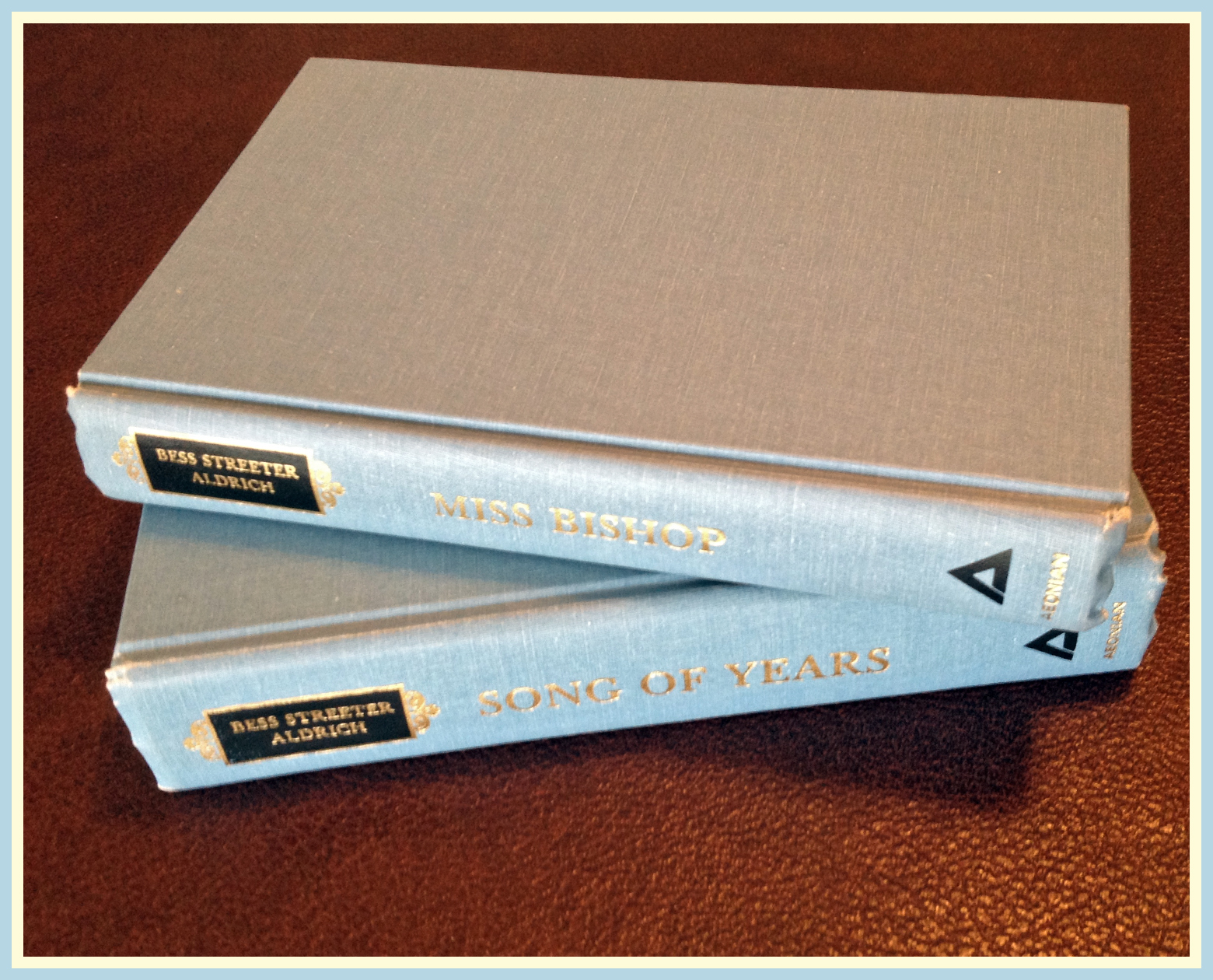
Books by Bess Streeter Aldrich

Books by Bess Streeter Aldrich

There is a giant push in the publishing industry, as well as a movement in modern readership, toward e-publication. And as someone who edits for an online literary journal and makes much of her living online (including one e-published short story at Smashwords.com), I am grateful for this technology.

At the same time, I still nurture that dream of some day walking into a bookstore and seeing my book on the shelf. (Or even better – seeing it purchased by an eager reader.) I cannot imagine any author not wanting this. But with the chances of landing an agent or publisher being so slim and the cost of self-publishing prohibitive for many, e-publishing is quite attractive.

When I was in the seventh grade, I was part of a small research group that researched and proposed a new kind of virtual book. It was the mid-1990s, and we didn’t even have the internet available for us to do our research, so this was quite a far-reaching idea for the time. We hoped that we would win an award – and maybe even enough grant money to create a prototype. But while I was honored to be chosen to work on such a project, the idea of the product really bothered me. Everyone else in the group was excited to create some virtual experience that would make people never want to go back to the traditional books again. I quietly kept my qualms to myself.

I doubt it was just my feelings about the project, but it never went anywhere. That doesn’t mean, of course, that the industry didn’t move forward without us. And there is a great use for e-books – don’t misread what may sound like a lack of enthusiasm on my part. I have a friend who travels all over the world and is also an avid reader. Her Kindle is her best friend. She can load eight or nine books on it for her trip and never have to worry about all that extra bulk in her luggage.

Tablets have so much going for them, and they only get more sophisticated as time goes on. Some books are only available via e-reader, and it’s much more convenient reading them on a tablet or a smartphone then having to sit at your desktop every time you want to read. I’ve purchased several books and read them this way, and what’s great is that I can read and fold laundry at the same time, not having to worry about the book flipping itself closed. If I ever end up some place with only my phone to keep me company, I have any number of public domain books available with one swipe.

So why would I ever need a physical book again? I mean, aside from wanting to publish one, of course. It would do me no good to see one on a bookstore’s shelf if people suddenly decided they didn’t want books anymore. But they still do. Even though they cost more. Even though they take up space.

I would have to argue that there is something viscerally satisfying – and I’m not talking about eating the pages. It’s something in the feel of a physical book that trumps the convenience of e-books. Especially if, like my friend, you haven’t read one in a while. It just feels good to run your fingers over the pages, to hear that rustle of paper. Sometimes the texture is fine. Sometimes the pages are thick. And when you’ve been with a book for a while, you wear it in like a good pair of shoes. You know the feel of it in your hands, and it’s not just the story you miss when it’s gone. I also like to see my progress, especially on a really thick book (my favorite kind). I feel like I’ve accomplished something as my bookmark moves from the front to the back.

Georgene's Bookmark

Georgene’s Bookmark

Oh, and bookmarks. How could I forget bookmarks? My friend Georgene, artist extraordinaire, made this one for me – isn’t it gorgeous? I confess that while some people have a shoe fetish or an obsession with jewelry, I have a thing for bookmarks. It’s best that I avoid the accessory section in general at bookstores because I’m liable to spend just as much on those little things as the books themselves. Oh wait – e-books come with bookmarks already in the program. Which is good because your kids can’t pull the bookmarks out and make you lose your spot. But then you also don’t have your friend’s art or Edward Cullen or Harry Potter looking at you every time you mark a page.

You might have many more reasons why you still keep books on your shelves – or why you continue to buy them. Or maybe you take issue with my whole argument. But if you do, I have one more thing I would like for you to consider: remember my friend and the book I’m lending him? Well, that wouldn’t be possible if another friend hadn’t bought the book for me to begin with. This, I think, has to be my favorite thing about owning actual, paper books. I love giving and receiving them as gifts. (There’s something so personal about giving a book you know will speak to someone.) I love lending them to others, and I’ve discovered so many wonderful books that I never would have known about if friends hadn’t lent them to me. My parents still have books that belonged to my dad when he was a kid, and the third generation is enjoying them now. We enjoy a person-to-person library system with no due dates, and as long as you’re careful about who you share with, it always pays off.

I am absolutely not advocating that we boycott e-books and e-readers. Just the opposite: I am grateful that we have the choice. What I am saying is that you don’t have to buy into the commercials that try to convince you that anything without an “e” in front of it is going the way of the T-Rex. After all, people still run outside, even though we have treadmills. And we bake cakes from scratch, even though we have cake mixes. We do what works for us, given our individual situations, and when a friend decides to share a book that might take up some space on your table or in your purse, it’s still an offer well-worth accepting.

The Rejection that I Really Needed

filedesc http://www.epa.gov/win/winnews/images...

Photo credit: Wikipedia

If you decide you’re going to be a writer, rejection is something you need to get used to early on. And it’s not just the newbies who find their inboxes full of metaphorical pink slips. Madeleine L’Engle, international bestseller, went through a ten-year slump, in which she thought she might have to give up on her career, before someone finally gave A Wrinkle in Time a chance. Especially after a run of success, rejection is hard to swallow, and that’s where I found myself last week.

My problem is that I am a planner to a fault. And I had a goal for how much money I wanted to earn last week, which was dependent on the number of articles that were accepted. I got past the halfway point with acceptance after acceptance, and I felt pretty good. I mean, I was writing about obscure things like foot valves – I didn’t have a clue what a foot valve was before I wrote that article – and getting paid for them. I began to have that indestructible, I’m-never-going-to-get-rejected-again feeling. And then you can guess what happened.

And it wasn’t something weird like the foot valve that did it. It was an article on treadmills. I used to run on a treadmill every day. I’m familiar with the super-fancy models they have in gyms, as well as the simpler models for home use. My instructions were specific about keyword phrases and how often to use them, and there was a website for reference. I followed all the instructions to a T, submitted the article. . . then waited. I waited longer than usual, then finally received an e-mail that it needed revisions. This worried me somewhat, but I figured I’d fix whatever I needed to fix, then have done with it. Except my instructions were that it was exactly not the kind of article the requester wanted. Well, I followed all of the instructions, so how else was I supposed to write it? Not only that, but she didn’t want me to edit the article. She wanted me to start from scratch. At that point, I’d already invested a couple hours of my time without being paid, and it wasn’t worth starting over – especially when the requester refused to send me specifics about what parts of the article didn’t work for her.

At that point, I was behind on my weekly goal, and unless I planned to stay up a couple hours later than usual to make up for it, I wasn’t going to be able to catch up. Now, my goal was ambitious, anyway, but that’s how I am. Instead of having a meltdown, however, which is what I tend to do when I can’t force things to go by the plan, I accepted it.

Looking back, I realize now that the pace I was keeping was liable to blow up in my face eventually, and the rejection actually saved me from what could have been much worse. I could have stuck to my goal, added to my sleep deficit, and lost my temper numerous times as I tried to cram thirty hours worth of work into a twenty-four hour day. Instead, I took some much-needed rest, read the novel I’ve been neglecting, and picked up a new project with a much friendlier deadline.

Rejections can be disappointing, yes, but they can also be freeing. Mine gave me perspective on the balance (or lack thereof) between my writing and personal life. That doesn’t mean I’m looking forward to the next one, but when it inevitably comes, it’ll probably be time for another wake up call, anyway.

Remember

The former World Trade Center twin towers. The...

The former World Trade Center twin towers. (Photo credit: Wikipedia)

If we don’t do it any other time, every year when September 11th rolls around, those of us who were around in 2001 reflect on where we were and what we were doing when we heard the news. My calendar calls it “Patriot Day.” Others refer to it as “Remembrance Day.” And it is good, therapeutic even, to remember.

I was a college sophomore, eighteen years old, carpooling with Thomas to our Tuesday morning class. He liked to listen to a morning radio show that grated on my nerves. The hosts were crass jerks, so when we heard one of them say that a plane had flown into one of the World Trade Towers, we figured it was some kind of sick joke. It was soon apparent, however, from the hosts’ shocked-sounding voices that they were merely giving a play-by-play of what they must have been watching on live TV. And as we searched for a parking spot, we heard that the second tower was hit. One of the hosts said one plane could be a terrible tragedy, but two was terrorism.

I was numb. Terrorism? In New York City? Thomas and I walked to our class, where everyone whispered or sat in shocked silence. Our professor, when she arrived, had no idea what had happened, and we were all too shell-shocked to say anything. She apologized profusely for it the next time our class convened. I don’t know if anyone remembered what happened in class that day.

Thomas and I went our separate ways for our next classes; we felt we had to because what if the other professors hadn’t turned on the news? We still didn’t understand the ramifications of what had happened. I walked into my classroom, and the TVs, which were usually off, showed more smoking wreckage – but not of the Twin Towers. One of my classmates was a military wife, and she was in tears. That’s how I found out about the attack at the Pentagon.

The rest of the day, week, and month were surreal. I didn’t know any of the victims, but I live in a military town and have family in the military. Everyone was glued to the TV or theorizing about what would happen next. We clung to our families for comfort.

I remember, as days passed and the likelihood of finding survivors lessened, watching people on TV as they showed pictures of loved ones. One man had a photo of his wife, who was pregnant with their first child. Too many days had passed, I knew, but I still prayed for her to be found safe. She wasn’t. There are too many stories like that.

Then someone created a slideshow, and it became a horrifying Internet sensation. Every picture was of a person jumping out of one of the Towers, choosing to end their lives rather than wait for the buildings to collapse. I didn’t know whether to be offended or savagely proud that someone had captured the last moments of those people’s lives. It seemed like exploitation. I can’t imagine the despair of the jumpers – or family members who saw that slide show. I prayed for them, too.

If remembering is what we do today, it’s so easy to get caught up in the negativity. Why didn’t we prevent it? Why did it happen to begin with? How can we stop such atrocities from ever happening again? It’s easy to point fingers, not only at leaders back then but at more current leaders. While an attack of that magnitude hasn’t happened again, there are other terrible acts that have happened. Too many. And no matter what we do, we will never be able to eradicate evil. Was that too strong a word? I’ll say it again: evil. I didn’t say the devil or blame it on something mystical. Maybe people aren’t evil to the core – I don’t know. But they certainly commit evil acts, and when they are bent on those acts, all the second-guessing in the world can’t stop them.

I won’t apologize for getting overly emotional or being so direct. But I also can’t end it there. Almost three thousand lives were lost September 11th, 2001. But not all of those people were the victims in the buildings that were hit or the planes that hit them. First responders sacrificed their lives to save as many as they could. They will say that they simply did their jobs, and that’s true; they had excellent training that carried them into dangers that many of us wouldn’t be able to face. They are the good in this equation. Does that mean they never made a bad decision, that they maybe didn’t say something they regretted before leaving the house that morning? Of course not. They’re human, too. But in the moments that mattered, they chose to face horrible odds, some dying in the process. Thanks to them, the death toll didn’t reach three thousand.

On this day when I can (and do) remember the terrible things, instead of dwelling on them, I remember that there are people who will do the right thing, when it comes right down to it. They won’t sit by and video the event, won’t run the other way, thinking it’s someone else’s problem, but instead they’ll give of themselves – even unto death – to help someone else. And for all of you who did that then and do that on a daily basis, I cannot thank you enough.

The Sock Graveyard

An argyle sock, knit using intarsia

Argyle Sock (Photo credit: Wikipedia)

I know your secret. Oh, yes, I do. You don’t tell other people because they’ll think you’re crazy. I know you’ve been doing your laundry as usual, folding the clean clothes, but that one stubborn sock is missing its twin. Where is the stupid thing? Why, it’s one of a myriad of socks in the great sock mountain, probably underground, with a little hairless sock goblin perched on top. He’s got bulbous eyes, a wide mouth, and he’s currently rubbing his hands together in glee, croaking, “Mwuhahahaha.”

If you live in a house like mine, where there is a place for everything, even if everything isn’t always in that place, you’ll understand that odd socks just don’t belong. The sock drawers in our house have the socks neatly organized in pairs, or in my kids’ rooms, I just roll pairs together because I know that, otherwise, they’ll become hopelessly separated.

These odd socks, the ones that don’t belong, live in a sock graveyard. And where is the sock graveyard? Well, in my house, it’s in the laundry room. That’s right, those socks don’t ever have a chance of getting onto a foot, not while I’m on the case. I currently have four, one that belongs to my husband and three to my elder son. Now, I have a pretty good idea where those three little socks are, but that one poor, black dress sock? It’s been hanging out for months, wishing I would put it out of its misery already. Perhaps waiting for me to turn my back, and the little sock goblin will take it away to be with its brother.

But I’m smarter than that. I know that if I throw it away, either the matching sock will suddenly decide to come back from wherever it’s been, or another of Thomas’s black dress socks will have a hole or something, and then the joke’s on me.

Now, why is the full-time writer mom pining away about a few odd socks? Well, “mom” is a part of my title, right? And my job description does include laundry. But you know I’m going to tie it back to writing, like I always (well, like I frequently) do. If nothing else, the sock goblin makes a good story, right? It takes the socks and replaces them with those totally useless wire hangers that only serve to ruin my shirts.

But there’s more to it than that. Sometimes I get an idea on the road or while wrestling my toddler or when I’m desperately trying to fall asleep, and the only thing to do to get that idea to leave me alone is to jot it down. I have an entire folder on my hard drive that is full of these unfinished (or barely started) documents. Sometimes I’ll simply write a title, knowing that it will be enough to get me started when I finally have time to write the content. Sometimes I have a bullet list of points I don’t want to forget. They’re incomplete and would make absolutely no sense to anyone else. They’re so much clutter when I have more fruitful projects on the line. Yet they still belong. Throw them out, and I may lose something important. Wait long enough, and the story or article may bloom some day when I least expect it.

Little sock/idea goblin, I’m watching. I know you’re there, and I’m holding onto what I have for dear life.

Back to School (Not So) Blues

Stress

Stress (Photo credit: Alan Cleaver)

My son went back to school on Tuesday, and I actually allowed my worries about getting back into the school routine to taint my last few days of summer break with unease. I wasn’t walking around in a funk, but I certainly did stress some. Part of that could be remembering the meltdown I had the day before Peter went back to school last year. And then there are all the questions. Can I get everything done in the mornings? How will my younger son behave without the distraction of his elder brother? Will my house ever be clean again? When will I read and write? Instead of looking forward to autumn, which is my favorite season, I focused on the little things that get under my skin.

I guess the problem is that my summer was just too good. I really enjoyed the freedom afforded me this year. I don’t remember a time when I’ve ever been so productive, as far as writing goes. I wanted to publish my latest story on Smashwords (I have another story, “Stranded,” published there already), and I did finish editing it right on schedule. But I decided to try my hand with the children’s literary magazine market instead. This is a new venture for me – and a new way to get rejected. Still, I figured it’s worth a shot. Maybe the story will end up on Smashwords anyway, just not as soon as planned. I also wrote blog content weeks in advance, something that I’ve missed this week. Plus, I loved the slightly later bedtime for everyone in the house. I found a nice rhythm of getting laundry done, cleaning the house, and cooking the majority of our meals from scratch. With things going so smoothly, the looming prospect of shaking everything up was daunting. “Disciplined” should be my middle name because I almost always have a plan for everything and generally stick to it. My problem is that when things don’t go as planned, I’m liable to have a conniption.

What I discovered this week, however, is that it’s kind of like what they say about riding a bike. And I haven’t even fallen off yet, which is a plus. Peter and I went to visit his kindergarten classroom on Monday, and I was immediately swept up by the school bug that made me want to volunteer and substitute teach there to begin with. It’s like Disney World for elementary school (and if there’s anything I love, it’s Disney). After only two days back on the get-up-at-4:30-and-out-of-the-house-before-7:00 schedule, I wondered why I was so worried. Yes, I have less time to clean the house, less time to relax, less time to write because, during the school year, when I’m either substituting or spending my days at my parents’ business. But since I’ve been at work every day, I’ve gotten to see my parents more, and work hasn’t piled up like it did over the summer, when I only came in a few hours every week. My younger son’s nap time has adjusted about two hours earlier, so my productivity during his nap is simply at a different time and station. I carry my laptop with me everywhere, typing and researching in my spare moments. And it’s working.

I wish I could say it will always be smooth sailing, but there have already been days when I’ve gone to bed with too much left to do. If I have a new goal, it’s not to stress out too much about it. And another nice perk is that the guys (well, my husband and five-year-old – not so much the toddler) are pitching in, too. The things that I often did myself over the summer, like cleaning and cooking, are shared responsibilities now. Why in the world do I have to be supermom? I can adjust, if only I’m willing to be flexible, and if I can just let go of my usual I’ll-do-it-myself attitude and allow myself to be satisfied with things that aren’t one hundred percent my way, I’ll make it through just fine.

Why Didn’t I Think of This Before?

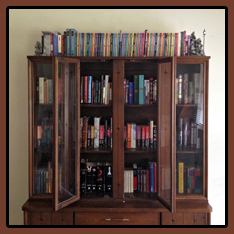
My Books (some of them)

My Books (some of them)

If you’ve ever seen Disney’s Beauty and the Beast and you’re a book-oholic like I am, your dream house might include a library like the one in the Beast’s castle. You know the kind – book-filled shelves stretching into the stratosphere, complete with those rolling ladder thingies that are absolute necessities if you want reach the upper shelves.

Of course, my fantasy house doesn’t stop there. I want books everywhere. I’ve seen houses where the stairs are shelves with books underneath or where unconventionally-shaped bookcases are built into the walls and nooks of every room.

Since, however, reality is quite a different thing than my dreams, my books reside in my china cabinet (the china is in boxes who knows where), on top of my spinet piano, in a small, three-shelf corner bookcase in my room, and the cookbooks are above the cabinets in the kitchen (let’s be honest: they’re all over the kitchen). The only reason my five-year-old’s bookshelf still has room on it is because his little brother strews the board books throughout the house, so I can’t even claim eminent domain and stash my stuff there. If I decide to buy one more book for myself. . . well, I guess I haven’t put any knickknacks on top of the buffet for a reason.

Space isn’t the only problem. Believe me, I will find room, if I have to balance them on top of fan blades or do something less creative like stack them in the corners. I do have several books in “the cloud” (either Kindle or iBook editions), but I prefer to read physical books with actual pages (although I do publish online – but that’s for another blog). So recently, when I realized that I was going to finish Drums of Autumn (Outlander), the fourth book in Diana Gabaldon’s Outlander series, I just couldn’t stomach shelling out another thirty bucks on a book that I want but don’t need. (Read this post to see how much catching up I have to do to reach 2013’s reading goal.)

Now, some of you have already figured out the obvious solution, which saves both space and money, and you’ll think I’m an idiot for not coming to the same conclusion earlier: just check out the book from the library. Well, duh, why didn’t I think of that?

Time to ‘fess. The last time I checked out a book from a local public library was when I was fourteen. And yes, that was over half my life ago. It’s rather shameful, I admit. I mean, my dad worked in libraries as a teenager, my mother worked in our former church’s media center, and one of my favorite places to volunteer at my son’s school is in the library. So why the decade-plus hiatus?

When I was fourteen, I started reading really long books – thousand-plus pagers. They took longer to read than libraries’ allotted two-week borrowing period, and I wanted to spend my time reading them rather than going back to renew all the time. Plus, once I started earning a little spending money, I could afford my own books and immediately grew my collection. I went from bugging my dad to search the various libraries for new Agatha Christies once a week or so to buying almost every Stephen King title available. It also didn’t hurt that we lived near an awesome used bookstore. (Chamblin Bookmine rocks!) Lastly, whereas I couldn’t care less about many other material things, books are the key to my heart – I want to possess them. (My husband figured that one out pretty quickly.)

Now, I did spend quite a bit of time in my university’s library back in my college days, but I didn’t go for the fun of it. When you associate going to the library with study groups and research papers, it kind of loses its appeal.

Then, early in our marriage, my husband and I moved to a different county, thus making my poor, unused library card obsolete anyway. We lived about ten minutes from a very nice library – which was right over the county line. And these two counties do not share benefits. I could enter that library, sure. But check a book out? No way, Jose. The closest library within our own county was over twenty minutes away, and since I was out of the habit. . . Well, you get the idea.

After I had kids, I heard people talk about story times at the various libraries around town, but it never occurred to me to take them. I’m a busy mom, I work, and I am somewhat anti-social. If another mom had invited me, I probably would have considered it. But I should have gone anyway, regardless. I recently had to meet a friend during the week, and the most convenient time was just after story time. So I figured I’d tag along with her, and at least my younger son would enjoy it. Peter was the oldest kid there by far, but I was glad that he was entranced by all the books. Unfortunately, it was, yet again, a library in the wrong county. Peter sometimes checks out books from our church’s library, but after seeing the real thing, he begged me to get a card. We now live less than ten minutes away from a library with an excellent children’s department, so I finally broke down and went. Not only could Peter have access to far more than I could ever afford, but it was clear that if I wanted to read The Fiery Cross (Outlander), I would have to go to the library or dip into the diaper fund. Sorry, books. When you have a twenty-month-old, diapers win.

Hey, I could get used to this. Now Peter has a new reason to be excited to read. And the two-week deadline gives me new incentive to read, read, read.

But just to make sure, when I checked out Gabaldon’s next 900-plus page doorstop, I asked the librarian how my chances were of renewing it.

She looked at me, taking in the baby on one hip and the energetic five-year-old next to me. I’m sure she was thinking, Good luck finishing this in the next two months, lady. Then she smiled and said, “They’re good.”

Story Trumps Writer

Dumbledore as portrayed by the late Richard Ha...

Dumbledore as portrayed by the late Richard Harris in Harry Potter and the Philosopher’s Stone. (Photo credit: Wikipedia)

While waiting for my latest round of literary agent rejections to come in, I haven’t just been twiddling my thumbs, wondering what to do. I’ve been working on other writing projects, such as short stories. One is getting close to being publishable, and while I was wondering what in the world I would write next, a new one popped into my head. But, as usually happens with a little idea, it turned into a big one. A really big one. From March to June, I wrote close to thirty-three thousand words, mostly backstory. When I weave all that in with the present-day, how long is this thing going to be?

I was talking to my mom about how happy I’ve been writing this story – sometimes three thousand words in a day – except for that I don’t know exactly where it’s going. That’s kind of a problem when it comes to publishing. But I’m good at having epiphanies. Sometimes it takes two or four or seven years to get one, so this is most likely a long-term project, but I’ll get there. The funny thing is, the end scene is already done. It pretty much came fully blown into my head while driving home one night. I was frantic to write as much of it as I could remember when I finally sat down with my laptop. It’s a good scene, but a tragic one, one that I’d like to be able to change in an epilogue, although I can’t imagine how I would.

When I told my mom that I don’t really want to end my book like this, she said, “Well, you are the writer.”

“Yes,” I said, “but it’s the story. Story trumps writer.”

I know people think I’m being all mystical and strange when I say things like this. And I’m such a practical person that it seems uncharacteristic for me. But it’s so true. In 2007, when it seemed that everyone who had a life was waiting with bated breath for Harry Potter and the Deathly Hallows (Book 7) to be published, I checked J.K. Rowling’s website all the time for possible insights and updates. And I remember her saying at one point that Dumbledore wasn’t cooperating. [Spoiler Alert] Nevermind that he was already dead, it intrigued me that her character was giving her trouble. None of my characters had done that to me. Yet.

Or maybe they had. Maybe that’s why I have so many broken-down manuscripts littering my hard drive. Maybe there’s an event that I don’t want to happen, so by not writing it, I delay the pain. Or there’s a character that I know needs to – gulp – die, but I can’t bear to kill.

I blogged last week about communication and when it breaks down between people (read it here). The same can happen between writers and their stories. It’s really obvious sometimes when a story desperately needs to go one way, but the writer just can’t do it – can’t kill the dashing suitor or separate the twins at birth or let the sickly-sweet heroine have a bad day for once. These stories suffer, I believe, because they are subverted from their true purpose. They’re stunted and can’t grow as they need to.

So when I was thinking about communication breakdowns, about the sad end to my new story, I remembered that pesky novel that I’m trying to get represented. I’ve revised it ten times over a period of ten years. And when I say “revised,” I don’t mean “proofread.” I mean top-to-bottom, scenes cut and added all over the place, names changed multiple times. And those epiphanies I mentioned? Yeah, they’ve caused a revision or four, as well. But is it done yet? Has it really had its say?

I’m having doubts about this book, which has been well-received by other writers. But is it because they’ve seen multiple versions, and my latest revision is so much better that they’re just glad to see improvement? Or are they complimenting it because they know me and don’t want to hurt my feelings? While doing some soul-searching, I’ve realized that some of the parts that I believe necessary to the story might need to go, which is tough. Even parts that get a lot of praise may not belong, like a silk ball gown on a trip to the beach.

One of the questions I’ve had to pose to myself is: do I know my story? I mean, do I truly, bone-deep know it? To the point that I could spell out the most important aspect in one sentence. And maybe I don’t. Maybe, if agents don’t accept it, it’s not ready to be accepted. Maybe I’m not ready for it to be accepted. Or it could be that I’m full of doubts because I really do know it, and they’re all just looking for the biggest sell, and my story isn’t “it.” And the struggle continues.

So while I should be writing, I’ve done a lot of stewing instead. You know, I prefer to let my favorite tomato sauce simmer on the back burner for hours before I eat it. Sure, it’s “ready” in twenty minutes or so, but it’s not nearly as good. Maybe that’s what my story needs to do. I think about it, mull it over, jot a few notes. . . and listen. Whenever it’s ready to give up the goods, I hope I hear it this time. Then, I’ll settle into revision number eleven.

Communication Is More Than Maintenance Talk

Communication

Communication (Photo credit: P Shanks)

Talking to my husband has always been easy. As his side of the story goes, he “fell” for me on a high school chorus trip to New York City. On the bus ride home to Florida, we sat together and talked almost all night. It had never been so natural for him to talk to a girl before. I certainly didn’t think at the time that I was making waves, but I guess my conversational charms won him over. I have my parents to thank, who work together and communicate very well, and who also have always treated me like I deserve respect for what I say. Even when I was a child, they conversed with me like I was a human being, not a sweet little darling who says cute stuff. That means that they’ve listened to a lot of dreams and ideas that they knew were naive or unrealistic. It also means they’ve had to set me straight a time or two. Although I didn’t particularly appreciate my dad telling me, when I was an adolescent, that pursuing a career in acting was not the way to go, I’m glad for the candor and that we shared the kind of trust that allowed me to lay out my dreams.

I look at my own kids and hope that the lines will be open for us as well. Communication truly starts in the womb, which is why I listened to music that I wanted my babies to hear and talked to my pregnant belly. When I was expecting baby number two, I encouraged Peter to talk to him. He would put his mouth up to my belly and say, “I love you, Baby Ian. I can’t wait to see you. I’m your big brother.” I think that has a lot to do with why Peter is Ian’s absolute favorite person in the world. It’s also sweet to me that Peter often says he can’t wait until Ian can talk (more than the baby talk he is capable of now).

Some people’s idea of “quality time” with their kids is to hover and be overprotective. Others feel guilty for not being able to spend as much time as they would like and create events that are supposed to equal that imagined quality. But do whirlwind trips to amusement parks, occasional weeknight baseball games, or other activities that wear us out and wear us thin make up for the everyday interactions that should be natural and lead to life-long trust and closeness? I’m not saying that doing those things is bad, but they don’t make up for lack of communication. A good friend once observed that every time she saw a marriage deteriorate to the point that maintenance talk was the only communication between husband and wife, divorce was usually around the corner. It happens to parents and children, too, who find they have no reason to talk after the nest is empty.

But maintenance talk is necessary, isn’t it? Thomas and I keep very busy schedules and are often like ships passing in the night. “What time is your meeting?” “Will you be able to watch the kids?” “I need more creamer when you go to the store.” “We need to run by Target to pick up school supplies.” When the necessary becomes the only conversation in a household, however, relationships become fragmented. My favorite parenting book, On Becoming Baby Wise: Giving Your Infant the GIFT of Nighttime Sleep, recommends that parents have “couch time.” (Read more about my Babywise experience here.) If there is no other time in their busy day when parents can talk, at least they’ll have fifteen precious minutes to catch upon more than the grocery list. And the key is to have couch time around the kids, so they can see that their parents are important to each other.

I remember my college days, when I thought my life couldn’t get any busier (ha). I always took five courses at a time, and I attended summer semesters, too. I worked twenty to thirty hours a week, sang in the church choir, sang with a community chorus, helped found and edited the journal Fiction Fix, attended numerous workshops and events for that same journal, and drove almost thirty minutes one-way to Thomas’s house four or five times a week. It was all a part of my plan to get my degree as quickly as possible while continuing to stay active in all the activities that were important in my life. I could have made things much easier on myself if I hadn’t gone to school over the summer, if I’d taken four classes instead of five. What was the big hurry to graduate, anyway? Well, Thomas and I were getting married, and we knew that one of us had to be out of college and working to support the other. Since I started a year before him, the pressure was on me: the sooner I finished, the sooner we could move on to the next stage of our life together. We planned a summer wedding, so he could continue to go to school without interrupting his spring or fall semesters.

Except that things didn’t turn out that way. Although I adored a few professors and enjoy some of my classes, I had no great love of college; it was an obstacle, something I had to conquer. But Thomas absolutely loathed it. College was something he could barely stomach, especially when a professor showed up and told his class to dress professionally – all while she was wearing sweats. I don’t know if that was the last straw, but it was certainly bad timing on that professor’s part. It was during that first week in the fall of 2003 that he met me after an evening class, and he just had that look. I took a deep breath, knowing what was coming. He had spent all evening thinking about what he was going to do and how in the world he was going to break it to me and his parents. I knew he was miserable in his classes, and I also knew that it in no way helped that it was my last semester, and he still had two years to go. I listened and tried to be sympathetic, encouraging. And then we moved on because talking through problems is what we do. And although we were creating a future together, he had to be at peace with his half of the deal. Fortunately, his chosen career wasn’t dependent on a four-year degree, and he did eventually (very eventually) graduate.

But there are couples out there who are sorely disappointed – even surprised – when they find out their relationships can’t survive on date nights and diamond rings alone. There are parents who think they can keep their kids busy with sports and camps and buy them cars, and those same kids will, in return, go to the colleges and pick the careers their parents prefer. And it’s not just parents and children. Everywhere you find relationships, you find people who expect things from others that are unrealistic, unfair even; you’ll find little respect for each other’s time and thoughts; you’ll find misunderstandings that could have been easily fixed. You’ll find broken communication. But when you see people really talking to each other – and listening – you witness a truly beautiful thing.

Sometimes our family has to drive somewhere in separate vehicles, and on those occasions, when Thomas can drive home and have Peter with him, I know he cherishes those rides. With the radio off and phones put away, they just talk. Peter asks questions, and Thomas answers. And Peter tells what he thinks about the world, and those are priceless (and often hilarious) moments. Thomas always seems to glow afterward, as if our five-year-old has just recharged him.

I watch parents who seem to care more about their phones or cars or any number of other distractions than their kids. Perhaps a big reason that young people have an increasing disrespect for their elders has a lot to do with the way we treat them, and often, I am convicted. I have to remember that I was once their age, too, yearning for answers, for information, for attention. And when I spend the time with my kids that they desire and deserve, I not only have hope for surviving the distant teenage years, but turning two men out into the world who will make it a better place.

I hope, if I have the chance to look back over my parenting experience some day in the distant future, I will see much improvement on my part and be proud of myself for hanging in there. And I hope that my kids will still want to talk to me then, to ask questions, to share their joys and concerns. But it won’t happen on its own; I have to work on it today – and always – to create that kind of a future.

You Don’t Have to Take My Word for It

Research

Research (Photo credit: astronomy_blog)

Anybody remember Reading Rainbow with Levar Burton? I watched it when I was a kid, and the line I always recall is, “But you don’t have to take my word for it.” Burton was encouraging kids to read the books he told them about and discover the wonder of their stories themselves.

Nowadays, I think we need to hear more of that, whereas what we seem to get is just the opposite. We’re supposed to believe that whatever we see in a commercial, read on our favorite social network site, or see in a news report is the gospel truth. Because, of course, no one would ever promote false advertising or report something without fact checking first – right?

I was watching the news several years ago when an eager reporter, who was about to fly out on his vacation, had a flight delay. Lucky for the uninformed public, he was the first guy on the scene, ready to tell us exactly what was going down. A bomb, he said. I have no idea where he got his intel, but apparently it didn’t need to be vetted, and suddenly this supposed bomb was headline news. Several hours later, his network sheepishly admitted that the “story” they’d covered all morning was just a reporter getting excited to break some news. No bomb threat. Nothing suspicious at all.

The mainstream media, modern marketing, and your general idiot on the street who doesn’t know what he’s talking about are all eager to spread the word, no matter if it’s true or not.

Some say that with the likes of YouTube and the Internet in general, people will do anything they can to get attention. If you subscribe to a social media site like Facebook, how many pictures do you see every day with someone holding a poster board that says, “My dad will get me a bike if I get 100,000 likes” or “My mom will stop smoking if she gets a million likes”? I could go off on a whole new tangent about this, but my point is that so many people are vying for attention that they’ll say – and consequently believe – anything that garners attention.

Maybe I’m missing something, but I like actual empirical evidence. For instance, I read product reviews. Sometime between my first and second pregnancies, my favorite maternity clothiers decided to vacate the brick and mortar stores and sell almost exclusively online. Now, if it’s hard to find clothes that fit a normal body, that problem is only magnified when you add a pregnant belly to the equation. Many reviews clued me in on the problems with the fit of a dress or shirt, and I steered clear. Others sang the praises of the durability of the fabric of a pair of pants. Still more had both positive and negative reviews, so I had to really think carefully about my buying options.

Hmm. . . Thinking carefully or critically, even. I hope that’s not a foreign concept to you, dear readers, although I’m losing more and more hope for people in general every day.

If you’ve read my personal account of signing on with a scammer agent a few years ago, you’ll know that I can get sucked in, too. One too many rejections can even make the thickest-skinned of us turn stupid. Someone likes my story? Really? I’ve never heard of this agency, but it must be the real deal because they like me!

To make a long story not quite as long, a funny feeling and Google search that reinforced that feeling showed me what I chose not to see when signing the (as it turns out) not-so-quite-legally-binding contract. Now, I always check out prospective agents on Preditors & Editors. But you know what? There’s dirt out there on that site, too. Fortunately, I was able to corroborate Pred & Ed’s lack of trust in my own agent with my personal experience, and other research has given me confidence that it continues to be a good resource.

Recently, I decided to take the plunge into the wheat-free/gluten-free realm. It wasn’t a decision I came to lightly, nor an easy one. It actually came more than a year after I first heard of the idea of dropping wheat specifically. I finally consulted Wheat Belly: Lose the Wheat, Lose the Weight, and Find Your Path Back to Health, at the same time knowing that a lot of people have negative things to say about it. One blogger (and a gluten-free guy, I might add) posted his refutations to three points that author and doctor William Davis made.

I researched enough references in Wheat Belly to make my head spin, and all that I can figure is that Davis fudged some of his statistics to further convince readers that no wheat is the way to go. I could be like the anti-Wheat Belly blogger and say the whole book is bogus. . . except that I know what he says about diabetes is true because of research that my dad did years ago, when he thought he might be pre-diabetic. I’ve heard anecdotes from people I know who have read the book – including an endorsement from my own doctor – and have read an array of articles by other doctors who point out enough similar evidence to come to my own conclusion: some of Wheat Belly may be merely well-informed opinion and against conventional wisdom, but much of it makes absolute sense. Still, I know many people will think I’m crazy and argue with me about my new lifestyle choice. Just know that I didn’t make this decision because some Hollywood starlet said it would turn me into a supermodel.

There is little that bothers me more than watching or reading something that was not researched properly. What works on the silver screen or in a book doesn’t necessary equal reality. That’s why I so admire those people who go the extra mile and do mounds of research. If you’ve ever read a Michael Crichton book, you’ll know what I mean. Back in the days when I thought that writerly skill could save me from having to do all that work (if it’s good enough, they’ll believe anything, right?), I wrote a story that opened up with a passenger train wreck. And I just assumed that, having taken a trip via Amtrak in the sixth grade, I was an expert. It never occurred to me that I might need to go to the library and look up passenger trains, accidents, policy about what law enforcement does in the clean up and investigation. I thought that if I gave my story a sci-fi twist, I could fudge all that stuff. Please forgive me, I was only thirteen.

How many parts of our lives would be improved if we did due diligence? For one, I know that my husband and I wouldn’t have jumped feet-first into a thirty-year fixed loan on a condo that would lose over sixty percent of its value before you could say “housing market crash.” Maybe people in general wouldn’t fall for as many bad car deals. Maybe we wouldn’t hit “send” too soon, lacing cyberspace with rumors that are difficult to track, even harder to take back.

Shopping for a TV today? Or an agent? Whoever it is doing the selling, you don’t have to take their word for it.