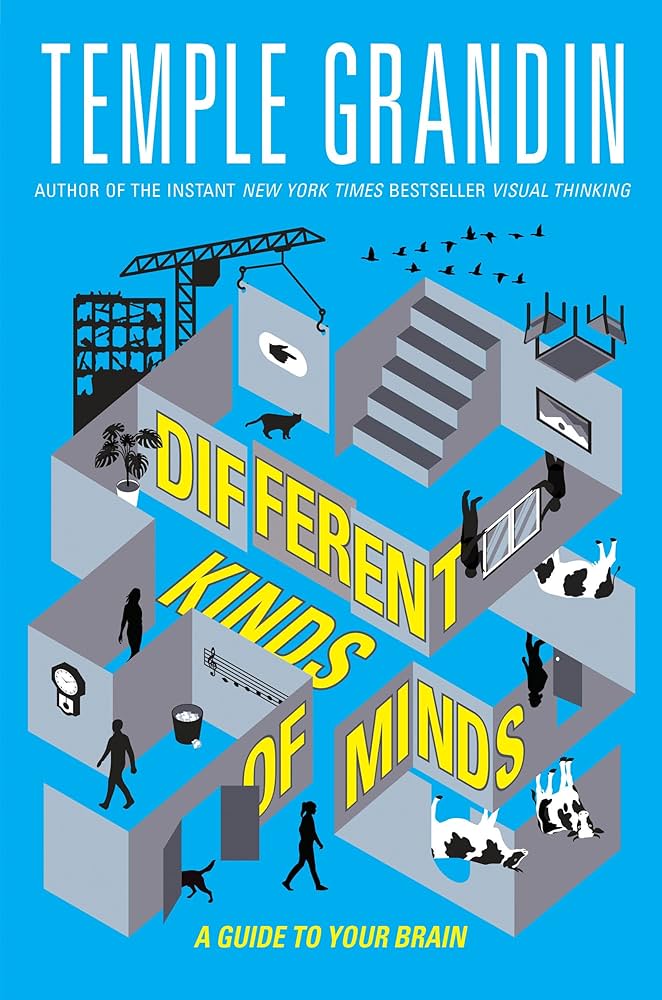
Earlier this year, my husband and I found ourselves in a little independent bookstore, and we did what I love to do in these establishments: we bought a book. (Note that it was just one book; I’m very proud of my restraint.) The book that caught our eyes—actually, the author who caught our eyes—was Temple Grandin. Years ago, we watched her eponymous movie (starring Claire Danes), and we knew that she is both brilliant and autistic. Our younger son is autistic, and we thought that Grandin’s Different Kinds of Minds would help us understand how he thinks. But how Ian thinks continues to be a bit of a puzzle because what Thomas and I discovered upon reading Different Kinds of Minds was a greater insight into the brain of our dyslexic son, Peter.
If you know me or have followed my educational posts, you’ve heard of Peter, and you might even know that I went back to grad school to help him and other struggling readers. I love reading so much that it broke my heart when Peter couldn’t learn his letters, much less blend them together to make actual words. I am now a reading specialist, certified to help students with dyslexia and other reading disabilities. For learners like Peter, the road to reading is blocked by dyslexia, but after much intervention, he was able to detour around this permanent roadblock so that, by the time he was a preadolescent, he could read a text aloud, and no one would know all the hard work that was going on in his brain to help the words flow freely. Still, though his reading sounds good now, he has to be extremely focused and has learned things about himself—such as that he needs to take notes and engage in discussion—in order to retain and comprehend what he reads. It’s tedious and by no means instantaneous; it makes reading even a short text a chore. Give him a graphic novel, photographs, charts, or videos, though, and information becomes much more accessible.
There are a couple different deficits that could affect a dyslexic person. One is a deficit in rapid naming (for example, showing them a series of easily identifiable shapes, which they know but have difficulty naming quickly). The second deficit is phonological in nature, which could include the inability to match letter sounds (phonemes) to their corresponding letter shapes (graphemes) or the inability to rhyme. A person with both of these deficits has double deficit dyslexia, and that’s Peter. Before we knew he had dyslexia, he was diagnosed with a working memory deficit, which unfortunately, has no permanent remediation. Testing also revealed that of the four kinds of learners, (visual, auditory, reading/writing, or kinesthetic), Peter was weakest in auditory, which is unusual; many dyslexic learners are auditorily adept, allowing them to memorize or at least easily comprehend what they hear. Not so for Peter. All of these put together make the American educational system a nightmare for him to negotiate. But it wasn’t until reading Temple Grandin’s book that I achieved a new level of clarity: not only are there different kinds of learners, but there are different kind of thinkers.
Grandin describes two kinds of thinkers, verbal and visual. The former “think more in words than in pictures,” are well-organized, have good executive functioning skills, and “learn best by reading books and listening” (p. 10). On the other hand, Grandin describes visual thinkers as those who “think in pictures more than words,” have messy backpacks and desktops but know exactly where to find things, excel at puzzles and chess, and “learn best from images, charts, and diagrams” (p. 11). She describes a verbal-to-visual spectrum, in which most people fall somewhere between these extremes. For Peter, though, and other visual thinkers like him, they are so far to the visual side that it is very difficult for them to succeed in a world built by and for verbal thinkers. Grandin provides an 18-question quiz that my whole family took. I was very surprised with my own results. If you answer 10 or more with “yes,” you are probably a visual thinker. Where do you fit?
Temple Grandin’s Visual Thinker Quiz from Different Kinds of Minds (pp. 38-39):
- Do you think mainly in pictures instead of words?
- Do you know things without being able to explain how or why?
- Do you solve problems in unusual ways?
- Do you have a vivid imagination?
- Do you remember what you see and forget what you hear?
- Are you terrible at spelling?
- Can you visualize objects from different perspectives?
- Do you have trouble organizing?
- Do you often lose track of time?
- Would you rather read a map than follow verbal directions?
- Do you remember how to get places you’ve visited only once?
- Is your handwriting slow and difficult for others to read?
- Can you feel what others are feeling?
- Are you musically, artistically, or mechanically inclined?
- Do you know more than others think you know?
- Do you hate speaking in front of a group?
- Did you feel smarter as you got older?
- Are you addicted to your computer?
For some of these questions, I wish I could ask what she means. Like #2, #15, and #17. I answered yes to all three. I suppose #2 refers to when you just “know” something (although I was a philosophy minor, so if I don’t know how or why, I tend to go to great lengths to figure out the answer and will create even longer explanations, like this very parenthetical aside). For #15, I know a lot of trivia and have a great memory for dates and names, a great skill to have in trivia games. But is that what the question is referring to? And for #17, I feel like pretty much everyone should be able to answer yes to this, so it doesn’t seem like it should count. Even without these, I answered “yes” to 11. The only ones that got a “no”: #1, I think in both words and pictures equally (and often simultaneously—my life is like a movie that I narrate in my head as I live it—often with a soundtrack that I may or may not be singing out loud); #6, I’m an excellent speller; #8, I’m an even better organizer (my super power, if you will); and #12, I have good, legible handwriting. Although I answered #18 with a “yes,” I suppose it may not count because, although my family would definitely say I’m addicted to my computer, what I’m usually working on is either a spreadsheet or a word document. But even if you don’t count that or #2, #15, and #17, that’s 10 with a “yes” answer. I was shocked. According to Grandin’s definition, I fit in with verbal thinkers because, hello, I’m verbose and write much better than I speak (BIG “YES” to #16). I also did very well in school and on tests, although I will forever hate standardized testing. I was not surprised that my husband was the least visual thinker (he answered “yes” to eight), and Ian had the next most, with 12. Peter, however, only answered “no” to one. He is almost entirely visual. And our schools are doing their best to hammer my visual boy into a verbal-shaped hole.
With her book and much of her life’s work, Grandin’s “goal is to get hands-on education back into schools so that we don’t screen out the people we need” (p. 7). Remember home-ec? Shop? They were a thing of the past by the time I got to high school. Although I live in a county that has some rural areas that still offer 4-H programs, not all students have opportunities like this. And who cares if you don’t want to be a farmer or rancher when you grow up? I think these are valuable things to learn, just to have an appreciation of them, if nothing else. I am a proponent of a well-rounded education, but the way our school system is nowadays, it shows what it values by testing students on the core subjects, period. And regarding standardized tests, if “the student doesn’t fit the mold? Too bad” (Grandin, p. 56).
This is a shame for people whose minds work in pictures instead of words. Who are these people? Grandin has a pet name for them that I love. She calls them “the clever engineers,” and they include artists, designers, inventors, electricians, architects, plumbers, and more (p. 7). Want some examples of real people? Think Steve Jobs, Albert Einstein, and Thomas Edison. Where would we be without these innovators? Peter also falls in this category of thinker. For years, we have trusted him to eye a space and tell us what should go where. For fun, he built our previous house in Minecraft. He’s in an architectural and engineering club in which they sometimes take on different challenges, and when the students were told to make a cantilever out of several pieces of paper, tape, and a paperclip, he was the only student to successfully MacGyver one out of the materials given. Yet he struggles with every midterm and final exam. He bombed both the ACT and SAT. If he has all the skills to become an architect but can’t pass the test to get into the college or university, what recourse does he have? Life skills seem to have no merit anymore. Grandin nails it when she writes, “It’s clear that doing well on tests can get you into good colleges; it’s not clear that doing well on tests leads to success in life” (p. 59).
At the elementary school where I teach, we strive to differentiate because we understand that there are as many types of learners as there are students in the classroom. At a professional development session a few years ago, our administration gave the faculty a group task that got us up and moving (which is great for our ADHD learners) and also allowed us to take on the tasks that spoke to our differing skill sets. At the end of it, everyone agreed that it was a great exercise that would work well with our students. One of my colleagues was worried, though—how would we assess their learning? And that’s the problem: there is so much emphasis on assessing that we lose all the great lessons learned in the process—including failure, which equals growth. I have no problem assessing skills to guide instruction, but I wish we would throw out letter grades. Yet, to keep our accreditation, to keep our doors open, we have to prove that our students are being taught and retaining certain skills. What is the answer?
First, I think that, if we say we honor “diversity” and “inclusion,” then we need to recognize that diversity goes much deeper than what we can see, and we need to include those who think differently than the test-writers. It has to do with what we can do and how we think, as well as what we bring from our individual experiences and cultures. Both of my kids are what we call “neurodiverse,” but even so, they are each differently neurodiverse, even though they have the same background and genetic makeup.
Second, for kids like Peter, who have artistic leanings but might get screened out of certain higher learning programs—which also means getting screened out of a career at which he could excel—we need more options. One option that Grandin touts is that of the apprenticeship, which is dying out in America. She writes that “we are facing an unprecedented skills gap. European and Asian countries have trained and encouraged their clever engineers. We have screened ours out” (p. 78). And if college degrees are still a requirement for such careers, then apprenticeships, internships, and experience should count toward college credit.
Lastly, more colleges—no, all colleges—need to quit requiring testing for acceptance. Does this make more work for the committees that decide who to admit and who to decline? Absolutely. But does it guarantee a fairer process? Yes. We have a friend who is an engineer, but he did so poorly on the math section of his SAT that the last college on his application list was the only one that would accept him, and even after entering their program, the academic rigors almost made him quit. Thank goodness he didn’t because he has had an amazing career and is very successful. His story gives me hope for Peter and learners like him, but… I wish that it didn’t have to be his story. How many others like him gave up and aren’t following their passion? I wish everyone’s story fit their learning profile and not what our school system decided to value. If you’re good at taking tests, hey, I am, too. But if not, you should be able to prove your knowledge some other way.
Grandin’s book covers many more issues, including parenting, a whole chapter on animals and how they think and feel, and the importance of different kinds of thinkers working in collaboration. I highly recommend it. (It’s also written for young readers, so it’s not full of dense jargon.) I bet you’ll start to identify visual thinkers in your life. The more we know about them and how they think, the more we can advocate for them and for changes that will help them have a positive educational experience. When our visual thinkers thrive, innovations happen, art and design are created, and we have outside-the-box problem solvers who can come to the rescue when there isn’t an instructional manual available.
Check out my Teachers Pay Teachers store for instructional videos and resources, Mrs C Loves to Read.

 Full-Time Writer Mom