Is May the New December?

I’ve noticed a pattern over the past several years, especially since I started substitute teaching: the school year speeds up exponentially after spring break. It’s like a race to the end of the year, to fit in all the end-of-year projects and parties and field trips. Everyone, especially the children, can feel that summer break is fast approaching, and life takes on a frenetic pace.

Maybe that’s why I’ve heard more than one person complain that May is the new December, as if December is a bad month. I quietly took issue with this notion. My favorite time of year is Advent, preparing for the birth of the Christ child. I love the Christmas music, Christmas shopping, wrapping Christmas presents at night while watching Christmas movies, doing the Advent calendar with my kids, and – yes – my seasonal socks. Yet for many people it’s a nightmare of obligations and deadlines and buying presents for people they don’t really like. I get it – December can be stressful. Not to mention that if you’re in college, you have exams, while all you can think about is the long break that’s so close you can almost touch it. I can certainly commiserate because I was a December college graduate. And that year, while I thought it would be such a relief to finally be done with school forever-and-ever-amen, I found myself immersed in not only editing but also typesetting the second volume of Fiction Fix when our previous typesetter bailed. People were counting on me, and I wasn’t able to enjoy December – or even being done with college – like I’d expected.

Maybe this is how my friends feel this month.

For me this year, May is more than teacher’s gifts and good-byes and summer planning. I took the Florida Teacher Certification Examination this past Monday, which meant cramming for almost two weeks. As soon as I got through with that, I took on the end-of-year books for my first grader’s class. These books hold the kids’ projects from August through the end of the year – over 20 pages of 12×18 construction paper – but what I didn’t realize was that about half of these projects still had to be glued to the paper before the books could be assembled. Another mom and I thought we could knock it out on Tuesday, only to find out we were in way over our heads. I’ve taken pages home every night, still have five or six to go, and need to finish by Tuesday.

First Grade Book-in-Progress

So my May has been busy. I’ve put off the usual things that fill up my to-do list, things that are still waiting for my attention, and I can feel them getting ready to pile back on. Like two freelance projects that I hope to finish in the next month, before our family vacation. Like a friend’s novel that I’ve been slowly beta reading since January. Like my own fiction projects, which I blogged about as recently as last week.

But I’ve been living with a kind of giddy feeling, anticipating the (temporary, at least) cessation of certain obligations. This weekend alone, three culminated: yesterday was my son’s last baseball game of the season; this morning was the last Sunday school class I have to teach until September; and this afternoon was my community chorale’s last concert of our spring season. Not to mention that this week will be the last meeting of my third-year Education for Ministry group (which means I’m almost finished with the 1000+-page history book we’ve been discussing since last fall). After Memorial Day weekend, my son has a partial week of school, and then first grade will be over.

What this means is that, even though we have school for a few more days, when we’re home for the evening, we’re home. I’ll have time to cook and actually enjoy supper. By the end of the month, I won’t have to wake up at 4:30 for a blessed two-and-a-half months. This doesn’t mean that I’m just going to sit around and twiddle my thumbs all summer – the kids and I will be plenty busy – but it does mean that I will be able to stop and breathe for a minute.

I love summers because I get a break. I’m grateful for this because so many parents aren’t able to have the time off with their kids. But if I’m not careful, I can allow myself to dread the end of summer break. I have to remind myself that I always love the beginning of a new school year, and I have ever since I was a kid. This year, my little guy will start preschool, so it’s going to be even more exciting. As my kids grow, everything seems to speed up, and I have to be careful not to stress too much over all the activities and responsibilities that go with being a mom-slash-chauffeur. What I do, I do for them and for us as a family. School and tutoring and daily chores are part of our life, but if we begin to allow the fun stuff – the baseball and the play dates and the trips to the park – become obligations instead of fun, it will be time to reassess. I don’t ever want to let a particular month turn into a time of dread, and I hope everyone else embroiled in the busyness of these times will do the same.

Don’t Live for Another Day

Embed from Getty Images

I can’t count how many times I’ve heard or read that we should live in the present moment, and being a planner, a goal-oriented person, it can be easy to scoff at such a notion. I’m always preparing for the next thing, which is good, for instance, when I’m crunched for time and I already packed my lunch the night before. But it can also make it easy to ignore what’s going on around me when I’m always focused on the future.

My morning commute is 30 to 40 minutes, time that I use to think about whatever’s next in my personal inbox – doctor’s appointments, writing projects, the household budget, all the activities that I have planned for the day or week. Couple that with the fact that I’m usually very tired, and I make for a poor conversationalist. This, naturally, is when my seven-year-old gets chatty. I’m liable to snap at him (he always pipes up right when I’m trying to listen to the traffic report or extended forecast), only to chastise myself moments later. The very last thing I want is to stifle my child and make him feel like he can’t tell me what’s on his mind – or his heart. One time recently, I nearly bit his head off, and as soon as he heard that the weather report was over, he asked in a quiet voice, “Can I talk now, Mommy?”

It’s during these moments that he opens up to me about his theological quandaries or epiphanies, some of which are very deep, or he’ll tell me about something he’s excited about at school. These are precious conversations, ones that I don’t want to miss. There’s nothing earth-shattering about them. These aren’t Kodak moments that I can post on Facebook, so all my friends can go “ooh” and “ahh” over them. But they’re special, the small moments that mean nothing to anyone except us, and they’re what build our relationship as a family.

That’s not to say that there aren’t other, special times. We all enjoyed our recent trip to Disney World. We looked forward to that trip for weeks, and we’ll always remember it as a great family vacation. Life is made up of these memorable occasions, balanced with hard times – sudden losses and deep sadness. But we can’t forget the moments in between that hold them all together, the conversations in the car, the nights reading books together on the couch, the activities that are so routine that we don’t give them much thought.

It is these in-between moments that make up our lives, even if they don’t stand out. They are the background that can be easily ignored. Unfortunately, many people allow the foreground to get so crowded with mountaintops and valleys that they leave no room for anything else.

I notice this in people who trudge through their weeks, hardly able to stomach the normal routine, living completely for the distant promise of a two-week break from it all, only to become depressed at the end of the vacation with the knowledge that an unsatisfactory “real life” awaits upon their return.

I met a woman some years ago, who shared the story of the hopes and dreams she and her husband had for after his retirement. His retirement came, along with a diagnosis of terminal cancer. They spent his last weeks laughing at the dark joke of it all – he struggled and worked hard for 30 years, only to die before he was able to enjoy the fruits of decades of labor.

I’m not advocating that we throw responsibility to the wind and do whatever makes us happy right now. Nor am I saying that we should give up on long-term plans. Rather, we need to find a balance between the two, but more importantly, we need to learn to be grateful and satisfied with what we have, even as we strive for better.

To put this in perspective, a dear friend of mine recently decided that she’s done battling cancer, and she’s now under Hospice care. This friend has been on disability and unable to hold a job for a number of years, but that hasn’t kept her from making her life a blessing to others. While her means aren’t great, her heart is. She embodies the ideal of a Christian servant, yet shies from receiving service for herself. Even in great pain and with ever-waning strength, she has never ceased being faithful, thoughtful, and an inspiration, even from her hospital bed. She could easily choose to let her situation weigh her down and fill her with despair, but she refuses.

How does she do it? How must it feel to know that there may be some good days, some bad, but there will never be a recovery? Her life is in that hospital room… yet her influence still extends beyond it and into the lives of her friends and loved ones. I have a lot to learn from my friend, not the least of which is that my complaints are pretty trivial.

I will never give up creating goals for myself or trying to improve my skills or situation. I want the world for my kids, and I look forward to our vacations and special times together, like any normal person. I understand there will be disappointments and stretches of days when I’m too tired to eek much joy from the moment, but that’s not going to stop me from trying. Who was it that said it’s the not the destination but the journey? (The answer is that lots of people have said it, and it’s only because it continues to be true.) So even though the destination may be wonderful when I get there, I’m going to be more conscious of the road I take to get there and the people traveling with me.

Done!

The setup for NaNoWriMo at home, if I need to ...

Ready to Write (Photo credit: Wikipedia)

Have you ever had a goal that seems to hover just out of reach? I’m talking about those last five pounds that you can’t shed, that last $1000 of debt that hangs over your head, that last month of pregnancy when everyone assumes you should’ve had the baby, yet you feel like it’s never going to happen.

I’ve been through all of those and more, but that’s not what I’m talking about this time. Nope, I’m talking about a writing goal.

That’s right, it’s the end of NaNoWriMo for Sarah!

If you happen to know what NaNoWriMo (National Novel Writing Month) is, you’re likely thinking, Aren’t you a couple months late, Sarah?

Yeah, yeah. I know that NaNoWriMo was officially over when the clock struck midnight, marking the end of November and the beginning of December. And I’d already “won,” which means that I wrote a 50,000-word novel in the month of November. (Actually, I wrote just over 61K.) But that didn’t mean I was done telling the story.

Last year, I also didn’t “finish” in November. I was certainly on a roll, writing 80,000 words in 30 days, but it took me 10 days into February to finish the first draft. I never slowed down the whole time; there was just so much story to tell.

This year’s NaNo was the sequel to last year’s. For months, I looked forward to continuing the story, but when it came to November, I struggled. I had the initial outpouring, which lasted for several thousand words, but after that, it was as if my muse had gone on vacation and at precisely the worst time.

So I “won” because I won’t sign up for something and then give up. But it was hard. I felt like the majority of what I wrote was just crap that would end up on the cutting room floor. I knew that if this were just any old novel, I would let it sit on the back burner and wait for my inspiration to return. I’m the queen of unfinished novels; I have more half-done manuscripts than I care to think about, and although I hate to admit it, I know that many of them will remain incomplete.

The difference with NaNoWriMo is that, after working so hard to get 50,000 words out, it seems like such a waste to just let the manuscript sit, unfinished. Even though it took two-plus extra months last year, I finished, and I think it’s the best novel I’ve ever written. And since this year’s novel was the sequel, I had to keep going.

Since it was such a tough book to write, I figured it would wrap up quickly and likely well under 100,000 words. Then I could sit back for a month, let it percolate a little, then return and make it worth reading after a hefty revision. To my surprise, a number of brainwaves hijacked my story when I thought I should be long done. The muse was back, although a month late. I continued writing and could see the end, but I couldn’t seem to reach it.

This past week, I had a couple 3000-word nights. My word count raced past 100,000 and didn’t look back. But still, I wasn’t done. I’d already told myself that I would absolutely finish this week. January is the month I had set aside to finish editing 2013’s novel and start querying agents, and here it is the 24th. I couldn’t let the 2014 novel hang over my head any longer. (Plus, I needed something to blog about.)

So last night, after the kids got to bed, I sat down and did some serious writing – 7000 words, to be exact. I’d joked with my husband that it would likely be a 2:00 A.M. bedtime. In reality, it was after 3:30. But I finished! I am worn out but feel so accomplished. I finally caught up to my goal, and I haven’t quite wrapped my head around it yet.

Now I get a month off from that book. And at the end of that month, I’ll go back and do a lot of cringing and cutting, and hopefully I’ll end up with a manuscript that’s at least 20,000 words shorter and worth sharing.

And in the meantime… I need a nap.

I Still Don’t Make New Year’s Resolutions

I first posted “I Don’t Make New Year’s Resolutions” at the end of 2012, a post about all the books I hoped to read in 2013 (four of which are still on my current list). And aside from the title, I didn’t go into an explanation of why I don’t make New Year’s resolutions. So here I am again, and this time I’ll try not to leave you hanging.

It seems that we can thank the Puritans for New Year’s resolutions. Abstaining from the revelry of the pagans, they instead reflected on the year past and the year to come. If you’re the introspective type, this could be a very constructive exercise. For instance, if you look over a year and see a lot of wasted spending, you could resolve to spend money more wisely, thus saving to buy a car or put a down payment on a house. And considering that Christmas is exactly one week before New Year’s Day, there are the ever-popular gym and diet resolutions. Many people take these seriously at first, only to fail when they realize that a month in the gym does not a truly fit person make or that getting up at 4:30 during the week is a tough commitment to keep.

So instead of using resolutions for their original, thoughtful purpose, we’ve turned them into a mockery. If you follow social media at all, you’ve likely read a number of resolutions from the snarky to the absurd:

Resolution 01

Resolution 02


Resolution 05

Resolution 07

And I just couldn’t resist this one (it’s for you, Thomas):

Resolution 08

And then there are just the sad ones. You know the ones: they’re the same resolutions that get made over and over again every year, as if this time they will actually happen – except they never do:

Resolution 03

So I’ve never made New Year’s resolutions. That isn’t to say that I don’t make resolutions at all. If you know me, I’m extremely goal-oriented, so it would seem that this kind of thing is right up my alley. Not so. I have enough of a hard time keeping up with the stuff that I want to do throughout the year.

For example, when my kids spent a weekend at their grandparents’ house over the summer, I stayed up past three A.M. cleaning up their messes (check out the before and after photos here). And after that, I resolved that the house would be clean (well, mess-free, not necessarily dusted and vacuumed) every night before I went to bed. It was something I stuck with until Christmas (read about that here). But one week later, I was on the wagon again (so to speak) and cleaned the house. The only clue that Christmas even happened is that our dining room table is now a Lego train station.

I’ve also made lifestyle resolutions before, although never at New Year’s. The original resolution: to lose weight by exercising. Hey, it worked, but I had to keep it up in order to stay in shape. I did this through two pregnancies. I continued when my elder son started school, even though it meant waking up at 4:30 in order to get a workout in.

For the longest time, I could blame any weight gain on terrible dietary choices. I would eat healthier and lose weight, but unlike my exercise-all-the-time resolution, the eating healthier thing was on-again, off-again until I decided to go wheat free.

But it wasn’t the antidote to my problem. Sure, I lost weight but gained it all back, plus 10 pounds. I gained weight on carrot sticks, for crying out loud, so why not just eat pizza? I allowed myself to get sucked into the resolution black hole that consumes so many well-meaning individuals early every year.

It wasn’t until my doctor told me that there was a very good reason (hypothyroidism) for gaining weight while eating carrots that I realized that I needed help to keep my resolution. After hearing two hours’ worth of dietary history, she put forth a plan to get my body back to equilibrium without living on a prescription, and the first step was to go gluten-free again. Now, however, I am accountable to someone other than myself, and although it may sound backwards, I finally feel the wonderful liberation of being able to share responsibility for my resolution.

The gluten-free thing was for December. But after Christmas, when there would be fewer tempting foods hanging around the house, I had to go totally grain free, as well as dairy free (or very limited dairy). Sounds kind of like a New Year’s resolution, doesn’t it? Except that it took three or four days after New Year’s to eat all the gluten-free pizza and drink my fill of Coolattas. I felt a bit like:

Resolution 06

I’ve never considered going fully Paleo before. After all, I love dairy. This isn’t even a resolution I would adopt, even if I did New Year’s resolutions. But because it’s what my doctor thinks will fix my problem, I’ve dropped grains and had almost no dairy to speak of for the past five days. This will be my lifestyle for at least three to six months, at which point my body may have healed itself enough to add a few of those prohibited foods back into my diet upon occasion.

Although it is certainly not always the case, many of the people whom I’ve seen keep their own resolutions (no matter when they’re made) are the ones who must make a change or face unpleasant physical consequences. Having hypothyroidism is no picnic, but in less than a week of living this resolution-like lifestyle, I have lost over two pounds that I could not shed before, and miraculously, I only crave food that I’m actually allowed to eat. If things keep progressing like this, it may not take much will power at all to keep myself on track.

I hope that whenever we seriously resolve to do something, we all make our best efforts and stay accountable. That way, if we do actually decide to take a step back in eleven-and-a-half months and see what we did with our year, we won’t say:

Resolution 04

Instead, we can pat ourselves on the back, say, “Job well done,” and not have any regrets so dire that they require nearly-impossible resolutions to fix.

Oh, and if you just want more beard, more power to you.

Sometimes You Have to Freeze Your Characters in Carbonite (Don’t Worry, It’s Temporary)


Embed from Getty Images

What a difference one week makes! If you read last week’s blog, I was gearing up for NaNoWriMo and nervous about starting. Not because of the whole 50,000 words in a month thing. I did it last year, so how hard could it be to do it again?

What I was worried about was finishing last year’s NaNo novel in time to move on to the sequel, which is this year’s NaNo novel. I was still deep in my last edit, and although I didn’t have many pages to go, I was at the crucial point where I needed to make the most drastic changes.

During the editing process, I cut almost 50,000 words (ironic – don’t you think? – since that’s the number I need to type this month). Cutting I can do all day. But the closer I got to the end, the more it became like slogging through verbal quicksand. It was the part of the editing process that I dreaded most. I had quite a bit of hard work ahead of me. On the one hand, I still needed to cut 3000 words, and on the other, I needed to add to the ending to improve it.

Then something wonderful happened, something that I hope happens many times this month (although it hasn’t yet): I had a brainwave. Whenever I read a novel with a plot twist or a really clever scene, I wonder if it was always a part of the plan or if it developed over time or maybe if it popped up out of nowhere, just in time to save the story. And while I’m not saying that I came up with something brilliant like the vanishing cabinet in Harry Potter and the Half-Blood Prince, this brainwave explained some of the points that I was afraid would never gel. This included making quite a few cuts and changing the ending even more than planned, and I just couldn’t stay up long enough to finish. Editing when you’re half asleep isn’t always in the best interest of the story, but on the plus side, I got to sleep on the brainwave.

November first, the first day of National Novel Writing Month, wasn’t much better. I had my weekly editing work for Fiction Fix and my son’s t-ball game. When the afternoon rolled around and I finally got a chance to edit, I would fix a scene, move on, add some more, realize that this affected an earlier scene, go back, rewrite again… and stare at the computer screen a lot as I tried to figure it all out.

I finally got it, finally realized exactly how it needed to end, and it dovetailed perfectly with the opening of the second book.

Half of my goals from last week were in the bag: I’d finished editing and gotten my word count under 100,000.

And as soon as I finished, I was supposed open up a brand new document and leave my editing hat at the proverbial door. Forget cutting! Now is the time for extraneous adverbs and adjectives. For people to ask sweetly and say quietly and walk quickly and wear elaborate gowns with one hundred buttons down the back, belled sleeves, and sweetheart necklines. Sometimes you have to break all your rules in order to get the job done – and tell your inner editor to shut up while you do it.

Typing that first page was painful. All I could think was, This isn’t a good opening line! No one will ever read beyond this.

And that’s how it’s been all week. My inspiration has just kind of fizzled. I’ve kept up with my word count, but the only reason I’ve been able to do so was because I typed over 4000 words that first day. I’ve seen a lot of things that need the axe. Even as I type, I think, This’ll get cut in the next draft.

But not in this one. Right now, I must plow on. It may be a tough slog the whole month. At least I’ve figured out why, not that it really helps. You see, I’m in the second book slump. This happens in trilogies. Okay, instant fix: don’t write a trilogy. It’s not that simple, though. My story needs to be told that way. And I’m not saying that all middle books should be thrown away, but often it’s necessary for the plot to slow or tough things to happen in order for better things to happen later in the trilogy. And so I think that the writing process naturally reflects some of the difficulties within the story. (And besides, it can happen in series with more than three books. Think about New Moon from the The Twilight Saga or Harry Potter and the Order of the Phoenix: necessary but often painful to read.)

The best example I can think of actually comes from the movie Star Wars: the Empire Strikes Back. First of all, what happened to Mark Hamill? Yeah, he’s still a stud, running around the swamps of Dagobah with Yoda on his back and all, but he’s not nearly as cute as in the first movie. Plus he loses an arm (Luke Skywalker, I mean, not Mark Hamill). And then Han Solo turns into a carbonite-cicle. It’s depressing stuff. If you’re a Star Wars fan, you still love it, but yikes. Thank goodness for Return of the Jedi, right?

And that’s what I have to keep in mind. There will be ups for every down. And the great light at the end of the tunnel is my book three, but I can’t get too distracted by that right now because, God-willing, I won’t start on it until NaNoWriMo 2015. What I need is to get through this book – not just get through but give it the attention it deserves, see it on its own terms rather than compared with its companions.

There is a time for choosing my words with great care, for analyzing and fine-tuning, but November is not one of those times. Editor, hop in the backseat. Writer, say whatever you want because you can always cut it out and make it pretty later. After all, the great thing about first drafts is that you can make all the mistakes you want and fix them before anyone finds out. My inner editor needs to take a forced month-long vacation, so I can get some work done.

Haunted by My Story


Embed from Getty Images

November is so close it’s almost scary.

It was just a few weeks ago that I was surprised by October’s arrival, so how could I let November sneak up on me, too? Lots of important things happen in November: Thanksgiving; Christmas shopping; several important birthdays, including my elder son’s; two clients’ book projects are due; a slew of writing assignments for a new client…

And the month-long time-gobbler that is both daunting and exciting, NaNoWriMo (National Novel Writing Month). Last year, I participated for the first time, and I will say again and keep on saying that it was the most fun I’ve ever had writing. In fact, I think it’s the best writing I’ve ever produced.

The goal this year is to at least match the enthusiasm and success of last year – or surpass it.

For the early part of this year, I wasn’t worried about NaNoWriMo 2014 because I was still finishing my 2013 novel. In early July, I produced 10 copies for beta readers. And then what typically happens when I’m busy with one project – I had a great idea for a new novel.

If you keep up with my blog, you’ll know that I decided to hold off writing, saving that new story for NaNoWriMo this year. But as my beta readers started giving me their critiques on my 2013 NaNo novel, I realized I wanted to edit it and write the sequel for NaNo this year. (And don’t worry about my new novel idea – I wrote a few important scenes and took plenty of notes for when I’m ready to start up with it again.)

I figured that it would be easy to edit last year’s book by October and even start querying literary agents again, saying, And if you like this, I’ll be working on the sequel in November.

Except that if today is the corner, then November is right around it, and I’m not done editing the first book yet.

Forget agents – I’ve got to finish this book in order to be able to properly start the next one. There’s nothing that says I absolutely have to start with the opening scene. If I feel like it, I can start with the last one (and yes, I already know what it will be – a cliffhanger leading up to book three, hee-hee). But I so want to start with confidence. That, and I don’t want a lot of editing to slow me down. 50,000 words in one month is a lot. Granted, I wrote 80,000 last November, but they say that lightning doesn’t strike the same place twice, so…

If only I’d written the first book perfectly to start with, right? But that would make me a magician or a novel goddess or something, which I am not. Or if I am, someone forgot to tell the big publishing houses because I’m still waiting for my million-dollar advance.

Instead of dreaming about gross improbabilities (or impossibilities if I don’t get myself in gear), I need to do both stories justice. The ending of book one was so hard to nail, but talking with several of my beta readers helped cement what I need to do to make it more satisfactory, yet leave readers hungry for the sequel. Now I’ve just got to make that happen, so I can pick right up where I left off on book two. By Saturday.

Picture me biting all my fingernails at once.

So I’m posting a tad earlier than usual in order to fully immerse myself in last year’s novel, and I hope that the next time I crawl out of my writer’s hole to blink at the sun, I will have nothing but positive results. And since sharing goals is a great way to stay on track, here they are:

  • Finish editing book one (soon!)
  • Get it under 100,000 words (I still have 3400 to cut – eek!)
  • Write seamless transition from the first to the second book
  • Write 14,000 words by the end of November 7th

Like I said, it’s daunting and exciting. And did I mention terrifying and exhilarating? Time to go to bed so I can indulge in a few NaNo nightmares.

Happy writing!

Mommy’s Summer Break

Flagler Beach

Flagler Beach (Photo credit: Wikipedia)

This summer, I’ve been more aware of the passage of time than ever before. I think part of that is due to updating the calendar with my six-year-old every day. It’s something he did in kindergarten and will continue to do in the first grade, and I figured it was an easy way to sneak in a little learning all summer long.

So when we turned to August, and I saw that the first day of school was less than three weeks away, I felt like our summer break had evaporated without me taking much notice. Then Peter asked me how many days were left, and I turned it into a quick math lesson. We counted the days of summer break up to that point, then counted the remaining days until school started, and we added them up for the total number of days.

Eighty-one. From the day after he finished kindergarten to the day before he starts first grade are 81 days. Not even three full months. I have to admit that I feel a little cheated. When I was a kid, we were out at the beginning of June and didn’t go back until the day after Labor Day.

A little past the mid-point of July, we were invited to a play date at the beach. I was talking to another mom, whom I hadn’t seen since early June, and she asked me about our summer. I was at a bit of a loss and had to admit that standing on the beach with her and our children was the first “summery” thing I’d done. Yes, my kids had occasional play dates and day camps or classes, but I hadn’t taken them to do anything that smacked of summer.

Before I had kids, I was rarely asked the “What have you done this summer?” question. After all, if you don’t have kids, you’re not in school yourself, or you’re not a teacher, summer is merely a hotter time of year. And when you live in Florida, it’s hot about eleven-and-a-half months, anyway, so it all kind of runs together.

But this summer, I’ve encountered this question a lot, and I’ve finally resorted to the, “It’s been very busy” answer. If you’re a regular reader, you know that I have completed three big projects since the end of the school year, but for every one of these projects, I’ve picked up at least one more. So my busy-ness has just shifted into other areas.

I’m not complaining. I love freelance writing and the flexibility of being able to go to the store when I need and to be available to take my sons to their various activities. Even being busy isn’t all that bad, except that I’ve had to utilize to-do lists more than ever in my life the last couple months because, otherwise, I might forget to brush my teeth or something.

I will have to say, though, that some things have suffered. Like the house. Because of my husband’s odd work hours, it seems that the only days he’s available to mow the lawn are when it rains. Consequently, our grass grows so thick and so high that we run through lawn mowers like candy. We finally gave in and hired a lawn guy (something I’d been rooting for since last fall), and when he showed up one morning this week and did what would have taken Thomas two days to accomplish, I said that my dreams had come true. Of course, that’s a gross exaggeration. He wasn’t publishing my book, cleaning the house, potty training my toddler, and mowing the lawn, but I’ll take what I can get.

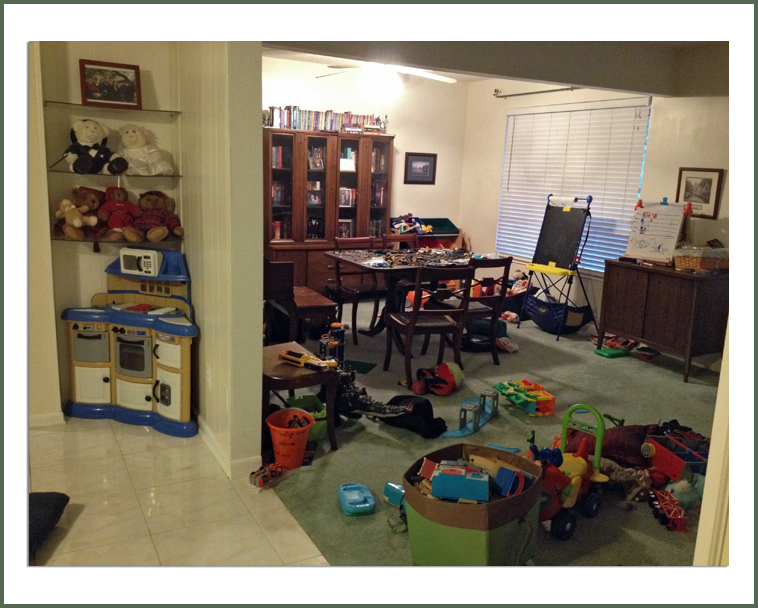
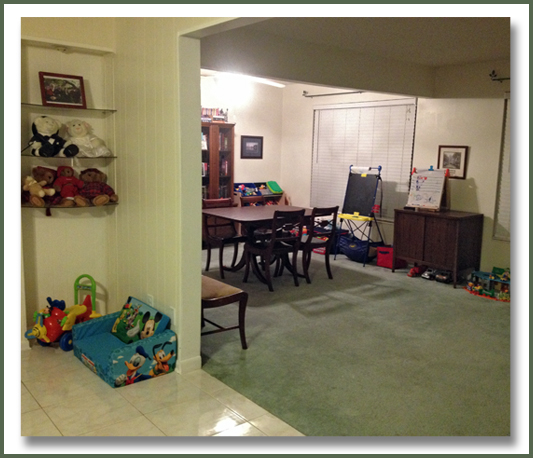
Ick – do we live like this?

Ick – do we live like this?

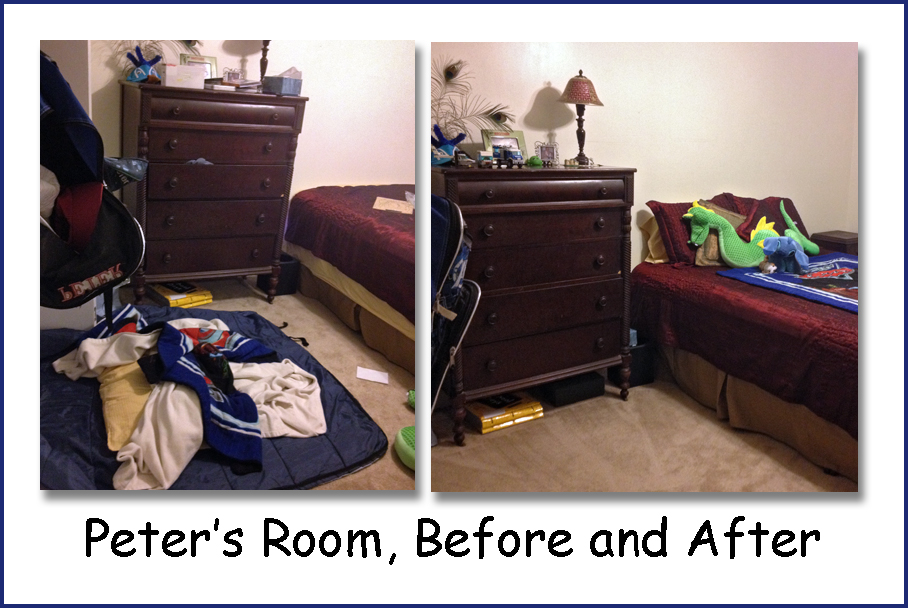
As for the interior of the house, it’s been the pits since before spring break, which was in March. People say that trying to clean while you have kids is like trying to shovel snow in a blizzard, which is true, but still. I have a nice little shelf with bins that will hold toys, if only the kids will use it. Then my elder son decided he wanted to sleep on the floor over eight months ago, and he’s slept there ever since. (Really – check out the picture.) So his floor is mostly taken up with a sleeping bag, which never gets picked up. Every once in a while, it gets so messed up that I straighten it, only to find a number of toys that we thought had disappeared.

Sleeping bag… and no more sleeping bag :)

Sleeping bag… and no more sleeping bag 🙂

With my summer dwindling – and although I’ve been busy, I have more free time now than I will when I start substitute teaching again – I need to take care of my house before it gets even more out of control. So this weekend is my opportunity. My in-laws are taking the kids for a couple days, and although I swore I would clean the last time they kept the kids, I didn’t. But this time, I’m tackling the mess. I’ll tell you, there’s nothing like being able to vacuum at three in the morning and not bother anyone, except for maybe the cat. (And sleep late because no one’s going to yell, “Mommy!” at six A.M.) It’s also nice to be able to pack away toys that my boys will never miss and donate them to children who will actually play with them instead of leaving them in the middle of the foyer.

So my life has come to this: it makes my day to pay someone to mow the lawn and to get rid of my kids long enough to clean up after them. Am I nuts, or what? My mommy-cation is not glamorous, nothing to write home about (although it does make for a convenient blog topic). And after all, my six-year-old gave Thomas and me his blessing to go out and have ice cream, see a movie, and have a romantic dinner. So, who knows? We may take him up on it… and come home to a house that looks like it belongs to civilized people.

The Happy Ending

The Happy Ending

Pacing Is Everything: The Parenting Version

Alphabet Soup & Wordsearch

Alphabet Soup & Wordsearch (Photo credit: dmelchordiaz)

I never understood what people meant when they talked about the “terrible twos.” My first child, Peter, has never had that kind of behavior problem. My second one? Well, Ian is a different story. When people ask if he’s a terrible two, I’ll usually come back with, “He has been since birth.”

Peter and Ian couldn’t be any more different. From the womb until the present, Ian has made sure everyone knows he’s his own person.

Still, I couldn’t help but compare my kids. And to aid me, I keep “baby’s first” books, where I record when they cut their teeth and ate solid food and took their first steps. Both of my boys walked and said their first words about the same time, so I made the bad assumption that their development would be pretty similar.

With such opposing personalities, I should have known better. For instance, Ian is a screamer. Granted, he had a rough start with colic and reflux – but so did Peter. Yet Peter got over his colic and was a happy baby. For Ian, however, the screams never stopped. He screams in his sleep, screams when he’s happy, screams when he’s upset, screams when he meets someone new. After witnessing one of these episodes, a woman told me, “That’s because he doesn’t know how to communicate yet. When he learns how to talk, he’ll stop.”

What I wanted to tell her was that I had a whole list of words that he’d said, but as soon as Ian learned a new one, he seemed to forget it. I made an effort to teach him baby sign language (after all, it worked with Peter), but Ian only ever picked up two or three signs. For the longest time, I would talk to him and get a blank look – or he would avoid looking at me altogether.

When Ian was about eighteen months old, we pulled out an old video of eighteen-month-old Peter. The difference was striking. Peter talked in complete sentences, told us his eyes were blue, and re-enacted scenes from his favorite book. We weren’t sure Ian even knew he had eyes, much less their color, and forget trying to read him a book. Thomas and I felt we had failed him at some point.

We knew we had to make an effort. We struggled to hold Ian in one spot to read a book. I took him for walks and pointed out lizards and flowers and told him the colors of things. For the longest time, it didn’t seem like he understood that a yellow house was, in fact, a house that was yellow. He said it like a compound word: “yellow-house.” He was months and months behind Peter.

But slowly, so slowly, he started using more words. Communications improved: I could say, “It’s time to clean up,” and he would clean up. There was one-way understanding, at least, even if he sounded like the Muppets’ Swedish Chef when he talked.

After Peter was diagnosed with several learning disabilities, we expected the same for Ian. In fact, when I researched the cues for reading disabilities (slow speech, late speech, trouble speaking complete and complex sentences), Ian fit them all. If our well-adjusted child had dyslexia and a practically non-existent working memory, what other surprises were in store with the kid who had behavior and communication problems? Instead of trying to force concepts into Ian’s brain (like we did with Peter), we hoped he would absorb things via osmosis, and we crossed our fingers that something would take.

Something did. A couple months ago, Ian started to recognize shapes. And colors, too. Not all of them but enough to show me that he understood that “yellow” and “house” were two separate things. And he started counting things – usually without skipping numbers. Thomas and I admitted that he was actually ahead of Peter on that score. He was learning, just at his own pace.

Then last week, the biggie:

We have letter and number magnets on our fridge. I have to keep them out of Ian’s reach, otherwise they’ll be all over the house. In fact, I’m not sure why I never got rid of them, but now I’m glad I didn’t. Out of the blue, he pointed up and said, “Bumblebee.” I looked all over the fridge for a bumblebee but only saw the magnet letter B. I pulled it down, and that’s exactly what he wanted.

Later that week, Thomas was wearing a shirt that said “FLORIDA,” and Ian started pointing at the letters and naming them. He got them all right. Shocked, we began writing uppercase letters at random. He knew them all, including Q and Z. Well, X did trip him up a little. He called it K. But as soon as I told him the difference, he got it. Peter, who is four years older, still gets M and W and B and D mixed up. I don’t think it will be long before Ian will be able to read the easy reading books that still challenge his dyslexic big brother.

After so much frustration, we’re watching our child blossom. I don’t know what triggered this change, only that I am grateful for it – that this is the turning point I have prayed for since we came home from the hospital with an inconsolable baby.

Not only does Ian know his letters, but he’s talking more than ever. He cracks us up with “Oh my goodnets” and “heeky-boos” (peek-a-boo). He often offers a spontaneous “thank you” when someone gives him something. He’s even able to entertain himself independently, something that he could only do sporadically a couple weeks ago.

I’m sorry I let mothering Ian be a chore for so long. A lot of it was that we were just out of sync. The greater part, however, was that I wasn’t one hundred percent okay with his pace.

I am well aware that there is plenty of room for all of us to grow. He still screams. And he still has to be potty-trained. But I know he’s not Peter, and I’m done wishing that he would be more like his big brother. I am fully aware of how unfair that is to him – and the frustrations it will cause if I expect him to meet someone else’s milestones. I am ready to parent him along the unexplored and exciting Ian Way.

Three Ways to Manage Your Busy Schedule – Instead of Letting It Manage You

Laura's work desk 13/05/2008

Piles of Work (Photo credit: Laura Whitehead)

After substituting in kindergarten for the third time this week, I drove home with that relieved, TGIF feeling. I love teaching, especially the freedom of being a substitute, but it makes for a busy day, often with no breaks or time to think.

But the entire weekend stretched ahead of me, with plenty of time to decompress and do the things I wanted to do.

My little fantasy didn’t even survive the drive home. I knew there was a pile of laundry waiting to be washed, plants that needed to be watered, sippy cups to be washed and refilled, and I still had my daily bookkeeping duties for the family business that I’d put off in order to substitute.

When I walked in the door, I discovered more things to do: a book sitting on the kitchen table that I need to read for a class next week; a pair of pants that need to be re-hemmed; a looming trip to the store before my son’s t-ball game. Oh yes, and then the t-ball game itself.

I also took on a new project today that I have to finish before we go on our spring break vacation, plus a novella to read for Fiction Fix, not to mention my personal fiction projects. Sometimes it’s hard to figure out what to do first when there are so many tasks at hand. Better just to take a nap and ignore them all, right?

If your life follows a similar pattern, you may feel that you’re always behind and rarely or never get to do anything for yourself. And it’s all too easy to give in to a negative attitude.

When Peter started playing t-ball, I dreaded the practices and games. My time is already so limited that I didn’t know when I would ever get anything done.

I had two choices: succumb to despair and have a nervous breakdown, or adapt and make the most of my new schedule.

I chose the latter, and you know what? I’m still able to embrace all the new projects I’ve taken on, and I’m even finding that elusive “me” time. Here are three tips that have helped me, and I hope they’ll help you, too:

1. Use Technology to Your Advantage

I know of people who have gotten rid of their TVs and phones because of the distractions they cause. If this seems a little drastic to you, there are ways to turn your electronics into a boon rather than a procrastinator’s crutch.

Did you know that there are a plethora of apps and computer programs that can help you manage your time? Some, like SelfControl from Mac users or SelfRestraint for Windows, block the internet altogether for set amounts of time. Just search for “time management apps” to see lists of what’s available and which one best fits your needs and personality.

Some of you may be able to control your electronics use by sheer will power. I fall into this category. I used to check my email any time I woke in the middle of the night, and the result was that I always had a hard time getting back to sleep. I finally made a deal with myself: don’t check email at night. It was as simple as that. If someone texts me, I know it’s urgent. Otherwise, it can wait.

Another thing I love is my phone’s timer, which I use in conjunction with step number two.

2. Take Baby Steps

When I have enough projects to fill a mile-long to-do list, I tackle them a bit at a time, baby-step style, and there are two ways to do this. As mentioned above, you can use that handy timer on your phone and work in blocks of time, or you can set goals, like editing one chapter and then moving on to a different project.

I’m currently rotating five projects in this manner, employing whichever method makes sense for each project, whittling away until they’re done. At the end of a hard day, instead of feeling like I’ve fallen short by ignoring one project while spending all my time on another, I can see that each one is closer to completion, even if only by a little bit.

3. Schedule Recreational Activities

It is very discouraging to run into someone on a Monday and have to come up with an answer to the “What’d you do this weekend?” question. I often stand there in utter silence, knowing I was busy but not able to remember anything specific. “Oh yeah,” I might say after a few seconds, “I weeded the lawn all day Saturday.” Exciting stuff, right?

When piles of laundry, flowerbeds full of weeds, grad school projects, and your kids’ sports schedules hijack what could have been your spare time, you feel like you’re stuck in a rut. This is when you can get in trouble by either going off the deep-end and throwing all responsibility to the wind, or you can wallow in self-pity and start hating anyone who did manage to enjoy her weekend.

If, instead, you schedule regular periods of recreation, just as you would schedule all the work that you need to do, you will have something to look forward to every day.

This is easier said than done, I know. Part of my personal promise to myself was to leave work well enough alone after my kids were in bed every night. If I could just hold out until they were in bed, I could read or write whatever my heart desired. But sometimes there’s not enough time in the day to get all my work done, and there’s still quite a bit left to finish after the kiddos are down. But I still make sure that I read or write or watch the occasional movie because my brain craves that break. Afterward, it’s much easier to work.

You may have more time but feel guilty about using it. Don’t! Fit in the occasional golf game or fishing trip or cup of coffee with a friend, if that’s what floats your boat. If you ignore opportunities such as these in order to “save” your enjoyment for a blow-out, two-week vacation that eats up a quarter of your annual salary, think of all the misery you’re subjecting yourself to in the meantime. Wouldn’t it be a shame to turn something you used to love doing, such as being a freelance writer, into a task to which you feel enslaved? I would rather have a few minutes of rest or fun every day, and the vacations, although they aren’t many, are truly special.

However you choose to do it, find time to do something not work-related on a regular basis, and you will be able to attack your projects again with renewed vigor and enjoyment.

Oh, and by the way, your house is patient: it will wait for you to clean it. Wash you underwear, by all means, but I won’t look at your baseboards if you won’t look at mine.

Do you have too many things to do 24/7/365? How do you manage your own workload?

Enhanced by Zemanta

When Life Happens

Goals

Goals (Photo credit: Celestine Chua)

People who know me know that I am a planner. And that’s really just a nice way of saying “control freak.”

I’ve gotten better about it. When things don’t go my way, I’m not as likely to flip out as I used to be. But still, as a self-motivated person, I set personal goals and stick to them for a reason. Even if those plans don’t mean anything to anyone else, they mean something to me.

So this weekend was going to be a full one. We would end the week with my husband visiting our kindergartener’s class and talking to them about his job, and later in the afternoon, I would take the boys on a quick trip to visit their grandparents.

As far as freelancing goes, I have certain tasks that I complete each day, and after the kids are in bed, I get to work on my own writing. A while ago, I devised a goal for the end of January: finish the first draft of my NaNoWriMo novel.

Yes, I did complete the 50,000-word goal before the end of November (actually, it was over 80,000 at that point), but the novel wasn’t done. One week out from the end of the month, my goal seemed almost too easy to attain. It was practically a sure thing.

Well, as you have most likely already figured out, things did not exactly go my way – or anyone else’s – this weekend. Life struck in a really awful way – in the form of that nasty fiend, the stomach bug. I can’t say I was totally unprepared because my younger son had it earlier in the week, but he got over it quickly, and no one else I knew had it.

But by Thursday evening, I had a bad feeling. My husband did the grocery shopping and took the kids to my son’s open house while I… well, let’s just say everyone involved is glad I decided not to tough it out and go with them.

After they got home, Thomas made some quick plans for how he would get the kids everywhere they needed to go and still talk to Peter’s class the next day. He would even take them with him to a meeting later in the afternoon to give me a break.

Then, when he was getting ready for bed, Peter woke up with the bug. Shortly after Thomas got done cleaning up Peter’s room, Ian awoke with it, too.

Not only were my own plans busted, but so were everyone else’s. On the plus side, I don’t have to feel bad about missing a day of exercise because I lost weight, anyway. But school and our trip and everything else I hoped to do were put on the back burner. I just wanted to make it through the night.

So my personal goal is shot. At times like this, it’s easy to give in and throw away goals all together. But the planner in me won’t let me give up so easily. I’m well enough to sit up and type, and maybe not quite being 100% will lend my story some really cool/trippy ending, even if it’s a few days later than planned.

And another plus: since I was so useless that I could do little more than sit around, I did some web surfing and found a short fiction contest with the deadline of January 31st. So I thought, What the heck? – might as well get something productive done, even if it wasn’t a part of the original plan – and revised a story and submitted it. At least there’s something positive coming out of my blown-to-bits weekend.

Enhanced by Zemanta