Books I’m Excited to Read in 2026

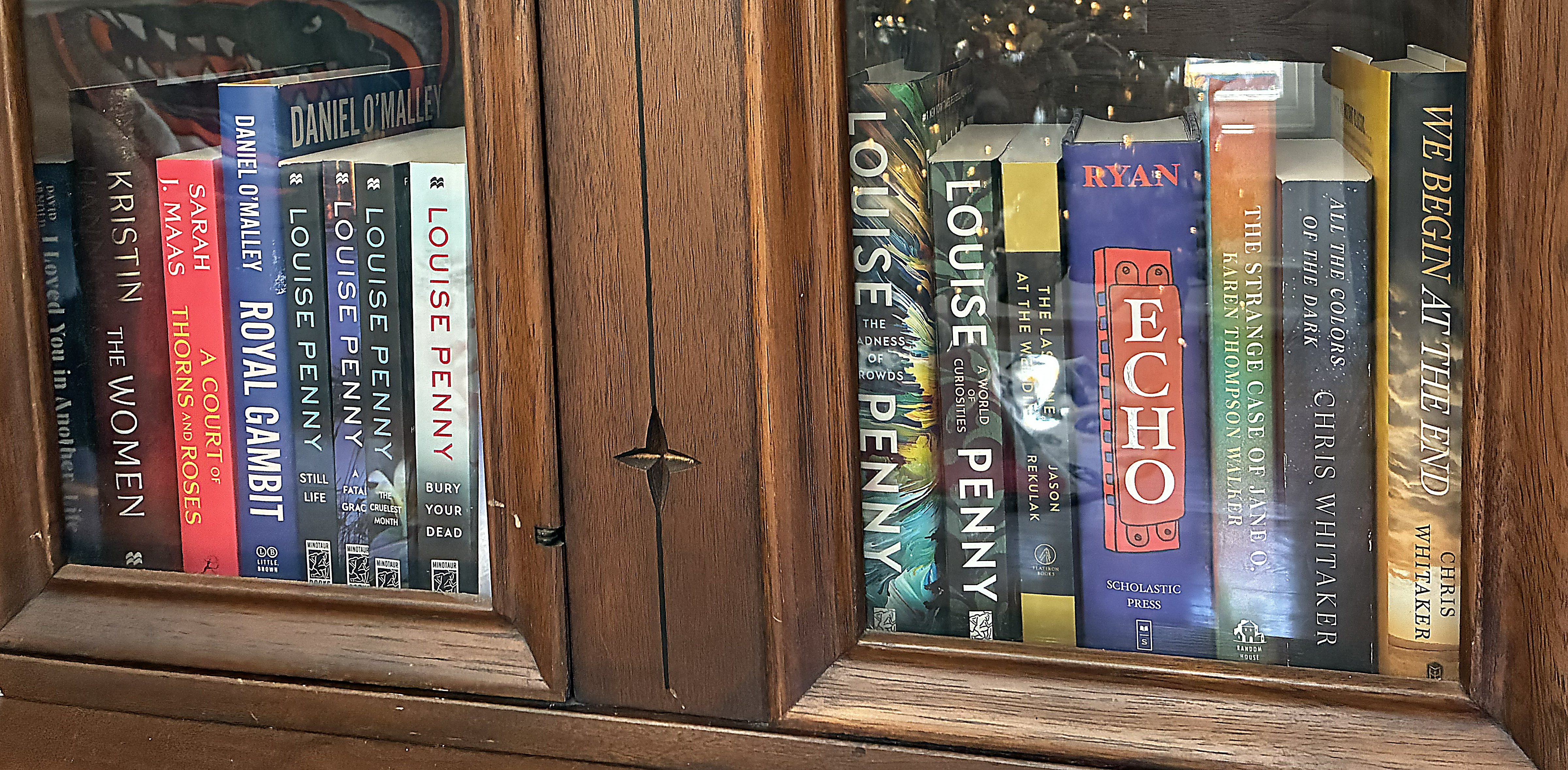
Just a few of my TBRs

I’m excited to do anything in 2026, to be honest. Three weeks ago, I had cardio-thoracic surgery. No one expected that the solution to my problem would be the easiest that it could possibly be, as far as diagnosis, procedure, and recovery because multiple doctors, who were informed by multiple scans and tests, were unsure what they would find when they went in. I couldn’t envision life beyond the surgery, although I anticipated that one or two more surgeries would be necessary to solve my problem. The problem? It started with a spontaneously collapsed lung in March and was followed by a recurrent collapsed lung in July. Thankfully, when the surgeon went in, he found out exactly what was causing my lung to collapse and fixed things so that it should never happen again (fingers, toes, and eyes crossed). The first collapse happened exactly 10 days after my last post. In combination with a number of other unforeseen events (one of which happened this week), 2025 became quite a memorable year—also a year in which keeping up with this blog was the least of my concerns. I did, however, keep up with my reading better than in recent years. And that’s why we’re here.

I had a simple goal for 2025: to read more than I read in 2024. Granted, I read more in 2024 (29 books) than the year before, but since I only read 21 books in 2023, that’s not saying much. At the end of the day, I own a lot of books, people lend me a lot of books, and I find joy in buying a lot of books, but it’s hard to justify getting more when my TBR list doesn’t change much from year to year. And I want to be very clear: no matter what, I will always want more books. It’s my vice, people. But I did it in 2025—I started the year with the goal of reading 25 novels (nine of them carried forward from 2024), and I read 20 of my goal titles. In fact, I read all but one of the carried-forward-from-2024 books, and number nine is the book I’m currently reading, so take that, 2024 and 2025 lists! I also have a strategic plan, and that is to prioritize the five books I’m bringing from 2025 into 2026 (with one exception—more on that in a sec) before reading the rest of the list or getting sidetracked by other books. (This is where Ron Howard starts narrating my life and says, “She got sidetracked.”)

Sadly, part of why I was able to read more in 2025 is because I didn’t dedicate much time to writing. Even if I don’t write during the rest of the year, I usually participate in National Novel Writing Month in November, but the non-profit NaNoWriMo went down in flames for a number of reasons, including their confusing stance on AI (read: they didn’t require writers to prove that they hadn’t used AI, which turned off most of their supporters). I have mixed feelings about NaNoWriMo shutting down because my first experience with NaNoWriMo in 2013 was exhilarating. Although I never matched that level of success again, NaNoWriMo (and the couple times I participated in Camp NaNoWriMo) helped me feel like I was staying connected to my writer side, especially when work and grad school pushed writing to the side. But when there was no validation process last year, the whole experience felt cheapened, and I honestly breathed a sigh of relief this past November because, for the first time in over a decade, I didn’t feel the internal push to write 50,000 words in 30 days (or, alternatively, the internal guilt for not doing it). I certainly hope I’m not done writing, but that extra time this year allowed me to squeeze in extra titles toward the end. And here they are in chronological order (* indicates books that weren’t on the original list):

  1. Rule of Wolves (King of Scars #2) by Leigh Bardugo
  2. Dark Age (Red Rising Saga #5) by Pierce Brown
  3. Light Bringer (Red Rising Saga #6) by Pierce Brown
  4. A Wish in the Dark by Christina Soontornvat
  5. Fourth Wing (The Empyrean #1) by Rebecca Yarros
  6. Iron Flame (The Empyrean #2) by Rebecca Yarros
  7. Onyx Storm (The Empyrean #3) by Rebecca Yarros*
  8. Sunrise on the Reaping (The Hunger Games #0.5) by Suzanne Collins
  9. Wild River (The Wild #2) by Rodman Philbrick
  10. Solimar: The Sword of Monarchs by Pam Munoz Ryan
  11. Took by Mary Downing Hahn*
  12. The Little Prince by Antoine de Saint-Expuréry*
  13. The Fire, the Water, and Maudie McGinn by Sally J. Pla*
  14. The Lost Year by Katherine Marsh*
  15. The Dearly Beloved by Cara Wall*
  16. When Sea Becomes Sky by Gillian McDunn*
  17. Murtagh (The Inheritance Cycle #5) by Christopher Paolini
  18. Simon Sort of Says by Erin Bow*
  19. The One (Dark Future #1) by John Marrs
  20. Olivetti by Allie Millington*
  21. The Cuckoo’s Calling (Cormoran Strike #1) by Robert Galbraith
  22. The Silkworm (Cormoran Strike #2) by Robert Galbraith
  23. The Storied Life of A.J. Fikry by Gabrielle Zevin*
  24. Career of Evil (Cormoran Strike #3) by Robert Galbraith
  25. Lethal White (Cormoran Strike #4) by Robert Galbraith
  26. Troubled Blood (Cormoran Strike #5) by Robert Galbraith
  27. The Ink Black Heart (Cormoran Strike #6) by Robert Galbraith
  28. The Running Grave (Cormoran Strike #7) by Robert Galbraith
  29. The Hallmarked Man (Cormoran Strike #8) by Robert Galbraith
  30. The Warm Hands of Ghosts by Katherine Arden*
  31. The Rook (The Checquy Files #1) by Daniel O’Malley
  32. Stiletto (The Checquy Files #2) by Daniel O’Malley

Not on the above list is the Bible (English Standard Version), which I read in 364 days. This was accompanied by a year-long devotional that a friend gave me last Christmas. To be honest, I wasn’t sure if I would do it because I didn’t think I could keep up with the readings (given my track record). But on January first last year, I dove in, and I am very proud of myself for making it to the finish line. I did use the audio version for many of the more difficult readings. (Not sure how to pronounce that jumble of letters? Let the audio guy do it!) I also read a book in relation to (but not required for) my job as a literacy specialist, but given that I only agreed with about half of it, I won’t be recommending it here.

Of the 32 books listed above, my top recommendation is the entirety of the Cormoran Strike series (which Robert Galbraith, aka J.K. Rowling has not finished writing yet). This is detective fiction, but if you’re thinking Miss Marple, think again. My husband was a detective for years, and a very good one, but he hasn’t figured whodunit in any of these books yet. Murder mysteries were my first fiction love, way back in 1996. Yes, I read plenty of books before then, but when I discovered Agatha Christie, I officially became book crazy, and I haven’t recovered since. I won’t say that if you love Harry Potter, you’ll love these—do not do J.K. Rowling the disservice of stuffing her into a magical young adult box. She is the most brilliant writer I’ve ever read (just my humble opinion). She grabs you from The Cuckoo’s Calling and builds on the realistic, historically correct British world of Cormoran Strike from there. They’re amazing mysteries, but the writing also reflects a good understanding of people and what makes them tick.

Another one of my loves is kidlit, and my school’s librarian hooked me up, yet again. Every single one of the titles I borrowed was amazing, so I highly recommend them if you have an upper elementary/middle school kid in your life or if you just love to read great books. The Fire, the Water, and Maudie McGinn is about an autistic girl (narrated first person), and it got me right in the feels. The Lost Year was a book that all our 6th Graders had to read, and it addresses the cover up of a devastating famine that happened in Ukraine in the 1930s. Not only is it a great read for historical purposes, but the ending—wow. When Sea Becomes Sky was another gut punch at the end and also a fun sibling adventure. Simon Sort of Says does a fine job of dealing with pre-adolescent PTSD without getting political or hitting you over the head with it. The narrator’s sense of humor provides a much-needed counterpoint to the heaviness of the subject matter. Thomas read it and enjoyed it as much as I did, and now Ian is reading it. Lastly, Olivetti is narrated by… a typewriter. Yep. And deals with how families can be affected by disease. Here’s the thing about good kidlit: done right, it addresses issues that kids can identify with in an authentic way. By this, I mean that kids can read these books without feeling like they’re being taught a moral or that they’re supposed to learn something. Kids enjoy them for their great storytelling, and adults enjoy that aspect, too, while understanding the full impact of the sensitive subject matter handled between those pages.

Thomas and I are fortunate to have friends who love to read as much as we do. One of the reasons I have such an extensive personal library is because I love sharing books that I’ve enjoyed (I may have mentioned that before). I borrowed and read six books from one such friend in 2025, and I want to highlight two in particular, The Dearly Beloved and The Storied Life of A.J. Fikry. These two deserve a chef’s kiss, and for completely different reasons. Thomas read The Dearly Beloved first and was interested to see what I would think about it. This book is about the intertwined lives of two pastors, but I hesitate to call it a Christian book. Is there Christianity in it? Yes. But at the heart, the more important thing is that this author gets life. Maybe it’s cliché, but this book made me feel heard, validated, whatever you want to call it. There were so many parts that resonated with me. Highly recommend. And A.J. Fikry was an interesting little book with some twists that really surprised me. It’s also a great book for book lovers—the main character owns a bookstore. I had Thomas read it, and he was also pleasantly surprised. And almost as soon as he finished, a different friend lent him Tomorrow, and Tomorrow, and Tomorrow, which is by the same author. Thomas has read it and gives it his stamp of approval. You’ll see it on this year’s book list.

As for The Empyrean series, yes, I got on that bandwagon. Thanks to a friend clueing me in ahead of time, I knew better than to mistake it for YA, even though it shared some young adult themes. Said a different way: I would let my own teenagers read a lot of other adult novels before these. It seems to assume that, for younger adults (if not teenagers) to want to read a book, it must include violence, foul language, and sex. Okay, fine. If they’re all so shallow (which I don’t believe), can’t we dress it up in better prose, style, and literary devices? The nougat center of this story is unique and compelling but enrobed in a layer of casualness around people biting it that is enrobed in an equally casual we-might-die-tomorrow-so-let’s-get-freaky-tonight outer shell. There are no clever turns of phrase, challenging vocabulary, or jaunty witticisms. And some lines are so cringey as to make me mentally gag: “I shatter.” Give me a break. Never has anyone ever shattered. I know it’s metaphorical, but also, who has ever thought, in the heat of the moment, “I shatter”? With that said, I did mention that the story is unique and compelling, didn’t I? I really have no idea where it’s going, so even though I’m not wild about how it’s being told, I am curious enough about what will happen in the next installment that I’ll probably check it out. I reserve the right to read books that I’ve semi-panned.

The one book on my list that is a definite no (and has already been turned in for credit at one of my favorite used bookstores) is The One. It was one of those craft-paper-wrapped, date-with-a-book purchases. And it’s made me shy away from ever buying one of those again (as alluring as the mystery of it may seem). The premise of this book is interesting: what if every person could be genetically matched to “the one,” their soulmate? Some of the writing is humorous, but it’s the first in a series of what seems to be a cautionary tale that I don’t need to be told (I felt the same way about The Circle when I read it years ago).

Lastly, I read The Rook in 2023, another book loan from my friend mentioned above. I knew I wanted to continue the series as soon as I finished it—it’s kind of a mash-up of X-Men and the Ministry of Magic with a Douglas Adams-ian sense of humor. In 2024, I planned to read the sequel, Stiletto, and the threequel, Blitz, but I didn’t acquire either until 2025—whoops. By then, I knew I wouldn’t remember the finer details of The Rook, so I went ahead and bought it, too. I was too deep into rereading Cormoran Strike one through seven, followed by the newly published eighth installment, The Hallmarked Man, to get all three of these books in by the end of the year. And guess what I found out when my planning my 2026 list? The fourth book, Royal Gambit, was recently published, so that’s the one book I’m planning to read early on before I tackle the leftovers from 2025 (or get distracted by something off-list).

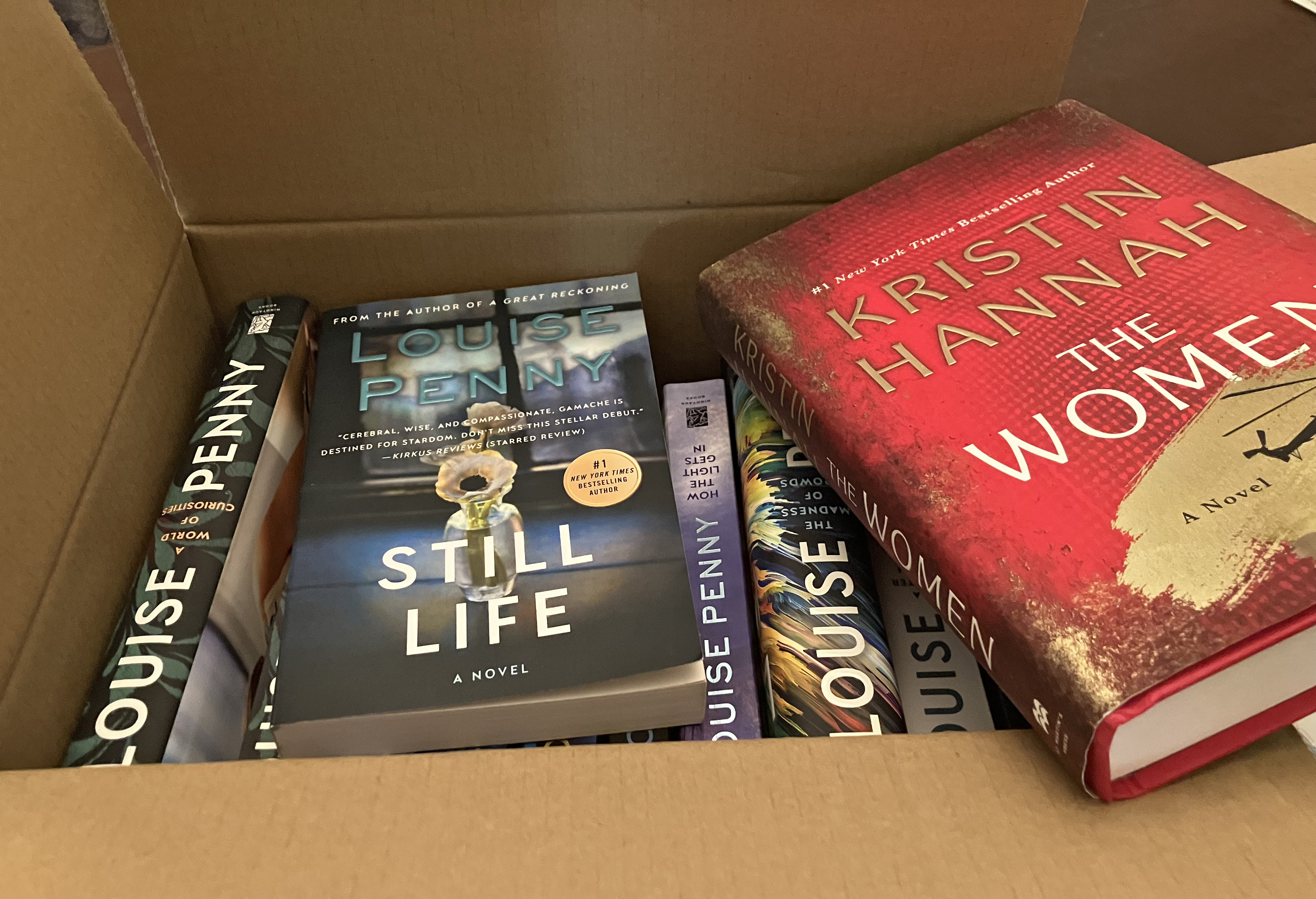
If you’re still hanging in there, my 2026 list contains many new books, thanks to contributions and recommendations from a few friends and some last-minute buys. In fact, the only repeat on the list is the Harry Potter series, which I haven’t read since 2019—yikes. A whole pandemic has happened since then. It’s time. You might have noticed a lot of Louise Penny books in my TBR shelf photo and wonder why I’m only listing one title. Penny is a complete unknown—these books were donated by good friends downsizing their library—so I am not going to commit to reading more than one before I know what I’m getting myself into. Maybe I’ll love them, and then—sidetrack. I’m also listing Corrie ten Boom’s autobiography, which belongs to Peter. He read it recently and then placed on my desk for me to read. (Even though I miss reading to little Peter and Ian, I am so happy to be trading with and recommending book to them.) One last minute addition that gives me immense joy is Neal Shusterman’s Break to You. I read Challenger Deep years ago on the recommendation of my cousin-in-law Julie, who became friends with Shusterman through a FAME (Florida Association for Media in Education) Conference. Julie is one of the librarians in the 2025 documentary The Librarians (which has its Florida debut this month), and she is the first person listed in Shusterman’s dedication in Break to You—of course I needed my own copy! Above all others, I will make this title a priority after finishing the books I’m bringing forward from 2025. And if, by some miracle I finish everything else on the list, will read the ancient behemoth Don Quixote. Since that I haven’t gotten through an entire year’s list in I don’t know how long (although it has happened before), I think I’ll be realistic and save it for 2027. (It’s Thomas’s book, anyway—he has to tackle it first.) With all that in mind, here are the books (alpha by author) that I hope to read in 2026:

  1. I Loved You in Another Life by David Arnold
  2. World War Z: An Oral History of the Zombie War by Max Brooks
  3. The Women by Kristin Hannah
  4. Demon Copperhead by Barbara Kingsolver
  5. A Court of Thorns and Roses (A Court of Thorns and Roses #1) by Sarah J. Maas
  6. Blitz (The Checquy Files #3) by Daniel O’Malley
  7. Royal Gambit (The Checquy Files #4) by Daniel O’Malley
  8. Still Life (Chief Inspector Armand Gamache #1) by Louise Penny
  9. The Last One at the Wedding by Jason Rekulak
  10. Harry Potter and the Philosopher’s Stone (Harry Potter #1) by J.K. Rowling
  11. Harry Potter and the Chamber of Secrets (Harry Potter #2) by J.K. Rowling
  12. Harry Potter and the Prisoner of Azkaban (Harry Potter #3) by J.K. Rowling
  13. Harry Potter and the Goblet of Fire (Harry Potter #4) by J.K. Rowling
  14. Harry Potter and the Order of the Phoenix (Harry Potter #5) by J.K. Rowling
  15. Harry Potter and the Half-Blood Prince (Harry Potter #6) by J.K. Rowling
  16. Harry Potter and the Deathly Hallows (Harry Potter #7) by J.K. Rowling
  17. Echo by Pam Munoz Ryan
  18. Mistborn: The Final Empire (Mistborn #1) by Brandon Sanderson
  19. The Well of Ascension (Mistborn #2) by Brandon Sanderson
  20. The Hero of Ages (Mistborn #3) by Brandon Sanderson
  21. Break to You by Neal Shusterman
  22. The Hiding Place: The Triumphant True Story of Corrie Ten Boom by Corrie ten Boom
  23. The Strange Case of Jane O. by Karen Thompson Walker
  24. All the Colors of the Dark by Chris Whitaker
  25. We Begin at the End by Chris Whitaker
  26. One of Our Kind by Nicola Yoon
  27. Tomorrow, and Tomorrow, and Tomorrow by Gabrielle Zevin

Time to go—I have some reading to do!

Please Let Me Read More in 2025

Shelf-Worthy Books?

Despite the title, I did read more in 2024 than in 2023. Still, I wish I’d been able to read more the last couple months of the year. Participating in NaNoWriMo and all the usual Christmas shenanigans gave me very little time to read—sometimes only several pages a day. I don’t think anyone who knows me will be surprised that I deviated from my planned list a few times. When family members or friends lend me books, I read them. That’s how I came by three series—All SoulsThe Kane Chronicles, and Schools of Dune—all of which I finally read in 2024 (two had been on my list since 2022). I also borrowed the King of Scars duology, which I hoped to finish in November, but I barely finished the first book by Christmas and am currently reading the second.

I always expect to deviate from my list when it comes to my students; I just don’t know which titles I’ll be reading with them. In 2024, this included Fantastic Mr. Fox and Charlotte’s Web, to name a couple. My school’s librarian also understands my love of all things kidlit and occasionally loads me up, so I read several unplanned books at the end of the 2023-24 school year (titles such as A Monster Like Me and Dead Wednesday). While I, sadly, no longer read aloud to my sons, the younger one got into the Underland Chronicles last spring and insisted I read them. I’d read the first book, Gregor the Overlander, in 2007, and with his encouragement, I finished the series 17 years later.

The only book that I read in 2024 that was a real stinker was A Psalm for the Wild-Built. It was a book I received in a book exchange from a total stranger, which is always a risk, but it was on my list, and I was determined to choke it down and get it over with. On the other hand, Wonder, which I read with a 4th Grade book club, was a delightful surprise.

I also have a couple non-fiction titles that I’m including this year. I don’t always list my non-fiction, but these were ones I truly enjoyed and believe they are accessible to many readers. In fact, Thomas and I both read and enjoyed these books, Tuesdays with Morrie (which I’d always assumed was fiction before reading it) and Different Kind of Minds (check out my review of it here).

In 2024, my book list included 25 titles. Although I only read 16 of the books I planned to read, I read 29 books in all, which I consider a win. Here they are, in the order in which I read them (* indicates the unplanned titles):

  1. A Discovery of Witches (All Souls Trilogy #1) by Deborah Harkness
  2. Shadow of Night (All Souls Trilogy #2) by Deborah Harkness
  3. Wonder by R.J. Palacio*
  4. The Book of Life (All Souls Trilogy #3) by Deborah Harkness
  5. The Red Pyramid (The Kane Chronicles #1) by Rick Riordan
  6. The Throne of Fire (The Kane Chronicles #2) by Rick Riordan
  7. The Serpent’s Shadow (The Kane Chronicles #3) by Rick Riordan
  8. Gregor the Overlander (Underland Chronicles #1) by Suzanne Collins*
  9. Gregor and the Prophecy of Bane (Underland Chronicles #2) by Suzanne Collins*
  10. Gregor and the Curse of the Warmbloods (Underland Chronicles #3) by Suzanne Collins*
  11. Gregor and the Marks of Secret (Underland Chronicles #4) by Suzanne Collins*
  12. Gregor and the Code of Claw (Underland Chronicles #5) by Suzanne Collins*
  13. New Dragon City by Mari Mancusi*
  14. Tuesdays with Morrie by Mitch Albom
  15. A Monster Like Me by Wendy S. Swore*
  16. Dead Wednesday by Jerry Spinelli*
  17. A Psalm for the Wild-Built (Monk & Robot #1) by Becky Chambers
  18. Fantastic Mr. Fox by Roald Dahl*
  19. Fractal Noise (Fractalverse #0) by Christopher Paolini
  20. Sisterhood of Dune (Schools of Dune #1) by Brian Herbert and Kevin J. Anderson
  21. Mentats of Dune (Schools of Dune #2) by Brian Herbert and Kevin J. Anderson
  22. Charlotte’s Web by E.B. White*
  23. Navigators of Dune (Schools of Dune #3) by Brian Herbert and Kevin J. Anderson
  24. Red Rising (Red Rising Saga #1) by Pierce Brown
  25. Golden Son (Red Rising Saga #2) by Pierce Brown
  26. Morning Star (Red Rising Saga #3) by Pierce Brown
  27. Different Kinds of Minds by Temple Grandin*
  28. King of Scars (King of Scars #1) by Leigh Bardugo*
  29. Iron Gold (Red Rising Saga #4) by Pierce Brown

In 2024, I said I would prioritize the books that I didn’t read in previous years, and I was mostly successful. I still need to read Pierce Brown’s Dark Age and Light Bringer to finish his Red Rising series, and then it will be on to the seven books left over from 2024. Something that was missing in 2024 was a real page-turner that made me want to prioritize reading. That’s not to say that I didn’t read some excellent books, but they were all books that I could put down. This year, I plan to dive into the Cormoran Strike series again because they are penned by my favorite author (Robert Galbraith, AKA J.K. Rowling), and they are the best mystery novels I’ve ever read. AND *drum roll please* the title of book eight of the series has been released, The Hallmarked Man. Although there’s no publication date yet, I am crossing my fingers that it will happen in 2025, so onto the list it goes. I am also going to pick up Harry Potter again. It’s been over five years since I’ve read the series, and even though I’ve read the first four books 13 times (and five to 12 times for books five through seven), there is so much to love about these books, and it goes much deeper than an orphaned wizard. My 13-year-old recently breezed through the series over the period of a couple weeks. It was the first time he’d read all the books on his own, and his enthusiasm for them (plus a deep understanding that he didn’t have previously) has rekindled my interest.

Rounding out my 2025 list are books that have yet to find a spot on my shelves. It used to be that, as soon as I acquired a new book, I would shelve it. Which usually meant a monumental shift of books, since I shelve all my fiction alphabetically by author across two large cabinets. Then one of my voracious-reader friends posted a picture of her unread books, which she keeps on a separate bookshelf. This, I realized, would not only keep the books I have yet to read front and center, but it would also keep me from shelving books that are unknown and might not be shelf-worthy. These are the books in the photo featured at the top of this post. While I don’t have an extra bookshelf to spare, I do have a handy hearth that is empty most of the year, so that’s where those books will live until they’re read and shelved or… they meet some other fate. (Not pictured are books I have yet to acquire—The Rook Files—or books in my classroom library.) In a separate corner of the house altogether is a box of books (shown above) that was gifted to me on the last day of the year. While visiting friends on New Year’s Eve, I was invited to take what I wanted, so I did just that. I am not familiar with Louise Penny, but I’m told she writes mystery novels, so I’ll try the first one of the series and see where it goes from there. And if none of these books work out, I won’t have to rearrange the whole bookcase again.

With all of that in mind, here are the nine books I’m pulling forward from 2023 and 2024 plus 16 new ones that I might possibly read in 2025:

  1. Rule of Wolves (King of Scars #2) by Leigh Bardugo
  2. Dark Age (Red Rising Saga #5) by Pierce Brown
  3. Light Bringer (Red Rising Saga #6) by Pierce Brown
  4. The Cuckoo’s Calling (Cormoran Strike #1) by Robert Galbraith
  5. The Silkworm (Cormoran Strike #2) by Robert Galbraith
  6. Career of Evil (Cormoran Strike #3) by Robert Galbraith
  7. Lethal White (Cormoran Strike #4) by Robert Galbraith
  8. Troubled Blood (Cormoran Strike #5) by Robert Galbraith
  9. The Ink Black Heart (Cormoran Strike #6) by Robert Galbraith
  10. The Running Grave (Cormoran Strike #7) by Robert Galbraith
  11. The Hallmarked Man (Cormoran Strike #8) by Robert Galbraith
  12. The Women by Kristin Hannah
  13. A Court of Thorns and Roses (A Court of Thorns and Roses #1) by Sarah J. Maas
  14. The One by John Marrs
  15. The Rook (The Rook Files #1) by Daniel O’Malley
  16. Stiletto (The Rook Files #2) by Daniel O’Malley
  17. Blitz (The Rook Files #3) by Daniel O’Malley
  18. Murtagh (The Inheritance Cycle #5) by Christopher Paolini
  19. Still Life (Chief Inspector Armand Gamache #1) by Louise Penny
  20. Wild River (The Wild #2) by Rodman Philbrick
  21. Harry Potter and the Philosopher’s Stone (Harry Potter #1) by J.K. Rowling
  22. Solimar: The Sword of Monarchs by Pam Munoz Ryan
  23. A Wish in the Dark by Christina Soontornvat
  24. Fourth Wing (The Empyrean #1) by Rebecca Yarros
  25. Iron Flame (The Empyrean #2) by Rebecca Yarros

When I first started making this list in 2013, it was mainly to give me something to look forward to during the year, not something to chain me down. While I understand I have an obligation when I borrow books, I also want to enjoy what I read, so that’s the ultimate goal. May you find joy in reading (or whatever your creative outlet is) over the next 360-something days.

Reading Is Healing: My 2021 Book List

If you read my post from just after ringing in the new year, you know that my 2021 started with a melancholy tone. A dear friend was battling COVID-19, and I awoke to learn that his body had finally succumbed. He was the director of the community chorale of which I’ve been a member since the late 1990s. With coronavirus shutting down almost all things choral (because singers are considered super spreaders), all of our rehearsals and plans for performances stopped last March. Singing is one of my outlets, and I’ve been fortunate to be one of the few singers at my church most Sundays.

Fortunately, while singing is incredibly healing, it’s not my only outlet. I also love to read. Maybe that’s an understatement. I have to have something to read at all times—a healthy addiction?—and I also love to share what I read. (Which is why I started making this annual post however-many years ago.)

While 2020 took so much from everyone, it was a great year for me as far as reading goes. I read all the books from my 2020 book list, plus some. In fact, I re-read two different trilogies immediately after finishing them—sometimes it’s just hard to let books go. (Those trilogies are Lady Helen and His Fair Assassin. I read the first book of Lady Helen in 2019 but all the rest in 2020.)

Many of the other books on my list were ones that I read with my children. We finished A Series of Unfortunate Events, as planned. I also read The Hunger Games to them because they enjoy the movies, and Suzanne Collins recently published a prequel, The Ballad of Songbirds and Snakes. We finished all of those about a week ago.

If you’re one of my regular readers, you know that my elder son is dyslexic. Even before his diagnosis, it was my habit to read my favorite children’s books to him. (Maybe it was crazy, but I read the Harry Potter books to both kids in utero.) We often read his school novels together, and the format of virtual school last spring was particularly challenging for him. His entire grade level broke into a handful of book clubs, and the book he chose (okay, that I encouraged him to choose because I wanted to read it to him anyway) was Lois Lowry’s The Giver. A dystopian novel before that was even a genre, The Giver was new when I was a kid. Since then, Lowry has published three sequels. We finished reading the quartet after the book club was finished, and Peter really enjoyed them.

Two or three years ago, I discovered Usborne’s graphic novel classics (including titles such as HamletThe Hound of the BaskervillesJason and the ArgonautsAlice in Wonderland, and many others). Graphic novels are a great way for people with reading difficulties to access literature because the drawings provide so many contextual clues. Each time I got one for Peter, he devoured it. It became his habit to read one every night before bed. I can’t tell you the joy I feel from my son finding enthusiasm for books. Plus, he’s being introduced to classic stories without the barrier of archaic language (which can prove onerous even for the most fluent of readers).

Still, there are plenty of great books that aren’t graphic novels. Peter loves historical fiction, especially of the World War II era, so that’s why Salt to the Sea and The Book Thief are on the 2020 list. (Salt to the Sea is centered around the greatest maritime disaster in history, regarding loss of life. And no, it wasn’t the Titanic or Lusitania—check it out!) After we finished these, since Usborne hadn’t released a new graphic novel in a while, my husband let Peter borrow Maus and Maus II, graphic novels about some of the events of World War II. When he finished those, something different and wonderful happened: Peter asked if we could recommend any other good books.

We decided that a good first on-his-own novel was Nicola Yoon’s Everything, Everything. This book has a unique style, including short chapters and drawings throughout. These would help break up the text, making it less daunting. Plus, the language isn’t that difficult, except for humuhumunukunukuapua’a—I have yet to make it from one end of that word to other without needing a nap in the middle. We gave it to Peter, and he devoured it. Every time he finished a chapter, he would tell us about it. A common trait of dyslexics is poor working memory. He’s had to learn study skills particular to his learning style, which allow him to suss out the main idea and decide which details are important. Summarizing what he’s read—and sometimes having in-depth discussions about it—is Peter’s strategy to aid his reading comprehension. After Everything, Everything, he asked for a book Thomas had told him about, Ernest Cline’s Ready Player One. It was a much more challenging read, but Peter made it through and now considers it his favorite book. (There’s a recently published sequel—hope it lives up to the first one!) He’s currently reading Stephen King’s The Green Mile. For his birthday and Christmas, we gave him more novels—Ender’s Game and Jurassic Park. Peter is excited to have his own growing collection, and on more than one occasion, he’s said, “Now I see why you and Dad read all the time.” After catching him staying up late to read more times than I can count (my favorite form of rebellion), he’s learned to look ahead and see how long a chapter is before getting started because he has to complete a chapter in order to fully process and remember it. I don’t care what it takes—this kid is making reading a priority and enjoying it.

Okay, Sarah, what does this have to do with books you read in 2020? Nothing at all. These are books I didn’t read—because Peter read them himself! And more books I didn’t read: Harry Potter. When we finished A Series of Unfortunate Events, that’s what Ian wanted to read, but when I noticed one of his classmates reading the series, I told Ian it was time to read them on his own. So that’s what he’s doing now, and I’m proud of him, too. It’s a real joy to see my boys reading on their own and loving it.

So without further ado, here is the complete list of novels I read in 2020, ordered chronologically. Titles in red are the books that I either read a second time or were not on the original list.

  1. Where the Crawdads Sing by Delia Owens
  2. The Wide Window (A Series of Unfortunate Events, Book the Third) by Lemony Snicket
  3. The Dark Days Pact (Lady Helen #2) by Alison Goodman
  4. The Miserable Mill (A Series of Unfortunate Events, Book the Fourth) by Lemony Snicket
  5. The Dark Days Deceit (Lady Helen #3) by Alison Goodman
  6. The Austere Academy (A Series of Unfortunate Events, Book the Fifth) by Lemony Snicket
  7. Salt to the Sea by Ruta Sepetys
  8. The Dark Days Club (Lady Helen #1) by Alison Goodman
  9. The Ersatz Elevator (A Series of Unfortunate Events, Book the Sixth) by Lemony Snicket
  10. The Dark Days Pact (Lady Helen #2) by Alison Goodman
  11. The Vile Village (A Series of Unfortunate Events, Book the Seventh) by Lemony Snicket
  12. The Dark Days Deceit (Lady Helen #3) by Alison Goodman
  13. The Hostile Hospital (A Series of Unfortunate Events, Book the Eighth) by Lemony Snicket
  14. Why We Broke Up by Daniel Handler
  15. The Carnivorous Carnival (A Series of Unfortunate Events, Book the Ninth) by Lemony Snicket
  16. Earth Unaware (The First Formic War #1) by Orson Scott Card
  17. The Slippery Slope (A Series of Unfortunate Events, Book the Tenth) by Lemony Snicket
  18. The Giver (The Giver #1) by Lois Lowry
  19. The Grim Grotto (A Series of Unfortunate Events, Book the Eleventh) by Lemony Snicket
  20. Earth Afire (The First Formic War #2) by Orson Scott Card
  21. Earth Awakens (The First Formic War #3) by Orson Scott Card
  22. The Penultimate Peril (A Series of Unfortunate Events, Book the Twelfth) by Lemony Snicket
  23. The Book Thief by Marcus Zusak
  24. The Starless Sea by Erin Morgenstern
  25. The Night Circus by Erin Morgenstern
  26. The End (A Series of Unfortunate Events, Book the Thirteenth) by Lemony Snicket
  27. The Cuckoo’s Calling (Cormoran Strike #1) by Robert Galbraith
  28. Stormbreaker (Alex Rider #1) by Anthony Horowitz
  29. The Silkworm (Cormoran Strike #2) by Robert Galbraith
  30. Career of Evil (Cormoran Strike #3) by Robert Galbraith
  31. Lethal White (Cormoran Strike #4) by Robert Galbraith
  32. Gathering Blue (The Giver #2) by Lois Lowry
  33. Graceling (Graceling Realm #1) by Kristin Cashore
  34. Messenger (The Giver #3) by Lois Lowry
  35. Fire (Graceling Realm #2) by Kristin Cashore
  36. Bitterblue (Graceling Realm #3) by Kristin Cashore
  37. Grave Mercy (His Fair Assassin #1) by Robin LaFevers
  38. Dark Triumph (His Fair Assassin #2) by Robin LaFevers
  39. Mortal Heart (His Fair Assassin #3) by Robin LaFevers
  40. Son (The Giver #4) by Lois Lowry
  41. Grave Mercy (His Fair Assassin #1) by Robin LaFevers
  42. The Hunger Games (The Hunger Games #1) by Suzanne Collins
  43. Dark Triumph (His Fair Assassin #2) by Robin LaFevers
  44. Catching Fire (The Hunger Games #2) by Suzanne Collins
  45. Mortal Heart (His Fair Assassin #3) by Robin LaFevers
  46. Mockingjay (The Hunger Games #3) by Suzanne Collins
  47. The Tower of Nero (The Trials of Apollo #5) by Rick Riordan
  48. An Ember in the Ashes (An Ember in the Ashes #1) by Sabaa Tahir
  49. The Ballad of Songbirds and Snakes (The Hunger Games #0) by Suzanne Collins
  50. A Torch Against the Night (An Ember in the Ashes #2) by Sabaa Tahir

As you can see, 22 of the 50 books I read were unplanned. While I was worried that some of them might derail me from reaching my goal, I don’t regret reading them. (Okay, one exception—Stormbreaker, a school book for Peter that neither of us enjoyed.) When I saw that Erin Morgenstern had a new book, I had to get it, and The Starless Sea might be the best book I’ve ever read. Unless it’s The Night Circus. Yikes, she needs to get busy and write a bunch more.

Woo-Hoo! New Books for 2021

Now for 2021. I’m excited that some of my favorite authors have penned new books, some adding to ongoing series. That’s why I’m re-reading An Ember in the Ashes, the fourth book of which was recently published and is on this year’s list. There’s also a fifth novel in the Robert Galbraith (J.K. Rowling) Cormoran Strike series. Since I just re-read the first three books over the summer in order for the story to be fresh for the new-to-me fourth book, I don’t need to re-read those. J.K Rowling also wrote a new book, The Ickabog, for families during the COVID lockdown. It was originally an online publication, and she held an illustration competition. The whole thing was published with beautiful color illustrations from the winners, and I just started reading it with my family today. A few chapters in, I’m reminded why Rowling is one of my favorite authors.

Other titles of interest: Christopher Paolini (author of the Eragon books) released a new book, unrelated to The Inheritance Cycle. I read S.J. Kincaid’s The Diabolic in 2019 and am finally collecting the other books in that trilogy. Years ago, my dad lent us the books from the Ender’s Game series, including spin-offs. I plan to finish those (one of which I just got for him for Christmas, so I’m going to have to borrow that when he’s done with it). I also plan to re-read Dune because—hello! Have you seen that they’re re-doing the movie? And of course, I need to have it fresh so I can get peeved every time the movie takes creative license. Actually, I have high hopes. Please don’t screw it up, new movie! (So when my dad reads this, please let me borrow Dune again, too.) There are other books I’ll re-read, since the list would be sparse, otherwise. (Hoping Diana Gabaldon publishes Outlander #9 in 2021 or early enough in 2022 that I won’t forget everything from the first eight books.) As always, I expect there will be a lot of red on here when I post what I read a year from now.

Until then, here’s my jumping off place (alpha by author):

  1. Six of Crows (Six of Crows #1) by Leigh Bardugo
  2. Crooked Kingdom (Six of Crows #2) by Leigh Bardugo
  3. Children of the Fleet (Fleet School #1) by Orson Scott Card
  4. The Swarm (The Second Formic War #1) by Orson Scott Card
  5. The Hive (The Second Formic War #2) by Orson Scott Card
  6. Ready Player One (Ready Player One #1) by Ernest Cline
  7. Ready Player Two (Ready Player One #2) by Ernest Cline
  8. Outlander (Outlander #1) by Diana Gabaldon
  9. Dragonfly in Amber (Outlander #2) by Diana Gabaldon
  10. Voyager (Outlander #3) by Diana Gabaldon
  11. Drums of Autumn (Outlander #4) by Diana Gabaldon
  12. The Fiery Cross (Outlander #5) by Diana Gabaldon
  13. A Breath of Snow and Ashes (Outlander #6) by Diana Gabaldon
  14. An Echo in the Bone (Outlander #7) by Diana Gabaldon
  15. Written in My Own Heart’s Blood (Outlander #8) by Diana Gabaldon
  16. Troubled Blood (Cormoran Strike #5) by Robert Galbraith
  17. Water for Elephants by Sara Gruen
  18. Dune (Dune Chronicles #1) by Frank Herbert
  19. The Diabolic (The Diabolic #1) by S.J. Kincaid
  20. The Empress (The Diabolic #2) by S.J. Kincaid
  21. The Nemesis (The Diabolic #3) by S.J. Kincaid
  22. To Sleep in a Sea of Stars by Christopher Paolini
  23. The Ickabog by J.K. Rowling
  24. A Reaper at the Gates (An Ember in the Ashes #3) by Sabaa Tahir
  25. A Sky Beyond the Storm (An Ember in the Ashes #4) by Sabaa Tahir

If you know of a book that I should add, please let me know in the comments—I’m always looking for recommendations! Good reading in 2021.

Hunkerin’

hurricane-dorian-1.jpg

Dorian, where are you?

I got married in what I call the Year of the Hurricane (2004). Within a few weeks that fall, four hurricanes hit Florida, devastating mainly the central corridor of our state. Where I live, we were lucky to be tucked away in a spot that rarely receives a direct hit. Still, we received wind and rains from the outer bands of those storms, resulting in loss of power for days on end. How did we fare? Pretty well. In our early 20s, Thomas and I weren’t concerned about water bottles or extra batteries. We had everything we needed in our tiny apartment: doughnuts, pizza, sodas, candles, and Scrabble. We played endless games of the latter until we decided it might be nice to have A/C and a warm shower and relocated to his parents’ house, where they never lost power.

Fast forward to the last few years. My kids think that hurricane days are an adventure, but talks of school closing put me on edge. As someone who works at said school, I know that days off don’t come for free. And then there was the time that the kids and I actually evacuated. The way Hurricane Matthew’s track looked, we thought we would get a direct hit. We pulled all our pictures off the walls and put valuables on top of our beds in case the house flooded. The boys and I headed to central Florida, where it was sunny and hot, while Thomas had to stay put, due to his job. He had everything staged for if he had to abandon the house and head for a shelter, but the worst thing that happened was that A/C unit outside flooded, so he went without air for a couple days.

Thank goodness for modern technology that (usually) lets us know when major weather events will happen. But that still doesn’t remove nature’s unpredictability factor. A few months after Hurricane Matthew, a microburst struck our side of town out of nowhere. Listening to wind and hail beat all four sides of the house, I thought it was a tornado. Thomas was just down the street at the time, and a tree fell right in front of his car. When I left for work the next morning, our neighborhood looked like a war zone. Every house had lost at least a portion of fence, not to mention trees and large limbs.

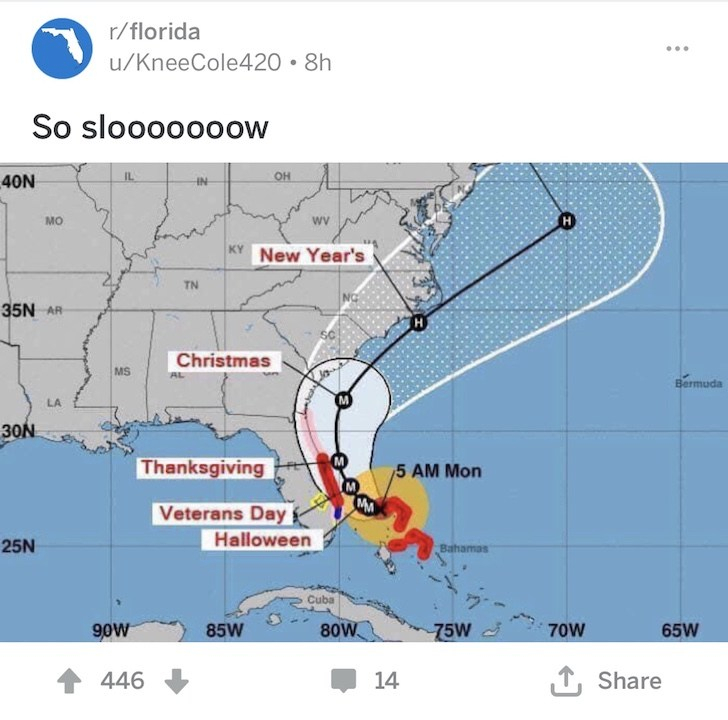
Hurricane Dorian 2For Dorian, we never considered evacuating, but we did prepare for our neighborhood to flood and for an extended power outage. A hard rain can back up our storm drains, and our power has been known to go out when it’s not even raining. But it hasn’t flickered once, and today there was hardly any wind and just light, drizzly rain. We cancelled our Labor Day weekend vacation and stayed in town, and… nothing happened. At least not here. I feel for the people of the Bahamas, and I’ve since heard that cruise ship lines are responding with aid to those devastated by this slow-moving storm.

I started grad school (online) last week, and with that added activity, I now have at least one obligation every weeknight (and sometimes I’m double-booked). But since last Friday, my schedule has been clear. So what have we done? Thomas and I taught the boys how to play Scrabble. Our back patio got a top-to-bottom cleaning. And we’ve read. A lot. When I realized that we would have so many days at home—and there’s no guarantee I’ll get such dedicated reading time again for a while—I decided that the boys and I would finish the books we’re reading together, and I would try to finish my own novel, as well.

One of the greatest joys of being a mom is sharing my favorite books with my kids. Over a year ago, I started on the Artemis Fowl series with Peter. We’ve had to take breaks to fit in required reading for school, but we’re now just a few pages away from finishing The Time Paradox, the sixth of this eight-book series. I was determined that we’d finish the series before the end of the year when I wrote this year’s book list (read that post here). After that, I want to pull out some of my favorite historical fiction; Peter’s begun to take an interest in World War II.

Ian and I started reading Harry Potter just before the school year started. He’s in the Harry Pottersecond grade, and that’s when I read them to Peter. These are the first longer chapter books Ian’s read, and I worried that they might bore him; after all, he’s my ADHD kid who could never sit still for me to read to him when he was a baby. It does help that we have the beautifully illustrated Jim Kay versions (for the first three books), but even on the pages without illustrations, Ian is rapt. Many times, he’s asked me to read just a few more pages, or he’s carried the giant book to me, singing the Harry Potter movie theme. I feel like I’ve done something right because he told me a few days ago that he thinks the books are better than the movies because they made more effort with the books.
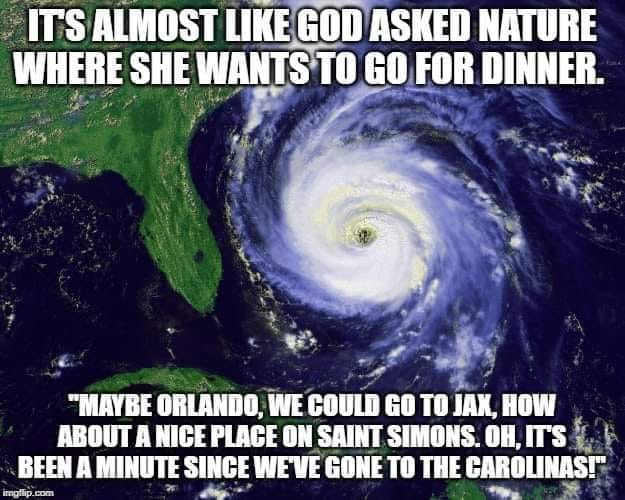
I feel guilty for getting so much time off when there was absolutely no reason for it. But how can you know? Not to mention that there are many people in my area who live in flood zones and aren’t as lucky. So the whole community has to abide by this schedule (and pray we don’t succumb to cabin fever). So I’m off now to read another chapter or two. Four books to go until I finish my 2019 book list!

Hurricane Dorian 3


I Shouldn’t Have to Say This

Reading RainbowWhen I was a teacher, I was perplexed when a student refused to check out books on our weekly trips to the library—until I learned that the books went home and were never read. I told her I would be glad to read them to her, but she refused. She had already learned that non-technological pursuits had less value than flashy apps. And even though some of these apps were “educational,” they couldn’t make up for the parent-child interaction that comes with reading together. This is a battle all parents of the twenty-first century are fighting. Or, rather, it’s a battle I wish we would all fight. Too many of us have already waved the white flag, assigning reading the status of optional.

This is something that’s hard to wrap my mind around, considering that reading is like breathing to me. I went through a short period during which I didn’t want to read on my own—and I’m sure it was due to learning to read and spending my energies on deciphering the language rather than taking in the story—but I got over that pretty quickly. When I started reading novels, I soon had no more books to read at home and then discovered the wonders of my elementary school’s library. I plowed through Beverly Cleary and Little Women and every book of mythology I could get my hands on. In middle school, my dad introduced me to Michael Crichton, and then I discovered the vast catalog of Agatha Christie titles. When I met my husband, I was on a Stephen King kick, and he soon started reading my books when I finished them. Over the years this evolved to Harry Potter and many others. Other couples may hire a babysitter and go on dates. We sit around and read and then bug each other to read the books we’ve just finished so we can talk about them.

Naturally, this has extended to our children. When our elder son was little, we read Go, Dog. Go! to him so much that he had the book completely memorized and would act out the scenes. There have been some nights recently when our activities have necessitated getting the kids to bed way past their usual bedtimes, and for the sake of sleep, we have foregone our usual reading-together-before-bed ritual. And let me tell you: the kids don’t like it. “Can we read [book of the moment]?” Peter will ask. And I’ll feel horrible for having to turn him down.

I was recently reading on a Friday night, and with absolutely no reason to get up early the next day, I kept going until past midnight, finishing the last 90 pages of the book. (For someone who gets up at 4:40 every weekday, that’s quite a feat!) Devouring a book because it’s too good to put down is an amazing feeling. Ordering the sequel on Amazon is a close second.

Unfortunately, many people labor under the mistaken belief that novels are only for “escape” or “fluff.” On the contrary: I’ve learned all kinds of things from my sojourns in fiction, from new vocabulary to customs unlike my own to truths I may not have pondered had they not been presented to me in a unique, fictional light. Not to mention that all writers should read simply for the exposure to another writer’s perspective. For every age, not just children, books provide an excellent avenue for learning and growth, and a great example for children is to see people to whom they look up reading.

When I learned my elder son was dyslexic, I was distressed, worrying that the child who loved to be read to would hate books once he had to read them on his own. And although he still struggles, he loves books—and there are wonderful apps out there to make books accessible to those who do have reading problems. There is absolutely no reason why everyone should not be able to enjoy books in some form or fashion. (Books aren’t available to everyone, you may argue. Click here to read a blog that addresses this very issue.)

I’m not saying that other activities are without merit. I’m also a baseball/musical theatre/piano/visual arts/LEGO/Marvel Universe mom. I pride myself on offering my kids multiple outlets for their talents and interests, but I believe I would be robbing them of a great opportunity if I didn’t share my love of books with them. I shouldn’t have to make this argument at all, yet so many people harbor the notion that reading is only for people with oodles of spare time or who have a nerdish personality. For example, if you saw a muscular dude reading a book in the park instead of engaging in some form of physical activity, would you be surprised? If yes, it’s because popular culture has created a stereotype for the typical “reader.” But it shouldn’t be that way. Books are for everyone.

Maybe it’s corny, but I think the Reading Rainbow theme song states it pretty well:

Butterfly in the sky, I can go twice as high.
Take a look, it’s in a book, a Reading Rainbow!
I can go anywhere.
Friends to know,
and ways to grow.
A Reading Rainbow!
I can be anything.
Take a look,
it’s in a book.
A Reading Rainbow.

Summer 2015 Reading

Magical books

Magical books (Photo credit: Wikipedia)

My last blog was all about the writing I’ve done this summer (and since then, I’ve achieved my Camp NaNoWriMo goal – yay!), but as any worthwhile author will tell you, you can’t write if you’re not reading. So I’ve been doing what a good writer should do, naturally.

The reading list that I set for myself this year is an ambitious one. (Read it here.) On it are 27 books, including several series. Christopher Paolini’s The Inheritance Cycle has been on my to-read list for three years now, and I finally finished it. But those books are dense and ate up a lot of my reading time. As I approached the halfway point through the year, I wondered how I was doing.

I’m happy to report that as of mid-July, I’ve finished 13 of the 27 books. Maybe Inheritance didn’t set me back too far, after all. Of course, I read a lot during our two-week vacation. I worried I was being overly ambitious when I packed the entire Divergent series, as well as a book that a friend lent to me a few months ago. But I read the whole borrowed book on the plane trip from east coast to west coast (Talk to the Hand by Lynne Truss – I highly recommend it, particularly if you’re a fan of British humor), and I plowed through all but a couple hundred pages of the Divergent series over the two weeks.

Ahead of me, I still have at least one doozy (Diana Gabaldon’s Written in My Heart’s Own Blood – all of the books in her Outlander series are formidable), plus Suzanne Collins’s The Hunger Games series. I know I re-read it last year, but I want it to be fresh when the final movie comes out this fall. Also, I’ll start reading Harry Potter and the Philosopher’s Stone to my seven-year-old in the next week. I’m excited that he’s finally old enough to comprehend the story – we may have another Potter geek in the making.

Other than my non-fiction books (which I rarely list here, unless it’s what I consider entertaining non-fiction, such as Talk to the Hand), I’ve stuck to my book list pretty well. Early on, I decided to read Daniel Woodrell’s Winter’s Bone because I’d seen the movie and was interested in seeing what kind of extra character developments happened in the book. I’m glad I did. Woodrell’s use of language is unique, and as a writer, it’s always helpful to mix it up with a different style from time to time.

The only other detour I’ve made was Lisa Genova’s Still Alice (also a book-turned-movie). This was a book I had to read. I’m going back to teach full-time in the fall, and the faculty at my school has a summer reading list. Still Alice was the only novel on our list of choices. I’ve jotted down the titles of several non-fiction books that interest me, but I wanted a good story – and I got it. But frequent criers, keep your tissues handy.

I’m sticking to my list and loving it. I hope to finish Lois Lowry’s The Giver series by the time the kids go back to school (I’m halfway through the second book, Gathering Blue), and then I’ll keep plowing ahead.

And never fear – if I actually make it through this whole list, I already have several new books waiting. (She rubs her hands together and cackles with glee.)

What’s in a Title?

http://www.gettyimages.com/detail/88295374

Recently, when speaking with a group of kids about being an author, one of the questions was how to come up with the perfect title. Good lord, I wish I’d been able to give an adequate answer. Instead, I pointed out titles of books I knew they’d read, like John Green’s The Fault in Our Stars. It started the conversation, at least, but it didn’t give them a fool-proof formula. Such a thing doesn’t exist.

I used to keep a list of what I considered brilliant titles. The problem, of course, is that they have nothing to do with anything I’ve ever written. And even tougher than coming up with book titles was deciding what to call all those pesky chapters lurking between the covers. (It never occurred to me until recently that I could just use “Chapter One” or simply “1.”)

It’s not just the little people like me who deal with this. I’m re-reading Christopher Paolini’s Inheritance Cycle, and while the book titles are decent, the chapter titles are inconsistent and often the pits. Yes, this is opinion speaking, but whenever I read some of them, I think, This guy was trying way too hard. Other times it seems like he just gave up. The first couple times I read these books, I didn’t give the chapter titles much thought, but this time around, I’m in a pickier mood. (Recently, I heard of a scholar who criticized the Bible for using subtitles for the various sections. It gives away what’s about to happen, she says. While I discounted her argument at the start, it’s niggled me enough to make me write this post.)

Unless you’re writing cookbooks or some other form of non-fiction, in which you need chapter titles and subtitles for quick reference’s sake, why bother with fiction? At first I thought it might just be a young adult thing, but then I remembered an adult series, Diana Gabaldon’s Outlander, which uses chapter titles throughout. While these are great books, the chapter titles leave a lot to be desired. Sometimes they’re melodramatic (“I Shall Go Down to the Sea”), and sometimes they kind of act as mini spoilers (“In Which Jamie Smells a Rat”). Other chapter titles read like throw-away lines that simply reminded the author what she was writing about in this particular chunk.

What I find most helpful are chapter titles that place the reader. For instance, in Rick Riordan’s The Heroes of Olympus series (great books, by the way), the chapter titles are simply characters’ names. Although narrated completely in third person, this tells the reader whose perspective is represented in each chapter. (The only problem I see with this is when you accidentally open to the last chapter and see that it’s narrated by a character that the author wants you to believe is dead. Whoops.)

Both Stephenie Meyer and Veronica Roth used this character-name approach in books later in their series (Twilight and Divergent, respectively). This is especially helpful, considering these books are both narrated first person. Paolini tries it once in Eldest. It’s the first time he switches to a perspective other than Eragon’s. Instead, it’s his cousin Roran, and the oh-so-imaginative title of Roran’s first chapter? Right, it’s “Roran.” Which I would be fine with if other chapters weren’t titled “Requiem” or “The Beginning of Wisdom.” Like I said, sometimes he tried too hard, and others, he didn’t try hard enough.

I know, for someone who admittedly can’t write a good title unless she just lucks into it, why am I complaining? I guess I’m really not. I’m just wondering aloud (or in print). Chapter titles are convenient if you have a table of contents. And there are some brilliant ones out there. “The Boy Who Lived” comes to mind. (Please tell me you understand that reference – but just in case you don’t, it’s from Harry Potter and the Philosopher’s Stone. What a great chapter title to pull you right into an amazing series.) So I guess they can’t all be bad. I’d just like some consistency, please.

Until reading Outlander and re-reading Eragon, I never gave chapter titles much thought. Some books have them, and others don’t. But now that I’ve started thinking about them so much, I know I’m going to scrutinize everything I read. Do I make predictions when there are titles, or do I forget the titles as soon as I finish reading them? Out of curiosity, I’ve picked a few books, different genres, different time periods, a diverse range of authors, and here’s what I’ve found:

Books with Chapter Titles:

Books with Only Numbered Chapters:

Books with Part Titles but No Chapter Titles:

There are other books that defy these kinds of categorizations, such as John Green’s Looking for Alaska and Daniel Woodrell’s Winter’s Bone. To see their unique chapter distinctions, I guess you’ll just have to check them out.

After looking back at all these books, some of which I’ve enjoyed multiple times, I realize that the chapter titles (or not) aren’t what I usually take away. Only when they get in the way are they problematic, such as with Outlander and Eragon. Yet with The Heroes of Olympus and Harry Potter, they actually helped orient me in the fictional worlds I was visiting – and sometimes even encouraged me to keep turning the pages. (She’s finally going to tell us about horcruxes! Oh wait, she isn’t. Darn, I guess I’ll just have to read another chapter…)

There isn’t a right or wrong way – or even one type of book that must follow one particular format. If I could, this is what I’d tell that middle school girl who asked me about titles: write what feels natural. If coming up with a creative name for each chapter feels contrived, don’t do it. But if titles are your thing, give them a try. At the end of the day, writing your story is the most important thing; fiction titles really should be secondary.

It seems that authors pick what they deem right for whichever books they’re writing at the time. After going over all the different types of chapter designations on my shelves, it’s obvious that I can’t just throw out one or another; there are some pretty awesome books that I don’t want to miss out on just because their chapter titles might put an idea in my head about some possible outcome.

Besides, you never know when an author is trying to trick you. Sometimes they can be pretty sneaky.

Spring “Cleaning”

Inheritance Cycle

Inheritance Cycle (Photo credit: Wikipedia)

I really wish I could tell you that I spent a good chunk of spring break getting rid of toys and clothes and giving my house the overhaul that it needs. Sadly, while I did the usual laundry and daily upkeep, I didn’t spend a lot of much-needed time cleaning.

My hope for our spring break, after returning from a few days at Disney World, was to catch up on my freelance projects and recreational reading. Any cleaning that happened in addition to that was gravy.

But would you believe it? My kids actually expected to do fun stuff for spring break. I know – can you believe the nerve? Really, they were little troupers. I had a lot of not-fun-for-kids stuff packed into those five weekdays. Now, they did get to stay up later than usual and watch movies and play outside, but there was still tutoring and the dentist and grocery shopping. I finally took them to the park last Friday, where they could just be kids.

It didn’t leave a whole lot of time for all that catching up I’d planned to do. I should have known better, but when spring break is on the horizon, it looks so sweet, has so much promise.

I did make some good progress on my biggest book project (and absolutely zero on another). I edited a bunch of my novel and only had a little left when school went back into session. In all honesty, I was happy to get any of that done.

But what I didn’t do much of was read for fun. Granted, I’m reading Eldest (sequel to Eragon). Not only is it close to 700 pages, but they’re a very cumbersome almost-700 pages. There’s a reason these books are on my book list for the third year in a row – and there’s also a reason I’m tackling them early.

For the first couple months of the year, I stuck to my 2015 book list, but to get more titles under my belt and break up the pace a little, I decided to read shorter books in between the Inheritance Cycle books. Aaaaand… well, I may have fallen off my book list wagon and bought a new book.

It was a shorty, I promise, and it was a really good one – a new-to-me author with a unique style that I admire, even if I can’t emulate it. (It was Daniel Woodrell’s Winter’s Bone, in case you’re wondering.) The only problem was that I made a sort-of promise to myself that I wouldn’t buy any new books until I read through all the other new books that I already own, and this was a new book.

But after that little detour, I’m back on track again. Except…

One of the other things the kids and I did on spring break was to stop by my favorite local bookstore, and because the owner knows what a sucker I am for books, she reminded me that their 40% off spring cleaning sale was coming up.

You should be proud of me. I only bought four, two of them chosen by my elder son. But I have to say it makes me happy to know that there are more books for next year’s list if I don’t get to them this year.

New Books!

New Books!

Plus, I also have to say that sometimes you get a nice surprise where you don’t expect it. That book on the top left – The Fantastic Flying Books of Mr. Morris Lessmore – is amazing. I highly recommend it if you love books; you don’t even have to have kids to appreciate it. I likely would not have bought it on my own, but Peter was excited to see it because he’d heard it before in his school’s library. I’ll have to say I’m pretty proud of my little bibliophile.

Despite not checking one thing off on my to-do list, I’m pretty happy with my spring break. It’s the little things.

How Do You Know What to Cut?


http://www.gettyimages.com/detail/138307331

Last year I asked a number of beta readers to read my 120,000-word NaNoWriMo 2013 novel. After receiving an excellent critique from one of these beta readers, I shared with him how annoyed I was that I was somehow supposed to cut my word count in half. “What would you cut?” he asked. He understood that the novel had issues that needed to be fixed, but he didn’t think length was one of them. He couldn’t fathom how I could drastically cut yet keep the same story.

But I’ve done it. (Well, I haven’t cut it in half, but I’ve cut over 40,000 words.) When he recently offered to read the edited version of my novel, the question changed to, “How do you know what to cut?” My friend is simply curious and fascinated about the writing process, but many writers want to know the same thing. Lost, they wonder if they can cut and still keep the integrity of their stories.

It comes down to more than just correcting typos. Typos I can fix all day, and in fact, I was the queen of clean copies back before I took my first fiction workshop. Clean copies that weren’t all that great to read, as it turns out.

After my first story was critiqued, I discovered that I wasn’t the prodigy I’d always imagined myself to be. I assumed, at first, that people just didn’t get what I was trying to say. It was their problem. It was humbling to realize that they didn’t get me because my stories were a mess.

The credit goes to Ari, who led those fiction workshops. Much of how I write and edit today goes all the way back to those seven semester-long workshops that I took from 2002 to 2005.

Reading others’ stories and discussing them brought to light so many issues that are common among many writers, not to mention learning a lot of tough lessons when my own stories were critiqued. Ari has all kinds of pet peeves, and to this day, I don’t think I’ve written a sentence that starts, “As he went to the fridge” or “As she tied her shoes.” That particular type of sentence drove Ari nuts, and I guess it’s because it shows up so often. The point isn’t to avoid that one kind of sentence but to be intentional. Don’t fall into the trap of using the same sentence structure over and over again. You’ll find yourself on the slippery slope to lazy, sloppy writing.

Showing instead of telling was another biggie. (You can read more about that here.) I used to be the type of writer who had to describe the layout of every room and the outfit of every character. Was this necessary? Nope. That’s not to say that all descriptions are bad, but what you write must add to the story.

For instance, Harry Potter’s lightning scar, green eyes, and trademark glasses form a quick mental picture, and the scar and eyes have their own stories. But is it important to know what brand of jeans or what color shirt he wears? Do we need to know every single item he keeps on top of his dresser? Only the ones that may come up later. Why? Chekov explains it so well: “If you say in the first chapter that there is a rifle hanging on the wall, in the second or third chapter it absolutely must go off. If it’s not going to be fired it shouldn’t be hanging there.”

Eragon and its sequels are popular young adult novels that run to excess when it comes to descriptions and scenes that don’t move the story forward. Each book could easily be cut by tens of thousands of words. Some descriptions are helpful. We’re dealing with a fantasy world, after all. But too much bogs down the text, gives it a plodding pace. I enjoy these books, but I know I have to invest a lot of time when I want to read them. Not because they’re thick books but because there’s a lot of unneeded padding packed into those pages.

You may have heard the phrase, “Kill your darlings” (attributed to just about every well-known writer, and it’s because they all know it’s true). Does this mean that I need to cut every word, every line, every scene that I’m proud of? Well, not quite. But what it does mean is that writers often get attached to bits of prose that ought not be included in the manuscripts where they currently reside.

Ugh. But I worked so hard on that scene. The words flow beautifully. If there’s one thing I won’t cut, it’s that line…

I’ve been there and cut that. My trick to save myself from writer’s remorse is to save all major revisions as separate documents. Then I don’t feel quite as bad about nixing a line or scene when I know I can go back and paste it in again. Which I’ve done.

It takes a certain willingness to cut any- and everything that is not essential to the story. It takes a thick skin when you realize what you cut the first time wasn’t enough (even if it was a lot), and you have to go back and perform major surgery again. It also takes a certain editorial know-how, which may mean that you’ll either have to hire an editor or babysit your favorite reader’s kids for the next five years. Even if you’re a proficient editor, I highly recommend beta readers. (Just be ready to read their stories, too. It’s only fair.)

As Stephen King recommends in On Writing: A Memoir of the Craft, temporal distance also helps. Take a month off; then come back to a manuscript with fresh eyes. You’ll be surprised at the number of throw away scenes that seemed brilliant at the time but are really just filler – and conversely, the number of excellent scenes you’re surprised you actually wrote. (And while we’re talking about On Writing, which I highly recommend you get, King also gives an excellent example of a block of text before, during, and after editing, so you can see the actual process.)

You may notice, after coming back to your story after a break, that you don’t like your opening chapter. You don’t even need that first scene, in the grand scheme of things. Or maybe it belongs much later. Be open to not just cutting words out of sentences, but restructuring completely. We’re not just talking a face lift or a nose job. We’re talking vivisection. It’s going to be messy, and it’s not going to look like the story you started with, but as I reassure everyone who’s read my beta novel and liked it, I haven’t changed the content, unless I improved it.

Last, please read your text aloud. I know it’s difficult if you have a full house and little privacy, but you really need to do this. You will be surprised how good something sounds in your head but how terrible it sounds when spoken. You’ll notice where you start to bore yourself. Or if you read aloud to another person, you’ll see where you lose your audience.

In all of these ways, you can transform a story, for instance, that opens with a girl thinking about how scared she is and how much she misses her old life (and why) to a story that puts the thing she fears on her doorstep and makes her take action.

It’s Query Time


Embed from Getty Images

Sometime between 2004 (when I first started querying literary agents) and now, there have been drastic changes in the publishing industry. When I first started, e-queries were a no-no. In fact, they were hardly mentioned on agents’ websites (if they had websites). I snail mailed every query with an SASE, which I wasn’t guaranteed to see for months, if at all (which always drove me nuts – I paid for the stamp, so please send it back). Very few agents accepted simultaneous submissions, and every query how-to that I read stressed the author bio part. Like the more creditability you have, the better your chance of landing an agent. So if you’re unpublished, good luck.

For a while, I didn’t change anything about the way I queried. I took time off to have a baby. Then I wasted almost two years with a scam artist for an agent (read about that here). After that, I didn’t much care for agents for a while and quit looking.

Then I immersed myself in the world of e-publishing – writing articles online for people I’ll never meet in person, publishing e-books that will never be printed. I felt up to braving the sea of rejections again and began researching query letters, figuring that I had to do something different than before.

Lo and behold, many of the “standards” of query submission from ten-plus years ago are now the exception rather than the rule. Most agents prefer e-mail submissions, and only a handful ask for exclusive submissions. In fact, more than one agent I’ve read about has said exclusive submissions are ridiculous because you could easily spend years and never get anywhere. Well, I’ve been there and done that.

With all this talk about querying, you can guess what I’ve been up to lately. Yep, I finished editing my 2013 NaNoWriMo novel (again), and I began looking into agents this week. Querying is one of the most challenging aspects of the writing process. Don’t get me wrong, I love reading about the agents and imagining how great it would be to work with this or that one. Except that imagining is as far as it’s ever gone. (The scammer that I had met exactly zero of my expectations, but I was so enthralled with the idea that I HAVE AN AGENT that I kind of pushed all that aside.)

As I’ve heard various agents say numerous times, it’s not the query that wins the contract but the book. The problem is, of course, that if you bomb on the query, your book may never even get a cursory glance. So I’ve always felt that pressure to write the perfect query letter. I’ve done my best to make them personal. But not only did I have exactly zero positive responses last time I queried (no surprise), I didn’t even get responses from the majority of them. One was an agent with whom I’d worked before. I queried her twice. Nada.

So this time, after stressing more than I should have about what to write and how to write it (and coming up with a great hook but forgetting to write it down), I went online to brush up on Query Writing 101. There are more good resources out there than I can count. Many of them agree on the basics (like the order of the paragraphs doesn’t matter, but when you do talk about your story, it better have a great hook), and they usually give examples of both good and bad queries. The bad ones are great (read one here). Not only will you laugh at the sheer stupidity of some writers, but the number of real, terrible queries gives me hope that one of these days, I may stand out from the masses.

The problem is that it doesn’t matter how many good queries you read, you can’t just switch out the words that apply to your book and call it good. Every writer and every story is different. I remember feeling hopeful when I read Stephen King’s On Writing because he uses a great query example, but I could never make that format work for me.

The absolute best resource I have found for writing queries is in literary agent Mary Kole’s book Writing Irresistible Kidlit. As the title suggests, it’s mostly about the writing process for middle grade and young adult writers. But as an agent herself, Kole does her readers a favor and devotes an entire chapter to query do’s and don’t’s. She also gives an example of a real query letter that worked, with lots of commentary about why.

The part that helped me the most is the section in which she boils down how to write the novel summary by answering five questions. I’ve done this exercise with two novels now, and not only does it show where your story has holes (if you can’t answer the questions easily), but it also gives you an easy way to summarize and not go on for pages and pages. Even if you don’t write kidlit, I would recommend this book just for the query chapter.

So I wrote a basic query for my novel that I will customize according to the agents I choose. I cannot stress enough that reading submission guidelines is an absolute must. Not only do you want to make sure you send exactly what the agent wants, but sometimes one agency may want you to include something in your query that you haven’t used before. This happened on my latest query. The agency wants to know why I’m the best writer for this book. It gave me the opportunity (although a very brief one) to explain how my story came to me.

It also seems that literary agents are less concerned with your credentials (for instance, some say that you should minimize publications that aren’t related to what you’re querying). Of course, if you’ve won an award, that’s always good information to have on your side. What they would rather hear is that you have a good grasp of your market. Although they don’t come out and say it, I believe this is because writers are expected to do more marketing than ever before. And if you don’t know your audience and what they like to read, you have little chance of selling your novel.

At the same time, it’s an absolute no-no to write a wizard book and then send a query saying you’re the J.K. Rowling of the next generation. I scanned my bookshelves and was surprised to find a number of non-Harry Potter books that had elements similar to my own story. My husband even made a great suggestion about a book with a character who shares some of my protagonist’s strengths. More than ever, the idea that you need to read voraciously in order to write is very important.

So that’s what I’m going to do: read, write, edit… and query. Wish me luck!