It’s a Major Award!

About as satisfying as winning a leg lamp (but not nearly as provocative), I won something this November. I won, I won, I won! What did I win? I won NaNoWriMo or National Novel Writing Month, the non-profit online gathering of writers from all over everywhere whose goal is to write a 50,000-word novel in the month of November. That’s it. Each person can interpret “novel” as they see fit. For instance, some may choose to write a short story collection. More than once, I’ve continued a novel from the year before. Whatever you write, your 50,000 word count must be contained within the month of November. It’s that simple and that hard.

This year was the ninth time I’ve won, although they weren’t consecutive wins. The first eight years I participated (2013-2020), I won every time. Then I took off 2021 and 2022 when I was bogged down by grad school, my creativity all but depleted. (I was also in grad school in 2019, but looking back at those stats reminds me how badly I struggled. I was able to participate in 2020 because I took the fall semester off, and honestly, what else was there to do in 2020?) Last year, I decided to participate almost one week into the month, knowing that a win was far from likely. Why did I do it? To make a long story short, I wanted to make myself write again, and I also wanted to show the perfectionist in me that it’s okay to fail. (Read the whole story here.)

This year, I wanted to participate again and had the feeling I would do better than last year—if only I knew what in the world to write. As October slipped by, however, I began to lose hope. It wasn’t until October 30th that an idea planted itself in my imagination, and I decided to run with it.

One question often asked of writers is where they get their ideas. Personally, I get a lot of mine from dreams (and many of these ideas are trippy and unusable in that form, but they’re catalysts, at least). I also get ideas from living life. On October 30, 2024, I opened the door that separates our house from the garage to throw something (a bottle or can, probably) in the recycling bin, which sits right inside the garage. After throwing the whatever-it-was in the bin, I closed the door, and it slammed. I started to call out an apology for the noise—in our old house, if you slammed the door to the garage, everyone in the house and perhaps the neighborhood heard—but in this house, you could probably blow the door open with dynamite and no one would be the wiser.

And that’s when the story idea came to me: A woman was folding laundry, and when she disappeared forever, no one knew because they didn’t hear the door slam from across the house.

I will be the first to admit that this is a flimsy premise for an entire novel. Why would this woman disappear? Did she walk out of her own volition? Did someone abduct her? These were questions that I hadn’t even answered after the first day of writing. But still, I managed over 2000 words on November 1st. Considering that I didn’t even start until the 5th last year (and then, I only wrote 733 words), I felt immediately successful.

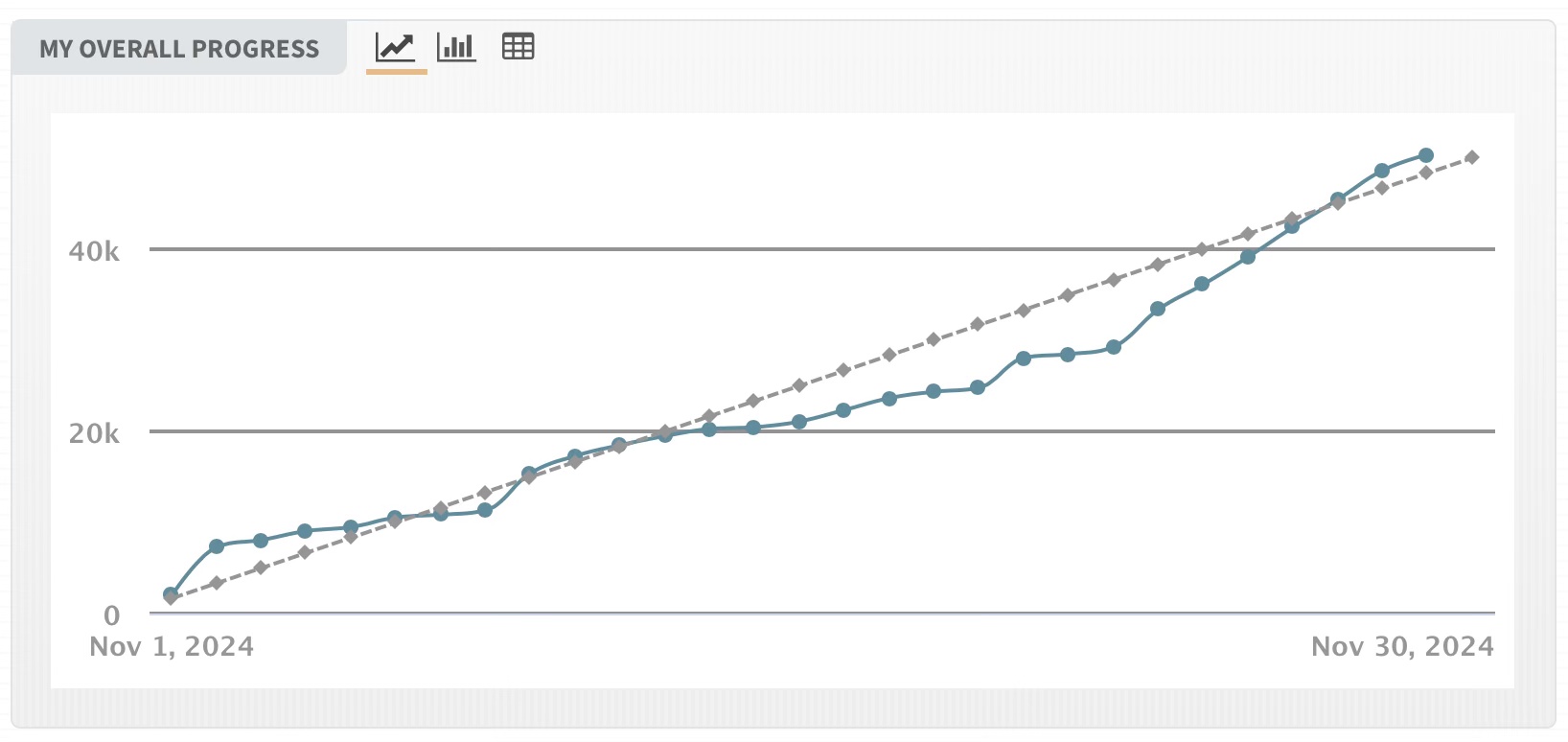
My daily progress (blue line) and the minimum I needed to write per day to win (grey line).

If you look at this year’s stats (above), you can see that, even though I started with a bang, I got behind and stayed behind for a long time. I entered this past week knowing I would have to write 2500 words per day to finish. I think the only way I wrote as much as I did this year was by making a promise to myself not to bring work home in the month of November (and I’m really bad about bringing work home—I’m a teacher). I also decided to give myself a break on weeknights. I figured that if I wrote 1000 words Monday through Thursday, I could write 2000 words each day of each weekend to catch up, and I would finish on time. But it’s not like my life is comprised of only work and writing. There were days when it would be half an hour past my bedtime when I finally sat down to bang out a couple hundred words. Even if I couldn’t meet the minimum word count (1667) every day, I was determined to write something—and I did. I technically have one day to go, and being done even a tiny bit early is such a good feeling. Did I actually complete the story I started? Not hardly, but now I can let it germinate and then finish writing it at a more leisurely pace.

Who knows if I’ll have something to write next year? Maybe I’ll still be working on this story. But I’m glad I did it this year, glad that new ideas can still happen. Here’s my badge that means absolutely nothing to anyone but me—and all my fellow WriMos:

Is AI Making Us Dumber?

In February 2023, I attended a conference for academic support teachers, and one of the workshops addressed ChatGPT. As an elementary school teacher, it wasn’t on my radar at all. The stance that the workshop leaders took wasn’t exactly “if you can’t beat them, join them,” but it wasn’t far off. If kids are going to be exploring ChatGPT anyway, they reasoned, we teachers need to make it our job to learn about it and any benefits it might have in the classroom.

I didn’t give ChatGPT another thought until last year’s preplanning, when one of our admin gave a ChatGPT demonstration by having it write her presentation. Were there some gaffes? Yes, but it did a decent job of covering her topic.

That was my only taste of ChatGPT until one day a few months later when I was completely burnt out and needed to write a lesson plan for my 3rd graders. One of my colleagues said, “Have ChatGPT write it for you.” So I thought, why not? I pulled it up and asked it to write my lesson plan. At the beginning of ChatGPT’s lesson plan, it gave instructions for whichever spelling pattern I was teaching (I wish I’d saved it—I can’t remember what pattern it was now), and while the structure of the lesson plan was fine, the explanation of the spelling pattern was incorrect. In ChatGPT’s defense, it is difficult to give printed instructions for a lesson that is dependent on sounds and articulation. I can imagine it being just as difficult to read a speech therapist’s lesson plan. Even so, the fundamental principals were just wrong. It concerned me that other teachers who are lost and looking to ChatGPT to help them might assume that it’s correct and teach it verbatim. You may think it doesn’t matter if kids don’t learn how to spell (after all, they can just have AI write it for them—yeesh), but what if it writes an incorrect chemistry or algebra lesson?

One thing I will give ChatGPT is that it asks for feedback, and I did not hold back. I told it that I couldn’t use the lesson plan because there were errors, and it asked me what those errors were because, as AI, it has the ability to learn. I told it what was wrong, but again, if I didn’t know what I was talking about, I could fill ChatGPT with all kinds of nonsense that it would internalize and use in the next lesson plan that some unsuspecting teacher asks for. In that way, it reminds me of Wikipedia—which, by the way, my school teaches students not to use as a trusted source. Sure, you may find facts there, but it’s also been known to have bogus information, such as that Sinbad died in 2007 (he’s still alive and well 17 years later).

ChatGPT isn’t the only AI out there. It seems like there’s something new every day. I see commercials for Grammarly constantly. Do we really need AI to help us with our emails? (Okay, I’ll admit, some people need to get help from somewhere. Apparently, it’s too much to ask people to proofread a two-liner before hitting send.) Even WordPress is trying to get me to use AI to “improve” this blog. I’m sorry, if I reach a smaller audience because I’m not using AI, at least that audience is reading my words.

And AI doesn’t just write and edit for you—it can also take a candid photo and make it look like a professional headshot. While this is a nice alternative to having to spend big bucks on a photographer, it’s also a hop, skip, and a jump away from fudging reality. If AI can make a snapshot of me at Disney World look like a professional headshot, couldn’t it also make it look like I’m best friends with J.K. Rowling? Or like I spent two weeks at a fancy resort that I’ve never actually visited? If seeing is believing… what if we can’t believe what we see anymore?

Thinking I’m a dinosaur who needs to get with the times, I asked my 16-year-old what he thinks about ChatGPT. To my surprise, I know more about it than he does. The extent of his knowledge is that it’s AI, therefore he has no interest in it. I asked him why—after all, he’s my dyslexic kiddo who has legitimate access to all the assistive technology he could ever want. What Peter said is that AI is allowing people to get dumber because they don’t have to think. There you have it from a high schooler, folks.

And as if the universe was giving me extra incentive to tackle this topic, I read this the other day: “Calculating machines could provide swift answers to complex sums, but what happened when the human mind atrophied and forgot how to calculate?” (Sisterhood of Dune by Brian Herbert and Kevin J. Anderson—yep, this lecture brought to you by a sci-fi geek).

I am all for assistive technology. After all, I’m the same person who made this vision board in grad school:

Just as I have students with dyscalculia (a math disorder) who are allowed to use calculators on math tests, there are assistive technologies that help people with just about any learning disability you can imagine. The more research that comes out about different learners, the more we’re able to differentiate and allow people to learn according to how they are wired. But before assistive technology can be used, the people using it need to know why they’re using these tools and how to use them properly. Putting a calculator into a child’s hands does no good if she doesn’t know which functions to use or the order of operations. Only once she understands the basic principles of math can she use the calculator to free up some of her working memory so she can think through problems and solve them correctly. In other words, we still have to teach people how to think.

Before writing this post, I did go back to ChatGPT to have it write a lesson plan on r-controlled vowels. The activities that it outlined were okay, but it lumped areriror, and ur into one lesson without any explicit instruction about the different sounds or how to differentiate between erir, and ur, which all sound the same. I’m sure I care more about this than most because I’m a specialist, but that’s the point: I’m the specialist, not ChatGPT. The next time I’m feeling overwhelmed, I’ll just take a breather and remember that, even on my worst days, I’m a better teacher than AI.

Here’s the thing: generative AI should only be used to supplement what we already know. It should not be the only source we turn to for anything, and when it’s used at all, it should be with extreme caution and—dare I say?—skepticism. In a time when it’s so easy to let our minds atrophy in front of screens, AI gives us another excuse to let our thinking “muscles” go slack. It’s such an issue that, when submitting a piece of writing for publication, I have to check a box saying it’s my own creation and that no part of it was written by artificial intelligence. Plagiarism, while still an issue, is no longer the main way that people claim works that aren’t their own.

I’ll leave you with this:

I love creating teaching materials or having brainwaves that make me lose myself in a piece of writing for long stretches of time. Don’t let AI steal what you love to do and turn it into a cheap imitation of your original, hard work.


For worksheets, activities, reading passages, lesson plans, and more (that I created), please check out my Teachers Pay Teachers store, Mrs C loves to read: https://www.teacherspayteachers.com/store/mrs-c-loves-to-read

Freedom to Fail

In November, I did something that I had not done since 2021: I signed up for NaNoWriMo (National Novel Writing Month). And in doing so, I did something I’ve never done before: I signed up for NaNoWriMo expecting to fail.

The last time I participated in NaNoWriMo, I was in the midst of grad school, and I think the only thing that saved me was that it was 2020, when most of my (and my children’s) extracurricular activities were postponed until who-knew-when. Was I still stressed out? Yes. But I validated a 51,000-word manuscript by the 25th of the month.

In 2021, I had just started a special education certificate program that required me to take more courses per semester in order to stick with my cohort. With sports and music programs in full swing again, I made the tough decision to forego NaNoWriMo in the interest of spending time with my family and keeping a shred of sanity. What made my decision particularly tough was that, in March of that year, I’d had a brainwave, and a new story idea was born. Despite this brainwave coinciding with a new semester at a new school, I split my time between typing papers and typing the story. By the end of June, I’d written close to 114,000 words. Then my creativity fizzled out. There was a two-year period in my story line in which I needed the characters to develop, but I had no idea what events would cause that development. I knew what would happen at the end of those two years, but as for filling in the details, I was stuck. NaNoWriMo would have been a great time to wrestle with that, but even if I hadn’t been stupid-busy, I’m not sure if I would have made progress.

Last year, I felt guilty for opting out for a second year in a row, but no new ideas—or even old ones—had occurred in my year-plus of writing abstinence. Even though I knew I would finish my degree by the end of the month, it wouldn’t be enough time to squeeze 50,000 words in. And I was so burnt out that I was grateful for the lack of pressure.

Why is there so much pressure with NaNoWriMo, by the way? It’s kind of an honor system, although I believe that most people who are crazy enough to sign up to write 50,000 words in a month will see it through properly—or proverbially die trying. I put all that pressure on myself. While fellow Wrimos supported me every year, it was me who was upset if I didn’t make a certain word count in a day. So as November approached this year, I knew that it was on me to take the plunge… or not. I hadn’t written anything new in almost two-and-a-half years. I’ve edited some since 2021, but what if editing was all I had left? Signing up for NaNoWriMo seemed like a final test. Can I still write? That was a more important question than, Can I write 50,000 words in a month?

At the end of October, I signed up, deciding that I would return to my unfinished manuscript from early 2021. It was November 5th before I had time to even think about starting, and when I did, it was only in short spurts. My momentum didn’t start until the week of Thanksgiving. At that point, I knew I was capable of making up my paltry word count—after all, for my first ever NaNoWriMo in 2013, I wrote close to 5000 words on my first day. But that kind of passion was absent this year, leaving me with more of a slow burn. The poor NaNoWriMo stats tracker eventually gave up on telling me how many words I needed to write in a day when the daily goal exceeded 8000.

Here is what I did do in November: I spent time reading a fabulous book (The Running Grave, sequel to The Ink Black Heart, if you read my last post); I enjoyed a day trip to Savannah with my family (also in my last post); I did some much-needed cleaning/decorating/straightening around the house we moved into two months ago; I gave my family and our pets more attention than I have in Novembers past; and I ultimately lost NaNoWriMo for the first time, writing just over 9000 words.

But if you don’t live, what is there to write about?

I don’t know what future Novembers will look like, but now that I’ve lost and survived it, it feels… good. My writing has slowed down, but in this slower season, I will keep moving forward in manageable chunks. I now know the answer to my initial question: Not only can I still write, but by allowing myself to change my pace, I’m even enjoying it again.

Premature NaNoWriMo?

I don’t plan to participate in National Novel Writing Month (NaNoWriMo) this year. There, I said it. It’s something I’ve been contemplating since the summer, and I know it’s the right thing to do. I’ve written a novel every November since 2013, but not this year. I started 2021 with a lot on my plate but added even more in March, when I ended a nine-month hiatus in my grad school venture, transferring to a new school and plunging back in with both feet. The queen of over-committing myself, I may have signed up for NaNoWriMo without batting an eye in previous years, but not now. Maybe it’s COVID that’s given me a different perspective, but I’m more protective of my time than I’ve ever been—I’ve actually said no to some things, and NaNoWriMo one of them.

The idea of skipping made me feel like a failure at first. I told myself that I would sign up but give myself permission not to write if I couldn’t afford the time. But I know me, and if I sign up for something, I’m going to by-God finish it. And I really can’t say I mind the sacrifice. What I’m doing with my degree connects with my passion for reading and writing: I’m working on a dyslexia certificate as a specialty within Reading Education. This time next year, I should be able to screen kids for dyslexia and devise individualized plans to help them learn to read. There’s not much sadder to me than knowing there are people who struggle to read but would love it if only someone would help them. I want to be that someone.

Another reason I don’t mind taking off this year is that I wrote a ton from early March through June—close to 114,000 words, in fact. It was one of those stories that just blossomed out of nowhere. I wondered why it couldn’t have hit me at a more convenient time—October 31st, say. But it happened in March, and I wrote 55,000 of those nearly 114,000 words during the first 30 days. At the time, I kicked myself because I was worried I wouldn’t have anything left by November. But as I continued with grad school, work, spending time with my family, and life in general, my initial impetus to write waned. I believe things happen for a reason, and it seems that the reason the story came to me eight months prematurely is because I wouldn’t be able to commit to it in November. When the time it right (write?), I’ll take it up again—with no regrets or guilt.

If you’ve read my previous November posts, you know that I have really struggled with NaNoWriMo the past few years. One year, I actually re-started my previous year’s novel from a different angle, hoping to break through the writer’s block that had kept me from finishing the book the first time. Maybe taking a year off—writing when I have the itch and not on a schedule—is what I need in this chapter of my life. I don’t say this to deter potential WriMos, but I do hope that those of you who struggle with the November-only commitment will feel relieved that you’re not alone. Life happens. Sometimes you can spin out 50,000 words in November; sometimes you can’t. For those of you who need to pause, you’re in good company. And for those of you who do participate, I wish you well.

____________________________________

Want to sign up for NaNoWriMo? Here’s the link: https://nanowrimo.org

You Can’t Take NaNoWriMo from Me, 2020!

With all the crazy changes that 2020 has brought, I was determined to have one normal thing: National Novel Writing Month, also known as NaNoWriMo. This year marked my eighth foray into the crazy undertaking of writing a 50,000-word novel in the month of November. It was also my eighth win—yay!

With everything else that’s gone awry so far this year, I was worried that NaNoWriMo would be added to the list, especially since it’s been a struggle the last few years. NaNoWriMo 2019 was the ultimate low for me. I did have a good excuse, at least: last fall, I started grad school, and I wondered if I would be able to cobble together 50,000 words. But while grad school made finding time to write a challenge, it was my enthusiasm for the story itself that was the real reason for my struggle. I really had reservations when, 22 days in, I had only written 17,000 words. But I’m not one to quit when I say I’m going to do something, so I knuckled down and validated by the 29th of the month. It was a pretty miserable experience, honestly. I labored on after November, attempting to finish the book, and then—boom—COVID. When you’re writing a book set in 2020, and then a pandemic happens, it tends to kill an already-floundering storyline. I don’t know. Maybe someday I’ll have the energy to go back and fix it.

Unfortunately, I was already on a downward spiral, with 2017 and 2018 being little better. Those two years, I actually wrote the same story. After 2017 lost its mojo, I decided to set it aside and start fresh for NaNoWriMo 2018. But even though I have two novels’ worth of material, I still have never been able to put it all together into one cohesive book.

I’ve had to face the reality that nothing will be like my first NaNoWriMo in 2013. That was the year I embraced what I thought was a completely insane experiment and started with a sprint—over 4700 typed on day one. And I hit 50,000 words just 14 days in. I’m realistic enough to know that that is not the standard to which I should hold myself, but still. I don’t want 2013 to be the one hit wonder of my NaNo experience.

Thank goodness it wasn’t. Although no subsequent year has been as easy as 2013, I finished writing each of my novels for 2014, ’15, and ’16 a few months after NaNoWriMo. And this year, I am determined to do the same. I can’t lie—it helps that I’ve taken a semester off from grad school this fall. Next year, I won’t be able to say the same. But for now, I am determined to enjoy my present success. I’ve already typed 57,000 words, and I haven’t grown weary of this story, as in the past several years. I’m excited to see where it takes me. (Hopefully not as unpredictable and outright nuts as this year, but I’m not counting anything out right now.) Right when I was beginning to fear that NaNoWriMo was just a chore, something from 2020 has finally given me hope.

If you’re a writer, I hope 2020 has provided some interesting fodder for your projects. Did you participate in NaNoWriMo? I’d love to know how you did!

Happy writing, friends.

NaNoWriMo 2019 Recap (Finally)

NaNoWriMo 2019 Winner Banner

I figured that I should probably address what happened during National Novel Writing Month (NaNoWriMo) this year before it rolls around again next year—so three-plus week late is better than never, right? My tardiness is an indication of how busy I was in November. And nothing’s going to change for as long as I’m in grad school (so forever, maybe).

My first year, NaNoWriMo 2013, was ridiculously easy; I validated on the 14th of the month. I wrote NaNoWriMo 2014 at more of a normal pace—not really a struggle, although not as easy as the first. The real difficulty was two years ago. I struggled just to validate and then lost my enthusiasm shortly afterward. With my previous four books, I finished each manuscript, even if it took several months. But in 2017, I gave up and decided to start the same novel over again in 2018. I validated on November 29th, but the results were little better than the previous year. I don’t know if I’ll ever finish that book.

Last spring, a scene with characters I’d never before imagined popped into my head. After jotting it down and giving it some thought, I realized it has novel-scope potential. I decided to save it for NaNoWriMo 2019. For the first three days, I kept up with my word count, and all was well. But starting day four… well, let’s just say that there were some days in November when I wrote less than 100 words. All along, I had prepared to catch up Thanksgiving week, when I would be off work and finally have some “free” time.

Unfortunately, Thanksgiving was late this year. If I didn’t finish by that Saturday,  I would fail at NaNoWriMo for the first time in my personal history. And since I am generally only competitive with myself, this was not an option I liked to consider.

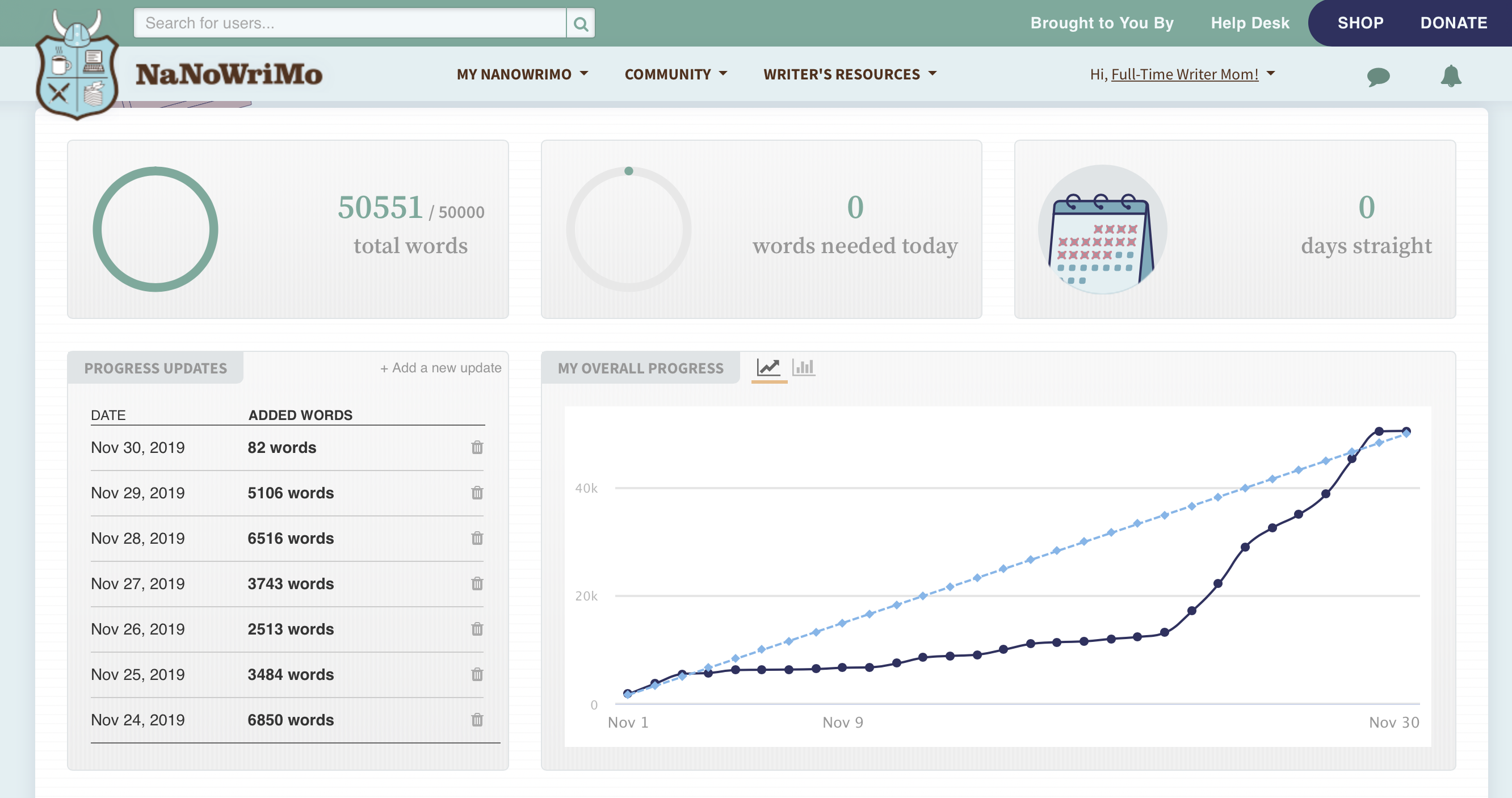
Look at how much I had to write in the last week of November by checking out this handy graph from the NaNoWriMo.org website:

NaNoWriMo 2019 Graph Every time I updated my word count, I had a visual that showed me exactly how far behind I was—and how much behinder I’d gotten since the previous day. By the time I got to that last week of November, I knew I had to write almost 5000 words per day in order to win. I really wanted to finished by the 29th, just to make sure, so it was a lot of pressure.

Let’s just say that I didn’t do much homework that week. Which left me extremely behind and staying up until 2:00 or 3:00 in the morning the following weekend, when my final project was due. But I did validate my novel and finish my project on time. I’m also glad to say that I’m still plugging away at this year’s book. I might actually finish it before NaNoWriMo 2020.

Last Minute Writing Tips

NaNoWriMo 2018 Winner BannerI think this is the first November since I started NaNoWriMo in 2013 in which I didn’t update my novel’s progress at some point between its start and validation. I was so behind on my word count for so long that I didn’t dare do any other writing project—even a short blog to update my (lack of) progress—for fear of stealing precious time from 2018’s novel.
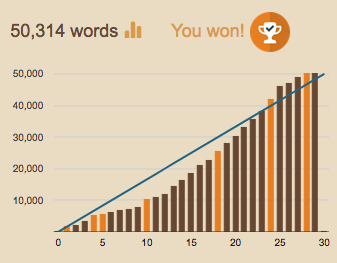
Just to give you a literal picture of how sad this situation was, take a look at my stats graph from nanowrimo.org:

Screen Shot 2018-11-29 at 1.29.27 PM

I think the worst was the day when I only typed 298 words. And there were too many other days when I typed well under 1000. In case you’ve stumbled across my blog, and this is the first time you’ve ever heard of this NaNo business, to “win” at National Novel Writing Month, you need to write a 50,000-word novel that you don’t start until November 1st and that you finish on the 30th. (And by finish, I just mean write 50,000 words. I have not ever actually completed a novel in the month of November.) That means 1667 words per day, if you don’t want to drown in a sea of unwritten words.

I could point to plenty of reasons why I had a hard time keeping up. The day when I only wrote 298 words was a Monday, the day of the week when I have zero free time. After working a full day, I’m usually eating dinner while walking around the kitchen, making sure one kid does his homework and the other practices piano—and then I run out to a choir rehearsal that takes up the rest of the night, then straight to bed with my alarm set for 4:30 am. I’m the type of person who takes personal goals seriously, so unless I die, I’m not going to sign up for NaNoWriMo and then fizzle out. Fortunately, I knew that I would be off during Thanksgiving week, and guess what? That’s when my daily word count started to go up.

If you’re in the same boat, I’m sorry to say that you only have a couple days to catch up, but I do have three tips that I used this year that really helped me. (If I’d done these in previous years, maybe I would have finished sooner and with a lot less stress.)

1. Let it be messy.

Back during NaNoWriMo 2016, I was really excited about my novel because I’d had this story bouncing around my head since the previous NaNo (when I was already committed to writing the third book of a trilogy). I had scenes already planned and ready to pour from my fingers to the page. But then I got stuck on Day 1 because I didn’t know how to start the dang thing. I must have typed ten different beginnings, only to erase them (big mistake—see #3) and try again… and again… and…

Let’s get real for a minute. While publishing houses and marketing people care very much about the opening of your book—if it isn’t any good, the reader will just put it down and go for something else, right?—you’re nowhere near publication ready when you get done with NaNoWriMo. I mean, that would be like giving birth, changing a few diapers, saying, “I think he’s got this,” and shoving your newborn out into the world to fend for himself. Who does that? (Terrible people and bad writers, that’s who.)

There’s nothing wrong with a cold open. You can come back and make it Pulitzer-worthy later. (Say, after you have 50,000 words down.) Or maybe if you get stuck transitioning from one scene to another, just write a note in the manuscript (“Something amazing happens between flight school and when Jack saves Flight 132!”), and move on to the next part you do know. There’s this thing called the editing process, and I find that a lot of magic happens then. Which leads to point two…

2. Write everything, including the kitchen sink.

I’m a perfectionist. Point #1 is hard for me. And even harder is this one. I want my writing to be meaningful, certainly not fluff or garbage. But guess what, Mama ain’t got time to mess around with getting the story perfect when there are 10,000 words left to type, and the clock’s ticking!

I found myself writing absolute rubbish that I hope never sees the light of day just to keep the story moving—and to keep that word count moving up. Once I made the decision, sitting down to write became a whole lot less daunting because I knew that, come revision time, all this mess would be gone. And who knows? When you’re writing anything and everything semi-stream-of-consciousness style, something brilliant might just pop out, which might have been stifled if you’d been more careful, more discerning, with your output.

What do I mean by writing everything? Well, if your character is a baker, explain the entire process of baking a cake. Maybe tell about his favorite pans and where he bought them (on sale for 30% off). See all those extra words? They count! If you character is sick, explain every gory detail (you know, the ones your grandma tells you, and you wish you could be anywhere else). Explain the disgusting diaper, the allergic reaction, the thousand-step process to assembling the bed from IKEA. Do whatever you have to do to keep the story moving (and you might actually solve a transition scene problem while you’re at it).

3. DON’T DELETE!

Okay, if you see a typo that’s bugging you, fix it. What I’m talking about here is the big stuff, such as an entire scene that you realize, after it’s had time to marinate, is actually not at all the direction your story needs to take. So move on; start a new paragraph, and rewrite it.

That’s exactly what happened to me a few days ago. I realized that if I deleted the scene I’d been so careful to write (kitchen sink and all), I would lose about 1000 words that I desperately needed. I thought about ways I could salvage the scene. Maybe the character would start to do this but then change her mind… and when I tried that, I was able to save about a third of it. Still, that was too much writing to sacrifice. So I highlighted the paragraphs I no longer wanted, changed the font to red so that I would know this is the bad section, and I continued the scene down the new path. I never lost a single word, and now my story is going in the right direction again. I wish I’d thought of this back in 2016!

Bonus tip: don’t give up! You still have time (and the 30th is on a Friday this year, which I think will help a lot of people). Good luck, friends who are still in the trenches. I’ll see you after you’ve won your battle.

What Happened to NaNoWriMo 2017?

Keep Calm and Write On

Who cares about NaNoWriMo 2017 when NaNoWriMo 2018 is right around the corner? Well, usually I update my progress on the previous year’s NaNoWriMo at least a couple times before I even start thinking about the next one. But this year is different.

Yes, I did technically “win” in 2017, writing 50,000 words on a new novel during the month of November. It was the toughest yet, and every year is harder than the last, so that makes 2018 look kind of grim.

While, for all my previous NaNos, I continued writing my novel until the entire book was done (which took more than one month and 50,000 words), I never finished writing 2017’s novel. Part of it was because I focused on editing four other novels almost as soon as I achieved the necessary word-count. But the bigger issue was that my inspiration simply dried up. All my wonderful ideas lost their luster, and the story lost its direction. And honestly, for a couple months, I didn’t even think about it.

With the next NaNoWriMo looming, I had two problems. The first, of course, was that I’d left the last novel unfinished. Unacceptable. And the second problem was that I had absolutely no idea what to write this November.

Then, for some reason, NaNoWriMo 2017 started plaguing me. I don’t mean that I was overwhelmed with guilt for not finishing it. Rather, its characters started reminding me of their existence at a time that wasn’t exactly convenient. They developed the oh-so-annoying trait of taking on lives of their own—when I wasn’t even writing! This one guy won’t stay despicable; he’s actually gaining dimension. Backstories are coming to the front.

This, I realized, could be a two-part solution. By life “interfering” and allowing me some space, my book developed in a way it couldn’t have if I’d insisted on plugging away at it. I hadn’t given up; I’d let it simmer. And now, I know exactly what I’m going to write this year.

Yes, a lot of the novel is largely written, but I have the feeling that much of it is going to end up consigned to the editing room floor. What I do write this year is going to be original or reconstructed from memory only. If I look at last year’s manuscript at all, it will only be to story-line check—no copying and pasting, I promise. I will start November at zero words, and I’m determined to end with 50,000. And once I’ve reached that goal, I will allow myself to merge the two novels, if still applicable.

Don’t let a novel that seems to have failed get you down. Stay creative, friends.

It Feels Like a Good Day to Write 50,000 Words

NaNoWriMo 2017 Badge

Okay, first off, I didn’t write 50,000 words today. As of this moment, I’ve written 2650 words today, but right around word 2550, I had 50,000 in my word bank, which means that I won NaNoWriMo (National Novel Writing Month) 2017!

If you read my last post (click here), you know that I was really taking a giant leap this year, working with little more than an idea I’d gotten from a dream. (And my husband can attest that some of my dreams are really strange and don’t necessarily lend themselves to coherent narratives.)

NaNoWriMo 2017 graph

NaNoWriMo 2017 Word Count Graph

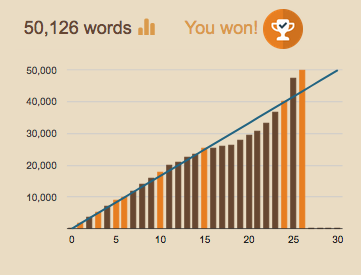
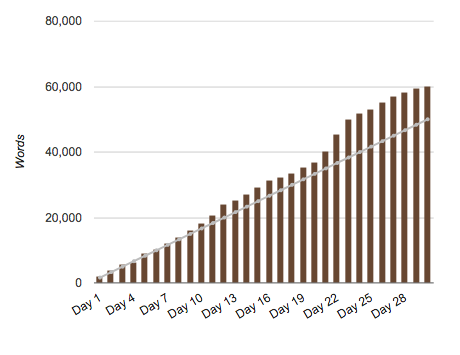
Add to that the challenge of this November’s brutal lack of free time, and I was lucky to keep up with the requisite 1667 words per day. In fact, I only kept up through day 15, as you can see in the 2017 graph. That nice diagonal line that’s going up? The bar for every day needs to reach that diagonal line in order to keep up with the word count. As you can see, I took a little dip for a few days. There was even one day when I only typed 201 words. Yikes.

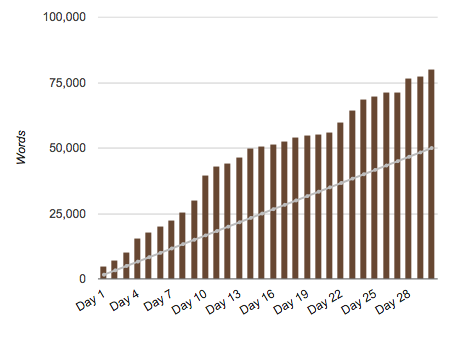
And this was uncharted territory for me. Never before have I fallen behind. Usually I’m just ahead (see my 2016 graph below—and I thought that novel was hard to write), but sometimes I’m way ahead. (See 2013—doesn’t that make you sick? I don’t know how I managed that except to say that I had inspiration strike just about every day.)

NaNoWriMo 2016 graph

NaNoWriMo 2016 Word Count Graph

NaNoWriMo 2013 graph

NaNoWriMo 2013 Word Count Graph

On Thanksgiving evening, my dad asked me what my word count was, and at the time, it was only about 33,500 (which I admitted with a cringe). Already, I had a plan to write 2500 that night and the following three nights, which would put me at 43,500 before I had to go back to work and reality on Monday. That would allow me to breathe a little, and I would only have to write a little over 2000 words for the next three days, thus giving me a tiny bit of cushion, and I would validate on the 29th.

Now it’s time to admit to why I had fallen so far behind, something that’s a huge NaNoWriMo no-no. About 25,000 words in, I realized I had a major flaw in my (half-written) novel and decided that, instead of tackling it in the editing stage, I would go ahead and fix it. Yep. That’s the OCD at work. Of course, I used the opportunity, while going back, to add scenes and fluff when- and wherever I could, but a lot of it was just reading, looking for the flaw, and fixing it.

Thanksgiving night, I decided I couldn’t afford to edit anymore, fast-forwarded to the end of my story, and just started typing thousands of words of info-dump back story. Yes, much of it will be woven into the larger story, so it won’t seem as dump-y in the end (I hope), but for now, I just need the words. (I even left in an entire scene that really needs to go, but I’m being a good girl and ignoring it for now.)

By Friday, I felt like I had enough words down that I went back and finished the edit, then started moving forward again. Yesterday, the epiphanies started to hit—finally! it only took 40,000 word to get there—and I wrote over 7000 words in one day. Whew. I can’t tell you the relief I feel. Meeting today’s word count was a breeze, and now the rest of my writing won’t feel as much “have to” as “want to.”

So if you’re stuck, if you can’t see the light at the end of your tunnel, stick with it! I promise you’ll be glad you ventured into the scary, dark unknown of your novel-in-progress. It’s Rainbow-Unicornland on the other side.

It’s Almost November! (This Happens Every Year)

02-scariest-moment

I’ve come to the critical time of October when the anticipation of National Novel Writing Month (aka NaNoWriMo, aka November) is putting me in an almost constant state of anxiety/excitement. Part of me wonders why I do this to myself—after all, couldn’t I pick any 30 days during the calendar year to start a novel from scratch and complete 50,000 words? Now that I’m working a full-time job for the first time in almost 10 years, the pressure is more acute than ever. It certainly would be easier to do this over the summer, when my kids have fewer events that require my attention.

But the greater part of me can’t wait for it to happen. There’s something about November that’s magical. It’s always been this way for me. There’s the possibility of cooler weather (yes, it’s only a possibility in northeast Florida) and the certainty of my favorite holidays ahead. I can bake pumpkin things without feeling weird about it, and I have my kids’ birthdays to look forward to. Even though I’m always crazy-busy and feel like I have zero spare minutes for me, adding this event that is only for me is a challenge to which I eagerly look forward.

Maybe other introverts will understand. Although NaNoWriMo is a community event, what with writers from all over the world participating, introverts are free to sign up and write behind the scenes. Yes, I update my word count online and post about my progress upon occasion, but otherwise, it’s a solitary event. The fact that I’m operating within my little bubble yet still accountable makes me push myself more than I would if I just decided to start a book tomorrow and finish 30 days later.

It presents a different set of challenges. If you’ve read my previous posts about NaNoWriMo over the years, you know that I don’t do a lot of prep. I’m not one for elaborate outlines, plotting every little twist and turn and then filling in the prose on day one. When I first participated in 2013, I had a book-size idea just days before November first and signed up on a whim. The following two years, I wrote books two and three of that trilogy—challenging, but at least I was dealing with characters with whom I was familiar. Last year, I wrote a book about which I’d been thinking for over a year, and I was bursting with ideas. Although every year after the first has been a challenge, I’ve always won.

This year’s novel… well, it’s going to be a fly-by-the-seat-of-my-pants composition. The premise is based on a dream I had several months ago. (Other writers, do you do this? Turn your dreams into stories?) I woke up and wrote down some elements and decided that another idea I’d had for a character quirk would work well with that scenario… and that’s it. It’s basically a scene. And a scene from the end, best I can tell. How do I start this thing? How do I build the characters and get them where they need to be and make it readable?

In the end, I don’t have to. That’s a challenge for the editing stage, which is months away. I have to hold all my thoughts together for a few more days and then let them flow from my brain to my fingertips and into Word starting on November first. If all I do is string together 50,000 words of scenes, I will win. Maybe I’ll surprise myself. Maybe golden prose will flow forth, and… who am I kidding? The manuscript is sure to be disjointed and chaotic, and this OCD girl is ready to embrace the messiness of it (with rubber gloves on, of course). Stay tuned.