It’s that time of year when we make it a point to reflect on gratitude. One thing I grew up hearing was how blessed we are. My maternal grandfather said it, often multiple times, every single time I saw him. I am ashamed to say that there were times when I kind of rolled my eyes at this sentiment. My grandfather lived through some tough things: working from the time he was 12 years old to support his family of five, serving in the U.S. Navy during World War II, losing the love of his life in a car accident. Yet he chose not to focus on the negative; it was far outshadowed by his everything-else. When he lay dying in a Hospice bed, barely conscious and in terrible pain, what he left with me was his insistence that he was “blessed beyond belief.”
I have never disagreed that I have enjoyed many blessings in my life, but I am certainly guilty of not always “count[ing] it all joy,” as the apostle James would have us do. It is easy to count my blessings when life is going well but much more difficult when I am frustrated, disappointed, or struggling. I am often guilty of looking forward to a time when my life will become less stressful, when things will become more manageable, when I can afford more or better than what I have right now, forgetting that what I have right now is not only enough, but it’s good.
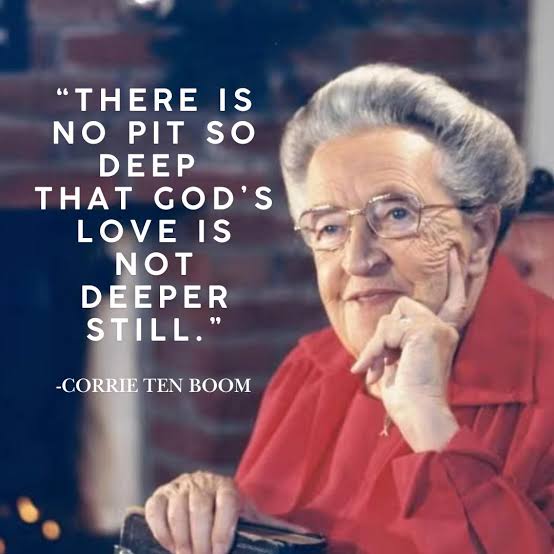
Recently, my perspective was challenged when I read Corrie ten Boom’s The Hiding Place. This is one of the books from my 2026 book list, but it’s different in that it’s a memoir, not a novel. I had heard of Corrie ten Boom and that she was a European World War II survivor, but that was the extent of my knowledge. My elder son Peter read this book last year and told me that I needed to read it, so I added it to my list. And then I spent most of the year passing over it.
I wish I had read The Hiding Place the minute Peter told me I should. I wish I had a crate of copies to hand out to everyone I know.
Corrie ten Boom was not (as I incorrectly assumed) a Jewish Holocaust survivor. She was a Dutch Christian, born to a watchmaker in the late 1800s. She grew up in a household where every day started and ended with a reading from the Bible. She grew up with her nuclear and extended family of three aunts living in the same household. Generosity was a part of the ten Boom DNA. The Hiding Place acquainted me first with Corrie as a person, with her hopes and dreams, some realized, some not. Before Holland ever fell to Nazi Germany, Corrie was a woman of deep faith who turned to God in prayer in every circumstance; it was as natural as breathing for the ten Booms. When Jewish friends and neighbors began to be displaced, the ten Boom home became a place of refuge for them. When a local pastor refused to house a Jewish infant, Corrie’s elderly father declared his life forfeit, if it meant saving this child. It is thanks to people like Corrie and her family that many Jewish people were saved.
There were times when Corrie ten Boom despaired, when she didn’t know what she would do next, when she felt her hope waning. But she always prayed and always did what she knew to be right, even when it put her life in jeopardy. Taking in Jewish refugees ultimately landed Corrie, her father, and all three of her siblings in jail. She and her eldest sister Betsie were later transported to Ravensbruck Concentration Camp in Germany. Hearing her firsthand account of the appalling conditions and the inmates’ inhumane treatment is chilling. That humans could do what they did to other humans is unthinkable, yet it happened. When Corrie and Betsie first arrived in the Ravensbruck barracks, every woman was all for herself, fighting for the best sleeping arrangement, reverting to a might-makes-right attitude toward her fellow prisoners. After the ten Boom sisters arrived and began sharing the Gospel, civility returned to this den of horrors. While this did nothing to improve their physical living conditions, it did everything to improve morale in a place that must have felt like Hell itself.
I have often heard that we can’t choose what happens to us, but we can choose how we react in less than ideal situations. Corrie ten Boom lived this. She chose her faith and shared it, even when those with whom she shared it did not react favorably. Corrie’s faith led her to forgive, even and especially those who committed unforgivable acts, even when she thought there was no possible way she could forgive. She brought hope to places where hope seemed to have died, and after the War, Corrie made it her life’s work to deliver faith, forgiveness, and hope to people around the world.
Corrie’s story shows that everyday miracles still do happen. Sometimes she prayed in hopeless circumstances, and it seemed that these prayers were somehow answered. I can’t say if what happened would have happened anyway, without her prayers, but other times, something happened that should not have happened. Or what seemed horrible at one time led to something good happening later. I won’t spoil these moments—I want you to read her amazing story and discover them for yourself.
I don’t face near the adversity that Corrie ten Boom did, not even a fraction. But the battles we all face daily feel big to us because we’re the ones living them. Corrie’s story has reminded me that every day is special, even the exhausting, trying ones. Not just this time of year, but always, I try to remember the blessings, the good things, the whatever-you-want-to-call-thems. This isn’t always easy, but it’s a habit I’m trying to build. If I could see any two people who are no longer living, first I would see my grandfather; I would thank him for his glass-half-full mentality, and I think we could talk into next week about our blessings. And second, I would love to meet Corrie ten Boom to tell her how her humble and humbling life has made a difference to me.

