Is AI Making Us Dumber?

In February 2023, I attended a conference for academic support teachers, and one of the workshops addressed ChatGPT. As an elementary school teacher, it wasn’t on my radar at all. The stance that the workshop leaders took wasn’t exactly “if you can’t beat them, join them,” but it wasn’t far off. If kids are going to be exploring ChatGPT anyway, they reasoned, we teachers need to make it our job to learn about it and any benefits it might have in the classroom.

I didn’t give ChatGPT another thought until last year’s preplanning, when one of our admin gave a ChatGPT demonstration by having it write her presentation. Were there some gaffes? Yes, but it did a decent job of covering her topic.

That was my only taste of ChatGPT until one day a few months later when I was completely burnt out and needed to write a lesson plan for my 3rd graders. One of my colleagues said, “Have ChatGPT write it for you.” So I thought, why not? I pulled it up and asked it to write my lesson plan. At the beginning of ChatGPT’s lesson plan, it gave instructions for whichever spelling pattern I was teaching (I wish I’d saved it—I can’t remember what pattern it was now), and while the structure of the lesson plan was fine, the explanation of the spelling pattern was incorrect. In ChatGPT’s defense, it is difficult to give printed instructions for a lesson that is dependent on sounds and articulation. I can imagine it being just as difficult to read a speech therapist’s lesson plan. Even so, the fundamental principals were just wrong. It concerned me that other teachers who are lost and looking to ChatGPT to help them might assume that it’s correct and teach it verbatim. You may think it doesn’t matter if kids don’t learn how to spell (after all, they can just have AI write it for them—yeesh), but what if it writes an incorrect chemistry or algebra lesson?

One thing I will give ChatGPT is that it asks for feedback, and I did not hold back. I told it that I couldn’t use the lesson plan because there were errors, and it asked me what those errors were because, as AI, it has the ability to learn. I told it what was wrong, but again, if I didn’t know what I was talking about, I could fill ChatGPT with all kinds of nonsense that it would internalize and use in the next lesson plan that some unsuspecting teacher asks for. In that way, it reminds me of Wikipedia—which, by the way, my school teaches students not to use as a trusted source. Sure, you may find facts there, but it’s also been known to have bogus information, such as that Sinbad died in 2007 (he’s still alive and well 17 years later).

ChatGPT isn’t the only AI out there. It seems like there’s something new every day. I see commercials for Grammarly constantly. Do we really need AI to help us with our emails? (Okay, I’ll admit, some people need to get help from somewhere. Apparently, it’s too much to ask people to proofread a two-liner before hitting send.) Even WordPress is trying to get me to use AI to “improve” this blog. I’m sorry, if I reach a smaller audience because I’m not using AI, at least that audience is reading my words.

And AI doesn’t just write and edit for you—it can also take a candid photo and make it look like a professional headshot. While this is a nice alternative to having to spend big bucks on a photographer, it’s also a hop, skip, and a jump away from fudging reality. If AI can make a snapshot of me at Disney World look like a professional headshot, couldn’t it also make it look like I’m best friends with J.K. Rowling? Or like I spent two weeks at a fancy resort that I’ve never actually visited? If seeing is believing… what if we can’t believe what we see anymore?

Thinking I’m a dinosaur who needs to get with the times, I asked my 16-year-old what he thinks about ChatGPT. To my surprise, I know more about it than he does. The extent of his knowledge is that it’s AI, therefore he has no interest in it. I asked him why—after all, he’s my dyslexic kiddo who has legitimate access to all the assistive technology he could ever want. What Peter said is that AI is allowing people to get dumber because they don’t have to think. There you have it from a high schooler, folks.

And as if the universe was giving me extra incentive to tackle this topic, I read this the other day: “Calculating machines could provide swift answers to complex sums, but what happened when the human mind atrophied and forgot how to calculate?” (Sisterhood of Dune by Brian Herbert and Kevin J. Anderson—yep, this lecture brought to you by a sci-fi geek).

I am all for assistive technology. After all, I’m the same person who made this vision board in grad school:

Just as I have students with dyscalculia (a math disorder) who are allowed to use calculators on math tests, there are assistive technologies that help people with just about any learning disability you can imagine. The more research that comes out about different learners, the more we’re able to differentiate and allow people to learn according to how they are wired. But before assistive technology can be used, the people using it need to know why they’re using these tools and how to use them properly. Putting a calculator into a child’s hands does no good if she doesn’t know which functions to use or the order of operations. Only once she understands the basic principles of math can she use the calculator to free up some of her working memory so she can think through problems and solve them correctly. In other words, we still have to teach people how to think.

Before writing this post, I did go back to ChatGPT to have it write a lesson plan on r-controlled vowels. The activities that it outlined were okay, but it lumped areriror, and ur into one lesson without any explicit instruction about the different sounds or how to differentiate between erir, and ur, which all sound the same. I’m sure I care more about this than most because I’m a specialist, but that’s the point: I’m the specialist, not ChatGPT. The next time I’m feeling overwhelmed, I’ll just take a breather and remember that, even on my worst days, I’m a better teacher than AI.

Here’s the thing: generative AI should only be used to supplement what we already know. It should not be the only source we turn to for anything, and when it’s used at all, it should be with extreme caution and—dare I say?—skepticism. In a time when it’s so easy to let our minds atrophy in front of screens, AI gives us another excuse to let our thinking “muscles” go slack. It’s such an issue that, when submitting a piece of writing for publication, I have to check a box saying it’s my own creation and that no part of it was written by artificial intelligence. Plagiarism, while still an issue, is no longer the main way that people claim works that aren’t their own.

I’ll leave you with this:

I love creating teaching materials or having brainwaves that make me lose myself in a piece of writing for long stretches of time. Don’t let AI steal what you love to do and turn it into a cheap imitation of your original, hard work.


For worksheets, activities, reading passages, lesson plans, and more (that I created), please check out my Teachers Pay Teachers store, Mrs C loves to read: https://www.teacherspayteachers.com/store/mrs-c-loves-to-read

Last Minute Writing Tips

NaNoWriMo 2018 Winner BannerI think this is the first November since I started NaNoWriMo in 2013 in which I didn’t update my novel’s progress at some point between its start and validation. I was so behind on my word count for so long that I didn’t dare do any other writing project—even a short blog to update my (lack of) progress—for fear of stealing precious time from 2018’s novel.
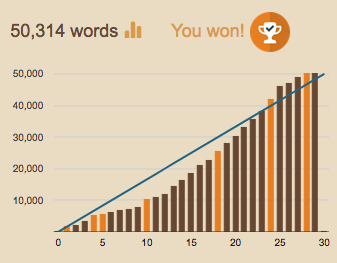
Just to give you a literal picture of how sad this situation was, take a look at my stats graph from nanowrimo.org:

Screen Shot 2018-11-29 at 1.29.27 PM

I think the worst was the day when I only typed 298 words. And there were too many other days when I typed well under 1000. In case you’ve stumbled across my blog, and this is the first time you’ve ever heard of this NaNo business, to “win” at National Novel Writing Month, you need to write a 50,000-word novel that you don’t start until November 1st and that you finish on the 30th. (And by finish, I just mean write 50,000 words. I have not ever actually completed a novel in the month of November.) That means 1667 words per day, if you don’t want to drown in a sea of unwritten words.

I could point to plenty of reasons why I had a hard time keeping up. The day when I only wrote 298 words was a Monday, the day of the week when I have zero free time. After working a full day, I’m usually eating dinner while walking around the kitchen, making sure one kid does his homework and the other practices piano—and then I run out to a choir rehearsal that takes up the rest of the night, then straight to bed with my alarm set for 4:30 am. I’m the type of person who takes personal goals seriously, so unless I die, I’m not going to sign up for NaNoWriMo and then fizzle out. Fortunately, I knew that I would be off during Thanksgiving week, and guess what? That’s when my daily word count started to go up.

If you’re in the same boat, I’m sorry to say that you only have a couple days to catch up, but I do have three tips that I used this year that really helped me. (If I’d done these in previous years, maybe I would have finished sooner and with a lot less stress.)

1. Let it be messy.

Back during NaNoWriMo 2016, I was really excited about my novel because I’d had this story bouncing around my head since the previous NaNo (when I was already committed to writing the third book of a trilogy). I had scenes already planned and ready to pour from my fingers to the page. But then I got stuck on Day 1 because I didn’t know how to start the dang thing. I must have typed ten different beginnings, only to erase them (big mistake—see #3) and try again… and again… and…

Let’s get real for a minute. While publishing houses and marketing people care very much about the opening of your book—if it isn’t any good, the reader will just put it down and go for something else, right?—you’re nowhere near publication ready when you get done with NaNoWriMo. I mean, that would be like giving birth, changing a few diapers, saying, “I think he’s got this,” and shoving your newborn out into the world to fend for himself. Who does that? (Terrible people and bad writers, that’s who.)

There’s nothing wrong with a cold open. You can come back and make it Pulitzer-worthy later. (Say, after you have 50,000 words down.) Or maybe if you get stuck transitioning from one scene to another, just write a note in the manuscript (“Something amazing happens between flight school and when Jack saves Flight 132!”), and move on to the next part you do know. There’s this thing called the editing process, and I find that a lot of magic happens then. Which leads to point two…

2. Write everything, including the kitchen sink.

I’m a perfectionist. Point #1 is hard for me. And even harder is this one. I want my writing to be meaningful, certainly not fluff or garbage. But guess what, Mama ain’t got time to mess around with getting the story perfect when there are 10,000 words left to type, and the clock’s ticking!

I found myself writing absolute rubbish that I hope never sees the light of day just to keep the story moving—and to keep that word count moving up. Once I made the decision, sitting down to write became a whole lot less daunting because I knew that, come revision time, all this mess would be gone. And who knows? When you’re writing anything and everything semi-stream-of-consciousness style, something brilliant might just pop out, which might have been stifled if you’d been more careful, more discerning, with your output.

What do I mean by writing everything? Well, if your character is a baker, explain the entire process of baking a cake. Maybe tell about his favorite pans and where he bought them (on sale for 30% off). See all those extra words? They count! If you character is sick, explain every gory detail (you know, the ones your grandma tells you, and you wish you could be anywhere else). Explain the disgusting diaper, the allergic reaction, the thousand-step process to assembling the bed from IKEA. Do whatever you have to do to keep the story moving (and you might actually solve a transition scene problem while you’re at it).

3. DON’T DELETE!

Okay, if you see a typo that’s bugging you, fix it. What I’m talking about here is the big stuff, such as an entire scene that you realize, after it’s had time to marinate, is actually not at all the direction your story needs to take. So move on; start a new paragraph, and rewrite it.

That’s exactly what happened to me a few days ago. I realized that if I deleted the scene I’d been so careful to write (kitchen sink and all), I would lose about 1000 words that I desperately needed. I thought about ways I could salvage the scene. Maybe the character would start to do this but then change her mind… and when I tried that, I was able to save about a third of it. Still, that was too much writing to sacrifice. So I highlighted the paragraphs I no longer wanted, changed the font to red so that I would know this is the bad section, and I continued the scene down the new path. I never lost a single word, and now my story is going in the right direction again. I wish I’d thought of this back in 2016!

Bonus tip: don’t give up! You still have time (and the 30th is on a Friday this year, which I think will help a lot of people). Good luck, friends who are still in the trenches. I’ll see you after you’ve won your battle.

What Happened to NaNoWriMo 2017?

Keep Calm and Write On

Who cares about NaNoWriMo 2017 when NaNoWriMo 2018 is right around the corner? Well, usually I update my progress on the previous year’s NaNoWriMo at least a couple times before I even start thinking about the next one. But this year is different.

Yes, I did technically “win” in 2017, writing 50,000 words on a new novel during the month of November. It was the toughest yet, and every year is harder than the last, so that makes 2018 look kind of grim.

While, for all my previous NaNos, I continued writing my novel until the entire book was done (which took more than one month and 50,000 words), I never finished writing 2017’s novel. Part of it was because I focused on editing four other novels almost as soon as I achieved the necessary word-count. But the bigger issue was that my inspiration simply dried up. All my wonderful ideas lost their luster, and the story lost its direction. And honestly, for a couple months, I didn’t even think about it.

With the next NaNoWriMo looming, I had two problems. The first, of course, was that I’d left the last novel unfinished. Unacceptable. And the second problem was that I had absolutely no idea what to write this November.

Then, for some reason, NaNoWriMo 2017 started plaguing me. I don’t mean that I was overwhelmed with guilt for not finishing it. Rather, its characters started reminding me of their existence at a time that wasn’t exactly convenient. They developed the oh-so-annoying trait of taking on lives of their own—when I wasn’t even writing! This one guy won’t stay despicable; he’s actually gaining dimension. Backstories are coming to the front.

This, I realized, could be a two-part solution. By life “interfering” and allowing me some space, my book developed in a way it couldn’t have if I’d insisted on plugging away at it. I hadn’t given up; I’d let it simmer. And now, I know exactly what I’m going to write this year.

Yes, a lot of the novel is largely written, but I have the feeling that much of it is going to end up consigned to the editing room floor. What I do write this year is going to be original or reconstructed from memory only. If I look at last year’s manuscript at all, it will only be to story-line check—no copying and pasting, I promise. I will start November at zero words, and I’m determined to end with 50,000. And once I’ve reached that goal, I will allow myself to merge the two novels, if still applicable.

Don’t let a novel that seems to have failed get you down. Stay creative, friends.

It Feels Like a Good Day to Write 50,000 Words

NaNoWriMo 2017 Badge

Okay, first off, I didn’t write 50,000 words today. As of this moment, I’ve written 2650 words today, but right around word 2550, I had 50,000 in my word bank, which means that I won NaNoWriMo (National Novel Writing Month) 2017!

If you read my last post (click here), you know that I was really taking a giant leap this year, working with little more than an idea I’d gotten from a dream. (And my husband can attest that some of my dreams are really strange and don’t necessarily lend themselves to coherent narratives.)

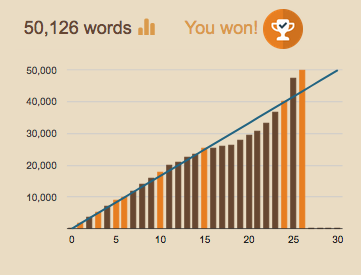
NaNoWriMo 2017 graph

NaNoWriMo 2017 Word Count Graph

Add to that the challenge of this November’s brutal lack of free time, and I was lucky to keep up with the requisite 1667 words per day. In fact, I only kept up through day 15, as you can see in the 2017 graph. That nice diagonal line that’s going up? The bar for every day needs to reach that diagonal line in order to keep up with the word count. As you can see, I took a little dip for a few days. There was even one day when I only typed 201 words. Yikes.

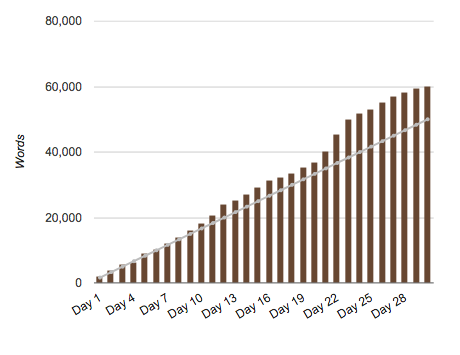
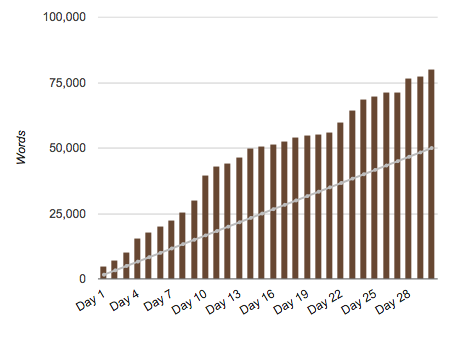
And this was uncharted territory for me. Never before have I fallen behind. Usually I’m just ahead (see my 2016 graph below—and I thought that novel was hard to write), but sometimes I’m way ahead. (See 2013—doesn’t that make you sick? I don’t know how I managed that except to say that I had inspiration strike just about every day.)

NaNoWriMo 2016 graph

NaNoWriMo 2016 Word Count Graph

NaNoWriMo 2013 graph

NaNoWriMo 2013 Word Count Graph

On Thanksgiving evening, my dad asked me what my word count was, and at the time, it was only about 33,500 (which I admitted with a cringe). Already, I had a plan to write 2500 that night and the following three nights, which would put me at 43,500 before I had to go back to work and reality on Monday. That would allow me to breathe a little, and I would only have to write a little over 2000 words for the next three days, thus giving me a tiny bit of cushion, and I would validate on the 29th.

Now it’s time to admit to why I had fallen so far behind, something that’s a huge NaNoWriMo no-no. About 25,000 words in, I realized I had a major flaw in my (half-written) novel and decided that, instead of tackling it in the editing stage, I would go ahead and fix it. Yep. That’s the OCD at work. Of course, I used the opportunity, while going back, to add scenes and fluff when- and wherever I could, but a lot of it was just reading, looking for the flaw, and fixing it.

Thanksgiving night, I decided I couldn’t afford to edit anymore, fast-forwarded to the end of my story, and just started typing thousands of words of info-dump back story. Yes, much of it will be woven into the larger story, so it won’t seem as dump-y in the end (I hope), but for now, I just need the words. (I even left in an entire scene that really needs to go, but I’m being a good girl and ignoring it for now.)

By Friday, I felt like I had enough words down that I went back and finished the edit, then started moving forward again. Yesterday, the epiphanies started to hit—finally! it only took 40,000 word to get there—and I wrote over 7000 words in one day. Whew. I can’t tell you the relief I feel. Meeting today’s word count was a breeze, and now the rest of my writing won’t feel as much “have to” as “want to.”

So if you’re stuck, if you can’t see the light at the end of your tunnel, stick with it! I promise you’ll be glad you ventured into the scary, dark unknown of your novel-in-progress. It’s Rainbow-Unicornland on the other side.

The Little Story That Could

Never Give Up

It’s actually not a “little” story at all. In fact, according to an article I read years ago, at over 153,000 words, my novel would be considered by some to be a super novel.

I’m talking about my yet-to-be-titled NaNoWriMo 2016 novel, which I just finished minutes ago.

I’ve been waiting to make the “I finished!” announcement for a while. I thought that I would finish on my spring break, which was over two weeks ago. And I did spend two days in a row typing over 10,000 words, which got me a lot closer to finishing, but as I’ve learned with my novels, they never cooperate. They’re like children, each of them different, each with its own set of challenges. Good lord was this one unruly. It’s the longest of my NaNoWriMo books, and it’s taken the longest to write. I thought, at the outset, that it might be more of a novella, that I might not have enough story to fill out NaNoWriMo’s 50,000-word minimum. Ha!

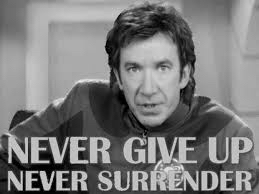
I’ve adopted a motto from one of my favorite movies, Galaxy Quest: “Never give up, never surrender!” I know that NaNoWriMo considers WriMos winners if they successfully write 50,000 words from scratch during the month of November, but when I first undertook the challenge in 2013, I decided that I was done with leaving manuscripts incomplete. Even if the book will never see the light of day, I have to at least finish it, give it the chance to someday be edited into shape.

So that’s what I’ve done four times now. It’s a personal goal, but one in which I take pride. Years ago, when I was enrolled in a fiction workshop in college, one of our assignments was to write a piece of short fiction and have it critiqued by our classmates. The second part of this assignment, upon which our final grades were dependent, was to then take the critiques of our classmates and edit our stories. Some critiques were worthless, some priceless. But the assumption was that none of us walked in with perfectly crafted pieces; there’s always room for improvement. One day, nearing the end of the semester, I overheard one of these classmates pouring out his woes to our professor, how he “just wasn’t feeling it.” Yeah, I’ve had manuscripts like that. There’re lots of them, sitting in files that I haven’t touched in years. But when someone assigns me a task—especially for a college class!—I do my best to complete it. I couldn’t believe the nerve of this guy, saying that he couldn’t do what was required, yet he still expected a pass.

Whenever I feel like giving up on a story, I think of him and what a lousy excuse he made, and I realize that I’m not going to do something lame like that, even if I’m only myself letting down. I didn’t spend months on this to just give up. I haven’t put off editing other pieces that desperately need attention for nothing. I fought writer’s block and wrote… maybe not like a boss, but like someone who takes writing seriously. It’s not about producing something perfect. It’s not even about following an outline to fruition (conflict introduced—check! love interest refuted—check!). It’s about giving the story the chance to have its say—especially if it ends nothing like what I expected at the start.

I finished, and now I have the satisfaction of another novel under my belt. I haven’t let myself down. Breathe, edit, repeat.


NaNoWriMo 2016 Wrap Up

nanowrimo-winner-2016-badge

I had a hard enough time believing it was already November—and that was over a month ago. It’s always one of the busiest months of my year, thanks in part to NaNoWriMo. Now that we’re several days into December, I have to remind myself daily that I can relax—I no longer need to achieve a certain word count every day.

Still, even though I “won” a minute before midnight on November 23rd, that’s just a step on the path to finishing my novel. When I first learned about NaNoWriMo in 2012 (the year before I started participating), I wrote a post entitled “What Happens After NaNoWriMo?” I wanted to know if people called it quits after reaching 50,000 words or if they kept with their novels until the end (assuming their novels didn’t end at exactly 50,000 words).

As for me, I keep plugging away after 50,000 words (however long it takes). Otherwise, I would have quit after day 14 my first year. Winning to me isn’t just writing 50,000 words—it’s continuing until the story is finished telling itself. Last year, which was the most challenging so far, it took until day 27 to “win,” but it took months to finish the first draft. The experience made me tackle this year’s NaNoWriMo with more purpose.

I’ve slowed down since December first, though. Part of it is the pure craziness that is December. (Perhaps this is why no one was foolish enough to put it in December—who would have the time?) The first day of the month, when I was already up an hour later than usual, I sat down and typed 100 words, just so I wouldn’t feel guilty about leaving my novel hanging for a day.

Without November looming over me anymore, it’s a lot easier to procrastinate—even though I’m one story-day away from the scene I’ve been imagining for over a year. I’m getting hung up on things like voice. As I mentioned in my last post, I’m using four first person narrators this time. It’s what this story needs, but the problem is differentiating the narrators from one another. While this is really an issue for the editing stage, I can’t help but let the worry creep in that I should be doing a better job up front.

The other day, when writing the youngest of these characters, she said something that seemed particularly her, and I thought, This is it! But now, how to make “this” happen in every section she narrates? In a book I read over the summer, Jandy Nelson’s I’ll Give You the Sun, there are two narrators, twins (brother and sister). These characters are unique and a little peculiar, but their individual peculiarities shine through in such a way that it’s easy to pick out who is narrating without being told whose section it is.

I love how discovery happens through reading someone else’s story. I dream of inspiring someone with one of my own stories someday—but it’s not going to happen if I don’t go ahead and write—no matter how ragged the first draft is.

The Book Birth Plan


Keep Calm and Write On

If you read my last post, it was all about birthing a book. And since NaNoWriMo loometh, it’s time to talk about book birth plans.

Oh, she means outlines, you might think.

But no, in fact, I don’t.

Outlines are key for writing non-fiction manuscripts, in which the author needs to present information in an organized format, but fiction is a whole different animal.

In my novel-writing experience, outlines kill creativity. I’ve written a couple novels that stuck right to the outlines I prepared for them. I would write a scene, then have to look and see what to write next. I didn’t write anything without consulting the outline first because I was afraid of messing up what I wanted to happen later in the plot, but the result was that they read like someone dragging the novels along against their wills. Those novels are now collecting virtual dust because I haven’t touched them in years.

There is a time to tidy up your mess of a novel, and it’s the next stage: editing. When writing, it’s good to have bullet points, things that you know need to happen over the course of the story, but I am here to say that some of the scenes I thought were the most important at the start of a book ended up on the cutting room floor.

If you’re querying and have to provide an outline, you should create it from a book you’ve already written, not the other way around. But that’s not to say that I think books—especially serial novels—should be written without any direction whatsoever. This is where the book birth plan comes in.

If you’ve ever had a baby and tried to have a birth plan, you’re probably laughing. From experience, I can tell you that birth plans are often tossed out with the bath water (just not with the baby). It’s more about comforting the soon-to-be parents by letting them think they have control than actually checking off every box on the list.

So if you’re gearing up to start your novel on November first, what would your “birth plan” look like? How will you know you’re ready to tackle this huge task?

I have a file for “notes” for every one of my NaNoWriMo novels. For my first, I didn’t even decide to participate until late October, so there was no time to plan at all. I had a few scenes in my head and just let the story flow with a vague idea of what I wanted to happen. Once I started writing, I wrote notes, like a quick reference guide, so I wouldn’t have to scroll through the entire document to remember something like a character’s birthday.

The next two years, I had notes already written before I started, so I had a general idea of where the books were going, but like having a baby, they certainly didn’t cooperate with all my expectations. The one thing I wish I’d done with the third book in particular was to decide on how to begin the thing. That little hiccup had me stuck in front of a blank document for a long time.

So write notes, by all means, like how to start your book (who’s narrating? where does it happen? etc.). You can scrap that scene or put it somewhere else later, but at least it will get you rolling.

If you’re dying to write a scene but know you can’t until November, jot down the parts you don’t want to forget: “Brenda runs into her ex at the store”; “Josh’s future plans change when he doesn’t make it onto the football team.” Your character(s) may have a complicated family tree, or you may have a timeline that jumps all over the place. Write these down if you’re afraid you’ll forget, but don’t stay married to them! Therein lies the trap. Read over your “plan” before you start typing on November first, but then set it aside, and write whatever wants to be written. You may discover that your story has some surprises that you never imagined—and that wouldn’t be realized if you stuck to a rigid plan.

This year, I know how I’m going to start the book and certain events that I want to happen, but this one is more about the characters than the plot. And there is every possibility that these characters will be difficult. Actually, I kind of hope that they are. Since I won’t actually be having a baby, it should be fun to see how far this story deviates from the “plan.”

Birthing a Book (as told by memes)

01-become-a-writer-they-said

If you follow my blog at all, you know that I’ve participated in both NaNoWriMo and Camp NaNoWriMo for the past several years. If you’ve read my most recent blogs, you’ll know that I’ve been struggling to finish writing my latest book for several months now. Even dedicating both Camp NaNos to this book didn’t do the trick.

I find that writing is often akin to jumping on a treadmill—I keep going without actually moving forward. With this latest book, in particular, I already had the ending written and just couldn’t seem to get the story to go there. Yes, I wrote—thousands and thousands more words than I wanted to write. And I was still just as far away from the end as I had been when I started. Or so it seemed.

I’m glad to say that I finally made it (and completely changed the ending, of course), and in celebration as well as exasperation, I would like to document this latest writing experience via some memes that must have been written by some poor souls who’ve had similar experiences.


So you get an idea for a book, only to discover that

02-scariest-moment

But

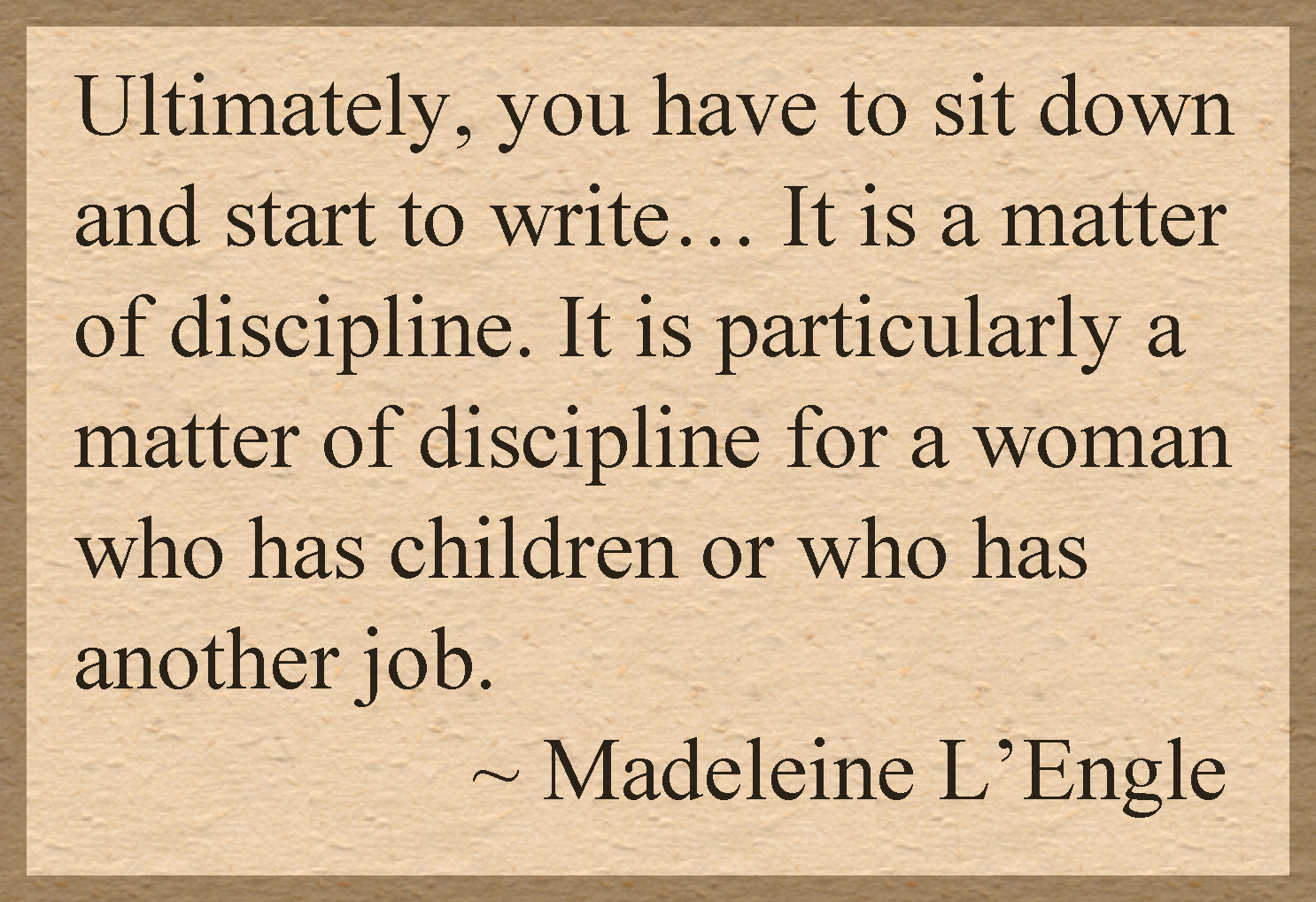
03 Madeleine L'Engle Quote.jpg

Yep, Madeleine L’Engle. At least you get it.

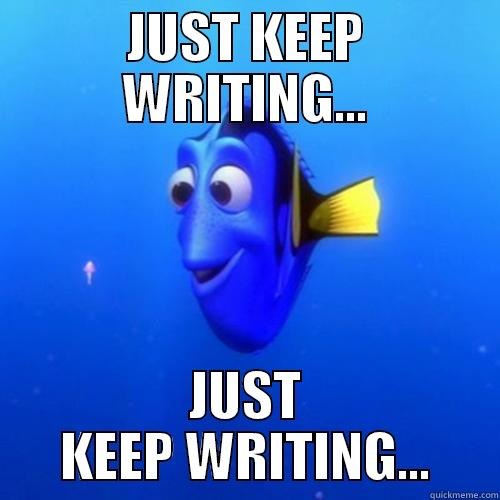
And Dory has some valuable advice, too:

04-just-keep-writing-dory

So you do, but sometimes

05-i-dont-know-what-im-writing-about

Or you read over what you wrote yesterday and wonder,

06-what-idiot-wrote-this

Because

07-reason-4

And there are those times when the page stays blank because of

08-writers-block

But no matter what,

09-you-should-be-writing-batman

So your days start to look like this:

10-rapunzel

Through it all, you have to remember that

11-oscar-the-grouch

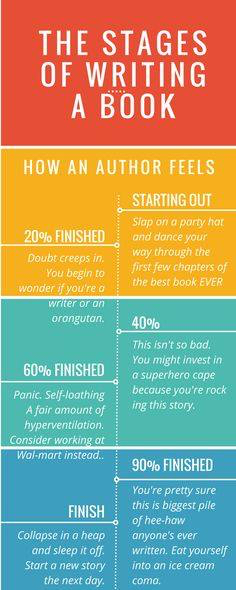
By the end of the process, you think this is a pretty good approximation of your mental state while writing:

12-stages-of-writing-a-book

You’re glad you stuck with it, however, because

13-happiness-is-a-good-book

But you’re not quite there yet. You still have to

14-keep-calm-and-revise

Why Not Sign Up for Camp NaNoWriMo?

Fiction Fix Typewriter

For those who may be learning about Camp NaNoWriMo for the first time, it’s offered twice a year – the months of April and July – as a kind of warm up for the biggie, National Novel Writing Month (NaNoWriMo), in November.

Last year, I finished editing my previous NaNoWriMo novel at the end of June and signed up for Camp NaNoWriMo in July to work on an old, unfinished manuscript. This past April, I signed up again to work on a different novel that I’d started in December.

So why am I writing this when it’s almost halfway through July? To be honest, I almost gave up on the idea of participating this time. No, I haven’t finished the novel I worked on in April (although I did achieve the word count goal I set for myself). What happened is that I came up against a writer’s roadblock that I’ve written about numerous times: the mid-novel slump.

There is little more frustrating for a writer than knowing how your novel will end but then getting lost on the way. It reminds me of the family vacation we recently took, in which my GPS simply wouldn’t believe that our destination was on Sugarloaf Road. It was glad to take us to an empty field on Sugarloaf Mountain Road. While it’s a little misadventure we can laugh about now (and others who have been mislead by GPS can commiserate), at the time, it was aggravating because we knew where we wanted to be, just not how to get there.

Of course, with my novel, I can’t blame GPS. I was cruising along just fine and decided on the perfect twist to give my story more tension. The only problem was that I wrote myself into a hole in which I couldn’t write myself out.

Not knowing what else to do, I committed a big no-no: I went back to the beginning and started editing. Although it’s cost me a lot of time, I’m glad that I did. I’d written quite a few things that I’d forgotten, so I took notes along the way. I also trimmed a lot of extraneous words. And as I went, I realized what I would have to do when I got to that problematic scene that had effectively stopped my forward momentum: I would have to cut it.

There’s still tension, just not nearly as much. Although my scene isn’t the shocker that I originally planned, it’s no longer stalling the manuscript. It meant cutting 20 pages out that I spent days writing, but sometimes that’s what you have to do. I’m just glad that I’m moving forward again.

So now that I know what I’m doing, even though it’s 13 days in, I’m signing up for Camp NaNoWriMo. I am giving myself a low word count goal (12,000 words) because I hope that’s all it takes to finish this novel. Knowing my propensity for verboseness, it’ll likely be longer, but that’s okay. It’s often the scenic route that is most memorable.


Read. These. Books.

It’s already July – that time of year when I look at the book list that I created on January first to assess how well I’m keeping up. This year, I am pleased to say that, of the 27 novels I hoped to read, I’ve already read 22. I hope I’m not speaking too soon when I say that 2016 may be the year I’ll finally read every book.

Of the books I’ve finished, I would like to highlight the multitude of teen fiction titles that I’ve recently read.

Florida Teen Reads books

Read these books!

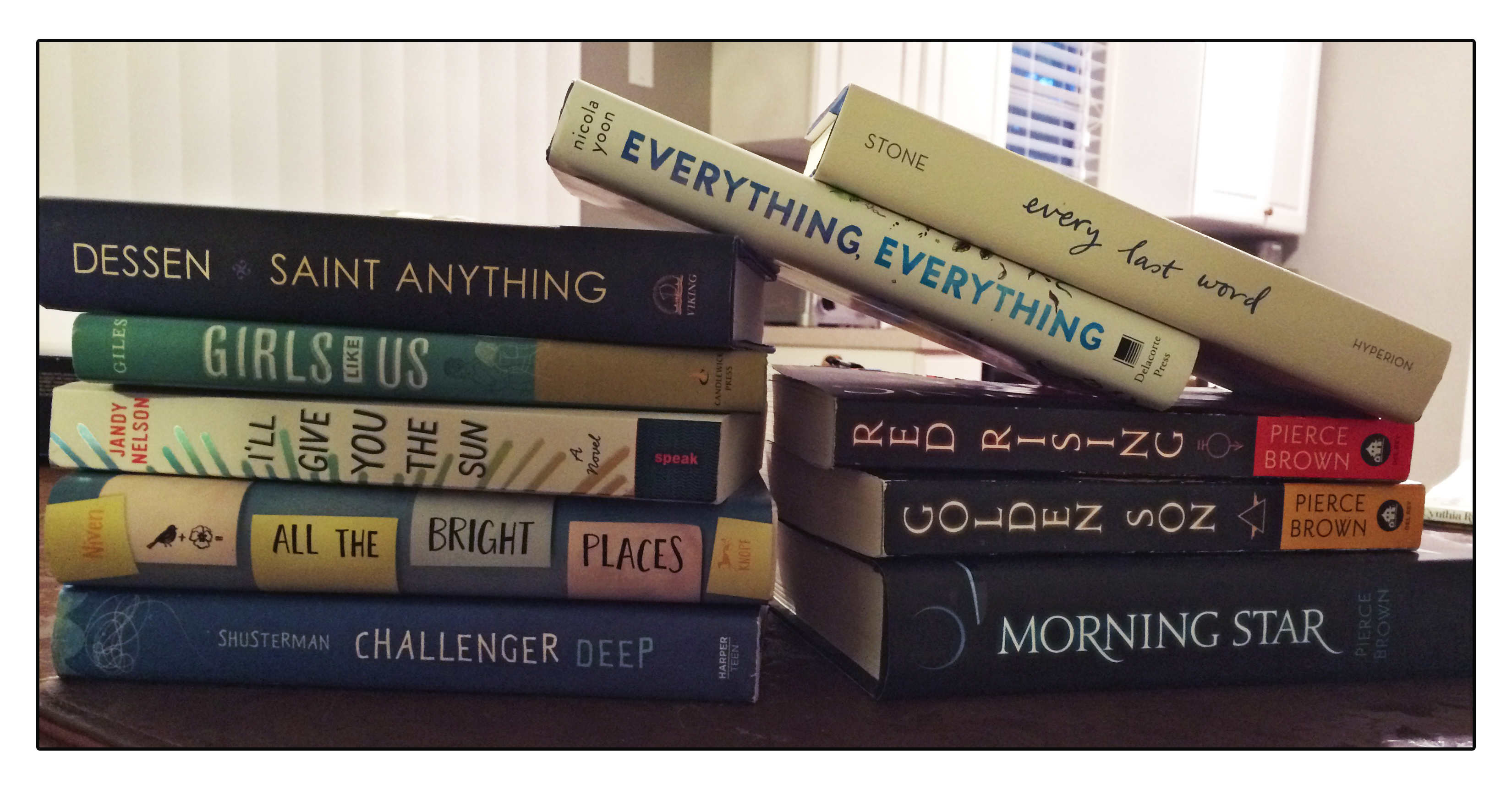
I mentioned in my book list post that my cousin’s wife is on the Florida Teen Reads committee. Last fall, she gave me a pile of the books she’d read for the committee, assuring me that there was a little bit of everything: sci-fi, romance, mental illness – you name it. I was excited to add them to this year’s list.

As always seems to happen, I read a few books from my list, and then I deviated some – that’s life, right? By May, I’d only read one of teen books I’d borrowed, but a message from my cousin-in-law gave me the little kick I needed to keep going. She would need to get two of the books back by the fall because they’re Florida Teen Reads finalists. I read both titles back-to-back – Every Last Word by Tamara Ireland Stone and Everything, Everything by Nicola Yoon. It was apparent why these books were finalists, and since I was on a roll, I continued reading the other FTR books, too.

Some of these books shine brighter than others. Knowing his taste, I had my husband read some of them and not others. One I had to twist his arm to finish, and he was glad he did. Another was the first book of a series, and Thomas liked it so much that he bought the whole trilogy – we both read them all.

Girl in PiecesIn the middle of reading all this teen fiction, I received an interesting opportunity: to read and review a teen fiction novel that hasn’t been published yet. While I’ve read books prior to publication before, it’s usually because I’m editing them, and that’s a completely different experience than being able to read a book to enjoy it. In this case, “enjoy” is a little too tame a description – I devoured Kathleen Glasgow’s Girl in Pieces in two days. (Read my review on Goodreads, and purchase it this fall.)

Before you say, “I’m not a teenager – why would I read any of these?”, let me assure you that teen fiction is not just for those in the 13 to 19 demographic. When I was in college, I took a class on young adult lit, and it was a rather recent genre classification at the time (in fact, much of what we read had previously been grouped with children’s lit). Books that fall into the YA genre star characters who live the issues that real young adults face. Okay, yes, sometimes the teens in these books are being chased by dragons, but they’re still coming of age and having all the issues that that entails.

Parents may find some YA issues uncomfortable, such as substance abuse, suicide, sexuality, and mental illness. Guess what? These are tough issues, but we can’t just put our heads in the sand and pretend they’re not there. When I read about a girl who hung with the cool crowd at school while keeping her OCD hidden from her best friends, I was glad that such a book was out there. It’s normal to read about the underdog succeeding – and I love those books, too – but to read about a cool girl with issues? Well, isn’t that life?

Today’s teenagers can only be sheltered so much. As a parent, I understand being protective, but I also would rather supervise my child’s exposure to these issues by handing him a book and then talking about it than praying that that kind of thing never happens. Who knows? My kids may have friends who face these issues one day – and many of these books list resources that provide support and help. Even within a fictional (and sometimes fantastical) setting, teens are capable of applying what they read to real life.

Read these books! Then share them with a teenager you care about.