Famous Last Words: “I Would Never Be a Teacher”

I could also have titled this “I Will Never Go Back to School.” And guess what? I’m a teacher, and went back to school. Hmm. I will never have a million dollars. Let’s see if that works.

Many little girls admire their teachers and like to play teacher, so becoming a teacher is a natural next step to take. That wasn’t my childhood dream. Almost from the time I could hold a crayon, I wanted to be a writer. The University of North Florida didn’t have a creative writing program, so I settled for the next best thing, a degree in English. When I told people my major, most assumed that I would teach high school English or literature. “I would never be a teacher,” I told them. In my arrogance, I thought I would be the one writer to break through, immediately land an agent, get published, have my books in bookstores all over the world, and be the breadwinner for my family—happily ever after, the end.

Yes, I was the editor in chief of a literary rag when I was 19, where I learned about the slush pile, the rejections, editing, printing, distributing, and so on. And that was just for a little start up. I dabbled in freelance writing and editing for a few years, which was a whole lot of work for very little pay. I even self-published a couple books over 10 years ago. I have been humbled and realize that my dream might remain just that.

When it was time for my elder son to start school, I convinced Thomas to put Peter in the elementary school I had attended, a small Christian school that went from preschool through the 6th grade. At the beginning of the year, Peter’s teacher solicited for parent volunteers. I liked the idea of being involved with what Peter did on a day-to-day basis, so I volunteered once a week, doing whatever Peter’s teacher asked me to do. Sometimes I was cutting laminated pieces or taking down and putting up bulletin boards. I played games with three- and four-year-olds. I painted with them. I ran stations. I continued going every week because I enjoyed every aspect of it.

The next year, a plea went out for substitute teachers. I thought that substituting couldn’t be much different than volunteering—with the added benefit of being paid for it. I took the plunge, wondering if any of the teachers would take me seriously, would entrust me with their classes… and I was soon working 20 to 30 hours or more per week as a substitute teacher. I taught all grades, all subjects, although I was particularly busy in the younger grades.

I began to think that, since I would have two children at the school before long, it would only make sense for me to work there full-time. I decided to pursue a teaching certificate, and since I didn’t have a degree in education, I had to go the competencies route. I’m not sure what this looks like in other states, but in Florida, it’s the alternative to going back to school. Aspiring teachers have to prove that they are competent enough to plan a lesson, assess students, teach students with different needs and in different modalities, and so on. If memory serves, there were about 17 different competencies. I had to take some online courses, type papers, complete projects, and present everything to a member of our administration, who helped me submit my materials to the Department of Education. I also had to take a number of tests, including one in the subject area of my choice. I chose to be certified to teach prekindergarten through 3rd grade students (and added a K-6thgrade certification a few years later). I took the first available job opening, which was as a PreK 4 assistant teacher.

That’s how I got my start. How I got where I am now has to do with Peter. Since I was in his classroom so much in the early days, I had the advantage that many parents don’t have: I was able to see how my child did in school firsthand. He was a people pleaser, not a behavior problem at all. He made friends easily, especially with kids who didn’t particularly fit in. These were all things that made my parent heart happy. One day toward the end of his first year of school, the kids were playing a game in which they marched around the outside of the classroom rug that was bordered with the letters of the alphabet. The teacher played music, and when the music stopped, the kids would stop and say whatever letter they landed on. As I watched Peter, I noticed that he got a little antsy every time he passed the P. Whenever the music stopped, he somehow managed to land on it. Finally, he landed on a different letter nowhere near the P. He tried to sneak his way over to the P, and his teacher called him out on it.

Although that wasn’t a lot of evidence, I had this feeling… so I looked up dyslexia markers, one of the biggest signs of which is delayed speech. Not only had Peter’s speech not been delayed, but he had spoken early and well—no speech impediment and full sentences with good grammar. I expressed my worries to Peter’s assistant teacher because the idea that he might have trouble reading broke my heart. He loved listening to me read to him, but I am not just a bookworm—I’m a bookdragon—and I wanted to pass my love of reading onto my boys. The assistant teacher reassured me, saying one of her sons was dyslexic and was doing fine in college, with the help of academic accommodations. While this was reassuring, all I knew about dyslexia was the little I’d heard from others, most of which was wrong. I started to drill Peter on his letters, to no avail. I remember one frustrating exercise, in which I recited the alphabet and then stopped, asking him to tell me which letter came next. He could not come up with it. I got upset, thinking he was intentionally messing up. We had other frustrating moments, not related to reading, when I would give Peter a simple task, like asking him to take dirty clothes, put them in the laundry basket, and turn out the light on his way back. He would get halfway down the hall and wonder why he was holding dirty clothes.

In Peter’s second year of school (PreK 4), I was in his classroom one day, and the kids were each assigned a different zoo animal to paint. Each child had to sound out the name of their animal and write it on a label under their painting. The youngest boy in the class, who was six months younger than Peter, wrote “BRD.” Today, I know that means that he heard all three phonemes (sounds) of the word bird. I can’t even remember what Peter’s animal was, but I do remember that he was only able to identify the first sound. It’s like the rest of the word didn’t even exist.

Sight word garage

By the beginning of kindergarten, Peter knew most of his letters and their sounds. The ones he still confused were B/D and M/W. But what really tripped him up were sight words. The students always had to do some sort of activity as they entered the class, and one week, the teachers had a sight word garage (as pictured) taped to the door. The students would lift a flap, read the sight word written underneath, and enter the class. Peter’s strategy was to listen to the kid in front of him, pick the same flap, and repeat the word he’d just heard. One morning, Peter arrived, and no one was in front of him. He was on his own. I prayed he would choose the flap that had Iunder it, but Peter didn’t remember which words were where. He chose one—not I—and didn’t know what the word was (I think it was either me or we). He had no idea where to start, and I was helpless to do anything for him. It was humiliating for both of us.

About a week later was the parent-teacher conference, and I felt like an abject failure. Peter had co-teachers that year, and I assured them that I read to Peter every night. I had no idea why he couldn’t read; it wasn’t like he was a first-time student. Both of his teachers teared up; they cared about my child and read my desperation, my confusion about what was going on with him. One of the teachers told me that when she got her children’s report cards, she would fold under the part with the grades and read the comments from the teacher because that’s what mattered. She assured me that Peter was a great citizen. Both teachers also told me they knew I was a good mom, which was a relief—I hadn’t done anything wrong. They were prepared with a list of child psychologists, and I immediately got on the phone to have Peter evaluated. In the end, Peter is dyslexic. He is also kinesthetically gifted, has an auditory deficit (which is unusual for dyslexic people), and his working memory is in the toilet. 

My boy has gone through many testing sessions over the years. He spent two days a week with a tutor his 1st grade year, and when he was in 2nd grade, the school finally had a full-time dyslexia specialist on staff who pulled Peter every day. Although I finally learned what dyslexia is (thanks to Overcoming Dyslexia by Sally Shaywitz), I still had no idea how to help him read. The summer before 1st grade, he was supposed to read Froggy Goes to School. Although I usually read everything to him, I believed that he should be able to read the one book the school had assigned to him. While the book was short enough to be read in one sitting, Peter struggled to read one page every day. It took weeks to finish that book. At the time, we didn’t know that Peter also had severe anxiety, so struggling to read, compounded with his feelings about himself, made for a miserable experience that we both still remember.

While Peter was going through his reading struggles, we were also trying to figure out what was going on with our younger son, Ian, who was language delayed (he would parrot a word he’d heard and never say it again) but at the age of two read every single letter on my husband’s t-shirt. Due to Peter’s reading struggles, we hadn’t pushed it with Ian, so this came out of left field. This was a kid who could read but couldn’t tell us what color his eyes were (we weren’t sure he even knew he had eyes), and he floundered behaviorally. So started our journey to get Ian diagnosed, as well. Although it took many doctors (some of whom were quacks) and years to get all the diagnoses, I can now tell you that we have two neurodiverse children. Ian is the poster child for ADHD (with a big ol’ H!), high on the autism spectrum (what they used to call Asperger’s), and has social pragmatic language disorder, OCD, and dyspraxia (the last of which I’d never even heard of when he was diagnosed). Every therapy known to man was recommended for him, and we finally settled on speech therapy, occupational therapy, and ABA, starting at age four and continuing through the 5th grade. For both of my children, I read every book and article I could get my hands on to give myself the tools to help them. But when it came right down to it, since I was already a teacher, I took the path that would help kids like Peter—the educational route—and at age 36, I gritted my teeth, swallowed my pride, and went to grad school to get a master’s degree in reading education.

When explaining to my adviser why I was going back to school, she told me about University of Florida’s Dyslexia Certificate program. Instead of the reading block that was a part of the Reading Education degree, I would detour and take five courses through the College of Special Education, ending with a 40-hour practicum, a master certificate in dyslexia, and a reading endorsement. I have done a lot of professional development, but the dyslexia certificate is by far the most valuable continuing education I have ever received. It changed my life, and finally, I felt like I not only had to tools to screen and assess for reading disabilities, but I had a game plan to remediate them. I finally made it onto my school’s student support team, and that’s where I’ve been for the past five years.

If you had told me what I would be doing now 20 years ago, I wouldn’t have believed you. In fact, I think I would have been sad to hear that I wouldn’t have a single novel published. I would still love to be an author—don’t get me wrong—but I feel like there is so much I have learned on this journey. Not only do I get to watch the light bulb go on for struggling learners all the time, but an unspoken part of my job is helping parents. These students need an advocate. One of the most unintentionally hurtful things said to me about Peter was, “But I thought he was so smart.” Well, guess what? Peter is smart, and dyslexia doesn’t change that. We need to stop treating As and Bs like they are the definition of a worthwhile student. This isn’t to say that people with good grades don’t work hard or don’t deserve praise, but grades aren’t everything and certainly don’t tell the full story. This is something that needs to be addressed in the American educational system, but that’s for another post.

If you have read this far, thank you. I am in the running for America’s Favorite Teacher. I am shocked that I made it through the first round as a Top 20 teacher. It would mean the world to me to win this, although I know it’s a very long shot. I wanted to write this to give my amazing supporters some idea what they’re supporting. Let me tell you, early morning wake-ups are hard, and many of the days are long. I always knew I wanted my kids to have the same great early educational experience I had—and they did. I did not expect to go back to school myself—both as a teacher and a student—and it’s been one of the most joyful and rewarding experiences of my life.

Please vote for me daily at the following link: https://americasfavteacher.org/2025/sarah-cotchaleovitch

In America, an A Is an A, and a B Is a D

Dusting off the top of my soapbox and climbing on

I’m on team of teachers who work exclusively with students with learning differences. We meet throughout the year to evaluate our students’ progress, problem-solve, and commiserate with each other over things we can’t change, such as what goes on at home. Many parents remain in denial about their children’s needs, even with a diagnosis in hand. One problem with learning differences is that they can be elusive. Okay, yes, you can tell that a child doing log rolls across the floor has the H (hyperactivity) of ADHD, but dyslexia, dyscalculia, anxiety? These are not nearly as obvious, and students with high IQs and good coping skills can fly under the radar for a long time. In some ways, it might be easier for children who have a physical difference because people can see it and adjust their expectations. For example, parents of a blind child might be disappointed that he won’t grow up to be a professional baseball player, but they understand his limitations. Not so with some of my students. I’ve known parents to name drop with the universities they attended, as if their impressive alma maters will somehow make it possible to “cure” their kids—like maybe I’ll try harder now that I know what’s at stake. They can’t accept that their kids might not be Harvard material because if their kids don’t follow in their footsteps, then what’s the point?

Think I’m being harsh? How many people do you know who have fallen out with their parents because they didn’t live up to their unreasonable expectations? Or even expectations that seem reasonable but don’t work for that particular child. Unfortunately, I can think of too many.

Reflecting on the worst of the discipline problems I dealt with this past year, they boil down to two categories:

  1. Parents don’t want to be bothered by child, so child seeks negative attention over no attention; and
  2. Parents don’t understand child, so child lashes out when parents try to force the square child into a round hole.

Forget about #1 for now—that’s a whole series of books unto itself. But #2 often happens with the best of intentions. The issue isn’t that parents don’t love their children (although one could argue that sometimes parents are attempting to fulfill their unrealized dreams vicariously through said children); the issue is that parents need to wake up.

My first wake up call came over 10 years ago (read about my second one here). My husband and I have no learning disabilities and are fairly intelligent people. We’re both college graduates, both motivated and self-disciplined. If we didn’t achieve something (academically), it was on us. When we had our first child, we did what “good” parents do: we kept him away from screens, read to him, fed him healthy foods, made sure he got plenty of sleep, gave him educational toys. He even started going to school at the age of three. There is not any reason in the world why this child with this life shouldn’t know his letters, except he didn’t. He is dyslexic. This is not something we could have bought our way out of or prevented, and it will be part of his identity his whole life. Just the possibility of him being dyslexic scared me because all I knew were a pile of myths and misinformation, and I thought trying harder and tutoring and encouraging him would fix the “problem.”

His problem had more to do with me than himself. Once I took the time to learn what dyslexia really is and how Peter is wired, I got the right help for him and realized that my expectations for him to follow in my academic footsteps put way too much pressure on him. He put in all the effort, but tests are not made for kids like him. Project-based learning is more his speed, but for all we educators like to talk about differentiation and equity (both great things—don’t get me wrong!), our American school system has yet to get with the times. And after all, it’s not as easy to assess a great, failed science project where lots of learning occurs than penciled-in bubbles on a scantron.

And even if we were able to assess every child in a way that took into account his or her own particular learning profile, that wouldn’t magically make kids who struggle good at every subject. For those who need help in one area or another or—gasp—only muster a B, are they unfulfilled as humans?

At one of my team’s meetings, we were talking about how great one of these “B” students was doing—a student with “we went to this impressive college” parents, so Bs aren’t acceptable—when one of my colleagues said, “In America, an A is an A, and a B is a D.” How right she was (and thanks for the great post title)! The opposite of apathy, this stance is that if you’re not achieving the top at [fill-in-the-blank], then you might as well have not tried to begin with. It’s even true of myself—cough—if I’m to be honest. When I was in grad school, I started to panic if I thought my work might earn less than 98%. And why? My grades were between my professors and me—no one else knew. It’s a hard habit to break, caring about grades. And it’s not that getting good grades is bad—I’m really proud of my kiddos (at home and in the classroom) when they do well. But I’m also proud of them when they make a good effort, when they take a risk by going outside their comfort zones, when they make mistakes and learn from them. Unfortunately, our esteemed institutes of higher learning don’t seem to think that way. Even state universities (like my alma mater) are turning away great kids. Can you blame Lori Loughlin and Felicity Huffman for doing what they did to fudge their kids’ college admission documents? Well, yeah, I can and do, but you get my point. If people with all the money in the world can’t get their kids into the schools they want, what are the rest of us lowly, normal parents to do? (Secondarily, why do they want those schools for their kids? Would their lives amount to anything at a different school—or no school?)

Those aren’t rhetorical questions. Here we go:

We can be proud of our kids for being who they are, period. I’m not talking about giving up. Kids should still be motivated to give their best effort, but even more importantly, they should be nurtured in ways that allow them to discover their true passions. I’m proud of a mom I know for doing just that. I was catching up on what her daughter’s been up to lately. This girl is a phenomenal singer and actress, and I was surprised to hear that she’s not pursuing the stage. “But it’s not her passion,” her mom said. Wow. If only more parents would realize this. Just because their kids are good at sports or ballet or academics doesn’t mean their future is decided based on those things. I feel like our culture is making this even harder now that young athletes are getting paid at the collegiate level. It certainly would be hard to turn down free college tuition and a giant paycheck, especially at the impressionable age of 18 when the lure of the almighty dollar is so powerful.

When I was in my 20s, I struggled with the desire to be at home with my children and my (in)ability to afford it. My husband just about killed himself, working extra to pay the bills, while I floundered at a mediocre freelance writing career (if you can call it that). I’m a good writer and editor, and I got some business, but it wasn’t nearly enough to pay for diapers, much less all the other expenses we incurred with two small children. A couple of my friends were court reporters and told me that, with my typing and proofreading skills, I would be a natural. I could “be my own boss” and make a six-figure income. It was very, very tempting. But when I thought about leaving my babies and spending all day in a courtroom…my soul shrank away from the idea. I know it’s a great job for some people but not for me, even though the idea of that salary was so alluring.

While I tried to figure out what in the world to do with my life, I began volunteering at Peter’s school, and when they put out a plea for substitute teachers, I thought that was something I could do and make a little extra money. When my younger son started attending there, too, it just so happened that they had a full-time job for me. In a very unexpected way, I found my love of teaching (something I said I would never do)… and it started with saying no to something much more lucrative. In fact, if we think about salaries, you could say I turned down an A for a C. But if it means making less money to be fulfilled, that doesn’t even feel like a choice.

Yes, encourage your kids to always do their best. Lead by showing them the right choices instead of the easy or flashy ones. Have compassion (on them and yourself) when setbacks happen. What did we learn?

That grades are for school, and there they should stay.

That tests are for people who are good at taking them.

That a life worth living can’t be documented on a resume or a paycheck.


Check out my TpT (Teachers Pay Teachers) store, Mrs. C Loves to Read, to see what I teach in the classroom.

Quit Raising Strivers

Think about being a 21st century teenager, about the dual pressures of excelling in school because college and career are looming and having a diverse extracurricular portfolio because this could make or break the chances of making it into said colleges and careers. Do you know many young people who are thriving through such challenges, or do they all seem to be stressed out? My children’s generation is the “‘running on empty’ generation,” the generation that educational psychologist Michele Borba, Ed.D. says is “less happy and more stressed, lonely, depressed, and suicidal when compared with any previous generation” (Thrivers, p. 2). I wish this were all just theoretical for me, but unfortunately, it’s personal.

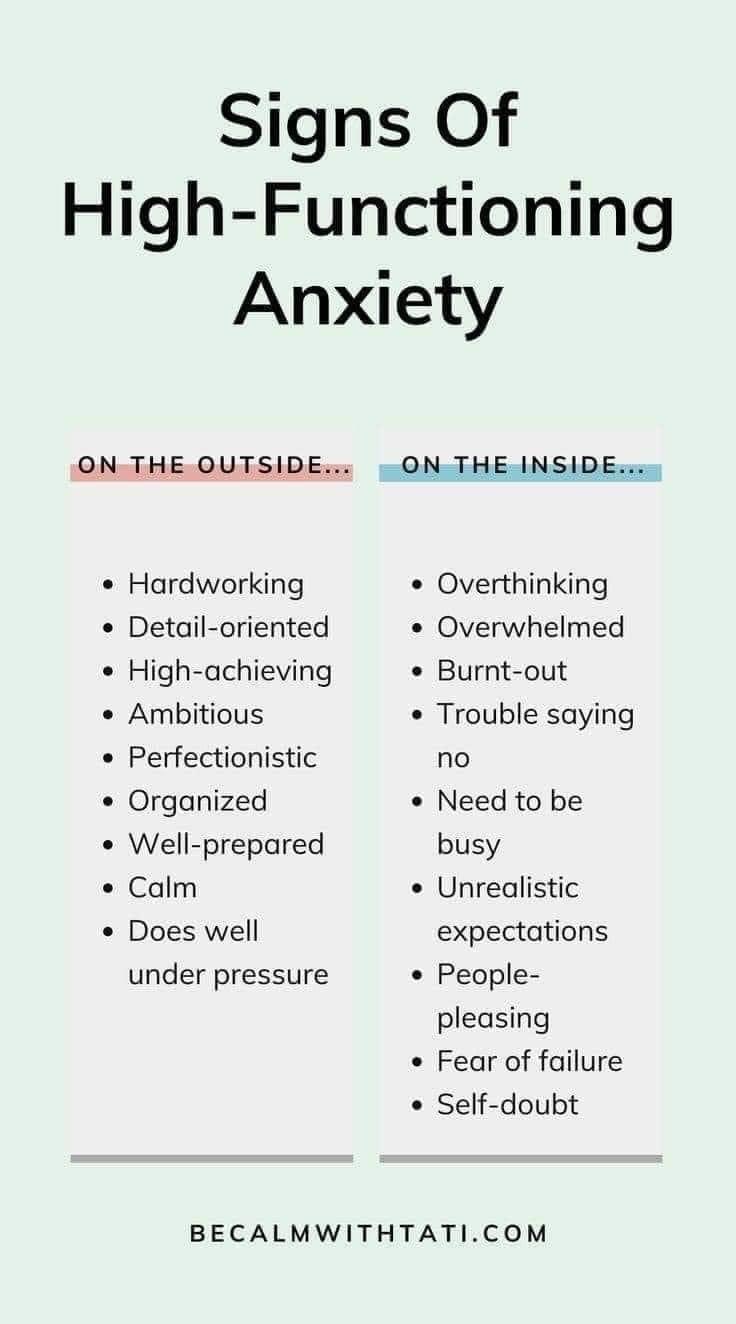
My elder son wasn’t handling the stresses of life well, and I know I was a big part of the problem. I live with anxiety; it’s a part of who I’ve always been. This is me:

Thanks to a supportive network (parents, husband, friends, etc.), I’ve made it to 40, maybe not with flying colors, but all in one piece. Does that mean that I’m comfortable living with high anxiety? I guess as comfortable as you would be if you had to wear shoes that are too small every day. But I’ve been able to cope. So it’s hard to get outside of myself and objectively ask if I would expect someone else to live how I live. For Peter, I don’t know if it was because puberty and a global pandemic hit at the same time or if it would have happened anyway, but halfway through the 8th grade, he was so overwhelmed that he couldn’t see the point of living anymore. My sweet, happy, well-adjusted boy…. wasn’t anymore.

In her book Thrivers, Borba is concerned with Peter’s generation, teenagers who are striving instead of thriving. But what’s wrong with striving? Don’t we admire those who strive and strive and finally manage to do something great? I’m thinking of the young Olympians who were their class’s valedictorian and spent every weekend volunteering at a homeless shelter. We hear about these people who seem like they can do everything—and everything incredibly well—and feel like, What have I done with my life? But are those people really fulfilled? Some might be; some might have the ability to do all that without breaking a sweat, but I would wager that most more closely resemble my anxiety graphic. Like Peter, many kids his age strive to achieve, to accomplish, sometimes just to finish a simple task… and striving is a lot like treading water in the hope of staying afloat long enough for the life raft to arrive. Last year, my fellow faculty members and I read Thrivers for our summer reading, and it was like a blow to the chest. I highlighted half the book, writing Peter’s name in every time I read a case study that sounded like him. And I’m not even close to being the only parent in this boat—it’s more like a fleet of aircraft carriers. As one devastated mom said of her daughter, “I didn’t realize how sad and overwhelmed she felt… I thought I’d given her everything she needed to be happy and successful, but I was so wrong. I missed helping her enjoy herself” (Borba, p. 3).

After reading the book, I had a very open conversation with Peter, and it broke my heart to hear him say, “I’m a striver, Mom.” With us backing him up one hundred percent, he decided not to pursue high school sports. This was after taking him for his sports physical, filling out all the appropriate forms, and making him take a number of exhaustive online tests to make him eligible to participate. Peter had played baseball since kindergarten and school sports since the 5th grade: basketball, flag football, and track and field. It just seemed natural that he would continue into high school. I was sad but supported his choice to cut back on after-school obligations. And he still played baseball for our local ballpark, which allowed him to play sports just for the fun of it. But when his academic schedule was still too much this spring, he told me that the only way he could handle his schedule was to quit baseball, too. I hate that he had to make that decision, but I’m proud of him for recognizing that, for the sake of his mental health, he had to drop something in order to balance his academics and the extracurricular activity that brings him the most joy: music.

Does this mean that Peter will always only ever do homework and play an instrument? Of course not. A friend and co-worker shared a podcast a few months ago that gave me new perspective on this issue. In her episode “How to Discover What Season You Are In,” Christy Wright encourages her listeners to give themselves grace throughout their different seasons in life. First, she points out that people of her (my) generation didn’t suffer from FOMO (fear of missing out) like our kids do because there was no social media; by the time we realized we were missing out on something, it was already over. Did kids our age still overdo it? Of course they did (waving my hand in the air), but it’s nothing like the widespread striving pandemic that’s catching with kids as young as five nowadays (Borba, p. 12).

The main point of Wright’s podcast is that we all go through seasons, and it’s unreasonable for us to expect the same results from ourselves in each season of life. What my own teen is going through right now is a season that is tough academically. There will be another season for him (as soon as final exams are over!) when he will enjoy more freedoms and have more choice about what he does with his time. This applies to everyone, not just teens. My own season in life doesn’t—and shouldn’t—look like the season when I was chasing toddlers. Right now, I’m still spending a lot of time transporting kids, but that will all change in just a few months. When I’m stressed about having to be in three places seemingly at once, I need to remember that there will be a time when I won’t have to take anyone anywhere anymore, so I need to soak up that valuable time by being present with my kids now.

Something that is not likely to go away in any season, however, is social media and our kids’ access to it. A friend of mine addressed this in a recent blog post, “A Safe Amount of Heroin.” (Sound provocative? Read it!) When I read her opening line, “The kids are not all right,” it felt like déjà vu because the opening line of Thrivers is, “Our kids are in trouble” (Borba, p. 1). Do I detect a theme? Although social media is certainly not the only culprit here, it’s a mighty powerful one. I’m middle-aged and can easily get sucked down a Facebook rabbit hole of all the trivia you would never believe about [pick your topic]. What about our kids, who learned how to swipe on an iPad before they ever gripped a crayon? These are the people who have a hard time grasping why anyone would turn to a book for research when all of Wikipedia is at their fingertips. Or who can communicate via Snapchat but have no idea how to interact in person. The rise in social media use and the instant availability of just about everything on smartphones has direct links to both depression and our kids’ inability to cultivate the traits that would otherwise allow them to thrive (forget page numbers—just read all of Thrivers). If you’re still not convinced, as my friend aptly points out in her post:

[T]he rise of smartphones and social media means that your average 14-year-old spends almost all her time surrounded by other 14-year-olds—at school, and then digitally everywhere else.

What that means is that these 14-year-olds see the entire world exclusively from the perspective of a 14-year-old, which is terrifying. When one of them experiences their first heartbreak, it is literally the worst thing that has happened to any of them.

Kids who have no access beyond their own experience are at an extreme disadvantage. (Anyone read Lord of the Flies?) My friend has chosen to hold off on giving her youngest child access to social media and smartphones as long as possible. At our house, we did not allow Peter a SIM card for his phone until he was 14, and we’re on the same path for Ian. We also have meals around the table as a family and play card games with three generations—so our kids aren’t living in an isolated world of only people their age. And we now have enough pets that everyone in the house has to take responsibility for them, which includes mandatory outside time (we have chickens!). Whatever you decide will undoubtedly be difficult but necessary because all the pressures of 21st century life make it harder than ever to raise people who will be fulfilled adults someday. In Thrivers, Borba devotes a chapter to each of the seven traits that she says are lacking in strivers: self-confidence, empathy, self-control, integrity, curiosity, perseverance, and optimism. None of these traits happen by accident, but with our help, our kids can fulfill their first and most important job: to be kids. This means playing, discovering, failing, eating some dirt, and nothaving to shoulder the stresses that we adults unnecessarily place on their shoulders. When our kids quit striving and start thriving, wonderful things will happen.

Let Them Be Children Now, So They Can Be Adults Later


Kids racing

I was saddened to learn of a recent teenage suicide, in which the boy who took his life apparently felt that he had screwed up so badly that the only recourse was to take his life. Why in the world would a seventeen-year-old from a good family and with a bright future think that ending his life was the only option he had left?

I believe that there are too many pressures on today’s kids, and you can see it in the way we structure their days. Think about the schools in which the arts and recess have been cut. What message are we sending? That sitting at a desk and making the right test score is the most important thing.

I jokingly lectured a dad of one of my preschoolers at the beginning of this school year that there’s nothing more developmentally appropriate for her to do than play. “Her Harvard application isn’t due for a few years,” I said, and I thought he would laugh, but the look he gave me said, I couldn’t disagree with you more. My question is, if she’s already being discouraged from letting her imagination run wild at the age of four, when exactly does she get to be a kid?

One of the tasks of a preschool teacher is, indeed, to evaluate the readiness of students to move on to the next level—but we’re talking kindergarten, folks, not the Ivy League. In considering one child in particular—a child who has all kinds of processing and attention and core strength issues—a comment was made that 10 years ago, he would have happily played through his preschool days and moved on to kindergarten with no one ever considering holding him back. But instead, he’s having all kinds of interventions to make sure that he can make it through preschool. And it’s not like he’s the only one.

As I already mentioned, children are losing many opportunities to express themselves creatively and physically with the loss of arts programs and recess, but the problem is that it’s not just at school where this is happening. Within the past 10 years, we’ve had the advent of the touch screen. We have a number of iPads designated for our classroom, and although our four- and five-year-olds love them, there is a marked difference in the way they behave when we bring them out. It places them in self-absorbed bubbles, and if that reminds you of anyone (ahem, teenagers and Millennials), then I hope you’re disturbed enough to want to reverse this trend. When you’re four and five years old, this kind of technology should be used sparingly, if at all, and LEGOs, building blocks, puzzles, and play kitchens should be the norm. (Here’s a great article about the dangers of turning over smartphone technology to our kids.)

At the end of 2016, I wrote about spending less time with my own technology (social media, in particular), and although I’ve really enjoyed putting my phone and down and breaking that addiction, I’m just one person. In this digital age, it’s more and more common to see families sitting around the dinner table, parents and older kids on their devices, ignoring the smallest members, who are literally screaming for attention. When asked recently by a workshop facilitator why we have K through 12 education (and in my case, PreK), it occurred to me that teachers have to provide more than the three R’s anymore; present day teachers are also teaching the things that children should be learning at home. Take manners and respect. It’s difficult expect a child to behave appropriately when he engages in disrespectful behavior right in front of his parents with no correction. These basics aren’t being taught at home because parents are mentally elsewhere, which gives people in my position an extra responsibility in addition to teaching letter and number recognition.

As infants, children are learning to swipe on a touch screen. Then when they start school, we teachers have to introduce their parents to such novel ideas as coloring with crayons, playing with Play-Doh, and painting at an easel—and paying for occupational therapy. For most children, if they’d just engaged in developmentally appropriate play to begin with, their parents wouldn’t have to incur this added expense just to teach them how to hold a pencil or use a pair of scissors.

I understand why technology is so attractive—it’s a great babysitter—but we have to understand that it can easily turn to junk food for the brain. There’s no substitute, in my book, for a box of LEGOs in the middle of the living room floor, a coloring book and crayons at the kitchen table, or a few minutes of introducing children to a beloved book. (Here’s an article about what parents of “good” kids do.)

More and more, we’ve come to expect that kids are just going to be tortured and inattentive while they sit at desks for extended periods, and that just shouldn’t be the case. A well-rounded childhood should include playing outside unstructured, which means that we shouldn’t micromanage every minute. One of the methods we use in our preschool to help children get ready for our “work” time is to let them run outside and play. In fact, I have one student who will hit the wall, and I’ve learned to just let him go and play with blocks for a few minutes, and he’ll be better able to finish a project after getting this little break. Here is one article, and here’s another, that both explain why the absence of play is leading to attention and sensory issues in this upcoming generation.

Kids can be kids when we sing silly songs in the car and at bath time, when we read books together, and, most of all, when we take the time to express why we do things the way we do. It doesn’t take any extra money, but it does take time and the willingness to put our children first. By connecting with them in these simple ways, we’re showing that we care, and if you don’t think that matters, then why did you have children to begin with?

Instead of raising techno-zombies and expecting them to succeed from the moment they show an interest in learning, we need to spend the effort to let them know that whatever they do, their lives are worthwhile. They need to learn how to fail, so they won’t expect everything to be handed to them without ever lifting a finger. They won’t be crushed when life, inevitably, is unfair. Instead, they’ll tackle challenges with creativity and resiliency. They’ll take responsibility for their actions and understand that other lives are being impacted as well, and they’ll have respect for those other lives.

In short, as long as we understand that throwing our hands in the air and doing the easy thing is not the best thing, then there’s the chance that this next generation will give aging Millennials the opportunity to say, “What’s with this generation? How’d they end up so well-adjusted? Oh, that’s right. We raised them that way.”

A Resolution I’m Eager to Make

alarm-clock

Four years ago, I wrote a post entitled “I Don’t Make New Year’s Resolutions”—and I don’t. Or didn’t. Anyhow, the point is that I’m not one of these people who is eager to start the new year on a new foot or new shoe or new path or whatever. (Actually, the post was about books—and you’ll see my 2017 update in a couple days.)

In general, I’m very happy with my life, and when I want to make a change, I go ahead and do it, no matter the date. So maybe that’s why I’m making my change today—two days before the new year. How very gauche of me.

It started with a video I saw on Facebook. In fact, I get a lot of my blog fodder from Facebook, so before I trash social media, I owe it a big thank you. Before you read on, please watch the video below. It’s well worth the 15 minutes.

There is so much here that applies to my life and the lives of people around me. I find it interesting that the guy (sorry, don’t know his name) brings responsibility back to corporations. I hope that I do the job I’m supposed to do as a parent, and my children won’t have a lot of these issues. One friend remarked that it’s not just Millennials who are the problem, and I would have to agree, although when I was growing up, I never received a participation award. (Or if I did, it ended up in the trash because it wasn’t worth squat.) I can’t help it that my son’s baseball team gives him a trophy every season for just showing up, but here’s what I can do something about: my own participation on social media.

One of my former clients wrote for people who were self-employed, and many of his articles centered around time management. There are apps that can help people limit the time they spend on social media or that will post for them on a predetermined schedule. Basically, it’s all about us managing rather than being managed by the social media that we use. He also wrote about only checking email at prescribed times because as soon as someone sees that you’ve answered an email at 11:00 P.M., they’ll start expecting you to be available then.

I fought getting a smart phone for a long time; I was a latecomer when I purchased my first iPhone in mid-2012. That was also when I was new at being a mom of two and deeply post-partum depressed. Overall, it was kind of a perfect storm. I got sucked into all sorts of games (that I have since deleted) and stopped doing a lot of things that I love. Did I become addicted, as the guy in the video says? It certainly is easy to just sit and scroll through posts on a phone when you’re exhausted, but I’m not exhausted anymore. I have the energy and motivation to do other things now, but the simple act of opening my Facebook app (itself an amoral action) can suck valuable minutes and hours from my life and the lives of my loved ones. That’s not to say that there aren’t great things on Facebook (after all, you might remember that that’s where I found the above video). The problem is that logging on to wish a quick happy birthday to a friend or to check my notifications can lead down a rabbit hole that costs me an entire afternoon—and costs my children my attention.

So here are some things I’ve decided to do:

  • Use an alarm clock

Yep. I can’t remember how long it’s been since I threw my old one away after being swatted to the floor one too many times. Fortunately, as the guy in the video says, they’re cheap. I’m going to start leaving my phone charging in the kitchen at night. That means that if you want me, you’d better call or text before 9:00 because I go to bed early during the school week. It also means that I should get better sleep, which will lead to better energy when I wake up, a rested brain, a nicer Sarah, etc.

  • Leave my phone in my purse

Yes, I do carry it with me everywhere. I like to take quick snapshots of my kids, and I use my calculator and dictionary apps almost as often as anything else—so it does have its uses. But there is absolutely no reason to check emails or IMDb or Facebook when I’m out to eat with my family. If I show my boys the attention that they deserve now, I hope they will learn that habit and carry it forward in the (far distant) future when they have their own phones.

  • Not post to social media the minute something happens

I was going through photos recently, and I found one from my younger son’s first trip to Disney World. There we were, all in a row: Thomas holding the baby and our older son sitting in between us—and me on my phone. I can tell you exactly what I was doing, which was posting photos from the trip we were on to Facebook. Instead of just enjoying the trip. What difference would it have made if I’d waited a few hours? I’ll tell you: I would have been looking at my children instead of my phone. No more! Take pictures, yes. Post to social media? It can wait until later.

I don’t want to be one of those people who is oblivious to what’s going on around her, sporting a premature dowager’s hump because I’m stooped over my screen. I want to enjoy people watching (it’s funny—admit it) instead of my husband telling me I just missed something hilarious. (Or if I do miss it, I want it to be because I was in my book, not in my phone.)

I hope that by implementing these small changes, I will help address some of the other issues mentioned in the video. Being a good example is key. Not to mention that I think I will be a happier person. I’m a bookworm who loves scrapbooking and adult coloring books, but while I still do read a lot, my other hobbies have suffered in recent years. That photo I found from Disney World? That was from New Year’s 2013—and I rediscovered it because I’m almost ready to start on my 2013 scrapbook. Part of the reason I’m nearly four years behind is because I’m a busy mom of two, but I can’t use that excuse for everything. I can reduce a lot of my busyness by limiting my time on my phone. And after all, the recipes that I love and the videos that are so funny will still be there later. And if you think that it’s something I absolutely must see, tag me. I will look at it after getting my kids to bed and before plugging my phone in—across the house—for the night.

Face Time

FaceTime logo

There’s a good reason why Apple chose “FaceTime” as the name of their video-calling product. Unlike a regular old phone call, it allows people with the FaceTime app to chat face-to-face. It’s something my husband and I used recently when our kids were out of town. I’m so grateful for the benefits of modern technology, but I also have to be careful not to let those same benefits turn detrimental.

I fought getting a Smartphone for a long time. My husband had a Blackberry for a while, and no offense to Blackberry, but it was a piece of garbage. I know now that it was just an inferior model, but its rudimentary GPS that only worked when you didn’t need it and super-slow Internet search capabilities left me underwhelmed. Not to mention that I would rather stay in the stone age than learn how to use new technology. Update the operating system on my computer, and I get all ticked off that the icons look different. You’d think I’m more like an octogenarian than a millennial.

I did finally break down and get an iPhone. A longtime Apple user, I knew that it would be user-friendly and easy to learn, and I wasn’t disappointed. But I had heard about people becoming glued to their Smartphones, compulsively checking email in the middle of the night, over-stimulating their brains by browsing Facebook instead of reading a book before bed. I was afraid I would turn into a Smartphone zombie, and the games and apps available soon had me trapped. I was playing Words with Friends at stoplights and browsing shallow entertainment articles when I could have been doing just about anything else. To lure a bookworm away from her books is quite a feat.

There were other issues at play—I can’t place all the blame on my iPhone. When I purchased it, I had a months-old infant and was mired in the depths of postpartum depression. It was easier to engage in mindless pursuits and live on autopilot than try to do… anything. Fortunately, the depression was temporary, and once I was myself again, I realized what was going on: I had allowed myself to be seduced by technology.

I deleted all the games I’d downloaded, and I moved the ones that I couldn’t delete off my home screen. I started to read again. I came out of my funk and remembered that I liked to write and edit and decided to try my hand at making some money on the side.

Thus began my transition from pro bono editor to freelance writer. I once again let technology take over. While I wasn’t necessarily playing games, I was writing articles when I should have been a mom. My wake up call came in the form of my elder son telling me that I wasn’t always very fun. I knew I had to make some changes, and you can read about them in my Work-At-Home Covenant post.

But working at home is just a part of it. Parents who work 40-plus hours a week outside of the home are just as susceptible to the likes of Candy Crush and Pokémon Go (or so I’ve heard—I engage in neither). I’ve set a few rules for myself. I don’t use my phone at all after I’ve gone to bed, unless responding to an emergency text in the middle of the night. I used to check emails if I awoke in the night, only to wake myself up so completely that I couldn’t get back to sleep. Also, after recently reading an article (written by a non-millennial) about how young people are unable to start their day without technology, I decided to buck that trend by starting my days with at least five minutes of contemplation. Sometimes this means that I fall back asleep (oh, well), but I usually spend it thinking about the people in my life who are going through tough times. If I tell you I’m keeping you in my thoughts and prayers, that’s not an idle promise—I’m doing it every morning.

So I’ve insulated myself when I need to sleep and when I wake—what about the rest of the day? Such as when I’m being a wife and mom?

It just so happens that when I was watching the news this morning, the resident “expert” seemed to be talking directly to me. The story was all about how harmful it is for parents to be on their phones when they’re around their children. It could be texting, spending time on social media, reading the news, or checking emails—it doesn’t matter what the parents are doing so much as what the children are seeing. They’re seeing that their parents are engaged with technology rather than the family.

The news story made me rethink my own use of technology, how I will sometimes read a stupid article with a catchy headline, which is followed by something like, “Readers who liked this also liked 50 Hairstyles You Don’t Care About and That Will Steal 10 More Minutes from Your Life!” I didn’t buy an iPhone to read vapid tripe like this. I use the camera feature when my kids are doing something cute; I use the alarm to keep to my schedule; I access dictionary apps when I need to look up a word—but the email and social media and all the rest is like so much icing, pleasant in moderation but sickening if I overindulge.

Many parents, conscious of the overstimulation of so much technology, limit the amount of time their kids watch TV, play video games, and spend on their phones doing who knows what. I do the same. So this morning, when my elder son asked if he could watch TV and I said, “No,” he pulled out the iPad. “That’s the same thing—you’re still watching a show,” I told him.

You’re using technology,” he said.

I was. I had my laptop open, ready to write this post. Touché, little man.

I closed the laptop and pulled out my novel. I helped my four-year-old cut some shapes that his brother had traced for him. And long after I’d planned to let my son turn the TV on again, he was still sitting on the couch, looking at one of my old scrapbooks.

It’s not all about technology, but rather about being present. Technology just happens to be the biggest culprit. So the next time you pull out your Smartphone or tablet or sit in front of the computer, take stock of why you’re doing what you’re doing. Is it useful? Can you do it later? When was the last time you played a board game with your kids or sat at the table as a family, all phones switched off? Do you remember when you last had actual face time?

Creation Station Summer

So the school year is over at the Cotchaleovitch residence, and it is time to sleep until 9:00 every morning, let the kids binge watch TV while I kick back with a book, and only change out of pajamas and emerge into the real world when we’re down to our last Capri Sun. Once we’ve recovered a little, we’ll consider a vacation.

Well, not quite. But by the last day of school, I was feeling pretty elated that we’d all made it. There were a lot of firsts in the 2015-16 school year: it was my first year teaching full-time; it was Ian’s first year in school; and it was Peter’s first year with an in-school reading resource for dyslexic kids, which meant I didn’t have to run him to a tutor twice a week.

We were on the home stretch. Other teachers commiserated with me when I noted that my students needed a second spring break. Like a permanent one. For the last month of school, we were all just holding on. That’s not to say that there weren’t good days, but there comes a point when a child can only take so much, and then every new bit of info you try to cram in their brains just comes spilling out of their ears. I’m sure parents felt much the same way (read one mom’s hilarious recap of her kids’ end of school year experience here).

Then, when it seemed that all the end-of-year events were falling into place, my eight-year-old got sick. I mean three-trips-to-the-doctor-in-six-days, two-different-antibiotics, absent-for-six-days sick. My husband, my parents, and I took turns watching him, and I stressed out over what he could possibly have (at the third appointment, the conclusion was bronchitis, but the fever that wouldn’t quit is still a mystery). Believe me, I was ready for some uninterrupted home time.

But there’s a part of me that knows what will happen in the fall if I just totally deflate and turn into a zombie for the next two-and-a-half months: everything my kids have learned in the past year will be relegated to their mental back burners, and the readjustment period come mid-August will be painful for both them and their teachers.

I had a rough idea of what my kids needed to accomplish this summer. Peter has a summer reading book, and so he doesn’t forget all his math skills, we need to play some math games that his teacher showed me. As for Ian, he’ll need to work on his fine motor skills. From working with four- and five-year-olds, I know that strengthening his fingers can be as simple as letting him put beads on strings, practice cutting with safety scissors, color, and play with Play-Doh.

So now, to implement all of these things into the days we spend at home. It was actually during Peter’s sickness that it all came together for me. One day, when his was fever was down and he had the energy get creative, he made this cute monster-Mickey-Mouse-ears thing:

Monster Frame.jpg

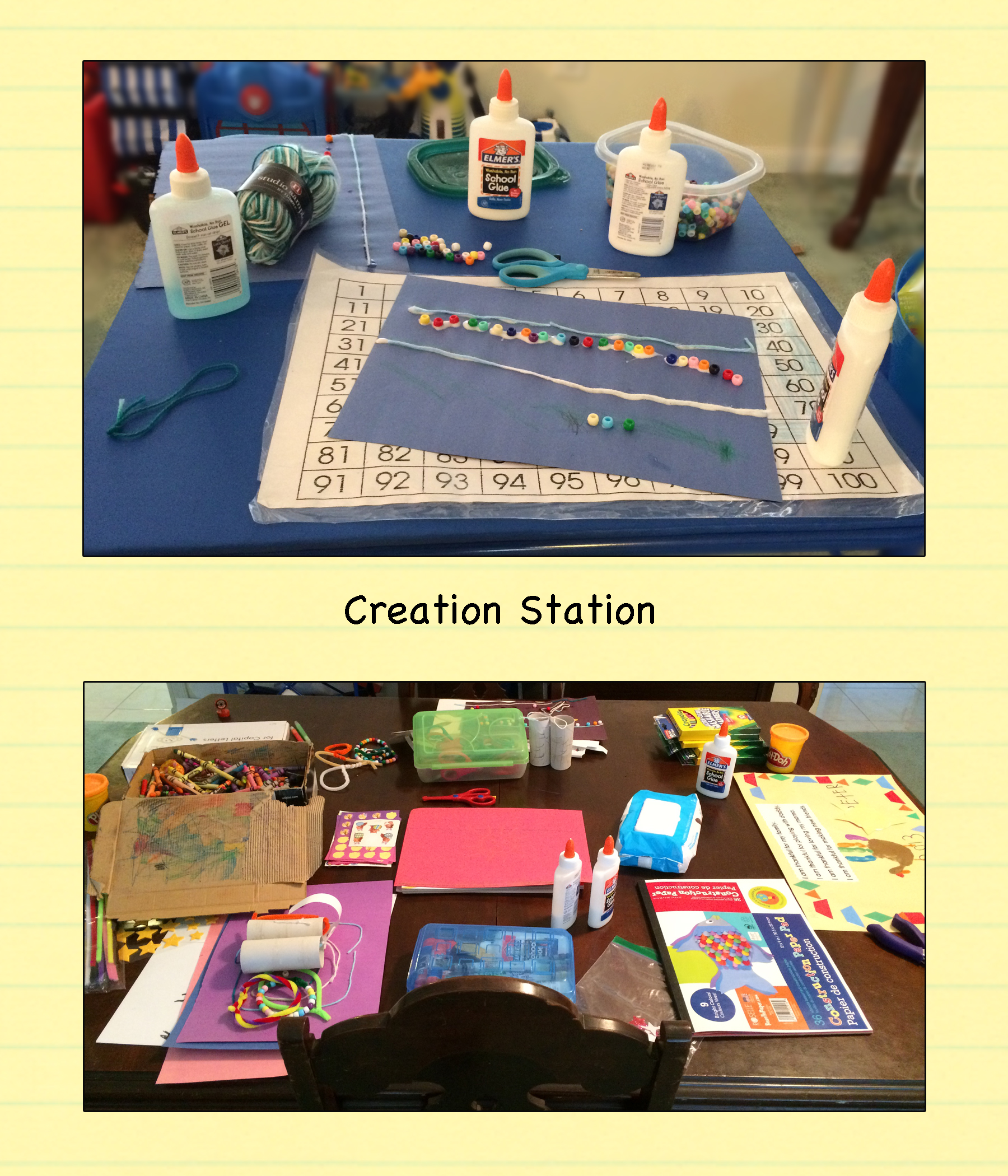
Ian loved it so much that Peter made another one for him. It shouldn’t have surprised me that the boys had so much fun inventing crafts from their own imaginations; after all, it’s what we encourage kids to do at school when we set up a table full of various supplies. It’s called “creation station.” At his age, it’s not the kind of thing Peter does much anymore, so it’s particularly enjoyable for him to do at home.

Creation Station.jpg

This is something that I can let my kids do with supplies already on hand and minimal brain power on my part. So many moms see crafts on Pinterest and then get stressed out because they think (I don’t know why) that their children expect perfection – or for them to spend hundreds of dollars on obscure supplies at craft stores. I promise you, they don’t. The kids I taught all year were usually happy with paper and crayons. While it may not be as easy as letting the TV babysit them, it keeps their little minds engaged without them even knowing it.

And the creation station portion of each day has an added benefit for me; it gives me a dedicated time to do a little prep for my class next year… and to do a little creating of my own. 🙂

Creation Station II.jpg


Prescribed Staycation

Staycation

If you read my blog last week, you know that I’m still working on my NaNoWriMo 2015 novel, and I was hoping to use this week to finish it because it’s our spring break. Yes, we’ve had other spring breaks in which we traveled – my kids’ first plane ride was over spring break – but this year, we’re having a well-deserved staycation. Since November, we’ve taken two big road trips and two trips to Disney. With another big road trip looming this summer, the idea of leaving home for a fifth month in a row didn’t appeal to me (or our budget).

So far, the kids and I have been to the dentist and the doctor; my elder son had a baseball game and piano lesson; we went to story time at our favorite indie book store and had lunch out with my husband; we visited my grandmother for an afternoon; we even saw a movie in the middle of the week – all the normal stuff that I did before I started working full-time again (except for the movie in the middle of the week part – I had to do something a little spring break-y). I’ve even gotten eight hours of sleep every night – doesn’t that sound like heaven? My main goal was just to be a homebody. My kids have ridden their bikes a lot and made pillow forts on the couch – things that we don’t always have time to do when school’s in session. They’ve had the chance to be boys (and I’ve had the chance to write).

Unfortunately, kids these days just don’t get the chance to be kids as much as they should. They’re overscheduled either because their parents both work full-time, and so they assume the children should also be occupied 40 hours of every week, or the stay-at-home moms want to have “freedom” when the kids are out of school – in other words, a kid-free house. While I am a huge proponent of structure for children, that doesn’t mean that they need to be up at 6:30, out the door by 7:30, and spending until 5:00 that night in day camps and kids’ gyms and sports and play groups and you-name-it.

One mom of now-adult children told me that she always felt like a cruise director when it came to her kids’ vacations, and while some of us may admire the Pinterest moms who have cool crafts and activities planned for every play date, what’s wrong with sending the kids out the door and just letting them play? If you’re at home with the kids, that doesn’t mean you have to helicopter 24/7. On the other hand, if you work full-time, you need to remember that your precious time off needs to be split between “me” time and kid time. A teacher I know once told a full-time working mom that, instead of signing her daughter up for a week of camp, the mom needed to take that week off to spend at home with her daughter. What a novel idea!

I know that many people don’t have the choice but to work full-time, but there’s something wrong if both of you are so busy that you can’t find the time to read to your child for five minutes before bedtime. Or go out for ice cream on the weekends. I know of a mom who gave up a great career when she had a harsh wake up call; after losing two family members, she realized that if something were to happen to her, her kids wouldn’t miss out on much more than a kiss right before bedtime. The money took a backseat to being able to be the one to pick her kids up from school.

Remember the 1989 movie Parenthood with Steve Martin and Mary Steenburgen? Remember how Steve Martin’s character is the overworked, underpaid, baseball coach dad of three with another on the way? Remember how, when complaining about not getting a promotion, his wife is more worried about him missing their kids’ upbringings, not the money? Yeah, she got it.

In his book The Christian Moral Life, Timothy F. Sedgwick writes that, while many take issue with the idea of sacrifice (such as losing one’s self in giving everything up for some other), “[t]he broader meanings associated with sacrifice arise from the original Latin meaning of sacrifice, which was to make something sacred or to perform a sacred act.”

Keep it sacred by keeping your children at the forefront. That sometimes means having a date night or a mini vacation away from them. But it also means coming back. It means letting them be kids – and being there to experience their childhood with them. Sometimes the only medicine needed is a vacation day with your child, snuggling on the couch and reading every picture book in the house.

Sound anticlimactic? If you’re thinking, But this isn’t what I thought I was signing up for when I became a parent, you’re right. It never is. It’s a whole lifetime of sharing amazing/frustrating/sleep-deprived/joyful moments with a unique human being that wouldn’t even be here if it weren’t for you.

Schedules and Sticker Charts – Success!

Educators of young children know that children love structure. Sometimes, parents are fortunate enough to know this, too. I have my sister-in-law to thank for giving me On Becoming Baby Wise when I was pregnant with Peter eight years ago (read my review here).

My first son was born with a compliant disposition, and since he didn’t have any competition in the sibling department until he was four, it was easy to build structure into his daily life by following Babywise‘s suggestions. By age three, he had been fully potty-trained for a while and was fairly independent. When Peter started preschool, the only thing I worried about was me surviving a much earlier wake-up time.

Everything changed with baby number two. I tried so hard to implement the same structure into Ian’s life as Peter’s, but there were two major stumbling blocks in the way of achieving this goal. The first is that when Ian came along, Peter didn’t just disappear; I am now a mom of two. Second, Ian is a completely different animal than his brother – strong-willed (he’ll touch the stove even when he knows it’s hot), mischievous (he’ll pull on the oven door just to find out what it does), clumsy (he’ll walk into the kitchen and fall flat on his face – right when I’m opening the oven door)– and did I mention strong-willed?

I feared Ian was developmentally delayed or somewhere low on the autistic spectrum (jury’s still out on both of these – trying to get an appointment with the only local developmental pediatrician has been harder than I imagined). Last spring, I started talking to the woman I hoped would be Ian’s teacher about his potty training issues and my worries about his behavior. She had also taught Peter and seemed alarmed to hear about Ian’s issues, but she was more than willing to advise me. To encourage Ian to be independent, as far as the potty is concerned, she told me to use incentives, rewards. As for his social behavior, she suggested structuring his day as much as possible. He had to learn to deal with interruptions in the middle of an activity he was enjoying without throwing a fit.

I was stressed over not being able to prepare him in time for the first day of school. I dreaded being in the middle of teaching my own class and getting a phone call that Ian had already messed up all three of his outfits. Or if that wasn’t the problem, he would disrupt class, push other children, fail to follow the rules, scream at the drop of a hat… he would be the nightmare student that no one wants to have. It was June. I had two months.

Fortunately, at the end of twelve months of potty training hell (read the account of the first nine months here), Ian was bowel trained the same day we solved a dietary issue – we got him on a magnesium supplement. The new issue was getting him to dress himself before leaving the bathroom. (I honestly don’t ever remember teaching Peter how to get dressed, other than how to tell his right shoe from his left – it was a total non-issue.) Obviously, it wouldn’t do for Ian take himself to the bathroom but not know how to pull his pants up again. It’s baby steps, folks, and with this child, each step seems to take about a decade.

I’d tried incentives with almost no success before, but as nothing else seemed to be working, I decided to go at it whole-heartedly. We found a school supply store and cute little incentive charts. Ian even picked out his own stickers. What I was really looking for, though, was some sort of calendar. When I subbed in the past, teachers used something like this:

PreK 4 Schedule

PreK 4 Schedule

These signs have Velcro on the back. My preschool class inherited the ones above from the kindergarten teacher who was in our room before, and we can move the components around every day. My four-year-old students actually pay attention to this schedule and depend on it to tell them about their day. I wanted to find something similar (but portable) for Ian.

Lo and behold – I found an Easy Daysies magnetic board with all sorts of optional magnetic schedule categories on the clearance table. I picked up the standard daily schedule (most of the magnets on the picture below are from this collection), as well as a set geared toward extracurricular activities like sports and dance and gymnastics – even one set that’s all about potty training.

Ian's Schedule

Ian’s Schedule

Between the school supply store and the local dollar store, I picked up a number of activities that I knew Ian would enjoy – foam alphabet puzzles, coloring books, stickers. I even filled a shoebox with scrap paper that he practices cutting. After buying all the supplies on a Saturday, I started “summer homeschool” the next Monday. I introduced Ian to songs I knew he would sing in PreK 3. I drew his attention to the new magnetic schedule. I awarded him with a sticker when he pulled his pants up by himself.

Sticker Charts! This kid has earned a bunch of rewards.

Sticker Charts! This kid has earned a bunch of rewards.

The transformation was amazing. It’s not like he’s morphed into a different person – he hasn’t turned into a miniature version of his brother – but he’s gained patience, is able to sit at an activity for an extended period, has an expanded vocabulary, and is even – gasp! – more compliant.

Although Ian loves his sticker charts (and earns some sort of reward every time he fills one up), he loves the schedule even more. He has to check it several times a day. Even though there are many days when nothing special happens, he reads it eagerly, reciting, “Naptime, suppertime, clean up time, brush teeth time, bedtime.” He is even willing to go right to bed when the schedule dictates. Maybe you don’t think that’s miraculous, but it certainly feels that way to me.

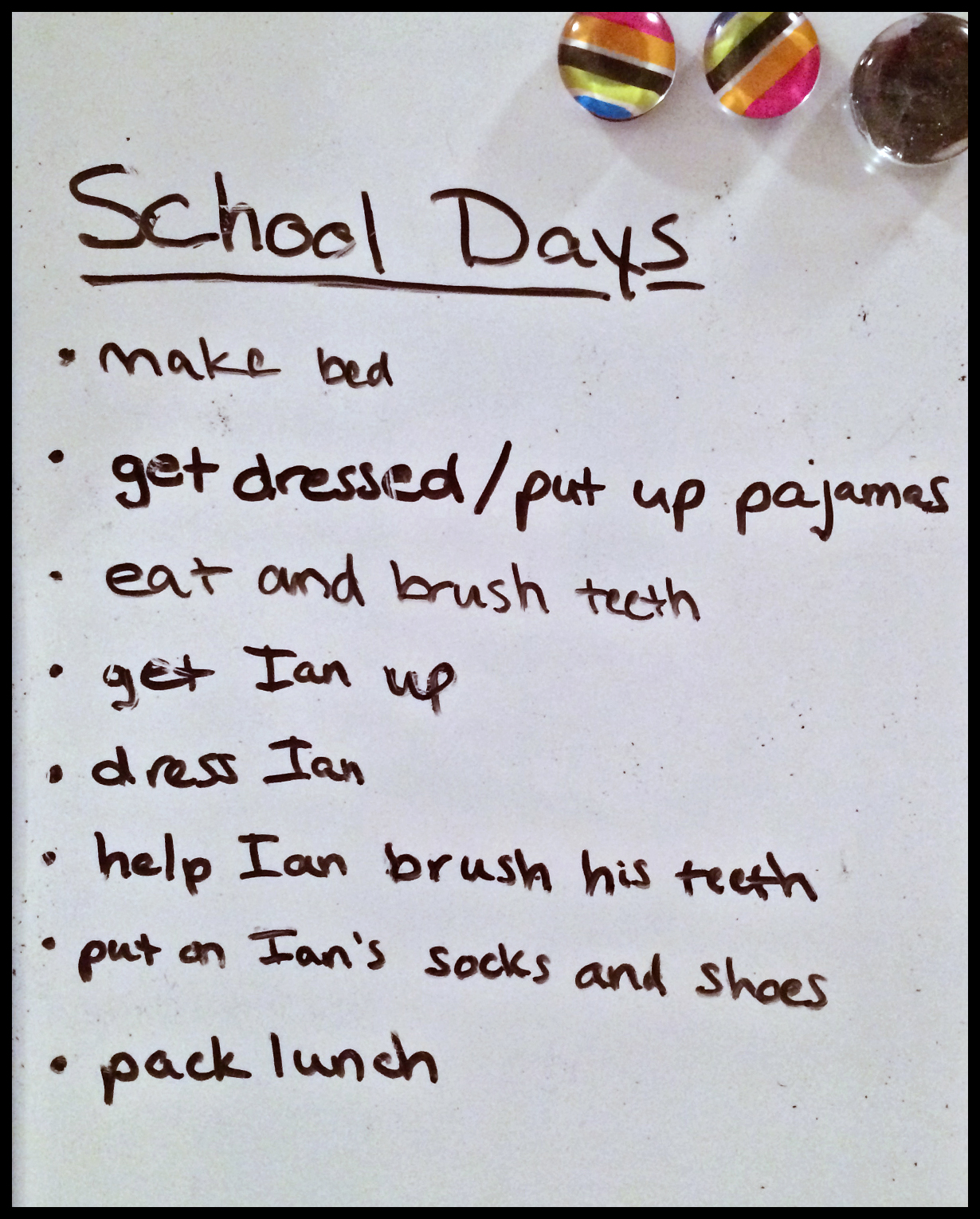
Even Peter has gotten onto to schedule/sticker bandwagon. I picked up a whiteboard for him. Over the summer, I wrote his daily chores, and now, I have a list of his morning chores. If he completes everything on the list before we leave, he gets a sticker, which equals a dollar. If he leaves his pajamas on the floor or doesn’t make his bed, for instance, his forgoes the sticker and money.

Peter's Jobs

Peter’s Jobs

My house is a different place. It’s still messier than I’d like, and it’s certainly far from peaceful at times, but a lot of the pressure that I used to feel – to be perfect, to do it all myself, you name it – is gone. It’s only natural, you say – my kids are growing up. Yeah, that’s true. And maybe I just happened to start implementing these plans at the time when my kids were ready for them anyway. Doesn’t matter – my house is a good place to be. It’s a place where I can entrust at least one child with some responsibility and in which I’m watching the other grow into his own little personality.

And, as always, even when a mishap happens, it’s all fodder for a good story.

Parental Pressure

Embed from Getty Images

This past week, I was fortunate to be trained to give an assessment, the Gesell Developmental Observation-Revised. My school administers it to all PreK3 students and any applicants for PreK4 and kindergarten. Although I may not ever be the examiner, I will need to know how to interpret this assessment’s results and share them with parents.

During the Gesell Institute‘s training, I realized that the information I gained about child development is crucial – not just for teachers, but for parents, as well. After being a mother for nearly eight years and being in the classroom almost three, I’ve figured out a lot of things, but some facts came as quite a surprise.

For instance, did you know you can do your child a disservice by teaching her to read too early? And the reason isn’t what you might initially think. Like everyone, I’ve been told that young brains are sponges, and this is absolutely true. But young bodies are still developing, and while a child’s brain might get that A is A and B is B, his eye muscles aren’t able to track from left to right (which we Westerners do when we read) until, on average, age five-and-a-half. In fact, you can usually tell a child who has learned to read too early because he turns his whole head in order to read across the page.

I can already hear outraged parents saying that their children learned to read on their own or that reading is a wonderful thing – we should promote it in any way possible. Number one, I know it’s possible that some kids just figure it out – my younger son certainly did, surprising us when he started reading the letters off my husband’s shirt a few months ago. It was not something we’d taught him at all. Number two, I absolutely agree that reading is wonderful and should be encouraged.

But could it also be possible that, underlying the desire to do what’s right for our kids by stimulating their little intellects and filling their minds with lots of valuable information, there’s something else at play here? Something a little selfish that you don’t want to admit?

I’m talking about peer pressure morphed into parental pressure. Peer pressure is an ugly thing when you’re thirteen, and your best friend makes a stupid decision and wants you along for the ride. It can either make you also do said stupid thing, or it can ostracize you from that friend when you say no. Either way, no fun, right?

But it doesn’t end when your zits disappear and your braces come off. It continues in fraternities and sororities, in the work place and across your neighbor’s fence. It’s the whole “keeping up with the Joneses” mess, which can turn expensive if you’re susceptible to it. It can wreck marriages or throw a kink into what you thought was a lifelong friendship.

And if you’re a parent, you can drag your innocent children into it. You have the best of intentions, but you’re actually doing damage to the precious people that you love so dearly.

I’m not saying that I’m immune. Far from it. When my son Peter was a toddler, I was talking to a mom whose child was a little older. This other child knew the entire alphabet and most of the sounds the letters made. While impressed, I also felt guilty. My son could sort of sing the alphabet, but that was the extent of it. Knowing little about early education at the time, I thought that I was remiss as a parent because my own child’s brain wasn’t brimming with this knowledge. So I came up with a brilliant plan.

Peter had a cute, wooden train, each car holding a different letter. I decided that every time he mastered a new letter, I would put the next car on. He loved trains. It would be a fun reward for him. We never got past B. I tried computer games, but the only ones he liked had nothing to do with letters. I was frustrated when nothing seemed to work, and I assumed that there was something wrong with how I was trying to teach him. But there was hope: in preschool, the problem would be solved because he would be with a person who was qualified to teach him.

Except letters didn’t come any easier in preschool. By the end of his first year, he could almost always tell you how to spell his name (and when he couldn’t, it was because he mixed up the order of the middle letters), and sometimes he could even recognize those four letters when they weren’t in his name. Otherwise, he knew the letter O.

Although it took until he was almost seven to get the formal diagnosis, we now know that Peter is dyslexic. When he couldn’t learn his letters, it wasn’t his fault, wasn’t my fault, and wasn’t his teacher’s fault. I could have saved myself a lot of frustration if I hadn’t tried to push him to do something at an age that was young for a normal child, not to mention unachievable for a dyslexic.

And reading isn’t the only place this happens.

Moms of babies, how often do you compare milestones with friends?

My child is seven months old and pulling up, but poor Susan – her baby is eight months old and hasn’t even crawled yet.

It’s hard not to feel that pride when your child does something that you think is Facebook status-worthy. I was thrilled that both of my boys walked at ten months, and I wasn’t shy about spreading the news. But that didn’t stop my elder son from having dyslexia. It didn’t teach my younger son how to behave.

One excellent resource that the Gesell Institute puts out is a booklet entitled “Ready or Not: Is My Child Ready for Kindergarten?” It points out that while the average child is able to walk at twelve months, the normal range is anywhere from eight-and-three-quarters to seventeen months. By two, all normal children can walk. Where is the relevance of my ten-month walkers now, when they’re seven and three?

Just as you don’t expect your newborn to get up and walk, you shouldn’t have ridiculous expectations for your child when it comes to reading. That’s not to say that exposure to words is bad or that certain children won’t start reading spontaneously. But it does mean that when it comes time to fill out college applications, the child who was seated in front of an encyclopedia at age two won’t have the upper hand over a child who learned to read in kindergarten.

So what are we parents to do? Are we not supposed to be proud of our children? Are we not supposed to encourage them when they show potential? A dad sees his four-year-old son chuck an acorn at a tree, and Dad immediately signs the kid up for the t-ball team (where he has just as much trouble tracking the ball flying toward him as he does reading without turning his head). A mom hears her two-year-old daughter singing along with the radio and starts looking for private music instruction.

Sometimes wonderful things happen. Star baseball players are discovered. Young musical prodigies attend Julliard and become famous concert pianists.

But sometimes Bobby complains that he doesn’t like t-ball, and then what do you do? It seems that parents are either reluctant to let him quit, thinking that he’ll get there one day if they keep pushing him, or they’re quick to involve him in another sport or activity because he’s got to be brilliant at something, right?

Maybe – and I know that I’m really going out on a limb here – maybe children need to be children. Maybe they are brilliant, yes, but that in no way means that they’ll miss their true calling unless they’re turned into little professionals right now. When they’re one or three or five or even ten, their true calling is to be a child. It’s to run around outside and catch lizards. Or to learn to ride a bike and even scrape their knees in the process. Or to have weekends that aren’t packed with activities, where they can bake cookies with their moms, help their dads wash the cars. Where the whole family can sit around and read a book together.

Through play, believe it or not, children learn. Play is their work. Putting puzzles together is a pre-cursor to reading. Building with large blocks can help them with math. Smooshing clay into pancakes or working it into balls with their little fingers develops fine muscles. Finger painting encourages hand-eye coordination, and cutting scrap paper with a pair of safety scissors teaches organization. (And I know, as a pre-school teacher, I might sound like I’m bashing my own job, but it’s nurturing and guided play that happens all day long with us.)

And reading… This one has a special place in my heart. Reading lessens discipline and self-esteem problems. It keeps kids in school, keeps them out of trouble (of course, good parenting is a big contributor, too, but then good parents often read to their children).

Since I’m such a big proponent of reading yet am getting onto parents for pressuring their kids to learn to read too early, what’s the solution? Read to your kids, of course. And not just moms – dads should be involved, too. Most nights, my husband reads a book like Goodnight Moon or Brown Bear, Brown Bear to our younger son, and I read a chapter book with our elder son. Right now, that chapter book happens to be Harry Potter and the Philosopher’s Stone, but at other times, it’s something easier, like Magic Tree House, that Peter can read to me.

Parents, quit pressuring your kids to be little adults. Quit expecting your schools to turn out mini physicists and doctors and poets by age four. And quit the boastful comparisons with other parents.

I don’t mean for everyone to immediately pull their kids from all ballet and music lessons, all gymnastics classes and tutoring sessions. As ever, you have to find the balance that’s right for your family. But that balance needs to include time to breathe, time to make a pile of leaves and jump on it, time to say yes to a trip to the park because you have plenty of time and aren’t stressed out about your packed schedule.

And when they’re tired and ready to rest, sit together and read a good book.

In closing, I’ll leave you with a list because, why not? Lists are cool. I wish I could take credit for it, but I’ll give credit where it’s due: my trainer from Gesell passed it out to everyone in our workshop, and I’m passing it on to you.

10 Reasons to Read to Your Child

  1. Because when you hold children and give them this attention, they know you love them.
  2. Because reading to children will encourage them to become readers.
  3. Because children’s books today are so good that they are fun even for adults.
  4. Because children’s books’ illustrations often rank with the best, giving children a life-long feeling for good art.
  5. Because books are one way of passing on your moral values to children. Readers know how to put themselves in others’ shoes.
  6. Because until they learn to read for themselves, they will think you are magic.
  7. Because every teacher and librarian they encounter will thank you.
  8. Because it’s nostalgic.
  9. Because for that short space of time, they will stay clean and quiet.
  10. Because, if you do, they may then let you read in peace.

And I’ll add my own #11: Because when the time is right (and it will be), they will read to you.