In America, an A Is an A, and a B Is a D

Dusting off the top of my soapbox and climbing on

I’m on team of teachers who work exclusively with students with learning differences. We meet throughout the year to evaluate our students’ progress, problem-solve, and commiserate with each other over things we can’t change, such as what goes on at home. Many parents remain in denial about their children’s needs, even with a diagnosis in hand. One problem with learning differences is that they can be elusive. Okay, yes, you can tell that a child doing log rolls across the floor has the H (hyperactivity) of ADHD, but dyslexia, dyscalculia, anxiety? These are not nearly as obvious, and students with high IQs and good coping skills can fly under the radar for a long time. In some ways, it might be easier for children who have a physical difference because people can see it and adjust their expectations. For example, parents of a blind child might be disappointed that he won’t grow up to be a professional baseball player, but they understand his limitations. Not so with some of my students. I’ve known parents to name drop with the universities they attended, as if their impressive alma maters will somehow make it possible to “cure” their kids—like maybe I’ll try harder now that I know what’s at stake. They can’t accept that their kids might not be Harvard material because if their kids don’t follow in their footsteps, then what’s the point?

Think I’m being harsh? How many people do you know who have fallen out with their parents because they didn’t live up to their unreasonable expectations? Or even expectations that seem reasonable but don’t work for that particular child. Unfortunately, I can think of too many.

Reflecting on the worst of the discipline problems I dealt with this past year, they boil down to two categories:

  1. Parents don’t want to be bothered by child, so child seeks negative attention over no attention; and
  2. Parents don’t understand child, so child lashes out when parents try to force the square child into a round hole.

Forget about #1 for now—that’s a whole series of books unto itself. But #2 often happens with the best of intentions. The issue isn’t that parents don’t love their children (although one could argue that sometimes parents are attempting to fulfill their unrealized dreams vicariously through said children); the issue is that parents need to wake up.

My first wake up call came over 10 years ago (read about my second one here). My husband and I have no learning disabilities and are fairly intelligent people. We’re both college graduates, both motivated and self-disciplined. If we didn’t achieve something (academically), it was on us. When we had our first child, we did what “good” parents do: we kept him away from screens, read to him, fed him healthy foods, made sure he got plenty of sleep, gave him educational toys. He even started going to school at the age of three. There is not any reason in the world why this child with this life shouldn’t know his letters, except he didn’t. He is dyslexic. This is not something we could have bought our way out of or prevented, and it will be part of his identity his whole life. Just the possibility of him being dyslexic scared me because all I knew were a pile of myths and misinformation, and I thought trying harder and tutoring and encouraging him would fix the “problem.”

His problem had more to do with me than himself. Once I took the time to learn what dyslexia really is and how Peter is wired, I got the right help for him and realized that my expectations for him to follow in my academic footsteps put way too much pressure on him. He put in all the effort, but tests are not made for kids like him. Project-based learning is more his speed, but for all we educators like to talk about differentiation and equity (both great things—don’t get me wrong!), our American school system has yet to get with the times. And after all, it’s not as easy to assess a great, failed science project where lots of learning occurs than penciled-in bubbles on a scantron.

And even if we were able to assess every child in a way that took into account his or her own particular learning profile, that wouldn’t magically make kids who struggle good at every subject. For those who need help in one area or another or—gasp—only muster a B, are they unfulfilled as humans?

At one of my team’s meetings, we were talking about how great one of these “B” students was doing—a student with “we went to this impressive college” parents, so Bs aren’t acceptable—when one of my colleagues said, “In America, an A is an A, and a B is a D.” How right she was (and thanks for the great post title)! The opposite of apathy, this stance is that if you’re not achieving the top at [fill-in-the-blank], then you might as well have not tried to begin with. It’s even true of myself—cough—if I’m to be honest. When I was in grad school, I started to panic if I thought my work might earn less than 98%. And why? My grades were between my professors and me—no one else knew. It’s a hard habit to break, caring about grades. And it’s not that getting good grades is bad—I’m really proud of my kiddos (at home and in the classroom) when they do well. But I’m also proud of them when they make a good effort, when they take a risk by going outside their comfort zones, when they make mistakes and learn from them. Unfortunately, our esteemed institutes of higher learning don’t seem to think that way. Even state universities (like my alma mater) are turning away great kids. Can you blame Lori Loughlin and Felicity Huffman for doing what they did to fudge their kids’ college admission documents? Well, yeah, I can and do, but you get my point. If people with all the money in the world can’t get their kids into the schools they want, what are the rest of us lowly, normal parents to do? (Secondarily, why do they want those schools for their kids? Would their lives amount to anything at a different school—or no school?)

Those aren’t rhetorical questions. Here we go:

We can be proud of our kids for being who they are, period. I’m not talking about giving up. Kids should still be motivated to give their best effort, but even more importantly, they should be nurtured in ways that allow them to discover their true passions. I’m proud of a mom I know for doing just that. I was catching up on what her daughter’s been up to lately. This girl is a phenomenal singer and actress, and I was surprised to hear that she’s not pursuing the stage. “But it’s not her passion,” her mom said. Wow. If only more parents would realize this. Just because their kids are good at sports or ballet or academics doesn’t mean their future is decided based on those things. I feel like our culture is making this even harder now that young athletes are getting paid at the collegiate level. It certainly would be hard to turn down free college tuition and a giant paycheck, especially at the impressionable age of 18 when the lure of the almighty dollar is so powerful.

When I was in my 20s, I struggled with the desire to be at home with my children and my (in)ability to afford it. My husband just about killed himself, working extra to pay the bills, while I floundered at a mediocre freelance writing career (if you can call it that). I’m a good writer and editor, and I got some business, but it wasn’t nearly enough to pay for diapers, much less all the other expenses we incurred with two small children. A couple of my friends were court reporters and told me that, with my typing and proofreading skills, I would be a natural. I could “be my own boss” and make a six-figure income. It was very, very tempting. But when I thought about leaving my babies and spending all day in a courtroom…my soul shrank away from the idea. I know it’s a great job for some people but not for me, even though the idea of that salary was so alluring.

While I tried to figure out what in the world to do with my life, I began volunteering at Peter’s school, and when they put out a plea for substitute teachers, I thought that was something I could do and make a little extra money. When my younger son started attending there, too, it just so happened that they had a full-time job for me. In a very unexpected way, I found my love of teaching (something I said I would never do)… and it started with saying no to something much more lucrative. In fact, if we think about salaries, you could say I turned down an A for a C. But if it means making less money to be fulfilled, that doesn’t even feel like a choice.

Yes, encourage your kids to always do their best. Lead by showing them the right choices instead of the easy or flashy ones. Have compassion (on them and yourself) when setbacks happen. What did we learn?

That grades are for school, and there they should stay.

That tests are for people who are good at taking them.

That a life worth living can’t be documented on a resume or a paycheck.


Check out my TpT (Teachers Pay Teachers) store, Mrs. C Loves to Read, to see what I teach in the classroom.

Does School Choir Matter?

singing

Sharing my love of music with my youngest

Before reading on, I invite you to watch a video (from whence I stole this post’s title) that addresses this issue by clicking here.

Growing up, I was always involved in some sort of music, from taking music lessons as a three-year-old and transitioning to piano to singing in children’s choir at church to my elementary school’s auditioned three-part chorus. My middle school’s chorus program was dying when I got there. After one frustrating year, I left that school, but I made my decision so late in the summer that it was too late to audition for our arts magnet middle school. Instead, my parents decided to try homeschooling me.

Maybe one reason I tend to read and write teen fiction is because I empathize with the ugly duckling teenagers who aren’t comfortable in their own skin and don’t know where they fit in the world. One reason I so readily left my middle school was because, somewhere in the adolescent muck, my old friends were no longer true friends. My rose-colored lenses were shattered beyond repair. Homeschooling was perfect; I no longer had to interact with my peers. Forget ugly duckling; I’d become a turtle that never poked her head out of her shell, and I’m sure my parents envisioned me locked in my childhood room, devouring books and Twinkies at the age of thirty-eight.

Completely against my will, they signed me up for a summer musical program at a local high school. It was a “normal school,” not one with a magnet program. But despite cuts in funding, this school still had musical theatre and chorus, the teachers of both programs collaborating to put on summer musicals that rivaled those of our city’s arts magnet. My closest cousin was a student at this school, and the chorus teacher was a friend of his family. My chorus teacher was (and still is) a loving man, who always put his students first. He took me under his wing, and even though I continued to homeschool, he became my advocate, convincing the principal to let me into the school’s chorus and musical theatre programs. After my first year, the musical theatre teacher left, but chorus remained. I sang in all the concerts, including three times in Disney’s Candlelight Processional. I sang in chorus, ensemble, and solo competitions at the district and state levels, participated in All State choruses, and went on two trips to New York City. I also met my husband.

The year after I graduated, the chorus program wilted. Funding at the school was cut, and they consolidated both chorus and band positions into one instructor, which was neither fair to the students nor the teacher. My chorus teacher, not wanting to compromise the program he’d built by being stretched so thin, went to a different school that still appreciated that chorus and band are two different things.

For a kid who homeschooled without being a part of a homeschool group, I would have missed so many opportunities if there hadn’t been a local high school chorus program and teacher willing to let me participate. It would be hypocritical of me to put my head in the sand with the attitude that because I love music, I’ll always make sure my own kids have opportunities to participate in musical programs. While that’s great for my boys, that’s not the point. So many kids have talents they’ll never get to nurture because their parents don’t have the time, means, or desire to help them outside of school. By cutting musical programs and only offering them at specialty or independent schools, we’re robbing children of a different way to learn, to think, to live. Not to mention that music also makes for excellent therapy.

But at least there’s always college, right? I mean, if they’re still interested at that point. After all, that’s how my parents met—in college chorale, where they not only had the opportunity to sing but to do so all over the US and Europe. But at the same junior college they attended (which is now a state college), the funding has been cut to the point that there may not be a choral program after the next couple years.

Let me ask: what do kids look forward to when they get up and go to school every day? Are they excited to learn how to take tests? I doubt it, but more and more, that’s what school is becoming. I looked forward to school (except for that one year) because I loved my friends and even my teachers. And my teachers made learning fun because they were actually allowed to teach subjects that excited them. If we send our kids to institutions for seven-plus hours five days a week but subtract all the parts that make child- and young adulthood fun, how can we expect their enthusiasm for learning to grow, much less flourish? This isn’t limited to music, folks. What happened to recess? Visual arts? Non-academic learning, such as kids problem solving and developing grit through play? These are all undervalued by the people in charge, whomever they are, and those of us who care are left sitting here, scratching our heads and wondering what we can do.

I wish I had an answer. I’m grateful to all the private music teachers, after-school programs, and conservatories that promote musical learning, but they’re often spread thin, too. These are private entities that depend on outside funding, tuition, or grants to keep their doors open, none of which are guaranteed. Why do we undervalue something that can bring about such positive change in the lives of everyone, from babies to the elderly? After all, the children of this generation will be taking care of me in a nursing home not too many decades from now, and when that time comes, I hope they’ll appreciate that playing some of my favorite songs and giving me a cool coloring book is more worthwhile than letting me turn into a vegetable in front of a TV.

The question isn’t really if school choir matters. It’s the why of the thing. It matters because it creates a safe space for children who come from different backgrounds, religions, cultures, and so on to create something together that’s much greater than what they can do individually. And if they grow an appreciation for this when they’re young, they’re more likely to take it with them as they grow and mature. I think it’s a pretty good place to start.

Creation Station Summer

So the school year is over at the Cotchaleovitch residence, and it is time to sleep until 9:00 every morning, let the kids binge watch TV while I kick back with a book, and only change out of pajamas and emerge into the real world when we’re down to our last Capri Sun. Once we’ve recovered a little, we’ll consider a vacation.

Well, not quite. But by the last day of school, I was feeling pretty elated that we’d all made it. There were a lot of firsts in the 2015-16 school year: it was my first year teaching full-time; it was Ian’s first year in school; and it was Peter’s first year with an in-school reading resource for dyslexic kids, which meant I didn’t have to run him to a tutor twice a week.

We were on the home stretch. Other teachers commiserated with me when I noted that my students needed a second spring break. Like a permanent one. For the last month of school, we were all just holding on. That’s not to say that there weren’t good days, but there comes a point when a child can only take so much, and then every new bit of info you try to cram in their brains just comes spilling out of their ears. I’m sure parents felt much the same way (read one mom’s hilarious recap of her kids’ end of school year experience here).

Then, when it seemed that all the end-of-year events were falling into place, my eight-year-old got sick. I mean three-trips-to-the-doctor-in-six-days, two-different-antibiotics, absent-for-six-days sick. My husband, my parents, and I took turns watching him, and I stressed out over what he could possibly have (at the third appointment, the conclusion was bronchitis, but the fever that wouldn’t quit is still a mystery). Believe me, I was ready for some uninterrupted home time.

But there’s a part of me that knows what will happen in the fall if I just totally deflate and turn into a zombie for the next two-and-a-half months: everything my kids have learned in the past year will be relegated to their mental back burners, and the readjustment period come mid-August will be painful for both them and their teachers.

I had a rough idea of what my kids needed to accomplish this summer. Peter has a summer reading book, and so he doesn’t forget all his math skills, we need to play some math games that his teacher showed me. As for Ian, he’ll need to work on his fine motor skills. From working with four- and five-year-olds, I know that strengthening his fingers can be as simple as letting him put beads on strings, practice cutting with safety scissors, color, and play with Play-Doh.

So now, to implement all of these things into the days we spend at home. It was actually during Peter’s sickness that it all came together for me. One day, when his was fever was down and he had the energy get creative, he made this cute monster-Mickey-Mouse-ears thing:

Monster Frame.jpg

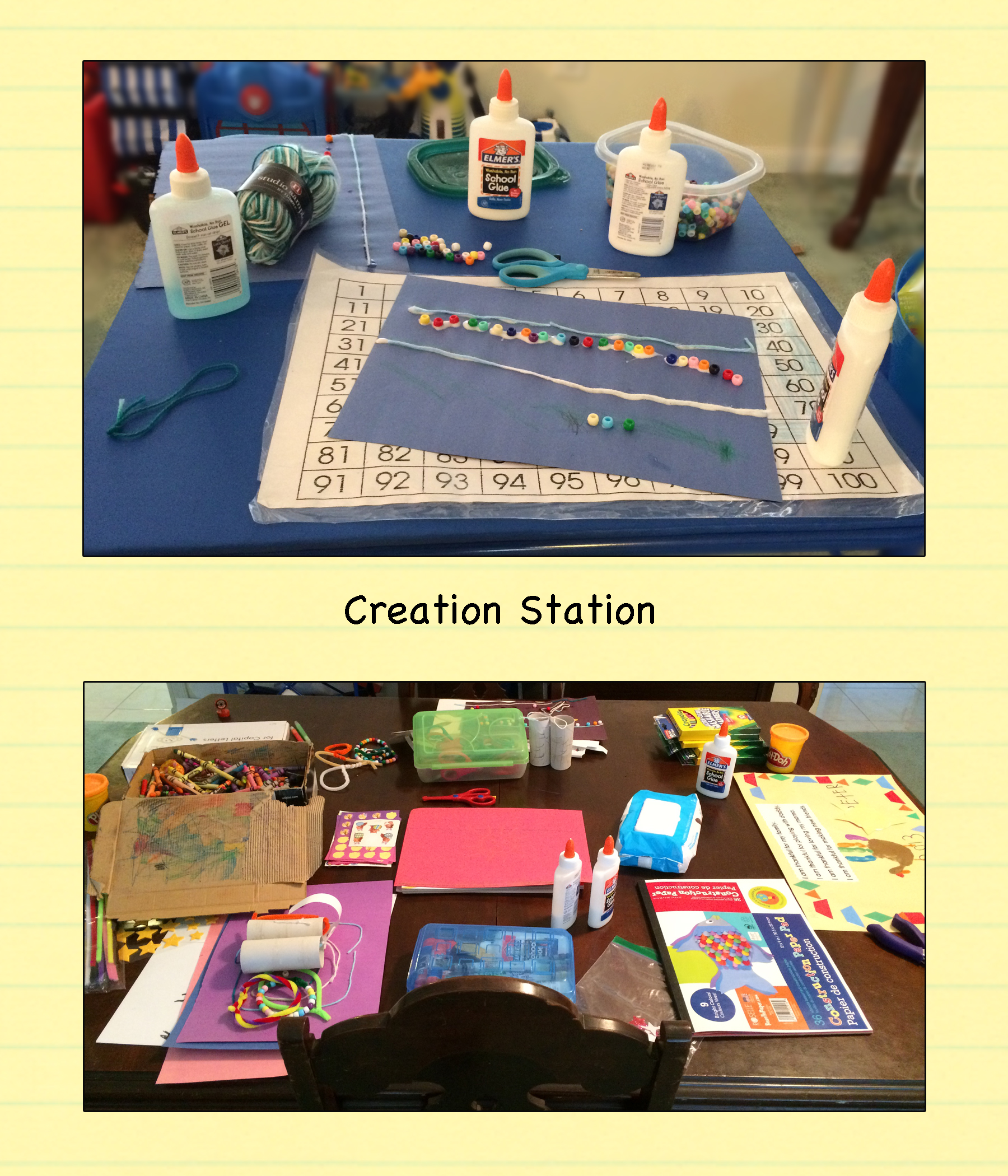
Ian loved it so much that Peter made another one for him. It shouldn’t have surprised me that the boys had so much fun inventing crafts from their own imaginations; after all, it’s what we encourage kids to do at school when we set up a table full of various supplies. It’s called “creation station.” At his age, it’s not the kind of thing Peter does much anymore, so it’s particularly enjoyable for him to do at home.

Creation Station.jpg

This is something that I can let my kids do with supplies already on hand and minimal brain power on my part. So many moms see crafts on Pinterest and then get stressed out because they think (I don’t know why) that their children expect perfection – or for them to spend hundreds of dollars on obscure supplies at craft stores. I promise you, they don’t. The kids I taught all year were usually happy with paper and crayons. While it may not be as easy as letting the TV babysit them, it keeps their little minds engaged without them even knowing it.

And the creation station portion of each day has an added benefit for me; it gives me a dedicated time to do a little prep for my class next year… and to do a little creating of my own. 🙂

Creation Station II.jpg


No Back to School Blues This Year

Two years ago, I posted a blog about the stress that surrounds the end of summer break and going back to school – and I wasn’t even the one going to school. Still, as a parent of a then-five-year-old, I was fully responsible for getting him there on time every day and felt that pressure. I don’t even remember if I had the same feeling last year – I was probably too busy to notice.

This summer, I’ve done more summery things than probably any other summer of my life, including a two-week vacation with my family. It would seem that a summer like this would stir that familiar anticipation, that early-morning-wake-up dread. But for once, I look forward to the days ahead, when I will have a set routine (even if it means a 4:15 alarm). Funny how things change.

Although I am a little anxious about what the fall will bring, with my little guy transitioning from loosely structured days with me or other family members, I’m thrilled that he’ll finally be in the classroom his brother first entered four years ago. I’ve spent much of the summer preparing my three-year-old by teaching him the songs he’ll sing in pre-school, as well as the concept that it’s not cool to walk out of the bathroom sans pants. It’s a work in progress, but he’s actually getting it. For the past month, he’s told me almost on a daily basis that he wants to go to school – and it’s not just Peter’s school anymore but Ian’s, too. And Peter, who will be entering the second grade, is excited to meet his teacher and see what friends will be in his class.

But the kids aren’t the only ones who are excited. A couple months ago, I received the call from one of their school’s administrators, asking if I would be interested in a PreK 4 assistant position. I jumped on it, probably sounding rather giddy. It was one of those pinch-myself kinds of moments. Summer break had just begun, though, so it didn’t sink in fully for a while. Every once in a while, when thinking about the upcoming year, I would have to remind myself that this year will be different. I will have an assigned parking spot. Instead of walking the kids up, they will come with me to my classroom. No more phone calls while I’m in the shower, asking if I can sub. All welcome changes.

Toward the end of July, I did have a little bit of an overwhelmed feeling, knowing that I had a couple weeks of training and pre-planning ahead of me. Before most of my teacher friends were even back, I was at school, learning how to administer and interpret the assessment we use for pre-schoolers and kindergarteners. Then this past week, while many of my friends posted pictures of their end-of-summer vacations on social media, I’ve been hard at work. I have my badge, which makes me official, and people keep welcoming me to the faculty, but I can’t help but feel like I’m still the same old volunteer-slash-substitute mom that I’ve been since 2011. I belong here, I have to remind myself. Not only do my colleagues help cement that feeling, but my delight in my position tells me it’s true. As I confided in another teacher, I’m having more fun than I feel like I should be allowed to have – and someone’s paying me for it!

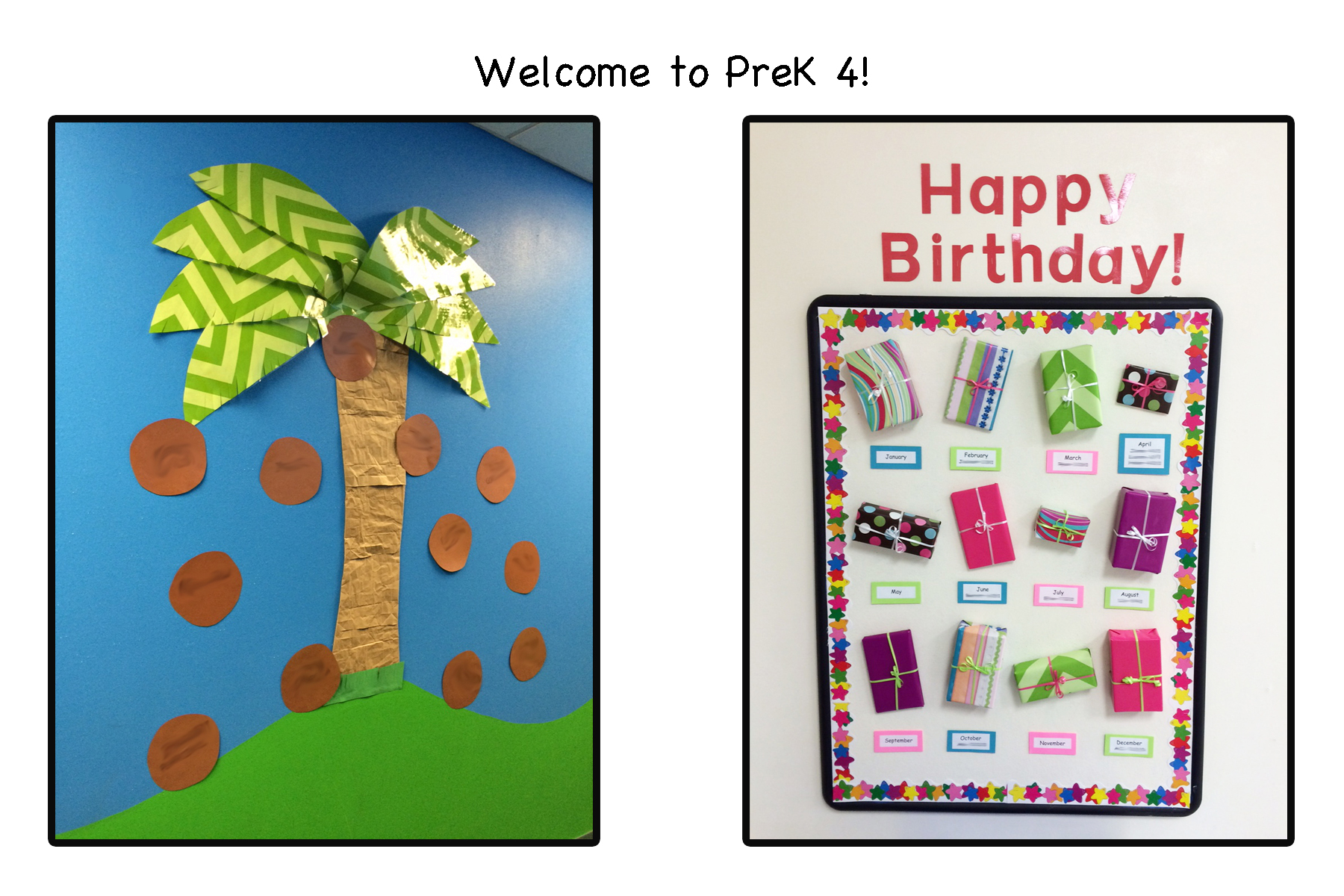
Regular readers, fear not – I’m still writing. I’m not about to give up on that dream. But now I’m able to help support my family in a way that freelancing didn’t allow, and my kids and I will be at the same place every day (although in different classrooms). I’ve die-cut, laminated, copied, stapled, cut, sorted, and painted my way through a number of projects this week, and while it sometimes felt like the room would never be finished, I’m proud of the results. I’m working with an amazing teacher, and since I subbed a lot in PreK 3 last year, I know eight of our ten kids already.

PreK 4 collage

I’m sure there are days ahead when I will be tired and irritable. There will be kids who grate on my frayed nerves. There will be days and weeks that never seem to end. I’m not deluded about what’s to come. Even so, I am very excited. So much so that I don’t have back to school blues at all. Instead, I feel like I do when a much-anticipated vacation is just around the corner. In fact, I feel much like I did over twenty years ago, when I was a girl attending this very school.

The night before the first day back will likely be a sleepless one. I’m just the kind of person who gets too excited to succumb to unconsciousness. So if you see me Tuesday, I’ll likely be carrying matching grey baggage under my eyes. But don’t worry, this is exactly the kind of thing I don’t mind losing sleep over.

Is May the New December?

I’ve noticed a pattern over the past several years, especially since I started substitute teaching: the school year speeds up exponentially after spring break. It’s like a race to the end of the year, to fit in all the end-of-year projects and parties and field trips. Everyone, especially the children, can feel that summer break is fast approaching, and life takes on a frenetic pace.

Maybe that’s why I’ve heard more than one person complain that May is the new December, as if December is a bad month. I quietly took issue with this notion. My favorite time of year is Advent, preparing for the birth of the Christ child. I love the Christmas music, Christmas shopping, wrapping Christmas presents at night while watching Christmas movies, doing the Advent calendar with my kids, and – yes – my seasonal socks. Yet for many people it’s a nightmare of obligations and deadlines and buying presents for people they don’t really like. I get it – December can be stressful. Not to mention that if you’re in college, you have exams, while all you can think about is the long break that’s so close you can almost touch it. I can certainly commiserate because I was a December college graduate. And that year, while I thought it would be such a relief to finally be done with school forever-and-ever-amen, I found myself immersed in not only editing but also typesetting the second volume of Fiction Fix when our previous typesetter bailed. People were counting on me, and I wasn’t able to enjoy December – or even being done with college – like I’d expected.

Maybe this is how my friends feel this month.

For me this year, May is more than teacher’s gifts and good-byes and summer planning. I took the Florida Teacher Certification Examination this past Monday, which meant cramming for almost two weeks. As soon as I got through with that, I took on the end-of-year books for my first grader’s class. These books hold the kids’ projects from August through the end of the year – over 20 pages of 12×18 construction paper – but what I didn’t realize was that about half of these projects still had to be glued to the paper before the books could be assembled. Another mom and I thought we could knock it out on Tuesday, only to find out we were in way over our heads. I’ve taken pages home every night, still have five or six to go, and need to finish by Tuesday.

First Grade Book-in-Progress

So my May has been busy. I’ve put off the usual things that fill up my to-do list, things that are still waiting for my attention, and I can feel them getting ready to pile back on. Like two freelance projects that I hope to finish in the next month, before our family vacation. Like a friend’s novel that I’ve been slowly beta reading since January. Like my own fiction projects, which I blogged about as recently as last week.

But I’ve been living with a kind of giddy feeling, anticipating the (temporary, at least) cessation of certain obligations. This weekend alone, three culminated: yesterday was my son’s last baseball game of the season; this morning was the last Sunday school class I have to teach until September; and this afternoon was my community chorale’s last concert of our spring season. Not to mention that this week will be the last meeting of my third-year Education for Ministry group (which means I’m almost finished with the 1000+-page history book we’ve been discussing since last fall). After Memorial Day weekend, my son has a partial week of school, and then first grade will be over.

What this means is that, even though we have school for a few more days, when we’re home for the evening, we’re home. I’ll have time to cook and actually enjoy supper. By the end of the month, I won’t have to wake up at 4:30 for a blessed two-and-a-half months. This doesn’t mean that I’m just going to sit around and twiddle my thumbs all summer – the kids and I will be plenty busy – but it does mean that I will be able to stop and breathe for a minute.

I love summers because I get a break. I’m grateful for this because so many parents aren’t able to have the time off with their kids. But if I’m not careful, I can allow myself to dread the end of summer break. I have to remind myself that I always love the beginning of a new school year, and I have ever since I was a kid. This year, my little guy will start preschool, so it’s going to be even more exciting. As my kids grow, everything seems to speed up, and I have to be careful not to stress too much over all the activities and responsibilities that go with being a mom-slash-chauffeur. What I do, I do for them and for us as a family. School and tutoring and daily chores are part of our life, but if we begin to allow the fun stuff – the baseball and the play dates and the trips to the park – become obligations instead of fun, it will be time to reassess. I don’t ever want to let a particular month turn into a time of dread, and I hope everyone else embroiled in the busyness of these times will do the same.