NaNoWriMo 2015: The Saga Continues

Keep Calm and Write On

Yeah, I’m still writing my 2015 NaNoWriMo book. Will I ever finish?  I had high hopes that I would be done this month, so I could focus on something different for Camp NaNoWriMo in April. But I don’t want to put a lot of pressure on myself (the pressure to write 50,000 words in November was enough), so I’m not going to go so far as to call this an actual goal.

My writing over the past week had started picking up, and I thought I was seeing light at the end of the proverbial tunnel. But as Metallica says, it’s just a freight train coming my way. Maybe the light is right behind the freight train, but I just don’t know yet.

See, here’s what happened: my novel is the third of a trilogy, and I realized that I’d made some discoveries about at least one of characters that would necessitate going back and making changes to the first two books. No big deal. The point right now is just to finish the first draft of this book. I can edit the earlier manuscripts to my heart’s content later. Like after I take a month-long breather.

But then I realized that I’d forgotten something crucial that affects the book I’m writing right now. Say, for instance, that there’s a character who loses a leg. This character can’t run a marathon the week after losing said leg. But I was so mired in the slow forward plod of my plot that I forgot this important detail (which isn’t a missing leg, by the way). Once I realized it, I had a brainwave about how to fix it – and how to use it to move the story forward in a new way – but I still have to go back over a bunch of scenes that I thought were (at least temporarily) behind me. For all of you hardcore WriMos, no, this is not editing but merely adding. If I were still worried about a word count, it would be great. But I’m not; I just want to finish.

What does this mean for finishing? Well, it means I’ll have to spend a lot of time reading over pages that I’ll desperately want to edit, just so I can figure out where to splice in the stuff I forgot. I’ll have to finesse it all later. It’s gonna be ugly, but it’s gotta happen.

So that’s where I am. It’s my spring break, so I’m going to try to dedicate my spare time to writing. And not forgetting about any more… ahem… absent body parts.

Wake Up Call

Last week, I bought a pile of used books at a school fundraiser and planned to blog/brag about them. After all, I love books, as do many of my followers.

But our weekend was busy, and blogging wasn’t on my mind at all. We were ending our night at Disney World on Sunday (Valentine’s Day) when I got a text from my dad that floored me. A young woman from my church – 20 years old, a senior in college – had died in a head-on collision that morning.

I was filled with the immediate guilt that I tend to feel when I’m happy and well, yet someone else has is facing a life-altering tragedy. This girl and her family’s grief have stuck with me all week. It seems that about half the people I work with are somehow connected to her, so I was constantly reminded of the terrible loss. I did not know her, but I know both of her parents and can only imagine the dread with which they face every day now without their younger daughter.

And, of course, this dredged up all the other tragedies that have touched me: my own grandmother, killed in a car accident when I was a child; my husband’s uncle, killed in a motorcycle accident that same year; a cousin who fell from the rooftop dog park of his apartment.

This tragedy has affected me more profoundly than those I see on the news every day, probably because I know the family. Not to mention that the victim was 20, had her whole life before her, and was innocent. Yet I think many of us have become desensitized to the number of innocents who die all the time; it’s a defense mechanism that allows us to continue to live, not bogged down under the weight of sadness and despair. Otherwise, we might spend all of our time worrying; after all, tragedies don’t care how old you are, how much you’re loved, or if your life holds infinite promise. An accident could take any of us at any time.

It’s when something like this happens that I always resolve to do better about enjoying each moment because it could be my last, to tell my loved ones how much they mean to me because I don’t know when the last time will be. But it goes even beyond that: life is too short to go through it like a zombie, taking the little things for granted.

While I can’t stop the frustrating, busy, bad days from happening, I can choose to pay better attention to the good things that fill in the gaps. Instead of dwelling on the traffic, which I can’t change, I can enjoy listening to my playlist. Instead of dreading the nights and weekends when my husband has to work, I’ll enjoy the time with my kids, remembering than one day they’ll be out of the house. I need to glean as much of the good as I can from every day, instead of allowing stress and worries to turn everything into a chore.

Earlier this week, I found myself somehow running 10 minutes late, only to discover that I hadn’t prepped my son’s lunch the night before – something that would cost me another 10 minutes. That’s something I would usually stress out over, which spirals to snapping at my children to hurry. But it wasn’t their fault that I was running late, and although it seemed farfetched, if our drive into school that morning happened to be our last, I didn’t want to spend it tense and angry. I made the choice to relax about it, and guess what? We somehow got out of the house early.

I know I’ve written before about balance being key and living for the current day, not some potential, future day that may or may not even happen – and I keep doing so because it’s a work in progress. Stated baldly, I know that one day, I will become a statistic. When and what kind of statistic I don’t know. But until then, I need to live like each day is special – even the weekdays when I have to get up at 4:15. Instead of looking forward to a different day, I need to recognize that, even though it may not be memorable beyond the present moment, it’s that moment I’m living that matters.

Fundraiser Books

Pile of Books

Circling back to those books – I will enjoy them, God willing, as well as all the little things and the big vacations and milestones, too. But if I were to die today, books unfinished, milestones unachieved, I don’t want anyone to mourn my unfinished to-do list. Rather, I want to leave people with no doubt that I enjoyed the small moments of my life; I want to leave my family and friends with memories of good times, fulfilling relationships, and no regrets.


The NeverEnding (NaNoWriMo) Story


Keep Calm and Write On

I received a peppy email from NaNoWriMo this week about it being editing time. Usually, I would be all over that, or even a couple steps ahead. Last year, I finished the first draft of my NaNoWriMo novel on January 24th. The year before, I was a little slower, taking until February 10th, but my first draft was 30,000 words longer. This year, sad to say, I’m still under 70,000 words (barely) and feel like I might have finally achieved the halfway point of the story arc (if there is such a thing).

I’m not giving up, just plodding along. I don’t write new material every day – I don’t even think about it every day – although I should. I’m just too busy – often with things besides writing. But I’m reading a really good book that I can hardly stand to put down. (Okay, I’m actually reading several good books, but only one page-turner that’s brand new to me.)

And I have become distracted by another writing project. Yes, I’m writing this with guilty fingers, fingers that have typed on another story. Just to think – I postponed work on my Camp NaNoWriMo novel for NaNoWriMo 2015, and now that’s slowed down because I had this completely unexpected novel barge in one day, demanding to be written. Books will do that sometimes, and although I’ve been able to put some of these stories off before, this one wouldn’t take “Wait” for an answer.

You see, it all happened when I read a good book. (That’s how my first NaNoWriMo happened to begin with, so I guess my muse is really rubbing her hands together in glee right now.) It was teen fiction. No vampires or werewolves or anything at all supernatural, which is somewhat unusual for me. And suddenly, I had a character and an idea, and poor NaNoWriMo 2015 was doomed. I’ve only typed a little on this new project (just under 5500 words), but there’s at least 10 times that much simmering in my head, ready to boil over. It’s not like anything I’ve ever written, which makes me think that maybe it’s special.

Or maybe I’m just coming up with excuses to let NaNoWriMo 2015 linger.

Somehow, I don’t think so. Although I’ve left quite a few manuscripts hanging out to dry before, my NaNoWriMo record to date stands at two participations, two wins, two completed manuscripts (and by completed, I mean that I plowed through to their respective ends, although they still need major editing). Considering it’s the third book of a trilogy, and I have beta readers who want to know how it ends, I need to finish it for them – and for me. Earlier this week, one of my characters surprised me and did something I thought a different character would do. I guess I ought to keep writing and see how that’s going to resolve.

But let me state up front what I’m not going to do. This year, I am not going to set goals that will put me in a panic. This year, when I finish, I plan to edit and do it right. I will eventually have a copy of this book for beta readers, but I don’t even know if CreateSpace has a deal for free books this year, and I’m not going to stress out about it. If I have to pay for books, I have to pay for books.

So I’m going to work on these two stories (plus Camp NaNoWriMo, plus editing books one and two of the trilogy again), and if they take me through the end of October, so be it. But come November 1, 2016… well, the NaNoWriMo piper will play for me again. I’m sure of it.

This Week in the News…

It has been quite the newsworthy week, both for the good and bad, locally and internationally.

At the start of the week, it was the tragedy of David Bowie’s death, and later, it was Alan Rickman’s. I’ll say that while Bowie’s was a shock, Alan Rickman’s came as a blow. And it’s not even like I knew him. Tragically, another acclaimed actor, who seemed to be a good person in real life, met an untimely end. But I’ve always had this thing about Alan Rickman, ever since he played the despicable Sheriff of Nottingham in Robin Hood Prince of Thieves. Maybe it’s because, as young a girl, I didn’t know to distinguish the actor from the character, so for years, I associated Alan Rickman with evil. It was only much later that I discovered that he was much more than the characters he portrayed. I admired him for so often choosing roles that were dark, challenging, even hated. Someone has to be very comfortable in his own skin to be able to sustain a career as such.

But getting back to the news…

Aside from additional tragic local news, there was also the national hoopla surrounding the billion-and-a-half-dollar Powerball. I’d never paid any attention to any sort of lottery before, but this one had the attention of even the most stringent non-gamblers (even if it was only to scoff). It’s hard not to wonder what it would be like to wake up one day as a billionaire. Some co-workers and I joked that we would happily “settle” for the lucky million-dollar ticket. Even after taking out taxes, that kind of money would make an incredible amount of difference in my life. And even big celebrities like Queen Latifa and David Duchovny said they were participating.

But what about people like David Bowie and Alan Rickman, who had a lot more than I’ll ever, even if not billions? Would that kind of money have made a difference to them? I’m thinking not. I’m thinking that they could already afford the best health care money could buy, yet they still both succumbed to the dreaded C-word.

While many people speculated about what they could do with that kind of money – from retiring at the tender age of 19 to buying houses in all the posh resorts around the world – I thought that I love my job and would hate to have to quit because of the sudden notoriety that being a big winner brings. If, somehow, I ever managed to get any kind of windfall that would allow me to do whatever I pleased (financially) for the rest of my life, I would want to hide it, so I could still do exactly what I’m doing right now.

I’m a pretty low maintenance girl. I don’t need fancy houses or luxury cars – although, I would like a cool reading nook or even library in my dream house. I wouldn’t spend the money on jewels or designer clothes because I’d rather wear yoga pants and a sweatshirt than anything else. It’d be nice to be able to live completely debt-free and know that my kids will always be taken care of. But money won’t cure my elder son’s dyslexia or my younger son’s whatever-he-has.

About the only changes I would make would be to buy a house closer to where I work, hire a cleaning lady once a week, and make my husband retire and become my personal chef. (He’s a good cook – no need to hire outside help.)

As for the rest – buying a new car with cash when the old one craps out or taking vacations on a whim just because we can or filling my library with all the books I could ever want – while that would be nice, there’s something to be said for earning it. Recently, we paid off a  car and finally bought a new one that has all the features we ever could have wanted but couldn’t afford until recently. And there’s something so fulfilling about knowing that we’re finally to that point – that we’ve made it ourselves.

And, hey, there’s still that very slim chance that I’ll make a comfortable living as a novelist. The odds are better than of winning the Powerball, at least.

And say that does happen – say that, someday, the world mourns my death like they’re mourning Alan Rickman’s – I’ll still want to live the quiet life. I’ll still want to sit on my couch or reading nook and be left alone to read a good book. Or read one of my favorites with my children or future grandchildren. I’ll still be enthusiastic about hosting book clubs. Because that’s who I am, and no amount of money (or lack of it) will change that.

And just because, I would like to end with a beautiful, very human quote of Alan Rickman’s. I think that anyone can appreciate it, but only true Potter fans will really get it. Alan Rickman certainly did.

Alan Rickman quote

Schedules and Sticker Charts – Success!

Educators of young children know that children love structure. Sometimes, parents are fortunate enough to know this, too. I have my sister-in-law to thank for giving me On Becoming Baby Wise when I was pregnant with Peter eight years ago (read my review here).

My first son was born with a compliant disposition, and since he didn’t have any competition in the sibling department until he was four, it was easy to build structure into his daily life by following Babywise‘s suggestions. By age three, he had been fully potty-trained for a while and was fairly independent. When Peter started preschool, the only thing I worried about was me surviving a much earlier wake-up time.

Everything changed with baby number two. I tried so hard to implement the same structure into Ian’s life as Peter’s, but there were two major stumbling blocks in the way of achieving this goal. The first is that when Ian came along, Peter didn’t just disappear; I am now a mom of two. Second, Ian is a completely different animal than his brother – strong-willed (he’ll touch the stove even when he knows it’s hot), mischievous (he’ll pull on the oven door just to find out what it does), clumsy (he’ll walk into the kitchen and fall flat on his face – right when I’m opening the oven door)– and did I mention strong-willed?

I feared Ian was developmentally delayed or somewhere low on the autistic spectrum (jury’s still out on both of these – trying to get an appointment with the only local developmental pediatrician has been harder than I imagined). Last spring, I started talking to the woman I hoped would be Ian’s teacher about his potty training issues and my worries about his behavior. She had also taught Peter and seemed alarmed to hear about Ian’s issues, but she was more than willing to advise me. To encourage Ian to be independent, as far as the potty is concerned, she told me to use incentives, rewards. As for his social behavior, she suggested structuring his day as much as possible. He had to learn to deal with interruptions in the middle of an activity he was enjoying without throwing a fit.

I was stressed over not being able to prepare him in time for the first day of school. I dreaded being in the middle of teaching my own class and getting a phone call that Ian had already messed up all three of his outfits. Or if that wasn’t the problem, he would disrupt class, push other children, fail to follow the rules, scream at the drop of a hat… he would be the nightmare student that no one wants to have. It was June. I had two months.

Fortunately, at the end of twelve months of potty training hell (read the account of the first nine months here), Ian was bowel trained the same day we solved a dietary issue – we got him on a magnesium supplement. The new issue was getting him to dress himself before leaving the bathroom. (I honestly don’t ever remember teaching Peter how to get dressed, other than how to tell his right shoe from his left – it was a total non-issue.) Obviously, it wouldn’t do for Ian take himself to the bathroom but not know how to pull his pants up again. It’s baby steps, folks, and with this child, each step seems to take about a decade.

I’d tried incentives with almost no success before, but as nothing else seemed to be working, I decided to go at it whole-heartedly. We found a school supply store and cute little incentive charts. Ian even picked out his own stickers. What I was really looking for, though, was some sort of calendar. When I subbed in the past, teachers used something like this:

PreK 4 Schedule

PreK 4 Schedule

These signs have Velcro on the back. My preschool class inherited the ones above from the kindergarten teacher who was in our room before, and we can move the components around every day. My four-year-old students actually pay attention to this schedule and depend on it to tell them about their day. I wanted to find something similar (but portable) for Ian.

Lo and behold – I found an Easy Daysies magnetic board with all sorts of optional magnetic schedule categories on the clearance table. I picked up the standard daily schedule (most of the magnets on the picture below are from this collection), as well as a set geared toward extracurricular activities like sports and dance and gymnastics – even one set that’s all about potty training.

Ian's Schedule

Ian’s Schedule

Between the school supply store and the local dollar store, I picked up a number of activities that I knew Ian would enjoy – foam alphabet puzzles, coloring books, stickers. I even filled a shoebox with scrap paper that he practices cutting. After buying all the supplies on a Saturday, I started “summer homeschool” the next Monday. I introduced Ian to songs I knew he would sing in PreK 3. I drew his attention to the new magnetic schedule. I awarded him with a sticker when he pulled his pants up by himself.

Sticker Charts! This kid has earned a bunch of rewards.

Sticker Charts! This kid has earned a bunch of rewards.

The transformation was amazing. It’s not like he’s morphed into a different person – he hasn’t turned into a miniature version of his brother – but he’s gained patience, is able to sit at an activity for an extended period, has an expanded vocabulary, and is even – gasp! – more compliant.

Although Ian loves his sticker charts (and earns some sort of reward every time he fills one up), he loves the schedule even more. He has to check it several times a day. Even though there are many days when nothing special happens, he reads it eagerly, reciting, “Naptime, suppertime, clean up time, brush teeth time, bedtime.” He is even willing to go right to bed when the schedule dictates. Maybe you don’t think that’s miraculous, but it certainly feels that way to me.

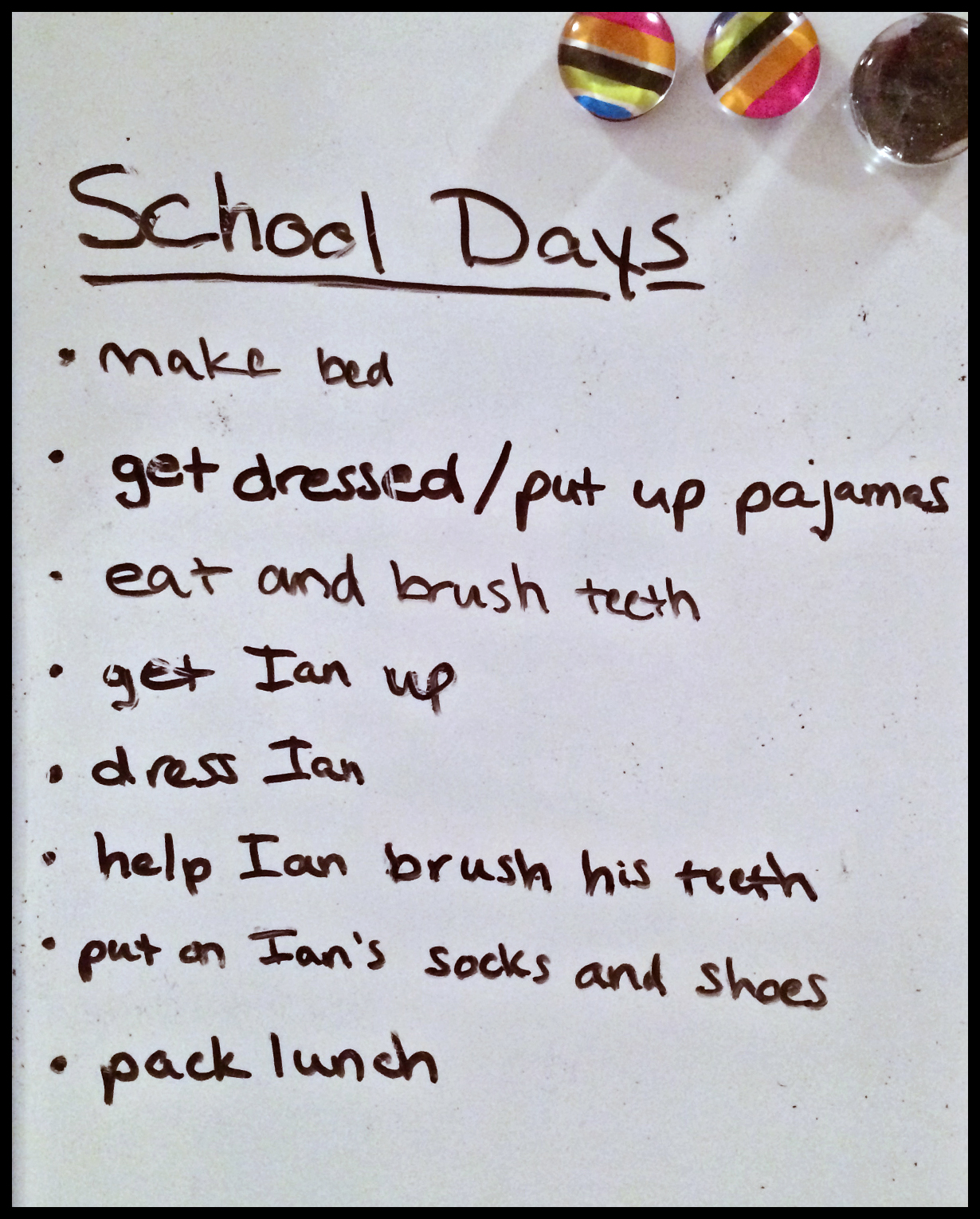
Even Peter has gotten onto to schedule/sticker bandwagon. I picked up a whiteboard for him. Over the summer, I wrote his daily chores, and now, I have a list of his morning chores. If he completes everything on the list before we leave, he gets a sticker, which equals a dollar. If he leaves his pajamas on the floor or doesn’t make his bed, for instance, his forgoes the sticker and money.

Peter's Jobs

Peter’s Jobs

My house is a different place. It’s still messier than I’d like, and it’s certainly far from peaceful at times, but a lot of the pressure that I used to feel – to be perfect, to do it all myself, you name it – is gone. It’s only natural, you say – my kids are growing up. Yeah, that’s true. And maybe I just happened to start implementing these plans at the time when my kids were ready for them anyway. Doesn’t matter – my house is a good place to be. It’s a place where I can entrust at least one child with some responsibility and in which I’m watching the other grow into his own little personality.

And, as always, even when a mishap happens, it’s all fodder for a good story.

Parental Pressure

Embed from Getty Images

This past week, I was fortunate to be trained to give an assessment, the Gesell Developmental Observation-Revised. My school administers it to all PreK3 students and any applicants for PreK4 and kindergarten. Although I may not ever be the examiner, I will need to know how to interpret this assessment’s results and share them with parents.

During the Gesell Institute‘s training, I realized that the information I gained about child development is crucial – not just for teachers, but for parents, as well. After being a mother for nearly eight years and being in the classroom almost three, I’ve figured out a lot of things, but some facts came as quite a surprise.

For instance, did you know you can do your child a disservice by teaching her to read too early? And the reason isn’t what you might initially think. Like everyone, I’ve been told that young brains are sponges, and this is absolutely true. But young bodies are still developing, and while a child’s brain might get that A is A and B is B, his eye muscles aren’t able to track from left to right (which we Westerners do when we read) until, on average, age five-and-a-half. In fact, you can usually tell a child who has learned to read too early because he turns his whole head in order to read across the page.

I can already hear outraged parents saying that their children learned to read on their own or that reading is a wonderful thing – we should promote it in any way possible. Number one, I know it’s possible that some kids just figure it out – my younger son certainly did, surprising us when he started reading the letters off my husband’s shirt a few months ago. It was not something we’d taught him at all. Number two, I absolutely agree that reading is wonderful and should be encouraged.

But could it also be possible that, underlying the desire to do what’s right for our kids by stimulating their little intellects and filling their minds with lots of valuable information, there’s something else at play here? Something a little selfish that you don’t want to admit?

I’m talking about peer pressure morphed into parental pressure. Peer pressure is an ugly thing when you’re thirteen, and your best friend makes a stupid decision and wants you along for the ride. It can either make you also do said stupid thing, or it can ostracize you from that friend when you say no. Either way, no fun, right?

But it doesn’t end when your zits disappear and your braces come off. It continues in fraternities and sororities, in the work place and across your neighbor’s fence. It’s the whole “keeping up with the Joneses” mess, which can turn expensive if you’re susceptible to it. It can wreck marriages or throw a kink into what you thought was a lifelong friendship.

And if you’re a parent, you can drag your innocent children into it. You have the best of intentions, but you’re actually doing damage to the precious people that you love so dearly.

I’m not saying that I’m immune. Far from it. When my son Peter was a toddler, I was talking to a mom whose child was a little older. This other child knew the entire alphabet and most of the sounds the letters made. While impressed, I also felt guilty. My son could sort of sing the alphabet, but that was the extent of it. Knowing little about early education at the time, I thought that I was remiss as a parent because my own child’s brain wasn’t brimming with this knowledge. So I came up with a brilliant plan.

Peter had a cute, wooden train, each car holding a different letter. I decided that every time he mastered a new letter, I would put the next car on. He loved trains. It would be a fun reward for him. We never got past B. I tried computer games, but the only ones he liked had nothing to do with letters. I was frustrated when nothing seemed to work, and I assumed that there was something wrong with how I was trying to teach him. But there was hope: in preschool, the problem would be solved because he would be with a person who was qualified to teach him.

Except letters didn’t come any easier in preschool. By the end of his first year, he could almost always tell you how to spell his name (and when he couldn’t, it was because he mixed up the order of the middle letters), and sometimes he could even recognize those four letters when they weren’t in his name. Otherwise, he knew the letter O.

Although it took until he was almost seven to get the formal diagnosis, we now know that Peter is dyslexic. When he couldn’t learn his letters, it wasn’t his fault, wasn’t my fault, and wasn’t his teacher’s fault. I could have saved myself a lot of frustration if I hadn’t tried to push him to do something at an age that was young for a normal child, not to mention unachievable for a dyslexic.

And reading isn’t the only place this happens.

Moms of babies, how often do you compare milestones with friends?

My child is seven months old and pulling up, but poor Susan – her baby is eight months old and hasn’t even crawled yet.

It’s hard not to feel that pride when your child does something that you think is Facebook status-worthy. I was thrilled that both of my boys walked at ten months, and I wasn’t shy about spreading the news. But that didn’t stop my elder son from having dyslexia. It didn’t teach my younger son how to behave.

One excellent resource that the Gesell Institute puts out is a booklet entitled “Ready or Not: Is My Child Ready for Kindergarten?” It points out that while the average child is able to walk at twelve months, the normal range is anywhere from eight-and-three-quarters to seventeen months. By two, all normal children can walk. Where is the relevance of my ten-month walkers now, when they’re seven and three?

Just as you don’t expect your newborn to get up and walk, you shouldn’t have ridiculous expectations for your child when it comes to reading. That’s not to say that exposure to words is bad or that certain children won’t start reading spontaneously. But it does mean that when it comes time to fill out college applications, the child who was seated in front of an encyclopedia at age two won’t have the upper hand over a child who learned to read in kindergarten.

So what are we parents to do? Are we not supposed to be proud of our children? Are we not supposed to encourage them when they show potential? A dad sees his four-year-old son chuck an acorn at a tree, and Dad immediately signs the kid up for the t-ball team (where he has just as much trouble tracking the ball flying toward him as he does reading without turning his head). A mom hears her two-year-old daughter singing along with the radio and starts looking for private music instruction.

Sometimes wonderful things happen. Star baseball players are discovered. Young musical prodigies attend Julliard and become famous concert pianists.

But sometimes Bobby complains that he doesn’t like t-ball, and then what do you do? It seems that parents are either reluctant to let him quit, thinking that he’ll get there one day if they keep pushing him, or they’re quick to involve him in another sport or activity because he’s got to be brilliant at something, right?

Maybe – and I know that I’m really going out on a limb here – maybe children need to be children. Maybe they are brilliant, yes, but that in no way means that they’ll miss their true calling unless they’re turned into little professionals right now. When they’re one or three or five or even ten, their true calling is to be a child. It’s to run around outside and catch lizards. Or to learn to ride a bike and even scrape their knees in the process. Or to have weekends that aren’t packed with activities, where they can bake cookies with their moms, help their dads wash the cars. Where the whole family can sit around and read a book together.

Through play, believe it or not, children learn. Play is their work. Putting puzzles together is a pre-cursor to reading. Building with large blocks can help them with math. Smooshing clay into pancakes or working it into balls with their little fingers develops fine muscles. Finger painting encourages hand-eye coordination, and cutting scrap paper with a pair of safety scissors teaches organization. (And I know, as a pre-school teacher, I might sound like I’m bashing my own job, but it’s nurturing and guided play that happens all day long with us.)

And reading… This one has a special place in my heart. Reading lessens discipline and self-esteem problems. It keeps kids in school, keeps them out of trouble (of course, good parenting is a big contributor, too, but then good parents often read to their children).

Since I’m such a big proponent of reading yet am getting onto parents for pressuring their kids to learn to read too early, what’s the solution? Read to your kids, of course. And not just moms – dads should be involved, too. Most nights, my husband reads a book like Goodnight Moon or Brown Bear, Brown Bear to our younger son, and I read a chapter book with our elder son. Right now, that chapter book happens to be Harry Potter and the Philosopher’s Stone, but at other times, it’s something easier, like Magic Tree House, that Peter can read to me.

Parents, quit pressuring your kids to be little adults. Quit expecting your schools to turn out mini physicists and doctors and poets by age four. And quit the boastful comparisons with other parents.

I don’t mean for everyone to immediately pull their kids from all ballet and music lessons, all gymnastics classes and tutoring sessions. As ever, you have to find the balance that’s right for your family. But that balance needs to include time to breathe, time to make a pile of leaves and jump on it, time to say yes to a trip to the park because you have plenty of time and aren’t stressed out about your packed schedule.

And when they’re tired and ready to rest, sit together and read a good book.

In closing, I’ll leave you with a list because, why not? Lists are cool. I wish I could take credit for it, but I’ll give credit where it’s due: my trainer from Gesell passed it out to everyone in our workshop, and I’m passing it on to you.

10 Reasons to Read to Your Child

  1. Because when you hold children and give them this attention, they know you love them.
  2. Because reading to children will encourage them to become readers.
  3. Because children’s books today are so good that they are fun even for adults.
  4. Because children’s books’ illustrations often rank with the best, giving children a life-long feeling for good art.
  5. Because books are one way of passing on your moral values to children. Readers know how to put themselves in others’ shoes.
  6. Because until they learn to read for themselves, they will think you are magic.
  7. Because every teacher and librarian they encounter will thank you.
  8. Because it’s nostalgic.
  9. Because for that short space of time, they will stay clean and quiet.
  10. Because, if you do, they may then let you read in peace.

And I’ll add my own #11: Because when the time is right (and it will be), they will read to you.
Camp NaNoWriMo Recap

Camp NaNoWriMo 2015 Winner

This time last year, I never would have thought of participating in Camp NaNoWriMo. I was too concerned with having enough material for NaNoWriMo in November to use up all of my creativity in July. But of course, a year before that, I never would have thought I would participate in National Novel Writing Month to begin with. Write 50,000 words in one month? It seemed like the kind of thing that crazy people with no life would do.

So I guess I’m a crazy person with no life.

If you’re a regular reader, you know that I participated in NaNoWriMo 2013. I didn’t even decide to do it until the weekend before November 1st. I never expected to actually write 50,000 words, but I wrote much more than that. In 2014, I signed up for NaNoWriMo again, and although it wasn’t nearly as easy the second time, I wrote the sequel to the 2013 novel, and I plan to write the third book of the trilogy this November.

Camp NaNoWriMo, which is a more laidback version of NaNoWriMo, takes place in both April and July. Instead of writing a 50,000-word novel from scratch, you simply declare your writing project goal for the month and then try to complete it. The minimum word count is 10,000, and you can even work on something that’s not a novel. April was a no for me both times because I was in the middle of editing the previous Novembers’ novels. But if you read my recent summer writing post, you already know that things changed for me this summer.

After finishing the latest revision of my 2014 novel, I gave my Muse a few days’ rest, but then she came back, apparently ready to get to work on a manuscript that’s been kicking around since 2009. It’s a story that I would add a scene to every once in a while, but I probably hadn’t opened the document in two to three years. After reading through everything I had – a little under 17,000 words at the time – I realized that I was ready to fill in the missing scenes, maybe even finish it.

I started writing, and much like my NaNoWriMo 2013 experience, it was like to direct the wall of water after the dam has broken. Then I realized that it was July, and if I was going to be writing anyway, I might as well declare my intentions officially by participating in Camp NaNoWriMo. When I signed up on July 9th, I was already at 20,000 words. Just in case the ideas petered out, I gave myself what seemed a pretty easy goal of 35,000 words total. That meant I only had to write 15,000 more in order to succeed. There were a couple days when it felt like I might be pushing it, but for the most part, inspiration was on my side.

I was at almost 54,000 words – well past my goal of 35,000 – when I began to slow down. I still had a week left, but I was already feeling the itch to edit. This is a no-no in NaNoWriMo because it can compromise your word count and keep you from finishing. But for Camp NaNoWriMo, I had more flexibility, and I really needed to go back and fix a big problem. I realized that I had too many main characters, one of whom was only the shell of a character. In my own mind, I considered him a throw-away – what would readers think? So I decided to cut him, but doing that meant going all the way back to the first page.

I also happened to have several unwritten scenes floating around in my head that I wanted to add to earlier parts of the book. Going back through it from the beginning helped me do this, and my word count slowly went up again. By July 31st, I recorded my word count at 55,652, and I have no intention of stopping, even though July is now behind me.

While I can’t say that Camp NaNoWriMo is the reason I’m working on an unexpected project in the middle of the summer, I am thankful that it lit a little bit of a fire under me, at least as far as making a writing goal is concerned. If you’re the type of person who has to be accountable to someone (or something) else in order to finish a writing project, I highly recommend it. You also have access to a community full of fellow campers who will give you support when you need it.

Not to mention that, if you’re unsure of if you should try the full NaNoWriMo experience, it’s a great way to practice. I know that I’m ready. Any experience that encourages me to write my heart out is a welcome one.

Summer 2015 Reading

Magical books

Magical books (Photo credit: Wikipedia)

My last blog was all about the writing I’ve done this summer (and since then, I’ve achieved my Camp NaNoWriMo goal – yay!), but as any worthwhile author will tell you, you can’t write if you’re not reading. So I’ve been doing what a good writer should do, naturally.

The reading list that I set for myself this year is an ambitious one. (Read it here.) On it are 27 books, including several series. Christopher Paolini’s The Inheritance Cycle has been on my to-read list for three years now, and I finally finished it. But those books are dense and ate up a lot of my reading time. As I approached the halfway point through the year, I wondered how I was doing.

I’m happy to report that as of mid-July, I’ve finished 13 of the 27 books. Maybe Inheritance didn’t set me back too far, after all. Of course, I read a lot during our two-week vacation. I worried I was being overly ambitious when I packed the entire Divergent series, as well as a book that a friend lent to me a few months ago. But I read the whole borrowed book on the plane trip from east coast to west coast (Talk to the Hand by Lynne Truss – I highly recommend it, particularly if you’re a fan of British humor), and I plowed through all but a couple hundred pages of the Divergent series over the two weeks.

Ahead of me, I still have at least one doozy (Diana Gabaldon’s Written in My Heart’s Own Blood – all of the books in her Outlander series are formidable), plus Suzanne Collins’s The Hunger Games series. I know I re-read it last year, but I want it to be fresh when the final movie comes out this fall. Also, I’ll start reading Harry Potter and the Philosopher’s Stone to my seven-year-old in the next week. I’m excited that he’s finally old enough to comprehend the story – we may have another Potter geek in the making.

Other than my non-fiction books (which I rarely list here, unless it’s what I consider entertaining non-fiction, such as Talk to the Hand), I’ve stuck to my book list pretty well. Early on, I decided to read Daniel Woodrell’s Winter’s Bone because I’d seen the movie and was interested in seeing what kind of extra character developments happened in the book. I’m glad I did. Woodrell’s use of language is unique, and as a writer, it’s always helpful to mix it up with a different style from time to time.

The only other detour I’ve made was Lisa Genova’s Still Alice (also a book-turned-movie). This was a book I had to read. I’m going back to teach full-time in the fall, and the faculty at my school has a summer reading list. Still Alice was the only novel on our list of choices. I’ve jotted down the titles of several non-fiction books that interest me, but I wanted a good story – and I got it. But frequent criers, keep your tissues handy.

I’m sticking to my list and loving it. I hope to finish Lois Lowry’s The Giver series by the time the kids go back to school (I’m halfway through the second book, Gathering Blue), and then I’ll keep plowing ahead.

And never fear – if I actually make it through this whole list, I already have several new books waiting. (She rubs her hands together and cackles with glee.)

To-Done!

Embed from Getty Images

If you read my post last week, you know that I had great hopes for this week. My to-do list needed to get a lot shorter, and guess what? I am happy to report that my first full week of summer break has been a success.

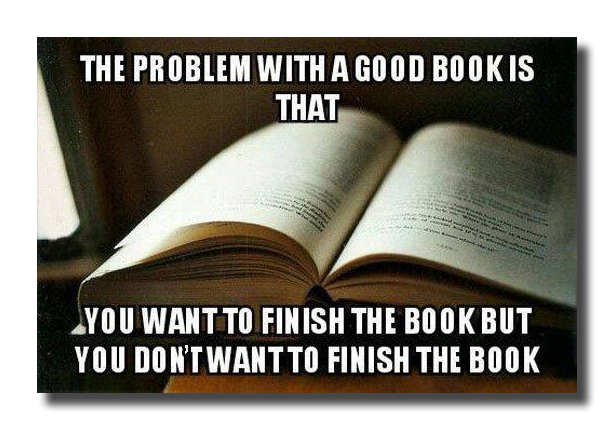
On Sunday, I finally finished Christopher Paolini’s Inheritance Cycle, the last book of which I’d been waiting for read for four years. I have to say, whatever my complaints about Paolini’s style in his early books, the last one more than made up for it. The only problem, of course, was that I was sad to be finished.
Reading Dilemma

With my recreational reading done, I plunged into work on Monday. And I even involved the kids. They sat at their table and had work time while I cleaned the kitchen. I have to tell you this because a day during which I clean an entire room (actually more than that because I cleaned the laundry room and one bathroom, too) is a day for the record books. (Please tell me I’m not crazy to be proud of this.)

I also spent my younger son’s entire naptime working on my biggest freelance project, a memoir that I’ve been working on for a year now. Thank goodness my client isn’t in a hurry. Although she still has some copy to turn in to me, my hope was to finish arranging and editing the material she’s given me so far and return it to her by the end of the week. I must have spent anywhere from three to six hours on this project every day this week, and although Microsoft Word had me practically pulling my hair out by the end, I did finally get a draft to her. (I would give details, but just know it had to do with pagination – if I try to be any more specific, I’ll most likely be reduced to gibberish and &%*!@ in order to keep this a family friendly blog.)

With one project out of the way (at least until that client gets back with me), I have one last freelance project (a much simpler one) to finish before our family vacation. I understand that I will come home from our vacation with work still to do, but my clients will have that time to decide what changes they would like for me to make, and I will only have to worry about finishing touches.

And then I will be done. As of this week, I am no longer offering my freelance writing services. And it’s not just Word that’s made me fed up enough to quit. Although I won’t go into details now, I am going to join the work force again soon, and if I’ve learned anything in life, it’s that I can make myself and my loved ones very miserable if my plate is too full. So while I will be glad to help friends with blogs or editing projects that don’t have critical deadlines, I am no longer pursuing freelance work.

It’s a relief, actually. Anyone who is self-employed understands the pressures of finding enough work to pay the bills. Last summer, I was able to land enough steady projects to earn a paycheck while I wasn’t substitute teaching, but it meant that when I was at home with my kids, we weren’t able to do much fun stuff; I was stuck at my computer working very hard for very little monetary compensation. This summer, I will be able to spend more time with them, and the time that I do spend at the computer will mostly be writing my own fiction.

Speaking of my fiction, now that I have one freelance project behind me, I have time to concentrate on editing last year’s NaNoWriMo book. I am determined to get my two free copies from CreateSpace. Beta readers, I will be reaching out to you sometime in July, so get ready!

Lastly, while I am reducing the stresses in my life, one of them will be this blog. No, I’m not quitting! Believe me, I still have a lot to say, but I won’t be pushing myself to reach my own personal deadline (which is once a week) anymore. Many weeks, I get to Sunday and panic because I don’t know what to write about. Or I have a lot to say but am too brain dead to arrange much of a coherent thought.

I have a friend who used to blog weekly, and she made the announcement earlier this year that she will now only post when she feels inspired to do so. At the time, I was saddened because I loved reading her blogs, but I could certainly understand – and I kept her idea in the back of my mind. To remove another stress that I put on myself sounded like bliss. I told myself that if I ever went back to work, changing from a weekly blog post to a “when I’m inspired to write” blog post would be the way to go.

Don’t worry. Even if you don’t hear from me next week, I still have plenty to say. I’ll likely update my book list sometime soon, and I’m sure I’ll have a lot to say about NaNoWriMo 2015. But when you don’t hear from me, know that I’m enjoying my family or a good book… and, as always, striving make more of my to-do list items to-done.

Playing Catch Up

Embed from Getty Images

During spring break, I was excited about the possibility of being able to cross off many much-neglected items on my to-do list. During that week, however, I was disappointed (as I often am) with the amount I was actually able to accomplish. Sure, I was home more than usual, but then so were the kids, and they had expectations, as well.

Since spring break, life has not become any less hectic. I’m not going to summarize all my busy-ness here – you can read any number of my recent blogs to get the idea. Just suffice it to say that, with the end of the school year drawing near, I was excited to see the proverbial light at the end of the tunnel.

Last weekend, I planned to partially unplug – which I did! My husband and I spent the night away from home sans kids, TV, and wifi. It was somewhat of a surreal experience, and we couldn’t help but say “The kids would love this” or “We’ll have to bring the boys here” at the beach and the fort and a little fudge shop near our bed and breakfast. But we survived and even managed to enjoy ourselves.

One of the things I’d hoped to do was catch up on my reading. If you follow my yearly list of books that I hope to read, Christopher Paolini’s Inheritance Cycle has been on there since 2013 – and I’m finally almost done! I had hoped to finish by the time my son finished school on Thursday, but I knew that was a very ambitious goal. Still, I only have a little over 200 pages to go, so I’ll definitely be through in the next couple days.

The reason I am so eager to finish (other than wanting to know what happens – this is a great series!) is because I have so much work that I need to do. While many other moms are posting selfies from the beach and running around like crazy people trying to keep their kids occupied, I plan to spend a lot of time at home. (Don’t worry – I still have plenty of fun activities planned for my kids!) This is partially because I’m tired of my commute, and our gas bill needs a little bit of a break, but it’s also because my to-do list includes clients’ projects, and these clients have been very patient. They know that I substitute teach during the year and, therefore, have an erratic schedule, but now they’re expecting results. I mean, what excuses do I have anymore?

I held off writing this post for a couple days, hoping that I’d be able to report that I spent the first full day of summer break plowing through my jobs and striking off to-do list items left and right. And I did make some progress, but it’s been slow. The children are still underfoot, although they’ve been great so far. My little one even likes my implementation of “work time” (where I have them sit at their table and color, write, or do quiet projects for a few minutes), thus giving them some structure and me some peace while I do my own work.

My goal (you know how I love goals) is to keep forging ahead, even if I only have two or three hours a day to devote to my projects. Although I’m not going to totally unplug during our upcoming family vacation (a girl still has to blog and write fiction when the mood strikes, right?), I don’t want to leave projects hanging over my head – or clients calling, only to be disappointed that I’ve put their work on hold for two weeks.

Okay, goals set. Deep breath. Next week, my to-do list is going to get a lot shorter.