FTWM’s 2018 Book List

Hello, 2018!

I’ll have to start by saying that I’m slightly disappointed in myself; I did not finish reading all of my books on my 2017 book list. As of last week, I was holding onto the faint hope that I might be reading the last book on my list at the turn of the new year, but alas, I am reading the second to last. Still, I did read every single new book on my list, at least.

So what novels did I read in 2017? Here follows the list in the order in which I read them (and if you want to see my original list, click here—you’ll see I read eight titles not on the original list, so I really can’t feel too bad):

  1. Children of the Mind (Ender’s Saga #4) by Orson Scott Card
  2. Nimona by Noelle Stevenson
  3. First Meetings in Ender’s Universe (Ender’s Saga #0.5) by Orson Scott Card
  4. The Sun Is Also a Star by Nicola Yoon
  5. Holding Up the Universe by Jennifer Niven
  6. A War of Gifts: An Ender Story (Ender’s Saga #1.1) by Orson Scott Card
  7. Don’t Get Caught by Kurt Dinan
  8. Red Queen (Red Queen #1) by Victoria Aveyard
  9. Dog Days (Diary of a Wimpy Kid #4) by Jeff Kinney
  10. Ender in Exile (Ender’s Saga #1.2) by Orson Scott Card
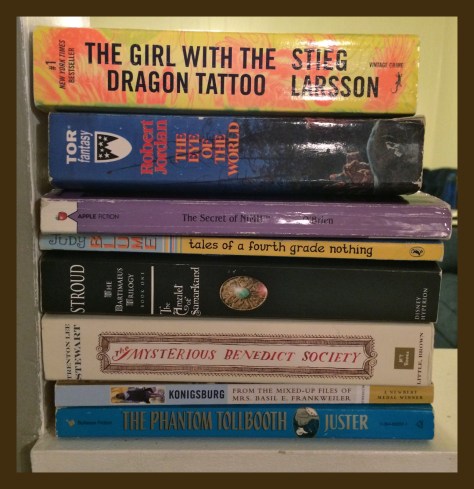
  11. The Phantom Tollbooth by Norton Juster
  12. Glass Sword (Red Queen #2) by Victoria Aveyard
  13. An Ember in the Ashes (An Ember in the Ashes #1) by Sabaa Tahir
  14. A Torch Against the Night (An Ember in the Ashes #2) by Sabaa Tahir
  15. Gone Girl by Gillian Flynn
  16. My Lady Jane by Cynthia Hand, Brodi Ashton, and Jodi Meadows
  17. Mrs. Frisby and the Rats of NIMH (Rats of NIMH #1) by Robert C. O’Brien
  18. The Lie Tree by Frances Hardinge
  19. Exit, Pursued by a Bear by E.K. Johnston
  20. Stone Fox by John Reynolds Gardiner
  21. I Survived the Joplin Tornado, 2011 (I Survived #12) by Lauren Tarshis
  22. From the Mixed-Up Files of Mrs. Basil E. Frankweiler by E.L. Konigsburg
  23. The Eye of the World (Wheel of Time #1) by Robert Jordan
  24. The Hammer of Thor (Magnus Chase and the Gods of Asgard Book II) by Rick Riordan
  25. The Lemonade War by Jacqueline Davies
  26. You Know Me Well by Nina LaCour and David Levithan
  27. Starflight (Starflight #1) by Melissa Landers
  28. D’Aulaires’ Book of Norse Myths by Ingri d’Aulaire
  29. The Hidden Oracle (The Trials of Apollo #1) by Rick Riordan
  30. Starfall (Starflight #2) by Melissa Landers
  31. Unaccustomed Earth by Jhumpa Lahiri
  32. This Savage Song (Monsters of Verity #1) by Victoria Schwab
  33. The Crown’s Game (The Crown’s Game #1) by Evelyn Skye
  34. The Mysterious Benedict Society by Trenton Lee Stewart
  35. Percy Jackson’s Greek Heroes by Rick Riordan
  36. The Dog Who Thought He Was Santa by Bill Wallace
  37. The Amulet of Samarkand (The Bartimaeus Trilogy Book I) by Jonathan Stroud
  38. The Darkest Corners by Kara Thomas
  39. Let It Snow by Maureen Johnson, John Green, and Lauren Myracle
  40. Red Rising by Pierce Brown

You may notice that many of the books I read are from series. Some are new series that I stumbled upon, and I just couldn’t help but buy the next book, which may be why I was set back a little at end of the year. Some of the books, to be honest, are already in my pile of books to pass on to someone else. I suppose it would be too good to be true to hope that every book I read is a winner. There are also quite a few titles that I would not have read if it weren’t for my 10-year-old wanting me to read with him. And as long as he wants me to, I will be glad to oblige.

Christmas Books 2017

Christmas Books!

Excepting the second and third books of the Red Rising series, this year’s list contains all new books for a change. One is not a novel (and yes, I do read non-fiction, although I don’t list it here unless it’s writing-related). Some books are parts of series that I started in 2017, so I can’t promise I won’t re-read those earlier books, but here’s hoping I can mostly stay on track. Included in this list is my latest pile of borrowed books from my media specialist cousin-in-law (pictured here from a post last summer). My Christmas books were also plentiful this year, as well. I received every one I wanted, plus a couple surprises.

So here is my 2018 book list (alpha by author):

  1. Mosquitoland by David Arnold
  2. Six of Crows (Six of Crows #1) by Leigh Bardugo
  3. The Diving Bell and the Butterfly by Jean-Dominique Bauby
  4. Passenger (Passenger #1) by Alexandra Bracken
  5. Golden Son (Red Rising Saga #2) by Pierce Brown
  6. Morning Star (Red Rising Saga #3) by Pierce Brown
  7. Iron Gold (Red Rising Saga #4) by Pierce Brown
  8. Ender’s Shadow (The Shadow Series #1) by Orson Scott Card
  9. Shadow of the Hegemon (The Shadow Series #2) by Orson Scott Card
  10. Shadow Puppets (The Shadow Series #3) by Orson Scott Card
  11. Shadow of the Giant (The Shadow Series #4) by Orson Scott Card
  12. Shadows in Flight (The Shadow Series #5) by Orson Scott Card
  13. The Reader (Sea of Ink and Gold #1) by Traci Chee
  14. Ready Player One by Ernest Cline
  15. The Circle by Dave Eggers
  16. Turtles All the Way Down by John Green
  17. Rebel of the Sands (Rebel of the Sands #1) by Alwyn Hamilton
  18. The Diabolic (The Diabolic #1) by S.J. Kincaid
  19. The Ugly Truth (Diary of a Wimpy Kid #5) by Jeff Kinney
  20. The Girl in the Spider’s Web (Millennium #4) by David Lagercrantz
  21. Nil (Nil #1) by Lynne Matson
  22. The Female of the Species by Mindy McGinnis
  23. A History of Glitter and Blood by Hannah Moskowitz
  24. The Dark Prophecy (The Trials of Apollo #2) by Rick Riordan
  25. The Ship of the Dead (Magnus Chase and the Gods of Asgard Book III) by Rick Riordan
  26. Carve the Mark (Carve the Mark #1) by Victoria Roth
  27. Fantastic Beasts and Where to Find Them: The Original Screenplay by J.K. Rowling
  28. The Hired Girl by Laura Amy Schlitz
  29. Our Dark Duet (Monsters of Verity #2) by Victoria Schwab
  30. The Crown’s Fate (The Crown’s Game #2) by Evelyn Skye
  31. A Reaper at the Gates (An Ember in the Ashes #3) by Sabaa Tahir

This is a shorter list than those of the past couple years because working full-time, year-round has decimated my free time, but I hope I’ll be able to stick to it and maybe have some room to intersperse some unplanned surprise titles.

I hope you’re inspired to read something you’ll fall in love with this year. Happy reading in 2018!


“Wow, You Really Like Books, Don’t You?”


New Stack of Books 2017

Books I can’t wait to read!

The title of this post is what my cousin said to me recently when I was at his house, returning a pile of books that his wife had lent me. And then because she has some sort of wicked sixth sense about her, she guessed that I might appreciate even more books, so she blessed me with another pile of loaner teen fiction. This is third such pile of books she’s let me borrow in the past couple years, and my cousin knows this, but I think this was the first time he was actually in the room while I eagerly accepted the books, all but bursting with delight to have my hands on more stuff to read.

If you know me, you know that I always have a book on hand. Nothing will stop me from reading. In fact, I finished one book and started another when I was in the delivery room, hours away from giving birth to my first baby. It’s a serious thing to me. (Some might call it a problem.) But I guess it’s different to witness me grabbing all the books I can get my hands on, a manic gleam in my eye, as if I’m on an episode of Oprah’s Favorite Things.

Now before anyone gets onto me for starting on a new pile of books before finishing what I set out to read at the beginning of the year, I will say that even though it’s killing me, I will read (or try my best to read) everything on my 2017 list before I get started on this latest stack of potential goodness. That’s not to say that I’ve been good and haven’t detoured at all. I have. The problem is that so many of the books from this year’s list are the first book of a series, and if I like a series, well… let’s just say that my bookshelf real estate is dwindling.

This could be a problem, having enough time to read everything I own. I was really worried when my position at work changed from teacher to admin support, which puts me in the office year-round. But I am not to be deterred. Maybe I’m not blogging as often, but I am reading and writing with as much gusto as ever.

It’s well past the halfway point of the year, so of the 34 books on my list, I should have read more than 17, correct? And I am happy to report that, despite getting sidetracked a few times, I’ve still crossed 23 off the list. (Check out the link to my Goodreads page in the sidebar for all the details.) If anything is going to sidetrack me from my list, it’s other books, not a lack of time to read them.

So bring them on! I need to have something to read in 2018, anyway. And please excuse me for cutting this post short; my current book is just getting to the good part.

Books, Books, and More Books!

2017-books-gifts

Christmas Books!

It’s that time of year again—Christmas has come and gone, and I’ve either received or purchased the books that I wanted to add to my library. Now I need to create a book list for 2017.

In 2016, I surpassed all of my expectations and read all 27 books that were on my list—and by September, no less—and even added 16 more. Here follows the complete list (in the order in which I read them):

  1. The Cuckoo’s Calling by Robert Galbraith (J.K. Rowling)
  2. The Silkworm by Robert Galbraith (J.K. Rowling)
  3. Harry Potter and the Half-Blood Prince by J.K. Rowling
  4. Career of Evil by Robert Galbraith (J.K. Rowling)
  5. The 5th Wave by Rick Yancey
  6. Harry Potter and the Deathly Hallows by J.K. Rowling
  7. The Infinite Sea by Rick Yancey
  8. Percy Jackson’s Greek Gods by Rick Riordan
  9. The Lightning Thief (Percy Jackson and the Olympians Book I) by Rick Riordan
  10. The Sea of Monsters (Percy Jackson and the Olympians Book II) by Rick Riordan
  11. And Another Thing… Douglas Adams’s Hitchhiker’s Guide to the Galaxy Part Six of Three by Eoin Colfer
  12. The Martian by Andy Weir
  13. Red Rising by Pierce Brown
  14. The Titan’s Curse (Percy Jackson and the Olympians Book III) by Rick Riordan
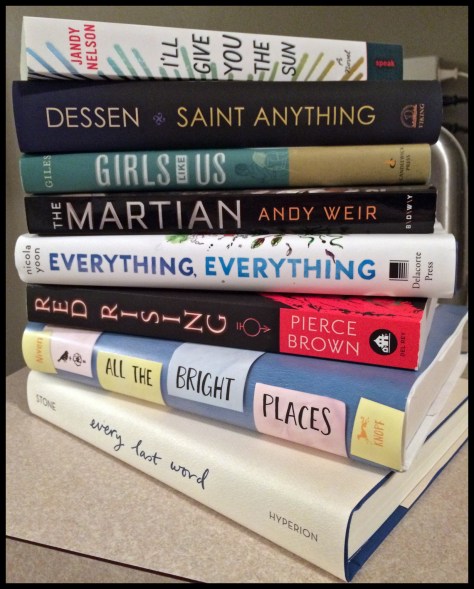
  15. Every Last Word by Tamara Ireland Stone
  16. Everything, Everything by Nicola Yoon
  17. Saint Anything by Sarah Dessen
  18. Girls Like Us by Gail Giles
  19. The Battle of the Labyrinth (Percy Jackson and the Olympians Book IV) by Rick Riordan
  20. I’ll Give You the Sun by Jandy Nelson
  21. All the Bright Places by Jennifer Niven
  22. Golden Son (Red Rising #2) by Pierce Brown
  23. The Last Olympian (Percy Jackson and the Olympians V) by Rick Riordan
  24. Morning Star (Red Rising #3) by Pierce Brown
  25. Girl in Pieces by Kathleen Glasgow
  26. Challenger Deep by Neal Shusterman
  27. The Revenant by Michael Punke
  28. Raven Queen by Pauline Francis
  29. Feed by M.T. Anderson
  30. NOS4A2 by Joe Hill
  31. Gooseberry Park by Cynthia Rylant
  32. The Sword of Summer (Magnus Chase and the Gods of Asgard #1)
  33. Diary of a Wimpy Kid by Jeff Kinney
  34. The Hobbit by J.R.R. Tolkien
  35. The Girl on the Train by Paula Hawkins
  36. Rodrick Rules (Diary of a Wimpy Kid #2) by Jeff Kinney
  37. Josefina Learns a Lesson: A School Story by Valerie Tripp
  38. Ender’s Game by Orson Scott Card
  39. How Tia Lola Came to (Visit) Stay by Julia Alvarez
  40. Speaker for the Dead (Ender’s Saga #2) by Orson Scott Card
  41. Chains by Laurie Halse Anderson
  42. Xenocide (Ender’s Saga #3) by Orson Scott Card
  43. The Last Straw (Diary of a Wimpy Kid #3) by Jeff Kinney

This doesn’t include any of the non-fiction titles I read this year or any shorter-than-novel-length books I read with my own children or at school. What it does include are quite a few titles that I read with my elder son (those would be the Harry Potter, Percy Jackson, and Diary of a Wimpy Kid series, plus Gooseberry Park). Since I love sharing novels with my kids, you can expect more of the same on this year’s list.

If you read my post “A Bookworm Without Any Books?” in September, you know that I was worried about what I would come up with to read in 2017 (not to mention the rest of 2016). I am glad to say that that is no longer a problem.

2017-books-ender

The Ender’s Game universe (what I have yet to read)

With no new books in my personal library, I went into a little-used cabinet where I store books that have been lent to me. Both my dad and my husband have read every book in Orson Scott Card’s Ender’s Game universe, and they’ve been bugging me to read them for a couple years. I tried to explain about the whole book list thing and how it’s hard to interrupt my already-planned reading for an entire series, so poor Ender’s Game collected dust. I finally had the chance to brush it off and read it, and it was a nice surprise to find that I liked the sequel even more. I am currently on the fourth book, Children of the Mind. When I finish the original series, I’ll set Ender aside for a while. As you can see from the picture, I could spend most of my year reading the Ender books alone, but if I finish all the books on my list early again, I can start tackling more of these titles.

2017-books-teen

Borrowed Teen Fiction

Aside from Ender, I borrowed another pile of teen fiction from my cousin-in-law, who is on the Florida Teens Read committee. The books she lent me last year were such a success that I can’t wait to sink my teeth into these. You may notice that two books on this year’s list, Holding Up the Universe and The Sun Is Also A Star, are written by authors from last year’s list. I love discovering new authors by accident or from friends’ recommendations. Many of the new additions to this year’s list fall in this category.

Some of the following books are ones I’m eager to re-read, plus many much-anticipated new titles (alphabetical by author):

  1. Red Queen by Victoria Aveyard
  2. Red Rising by Pierce Brown
  3. Golden Son (Red Rising #2) by Pierce Brown
  4. Morning Star (Red Rising #3) by Pierce Brown
  5. First Meetings in Ender’s Universe (Ender’s Saga #0.5) by Orson Scott Card
  6. A War of Gifts: An Ender Story (Ender’s Saga #1.1) by Orson Scott Card
  7. Ender in Exile (Ender’s Saga #1.2) by Orson Scott Card
  8. Children of the Mind (Ender’s Saga #4) by Orson Scott Card
  9. Don’t Get Caught by Kurt Dinan
  10. Gone Girl by Gillian Flynn
  11. My Lady Jane by Cynthia Hand, Brodi Ashton, and Jodi Meadows
  12. The Lie Tree by Frances Hardinge
  13. Let It Snow by Maureen Johnson, John Green, and Lauren Myracle
  14. Exit, Pursued by a Bear by E.K. Johnston
  15. The Eye of the World (Wheel of Time #1) by Robert Jordan
  16. The Phantom Tollbooth by Norton Juster
  17. Dog Days (Diary of a Wimpy Kid #4) by Jeff Kinney
  18. From the Mixed-Up Files of Mrs. Basil E. Frankweiler by E.L. Konigsburg
  19. Unaccustomed Earth by Jhumpa Lahiri
  20. You Know Me Well by Nina LaCour and David Levithan
  21. Starflight by Melissa Landers
  22. Holding Up the Universe by Jennifer Niven
  23. Mrs. Frisby and the Rats of NIMH (Rats of NIMH #1) by Robert C. O’Brien
  24. The Hammer of Thor (Magnus Chase and the Gods of Asgard Book II) by Rick Riordan
  25. The Hidden Oracle (The Trials of Apollo #1) by Rick Riordan
  26. Percy Jackson’s Greek Heroes by Rick Riordan
  27. This Savage Song (Monsters of Verity #1) by Victoria Schwab
  28. The Crown’s Game by Evelyn Skye
  29. Nimona by Noelle Stevenson
  30. The Mysterious Benedict Society by Trenton Lee Stewart
  31. The Amulet of Samarkand (The Bartimaeus Trilogy Book I) by Jonathan Stroud
  32. An Ember in the Ashes by Sabaa Tahir
  33. The Darkest Corners by Kara Thomas
  34. The Sun Is Also a Star by Nicola Yoon

The toughest thing about this list is choosing what to read next—my favorite kind of problem to solve.

A Bookworm Without Any Books?

Borrowed Books 2016

A few of the books I’ve read

For the first time since I’ve started publishing a list of fiction titles that I hope to read in a year, I’ve actually managed to read them all—and in under 10 months! I didn’t assign any less books this year than previously, and some were even of the long or slower-paced variety. I’ve even gone astray and read extra books that weren’t on my list. If you’re interested, check out my activity on Goodreads, or read the 2016 list by clicking here.

Although I feel oh-so accomplished, there is a problem: What’s a girl to read when she can choose any book in the world? I just so happened to buy several not-on-the-list books this year that I have yet to read, and they’ll tide me over for a while. But even so, I’m three months ahead of schedule, so what will I read in 2017?

The problem is always in the choosing. There are many books I would like to read or even re-read, but guidance is always welcome. So if you’ve read something that really moved you or that you think fits my profile (again, see Goodreads), please recommend away. The bookworm grows restless!

Fundraiser Books

More books to read and re-read

Face Time

FaceTime logo

There’s a good reason why Apple chose “FaceTime” as the name of their video-calling product. Unlike a regular old phone call, it allows people with the FaceTime app to chat face-to-face. It’s something my husband and I used recently when our kids were out of town. I’m so grateful for the benefits of modern technology, but I also have to be careful not to let those same benefits turn detrimental.

I fought getting a Smartphone for a long time. My husband had a Blackberry for a while, and no offense to Blackberry, but it was a piece of garbage. I know now that it was just an inferior model, but its rudimentary GPS that only worked when you didn’t need it and super-slow Internet search capabilities left me underwhelmed. Not to mention that I would rather stay in the stone age than learn how to use new technology. Update the operating system on my computer, and I get all ticked off that the icons look different. You’d think I’m more like an octogenarian than a millennial.

I did finally break down and get an iPhone. A longtime Apple user, I knew that it would be user-friendly and easy to learn, and I wasn’t disappointed. But I had heard about people becoming glued to their Smartphones, compulsively checking email in the middle of the night, over-stimulating their brains by browsing Facebook instead of reading a book before bed. I was afraid I would turn into a Smartphone zombie, and the games and apps available soon had me trapped. I was playing Words with Friends at stoplights and browsing shallow entertainment articles when I could have been doing just about anything else. To lure a bookworm away from her books is quite a feat.

There were other issues at play—I can’t place all the blame on my iPhone. When I purchased it, I had a months-old infant and was mired in the depths of postpartum depression. It was easier to engage in mindless pursuits and live on autopilot than try to do… anything. Fortunately, the depression was temporary, and once I was myself again, I realized what was going on: I had allowed myself to be seduced by technology.

I deleted all the games I’d downloaded, and I moved the ones that I couldn’t delete off my home screen. I started to read again. I came out of my funk and remembered that I liked to write and edit and decided to try my hand at making some money on the side.

Thus began my transition from pro bono editor to freelance writer. I once again let technology take over. While I wasn’t necessarily playing games, I was writing articles when I should have been a mom. My wake up call came in the form of my elder son telling me that I wasn’t always very fun. I knew I had to make some changes, and you can read about them in my Work-At-Home Covenant post.

But working at home is just a part of it. Parents who work 40-plus hours a week outside of the home are just as susceptible to the likes of Candy Crush and Pokémon Go (or so I’ve heard—I engage in neither). I’ve set a few rules for myself. I don’t use my phone at all after I’ve gone to bed, unless responding to an emergency text in the middle of the night. I used to check emails if I awoke in the night, only to wake myself up so completely that I couldn’t get back to sleep. Also, after recently reading an article (written by a non-millennial) about how young people are unable to start their day without technology, I decided to buck that trend by starting my days with at least five minutes of contemplation. Sometimes this means that I fall back asleep (oh, well), but I usually spend it thinking about the people in my life who are going through tough times. If I tell you I’m keeping you in my thoughts and prayers, that’s not an idle promise—I’m doing it every morning.

So I’ve insulated myself when I need to sleep and when I wake—what about the rest of the day? Such as when I’m being a wife and mom?

It just so happens that when I was watching the news this morning, the resident “expert” seemed to be talking directly to me. The story was all about how harmful it is for parents to be on their phones when they’re around their children. It could be texting, spending time on social media, reading the news, or checking emails—it doesn’t matter what the parents are doing so much as what the children are seeing. They’re seeing that their parents are engaged with technology rather than the family.

The news story made me rethink my own use of technology, how I will sometimes read a stupid article with a catchy headline, which is followed by something like, “Readers who liked this also liked 50 Hairstyles You Don’t Care About and That Will Steal 10 More Minutes from Your Life!” I didn’t buy an iPhone to read vapid tripe like this. I use the camera feature when my kids are doing something cute; I use the alarm to keep to my schedule; I access dictionary apps when I need to look up a word—but the email and social media and all the rest is like so much icing, pleasant in moderation but sickening if I overindulge.

Many parents, conscious of the overstimulation of so much technology, limit the amount of time their kids watch TV, play video games, and spend on their phones doing who knows what. I do the same. So this morning, when my elder son asked if he could watch TV and I said, “No,” he pulled out the iPad. “That’s the same thing—you’re still watching a show,” I told him.

You’re using technology,” he said.

I was. I had my laptop open, ready to write this post. Touché, little man.

I closed the laptop and pulled out my novel. I helped my four-year-old cut some shapes that his brother had traced for him. And long after I’d planned to let my son turn the TV on again, he was still sitting on the couch, looking at one of my old scrapbooks.

It’s not all about technology, but rather about being present. Technology just happens to be the biggest culprit. So the next time you pull out your Smartphone or tablet or sit in front of the computer, take stock of why you’re doing what you’re doing. Is it useful? Can you do it later? When was the last time you played a board game with your kids or sat at the table as a family, all phones switched off? Do you remember when you last had actual face time?

Read. These. Books.

It’s already July – that time of year when I look at the book list that I created on January first to assess how well I’m keeping up. This year, I am pleased to say that, of the 27 novels I hoped to read, I’ve already read 22. I hope I’m not speaking too soon when I say that 2016 may be the year I’ll finally read every book.

Of the books I’ve finished, I would like to highlight the multitude of teen fiction titles that I’ve recently read.

Florida Teen Reads books

Read these books!

I mentioned in my book list post that my cousin’s wife is on the Florida Teen Reads committee. Last fall, she gave me a pile of the books she’d read for the committee, assuring me that there was a little bit of everything: sci-fi, romance, mental illness – you name it. I was excited to add them to this year’s list.

As always seems to happen, I read a few books from my list, and then I deviated some – that’s life, right? By May, I’d only read one of teen books I’d borrowed, but a message from my cousin-in-law gave me the little kick I needed to keep going. She would need to get two of the books back by the fall because they’re Florida Teen Reads finalists. I read both titles back-to-back – Every Last Word by Tamara Ireland Stone and Everything, Everything by Nicola Yoon. It was apparent why these books were finalists, and since I was on a roll, I continued reading the other FTR books, too.

Some of these books shine brighter than others. Knowing his taste, I had my husband read some of them and not others. One I had to twist his arm to finish, and he was glad he did. Another was the first book of a series, and Thomas liked it so much that he bought the whole trilogy – we both read them all.

Girl in PiecesIn the middle of reading all this teen fiction, I received an interesting opportunity: to read and review a teen fiction novel that hasn’t been published yet. While I’ve read books prior to publication before, it’s usually because I’m editing them, and that’s a completely different experience than being able to read a book to enjoy it. In this case, “enjoy” is a little too tame a description – I devoured Kathleen Glasgow’s Girl in Pieces in two days. (Read my review on Goodreads, and purchase it this fall.)

Before you say, “I’m not a teenager – why would I read any of these?”, let me assure you that teen fiction is not just for those in the 13 to 19 demographic. When I was in college, I took a class on young adult lit, and it was a rather recent genre classification at the time (in fact, much of what we read had previously been grouped with children’s lit). Books that fall into the YA genre star characters who live the issues that real young adults face. Okay, yes, sometimes the teens in these books are being chased by dragons, but they’re still coming of age and having all the issues that that entails.

Parents may find some YA issues uncomfortable, such as substance abuse, suicide, sexuality, and mental illness. Guess what? These are tough issues, but we can’t just put our heads in the sand and pretend they’re not there. When I read about a girl who hung with the cool crowd at school while keeping her OCD hidden from her best friends, I was glad that such a book was out there. It’s normal to read about the underdog succeeding – and I love those books, too – but to read about a cool girl with issues? Well, isn’t that life?

Today’s teenagers can only be sheltered so much. As a parent, I understand being protective, but I also would rather supervise my child’s exposure to these issues by handing him a book and then talking about it than praying that that kind of thing never happens. Who knows? My kids may have friends who face these issues one day – and many of these books list resources that provide support and help. Even within a fictional (and sometimes fantastical) setting, teens are capable of applying what they read to real life.

Read these books! Then share them with a teenager you care about.

Camp NaNoWriMo April 2016 Recap

Camp NaNoWriMo Apr 2016 Winner

I will have to say, compared to NaNoWriMo 2015, Camp NaNoWriMo in April was a cakewalk. Of course, part of that might be that you get to choose your word count goal. The minimum is 10,000, and although I was tempted to let that be it, I decided to do double. Twenty thousand words is nothing compared to the 50,000 in November, but after the struggle to finish the first draft of my 2015 novel, I wanted to take it easy (comparatively).

What I love about both NaNoWriMo and Camp NaNoWriMo is that you can update your word count every day, and then they create a graph to show how well (or poorly) you’re doing. This can be depressing if you’re coming in under. Considering that I didn’t even sign up for Camp NaNoWriMo until April 4th, my graph looked pretty pathetic at first. A bunch of nothing until day four, and then it was just a tiny little line. My total word count on the first day? Thirty-three words. But I’m happy to say that the line started to creep up, day by day. Being able to view my progress on that graph was encouraging.

The project I picked for Camp NaNoWriMo was a novel that I started in December (unexpectedly inspired to write by some good teen fiction). While concentrating on finishing the NaNoWriMo novel, I put this other one on the back burner, and when I signed up for Camp NaNoWriMo, I had to read through all 20,000 words of what I’d written so far to figure out what to write next. During that read-through, I ended up cutting some (yes, a big NaNoWriMo no-no) and adding more, for a net gain of 33.

Another fun thing about both of these websites is that they calculate, based on your current rate of words per day, how long it will take to finish. I was supposed to write 20,000 words by the end of April, but for the first week or so, the calculation had me finishing in September. Yeesh. But as the days passed and the number of words I wrote per day went up, the gap closed. I would hit 20,000 by August, then July. Finally, I was on target to finish during the month of April. Typing like crazy, I hit my goal on the 20th.

As of April 30th, I had typed almost 31,000 words during Camp NaNoWriMo. The story still isn’t complete (it never is after just one month), but it’s a lot closer than it was a few weeks ago. Rather than interrupting it to edit my NaNoWriMo 2013, 2014, and 2015 books (because they’re a trilogy and need a lot of work), I’m going to keep going until I finish this one. It might be a long summer (with one more Camp NaNoWriMo opportunity in July), but I’m going to enjoy the process.

And if you’re a regular reader, you know that a big part of that process is reading. Right now I am devouring and being inspired by a lot of great teen fiction. But that’s a topic for another post.

Borrowed Books 2016

Stack of incredible teen books (and The Martian – also incredible)

This Week in the News…

It has been quite the newsworthy week, both for the good and bad, locally and internationally.

At the start of the week, it was the tragedy of David Bowie’s death, and later, it was Alan Rickman’s. I’ll say that while Bowie’s was a shock, Alan Rickman’s came as a blow. And it’s not even like I knew him. Tragically, another acclaimed actor, who seemed to be a good person in real life, met an untimely end. But I’ve always had this thing about Alan Rickman, ever since he played the despicable Sheriff of Nottingham in Robin Hood Prince of Thieves. Maybe it’s because, as young a girl, I didn’t know to distinguish the actor from the character, so for years, I associated Alan Rickman with evil. It was only much later that I discovered that he was much more than the characters he portrayed. I admired him for so often choosing roles that were dark, challenging, even hated. Someone has to be very comfortable in his own skin to be able to sustain a career as such.

But getting back to the news…

Aside from additional tragic local news, there was also the national hoopla surrounding the billion-and-a-half-dollar Powerball. I’d never paid any attention to any sort of lottery before, but this one had the attention of even the most stringent non-gamblers (even if it was only to scoff). It’s hard not to wonder what it would be like to wake up one day as a billionaire. Some co-workers and I joked that we would happily “settle” for the lucky million-dollar ticket. Even after taking out taxes, that kind of money would make an incredible amount of difference in my life. And even big celebrities like Queen Latifa and David Duchovny said they were participating.

But what about people like David Bowie and Alan Rickman, who had a lot more than I’ll ever, even if not billions? Would that kind of money have made a difference to them? I’m thinking not. I’m thinking that they could already afford the best health care money could buy, yet they still both succumbed to the dreaded C-word.

While many people speculated about what they could do with that kind of money – from retiring at the tender age of 19 to buying houses in all the posh resorts around the world – I thought that I love my job and would hate to have to quit because of the sudden notoriety that being a big winner brings. If, somehow, I ever managed to get any kind of windfall that would allow me to do whatever I pleased (financially) for the rest of my life, I would want to hide it, so I could still do exactly what I’m doing right now.

I’m a pretty low maintenance girl. I don’t need fancy houses or luxury cars – although, I would like a cool reading nook or even library in my dream house. I wouldn’t spend the money on jewels or designer clothes because I’d rather wear yoga pants and a sweatshirt than anything else. It’d be nice to be able to live completely debt-free and know that my kids will always be taken care of. But money won’t cure my elder son’s dyslexia or my younger son’s whatever-he-has.

About the only changes I would make would be to buy a house closer to where I work, hire a cleaning lady once a week, and make my husband retire and become my personal chef. (He’s a good cook – no need to hire outside help.)

As for the rest – buying a new car with cash when the old one craps out or taking vacations on a whim just because we can or filling my library with all the books I could ever want – while that would be nice, there’s something to be said for earning it. Recently, we paid off a  car and finally bought a new one that has all the features we ever could have wanted but couldn’t afford until recently. And there’s something so fulfilling about knowing that we’re finally to that point – that we’ve made it ourselves.

And, hey, there’s still that very slim chance that I’ll make a comfortable living as a novelist. The odds are better than of winning the Powerball, at least.

And say that does happen – say that, someday, the world mourns my death like they’re mourning Alan Rickman’s – I’ll still want to live the quiet life. I’ll still want to sit on my couch or reading nook and be left alone to read a good book. Or read one of my favorites with my children or future grandchildren. I’ll still be enthusiastic about hosting book clubs. Because that’s who I am, and no amount of money (or lack of it) will change that.

And just because, I would like to end with a beautiful, very human quote of Alan Rickman’s. I think that anyone can appreciate it, but only true Potter fans will really get it. Alan Rickman certainly did.

Alan Rickman quote

Parental Pressure

Embed from Getty Images

This past week, I was fortunate to be trained to give an assessment, the Gesell Developmental Observation-Revised. My school administers it to all PreK3 students and any applicants for PreK4 and kindergarten. Although I may not ever be the examiner, I will need to know how to interpret this assessment’s results and share them with parents.

During the Gesell Institute‘s training, I realized that the information I gained about child development is crucial – not just for teachers, but for parents, as well. After being a mother for nearly eight years and being in the classroom almost three, I’ve figured out a lot of things, but some facts came as quite a surprise.

For instance, did you know you can do your child a disservice by teaching her to read too early? And the reason isn’t what you might initially think. Like everyone, I’ve been told that young brains are sponges, and this is absolutely true. But young bodies are still developing, and while a child’s brain might get that A is A and B is B, his eye muscles aren’t able to track from left to right (which we Westerners do when we read) until, on average, age five-and-a-half. In fact, you can usually tell a child who has learned to read too early because he turns his whole head in order to read across the page.

I can already hear outraged parents saying that their children learned to read on their own or that reading is a wonderful thing – we should promote it in any way possible. Number one, I know it’s possible that some kids just figure it out – my younger son certainly did, surprising us when he started reading the letters off my husband’s shirt a few months ago. It was not something we’d taught him at all. Number two, I absolutely agree that reading is wonderful and should be encouraged.

But could it also be possible that, underlying the desire to do what’s right for our kids by stimulating their little intellects and filling their minds with lots of valuable information, there’s something else at play here? Something a little selfish that you don’t want to admit?

I’m talking about peer pressure morphed into parental pressure. Peer pressure is an ugly thing when you’re thirteen, and your best friend makes a stupid decision and wants you along for the ride. It can either make you also do said stupid thing, or it can ostracize you from that friend when you say no. Either way, no fun, right?

But it doesn’t end when your zits disappear and your braces come off. It continues in fraternities and sororities, in the work place and across your neighbor’s fence. It’s the whole “keeping up with the Joneses” mess, which can turn expensive if you’re susceptible to it. It can wreck marriages or throw a kink into what you thought was a lifelong friendship.

And if you’re a parent, you can drag your innocent children into it. You have the best of intentions, but you’re actually doing damage to the precious people that you love so dearly.

I’m not saying that I’m immune. Far from it. When my son Peter was a toddler, I was talking to a mom whose child was a little older. This other child knew the entire alphabet and most of the sounds the letters made. While impressed, I also felt guilty. My son could sort of sing the alphabet, but that was the extent of it. Knowing little about early education at the time, I thought that I was remiss as a parent because my own child’s brain wasn’t brimming with this knowledge. So I came up with a brilliant plan.

Peter had a cute, wooden train, each car holding a different letter. I decided that every time he mastered a new letter, I would put the next car on. He loved trains. It would be a fun reward for him. We never got past B. I tried computer games, but the only ones he liked had nothing to do with letters. I was frustrated when nothing seemed to work, and I assumed that there was something wrong with how I was trying to teach him. But there was hope: in preschool, the problem would be solved because he would be with a person who was qualified to teach him.

Except letters didn’t come any easier in preschool. By the end of his first year, he could almost always tell you how to spell his name (and when he couldn’t, it was because he mixed up the order of the middle letters), and sometimes he could even recognize those four letters when they weren’t in his name. Otherwise, he knew the letter O.

Although it took until he was almost seven to get the formal diagnosis, we now know that Peter is dyslexic. When he couldn’t learn his letters, it wasn’t his fault, wasn’t my fault, and wasn’t his teacher’s fault. I could have saved myself a lot of frustration if I hadn’t tried to push him to do something at an age that was young for a normal child, not to mention unachievable for a dyslexic.

And reading isn’t the only place this happens.

Moms of babies, how often do you compare milestones with friends?

My child is seven months old and pulling up, but poor Susan – her baby is eight months old and hasn’t even crawled yet.

It’s hard not to feel that pride when your child does something that you think is Facebook status-worthy. I was thrilled that both of my boys walked at ten months, and I wasn’t shy about spreading the news. But that didn’t stop my elder son from having dyslexia. It didn’t teach my younger son how to behave.

One excellent resource that the Gesell Institute puts out is a booklet entitled “Ready or Not: Is My Child Ready for Kindergarten?” It points out that while the average child is able to walk at twelve months, the normal range is anywhere from eight-and-three-quarters to seventeen months. By two, all normal children can walk. Where is the relevance of my ten-month walkers now, when they’re seven and three?

Just as you don’t expect your newborn to get up and walk, you shouldn’t have ridiculous expectations for your child when it comes to reading. That’s not to say that exposure to words is bad or that certain children won’t start reading spontaneously. But it does mean that when it comes time to fill out college applications, the child who was seated in front of an encyclopedia at age two won’t have the upper hand over a child who learned to read in kindergarten.

So what are we parents to do? Are we not supposed to be proud of our children? Are we not supposed to encourage them when they show potential? A dad sees his four-year-old son chuck an acorn at a tree, and Dad immediately signs the kid up for the t-ball team (where he has just as much trouble tracking the ball flying toward him as he does reading without turning his head). A mom hears her two-year-old daughter singing along with the radio and starts looking for private music instruction.

Sometimes wonderful things happen. Star baseball players are discovered. Young musical prodigies attend Julliard and become famous concert pianists.

But sometimes Bobby complains that he doesn’t like t-ball, and then what do you do? It seems that parents are either reluctant to let him quit, thinking that he’ll get there one day if they keep pushing him, or they’re quick to involve him in another sport or activity because he’s got to be brilliant at something, right?

Maybe – and I know that I’m really going out on a limb here – maybe children need to be children. Maybe they are brilliant, yes, but that in no way means that they’ll miss their true calling unless they’re turned into little professionals right now. When they’re one or three or five or even ten, their true calling is to be a child. It’s to run around outside and catch lizards. Or to learn to ride a bike and even scrape their knees in the process. Or to have weekends that aren’t packed with activities, where they can bake cookies with their moms, help their dads wash the cars. Where the whole family can sit around and read a book together.

Through play, believe it or not, children learn. Play is their work. Putting puzzles together is a pre-cursor to reading. Building with large blocks can help them with math. Smooshing clay into pancakes or working it into balls with their little fingers develops fine muscles. Finger painting encourages hand-eye coordination, and cutting scrap paper with a pair of safety scissors teaches organization. (And I know, as a pre-school teacher, I might sound like I’m bashing my own job, but it’s nurturing and guided play that happens all day long with us.)

And reading… This one has a special place in my heart. Reading lessens discipline and self-esteem problems. It keeps kids in school, keeps them out of trouble (of course, good parenting is a big contributor, too, but then good parents often read to their children).

Since I’m such a big proponent of reading yet am getting onto parents for pressuring their kids to learn to read too early, what’s the solution? Read to your kids, of course. And not just moms – dads should be involved, too. Most nights, my husband reads a book like Goodnight Moon or Brown Bear, Brown Bear to our younger son, and I read a chapter book with our elder son. Right now, that chapter book happens to be Harry Potter and the Philosopher’s Stone, but at other times, it’s something easier, like Magic Tree House, that Peter can read to me.

Parents, quit pressuring your kids to be little adults. Quit expecting your schools to turn out mini physicists and doctors and poets by age four. And quit the boastful comparisons with other parents.

I don’t mean for everyone to immediately pull their kids from all ballet and music lessons, all gymnastics classes and tutoring sessions. As ever, you have to find the balance that’s right for your family. But that balance needs to include time to breathe, time to make a pile of leaves and jump on it, time to say yes to a trip to the park because you have plenty of time and aren’t stressed out about your packed schedule.

And when they’re tired and ready to rest, sit together and read a good book.

In closing, I’ll leave you with a list because, why not? Lists are cool. I wish I could take credit for it, but I’ll give credit where it’s due: my trainer from Gesell passed it out to everyone in our workshop, and I’m passing it on to you.

10 Reasons to Read to Your Child

  1. Because when you hold children and give them this attention, they know you love them.
  2. Because reading to children will encourage them to become readers.
  3. Because children’s books today are so good that they are fun even for adults.
  4. Because children’s books’ illustrations often rank with the best, giving children a life-long feeling for good art.
  5. Because books are one way of passing on your moral values to children. Readers know how to put themselves in others’ shoes.
  6. Because until they learn to read for themselves, they will think you are magic.
  7. Because every teacher and librarian they encounter will thank you.
  8. Because it’s nostalgic.
  9. Because for that short space of time, they will stay clean and quiet.
  10. Because, if you do, they may then let you read in peace.

And I’ll add my own #11: Because when the time is right (and it will be), they will read to you.

Summer 2015 Reading

Magical books

Magical books (Photo credit: Wikipedia)

My last blog was all about the writing I’ve done this summer (and since then, I’ve achieved my Camp NaNoWriMo goal – yay!), but as any worthwhile author will tell you, you can’t write if you’re not reading. So I’ve been doing what a good writer should do, naturally.

The reading list that I set for myself this year is an ambitious one. (Read it here.) On it are 27 books, including several series. Christopher Paolini’s The Inheritance Cycle has been on my to-read list for three years now, and I finally finished it. But those books are dense and ate up a lot of my reading time. As I approached the halfway point through the year, I wondered how I was doing.

I’m happy to report that as of mid-July, I’ve finished 13 of the 27 books. Maybe Inheritance didn’t set me back too far, after all. Of course, I read a lot during our two-week vacation. I worried I was being overly ambitious when I packed the entire Divergent series, as well as a book that a friend lent to me a few months ago. But I read the whole borrowed book on the plane trip from east coast to west coast (Talk to the Hand by Lynne Truss – I highly recommend it, particularly if you’re a fan of British humor), and I plowed through all but a couple hundred pages of the Divergent series over the two weeks.

Ahead of me, I still have at least one doozy (Diana Gabaldon’s Written in My Heart’s Own Blood – all of the books in her Outlander series are formidable), plus Suzanne Collins’s The Hunger Games series. I know I re-read it last year, but I want it to be fresh when the final movie comes out this fall. Also, I’ll start reading Harry Potter and the Philosopher’s Stone to my seven-year-old in the next week. I’m excited that he’s finally old enough to comprehend the story – we may have another Potter geek in the making.

Other than my non-fiction books (which I rarely list here, unless it’s what I consider entertaining non-fiction, such as Talk to the Hand), I’ve stuck to my book list pretty well. Early on, I decided to read Daniel Woodrell’s Winter’s Bone because I’d seen the movie and was interested in seeing what kind of extra character developments happened in the book. I’m glad I did. Woodrell’s use of language is unique, and as a writer, it’s always helpful to mix it up with a different style from time to time.

The only other detour I’ve made was Lisa Genova’s Still Alice (also a book-turned-movie). This was a book I had to read. I’m going back to teach full-time in the fall, and the faculty at my school has a summer reading list. Still Alice was the only novel on our list of choices. I’ve jotted down the titles of several non-fiction books that interest me, but I wanted a good story – and I got it. But frequent criers, keep your tissues handy.

I’m sticking to my list and loving it. I hope to finish Lois Lowry’s The Giver series by the time the kids go back to school (I’m halfway through the second book, Gathering Blue), and then I’ll keep plowing ahead.

And never fear – if I actually make it through this whole list, I already have several new books waiting. (She rubs her hands together and cackles with glee.)