Face Time

FaceTime logo

There’s a good reason why Apple chose “FaceTime” as the name of their video-calling product. Unlike a regular old phone call, it allows people with the FaceTime app to chat face-to-face. It’s something my husband and I used recently when our kids were out of town. I’m so grateful for the benefits of modern technology, but I also have to be careful not to let those same benefits turn detrimental.

I fought getting a Smartphone for a long time. My husband had a Blackberry for a while, and no offense to Blackberry, but it was a piece of garbage. I know now that it was just an inferior model, but its rudimentary GPS that only worked when you didn’t need it and super-slow Internet search capabilities left me underwhelmed. Not to mention that I would rather stay in the stone age than learn how to use new technology. Update the operating system on my computer, and I get all ticked off that the icons look different. You’d think I’m more like an octogenarian than a millennial.

I did finally break down and get an iPhone. A longtime Apple user, I knew that it would be user-friendly and easy to learn, and I wasn’t disappointed. But I had heard about people becoming glued to their Smartphones, compulsively checking email in the middle of the night, over-stimulating their brains by browsing Facebook instead of reading a book before bed. I was afraid I would turn into a Smartphone zombie, and the games and apps available soon had me trapped. I was playing Words with Friends at stoplights and browsing shallow entertainment articles when I could have been doing just about anything else. To lure a bookworm away from her books is quite a feat.

There were other issues at play—I can’t place all the blame on my iPhone. When I purchased it, I had a months-old infant and was mired in the depths of postpartum depression. It was easier to engage in mindless pursuits and live on autopilot than try to do… anything. Fortunately, the depression was temporary, and once I was myself again, I realized what was going on: I had allowed myself to be seduced by technology.

I deleted all the games I’d downloaded, and I moved the ones that I couldn’t delete off my home screen. I started to read again. I came out of my funk and remembered that I liked to write and edit and decided to try my hand at making some money on the side.

Thus began my transition from pro bono editor to freelance writer. I once again let technology take over. While I wasn’t necessarily playing games, I was writing articles when I should have been a mom. My wake up call came in the form of my elder son telling me that I wasn’t always very fun. I knew I had to make some changes, and you can read about them in my Work-At-Home Covenant post.

But working at home is just a part of it. Parents who work 40-plus hours a week outside of the home are just as susceptible to the likes of Candy Crush and Pokémon Go (or so I’ve heard—I engage in neither). I’ve set a few rules for myself. I don’t use my phone at all after I’ve gone to bed, unless responding to an emergency text in the middle of the night. I used to check emails if I awoke in the night, only to wake myself up so completely that I couldn’t get back to sleep. Also, after recently reading an article (written by a non-millennial) about how young people are unable to start their day without technology, I decided to buck that trend by starting my days with at least five minutes of contemplation. Sometimes this means that I fall back asleep (oh, well), but I usually spend it thinking about the people in my life who are going through tough times. If I tell you I’m keeping you in my thoughts and prayers, that’s not an idle promise—I’m doing it every morning.

So I’ve insulated myself when I need to sleep and when I wake—what about the rest of the day? Such as when I’m being a wife and mom?

It just so happens that when I was watching the news this morning, the resident “expert” seemed to be talking directly to me. The story was all about how harmful it is for parents to be on their phones when they’re around their children. It could be texting, spending time on social media, reading the news, or checking emails—it doesn’t matter what the parents are doing so much as what the children are seeing. They’re seeing that their parents are engaged with technology rather than the family.

The news story made me rethink my own use of technology, how I will sometimes read a stupid article with a catchy headline, which is followed by something like, “Readers who liked this also liked 50 Hairstyles You Don’t Care About and That Will Steal 10 More Minutes from Your Life!” I didn’t buy an iPhone to read vapid tripe like this. I use the camera feature when my kids are doing something cute; I use the alarm to keep to my schedule; I access dictionary apps when I need to look up a word—but the email and social media and all the rest is like so much icing, pleasant in moderation but sickening if I overindulge.

Many parents, conscious of the overstimulation of so much technology, limit the amount of time their kids watch TV, play video games, and spend on their phones doing who knows what. I do the same. So this morning, when my elder son asked if he could watch TV and I said, “No,” he pulled out the iPad. “That’s the same thing—you’re still watching a show,” I told him.

You’re using technology,” he said.

I was. I had my laptop open, ready to write this post. Touché, little man.

I closed the laptop and pulled out my novel. I helped my four-year-old cut some shapes that his brother had traced for him. And long after I’d planned to let my son turn the TV on again, he was still sitting on the couch, looking at one of my old scrapbooks.

It’s not all about technology, but rather about being present. Technology just happens to be the biggest culprit. So the next time you pull out your Smartphone or tablet or sit in front of the computer, take stock of why you’re doing what you’re doing. Is it useful? Can you do it later? When was the last time you played a board game with your kids or sat at the table as a family, all phones switched off? Do you remember when you last had actual face time?
Why Not Sign Up for Camp NaNoWriMo?

Fiction Fix Typewriter

For those who may be learning about Camp NaNoWriMo for the first time, it’s offered twice a year – the months of April and July – as a kind of warm up for the biggie, National Novel Writing Month (NaNoWriMo), in November.

Last year, I finished editing my previous NaNoWriMo novel at the end of June and signed up for Camp NaNoWriMo in July to work on an old, unfinished manuscript. This past April, I signed up again to work on a different novel that I’d started in December.

So why am I writing this when it’s almost halfway through July? To be honest, I almost gave up on the idea of participating this time. No, I haven’t finished the novel I worked on in April (although I did achieve the word count goal I set for myself). What happened is that I came up against a writer’s roadblock that I’ve written about numerous times: the mid-novel slump.

There is little more frustrating for a writer than knowing how your novel will end but then getting lost on the way. It reminds me of the family vacation we recently took, in which my GPS simply wouldn’t believe that our destination was on Sugarloaf Road. It was glad to take us to an empty field on Sugarloaf Mountain Road. While it’s a little misadventure we can laugh about now (and others who have been mislead by GPS can commiserate), at the time, it was aggravating because we knew where we wanted to be, just not how to get there.

Of course, with my novel, I can’t blame GPS. I was cruising along just fine and decided on the perfect twist to give my story more tension. The only problem was that I wrote myself into a hole in which I couldn’t write myself out.

Not knowing what else to do, I committed a big no-no: I went back to the beginning and started editing. Although it’s cost me a lot of time, I’m glad that I did. I’d written quite a few things that I’d forgotten, so I took notes along the way. I also trimmed a lot of extraneous words. And as I went, I realized what I would have to do when I got to that problematic scene that had effectively stopped my forward momentum: I would have to cut it.

There’s still tension, just not nearly as much. Although my scene isn’t the shocker that I originally planned, it’s no longer stalling the manuscript. It meant cutting 20 pages out that I spent days writing, but sometimes that’s what you have to do. I’m just glad that I’m moving forward again.

So now that I know what I’m doing, even though it’s 13 days in, I’m signing up for Camp NaNoWriMo. I am giving myself a low word count goal (12,000 words) because I hope that’s all it takes to finish this novel. Knowing my propensity for verboseness, it’ll likely be longer, but that’s okay. It’s often the scenic route that is most memorable.


Read. These. Books.

It’s already July – that time of year when I look at the book list that I created on January first to assess how well I’m keeping up. This year, I am pleased to say that, of the 27 novels I hoped to read, I’ve already read 22. I hope I’m not speaking too soon when I say that 2016 may be the year I’ll finally read every book.

Of the books I’ve finished, I would like to highlight the multitude of teen fiction titles that I’ve recently read.

Florida Teen Reads books

Read these books!

I mentioned in my book list post that my cousin’s wife is on the Florida Teen Reads committee. Last fall, she gave me a pile of the books she’d read for the committee, assuring me that there was a little bit of everything: sci-fi, romance, mental illness – you name it. I was excited to add them to this year’s list.

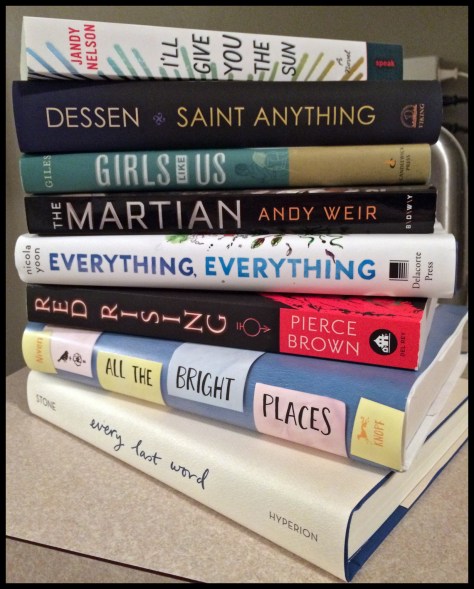
As always seems to happen, I read a few books from my list, and then I deviated some – that’s life, right? By May, I’d only read one of teen books I’d borrowed, but a message from my cousin-in-law gave me the little kick I needed to keep going. She would need to get two of the books back by the fall because they’re Florida Teen Reads finalists. I read both titles back-to-back – Every Last Word by Tamara Ireland Stone and Everything, Everything by Nicola Yoon. It was apparent why these books were finalists, and since I was on a roll, I continued reading the other FTR books, too.

Some of these books shine brighter than others. Knowing his taste, I had my husband read some of them and not others. One I had to twist his arm to finish, and he was glad he did. Another was the first book of a series, and Thomas liked it so much that he bought the whole trilogy – we both read them all.

Girl in PiecesIn the middle of reading all this teen fiction, I received an interesting opportunity: to read and review a teen fiction novel that hasn’t been published yet. While I’ve read books prior to publication before, it’s usually because I’m editing them, and that’s a completely different experience than being able to read a book to enjoy it. In this case, “enjoy” is a little too tame a description – I devoured Kathleen Glasgow’s Girl in Pieces in two days. (Read my review on Goodreads, and purchase it this fall.)
Before you say, “I’m not a teenager – why would I read any of these?”, let me assure you that teen fiction is not just for those in the 13 to 19 demographic. When I was in college, I took a class on young adult lit, and it was a rather recent genre classification at the time (in fact, much of what we read had previously been grouped with children’s lit). Books that fall into the YA genre star characters who live the issues that real young adults face. Okay, yes, sometimes the teens in these books are being chased by dragons, but they’re still coming of age and having all the issues that that entails.

Parents may find some YA issues uncomfortable, such as substance abuse, suicide, sexuality, and mental illness. Guess what? These are tough issues, but we can’t just put our heads in the sand and pretend they’re not there. When I read about a girl who hung with the cool crowd at school while keeping her OCD hidden from her best friends, I was glad that such a book was out there. It’s normal to read about the underdog succeeding – and I love those books, too – but to read about a cool girl with issues? Well, isn’t that life?

Today’s teenagers can only be sheltered so much. As a parent, I understand being protective, but I also would rather supervise my child’s exposure to these issues by handing him a book and then talking about it than praying that that kind of thing never happens. Who knows? My kids may have friends who face these issues one day – and many of these books list resources that provide support and help. Even within a fictional (and sometimes fantastical) setting, teens are capable of applying what they read to real life.

Read these books! Then share them with a teenager you care about.

Creation Station Summer

So the school year is over at the Cotchaleovitch residence, and it is time to sleep until 9:00 every morning, let the kids binge watch TV while I kick back with a book, and only change out of pajamas and emerge into the real world when we’re down to our last Capri Sun. Once we’ve recovered a little, we’ll consider a vacation.

Well, not quite. But by the last day of school, I was feeling pretty elated that we’d all made it. There were a lot of firsts in the 2015-16 school year: it was my first year teaching full-time; it was Ian’s first year in school; and it was Peter’s first year with an in-school reading resource for dyslexic kids, which meant I didn’t have to run him to a tutor twice a week.

We were on the home stretch. Other teachers commiserated with me when I noted that my students needed a second spring break. Like a permanent one. For the last month of school, we were all just holding on. That’s not to say that there weren’t good days, but there comes a point when a child can only take so much, and then every new bit of info you try to cram in their brains just comes spilling out of their ears. I’m sure parents felt much the same way (read one mom’s hilarious recap of her kids’ end of school year experience here).

Then, when it seemed that all the end-of-year events were falling into place, my eight-year-old got sick. I mean three-trips-to-the-doctor-in-six-days, two-different-antibiotics, absent-for-six-days sick. My husband, my parents, and I took turns watching him, and I stressed out over what he could possibly have (at the third appointment, the conclusion was bronchitis, but the fever that wouldn’t quit is still a mystery). Believe me, I was ready for some uninterrupted home time.

But there’s a part of me that knows what will happen in the fall if I just totally deflate and turn into a zombie for the next two-and-a-half months: everything my kids have learned in the past year will be relegated to their mental back burners, and the readjustment period come mid-August will be painful for both them and their teachers.

I had a rough idea of what my kids needed to accomplish this summer. Peter has a summer reading book, and so he doesn’t forget all his math skills, we need to play some math games that his teacher showed me. As for Ian, he’ll need to work on his fine motor skills. From working with four- and five-year-olds, I know that strengthening his fingers can be as simple as letting him put beads on strings, practice cutting with safety scissors, color, and play with Play-Doh.

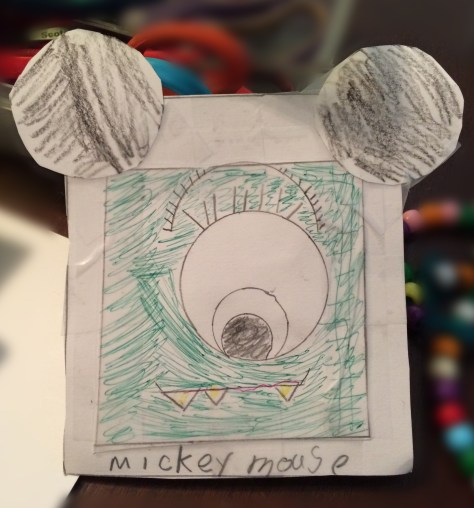
So now, to implement all of these things into the days we spend at home. It was actually during Peter’s sickness that it all came together for me. One day, when his was fever was down and he had the energy get creative, he made this cute monster-Mickey-Mouse-ears thing:

Monster Frame.jpg

Ian loved it so much that Peter made another one for him. It shouldn’t have surprised me that the boys had so much fun inventing crafts from their own imaginations; after all, it’s what we encourage kids to do at school when we set up a table full of various supplies. It’s called “creation station.” At his age, it’s not the kind of thing Peter does much anymore, so it’s particularly enjoyable for him to do at home.

Creation Station.jpg

This is something that I can let my kids do with supplies already on hand and minimal brain power on my part. So many moms see crafts on Pinterest and then get stressed out because they think (I don’t know why) that their children expect perfection – or for them to spend hundreds of dollars on obscure supplies at craft stores. I promise you, they don’t. The kids I taught all year were usually happy with paper and crayons. While it may not be as easy as letting the TV babysit them, it keeps their little minds engaged without them even knowing it.

And the creation station portion of each day has an added benefit for me; it gives me a dedicated time to do a little prep for my class next year… and to do a little creating of my own. 🙂

Creation Station II.jpg


Camp NaNoWriMo April 2016 Recap

Camp NaNoWriMo Apr 2016 Winner

I will have to say, compared to NaNoWriMo 2015, Camp NaNoWriMo in April was a cakewalk. Of course, part of that might be that you get to choose your word count goal. The minimum is 10,000, and although I was tempted to let that be it, I decided to do double. Twenty thousand words is nothing compared to the 50,000 in November, but after the struggle to finish the first draft of my 2015 novel, I wanted to take it easy (comparatively).

What I love about both NaNoWriMo and Camp NaNoWriMo is that you can update your word count every day, and then they create a graph to show how well (or poorly) you’re doing. This can be depressing if you’re coming in under. Considering that I didn’t even sign up for Camp NaNoWriMo until April 4th, my graph looked pretty pathetic at first. A bunch of nothing until day four, and then it was just a tiny little line. My total word count on the first day? Thirty-three words. But I’m happy to say that the line started to creep up, day by day. Being able to view my progress on that graph was encouraging.

The project I picked for Camp NaNoWriMo was a novel that I started in December (unexpectedly inspired to write by some good teen fiction). While concentrating on finishing the NaNoWriMo novel, I put this other one on the back burner, and when I signed up for Camp NaNoWriMo, I had to read through all 20,000 words of what I’d written so far to figure out what to write next. During that read-through, I ended up cutting some (yes, a big NaNoWriMo no-no) and adding more, for a net gain of 33.

Another fun thing about both of these websites is that they calculate, based on your current rate of words per day, how long it will take to finish. I was supposed to write 20,000 words by the end of April, but for the first week or so, the calculation had me finishing in September. Yeesh. But as the days passed and the number of words I wrote per day went up, the gap closed. I would hit 20,000 by August, then July. Finally, I was on target to finish during the month of April. Typing like crazy, I hit my goal on the 20th.

As of April 30th, I had typed almost 31,000 words during Camp NaNoWriMo. The story still isn’t complete (it never is after just one month), but it’s a lot closer than it was a few weeks ago. Rather than interrupting it to edit my NaNoWriMo 2013, 2014, and 2015 books (because they’re a trilogy and need a lot of work), I’m going to keep going until I finish this one. It might be a long summer (with one more Camp NaNoWriMo opportunity in July), but I’m going to enjoy the process.

And if you’re a regular reader, you know that a big part of that process is reading. Right now I am devouring and being inspired by a lot of great teen fiction. But that’s a topic for another post.

Borrowed Books 2016

Stack of incredible teen books (and The Martian – also incredible)

The End of the Story

Print

Fer Realz

I know, I know, this is the third post I’ve written in nine days – a new record for me – but I just couldn’t keep it to myself: I finished my NaNoWriMo 2015 book! I was stressed out about it taking so long, but I guess spring break was the medicine I needed. That and a little visit from my muse.

I hoped that if I managed 2000 words per day (the usual goal during the month of November for NaNoWriMo participants – and much more than I’ve averaged since then), I would be able to finish the story. But as any WriMo knows, you can type 2000 words without saying much of anything at all.

So by Friday, the last official weekday of my break, I was feeling a little antsy. March was over, I’d hit 100,000 words (just over 101K, if you want to be specific), and I still had a lot to say. The problem was that I had this looming showdown between two characters, and I knew how I wanted it to end, just not how to get the characters there.

Then, the floodgates opened that night. I typed over 5500 words and was so close – but I still wasn’t done. I joked with my husband that I should just kill everyone off.

No, I promise that I didn’t take the axe to my characters. I actually wrote a real ending, but it’s clunky. When editing time comes, well, that’s when I’m going to pull out my axe. The manuscript is nowhere near ready for even my most trusted (and kindest) of beta readers; right now, there are some passages that are as awkward as a sixteen-year-old guy meeting his girlfriend’s dad for the first time. (Hey, that’s appropriate; this is a young adult novel.)

Anyway, I’m done, and I can breathe. I can actually think about other stuff for a while. Such as Camp NaNoWriMo, which officially began two days ago. Jeez, I’m already behind.

What, did you really think I was going to stop writing?

Prescribed Staycation

Staycation

If you read my blog last week, you know that I’m still working on my NaNoWriMo 2015 novel, and I was hoping to use this week to finish it because it’s our spring break. Yes, we’ve had other spring breaks in which we traveled – my kids’ first plane ride was over spring break – but this year, we’re having a well-deserved staycation. Since November, we’ve taken two big road trips and two trips to Disney. With another big road trip looming this summer, the idea of leaving home for a fifth month in a row didn’t appeal to me (or our budget).

So far, the kids and I have been to the dentist and the doctor; my elder son had a baseball game and piano lesson; we went to story time at our favorite indie book store and had lunch out with my husband; we visited my grandmother for an afternoon; we even saw a movie in the middle of the week – all the normal stuff that I did before I started working full-time again (except for the movie in the middle of the week part – I had to do something a little spring break-y). I’ve even gotten eight hours of sleep every night – doesn’t that sound like heaven? My main goal was just to be a homebody. My kids have ridden their bikes a lot and made pillow forts on the couch – things that we don’t always have time to do when school’s in session. They’ve had the chance to be boys (and I’ve had the chance to write).

Unfortunately, kids these days just don’t get the chance to be kids as much as they should. They’re overscheduled either because their parents both work full-time, and so they assume the children should also be occupied 40 hours of every week, or the stay-at-home moms want to have “freedom” when the kids are out of school – in other words, a kid-free house. While I am a huge proponent of structure for children, that doesn’t mean that they need to be up at 6:30, out the door by 7:30, and spending until 5:00 that night in day camps and kids’ gyms and sports and play groups and you-name-it.

One mom of now-adult children told me that she always felt like a cruise director when it came to her kids’ vacations, and while some of us may admire the Pinterest moms who have cool crafts and activities planned for every play date, what’s wrong with sending the kids out the door and just letting them play? If you’re at home with the kids, that doesn’t mean you have to helicopter 24/7. On the other hand, if you work full-time, you need to remember that your precious time off needs to be split between “me” time and kid time. A teacher I know once told a full-time working mom that, instead of signing her daughter up for a week of camp, the mom needed to take that week off to spend at home with her daughter. What a novel idea!

I know that many people don’t have the choice but to work full-time, but there’s something wrong if both of you are so busy that you can’t find the time to read to your child for five minutes before bedtime. Or go out for ice cream on the weekends. I know of a mom who gave up a great career when she had a harsh wake up call; after losing two family members, she realized that if something were to happen to her, her kids wouldn’t miss out on much more than a kiss right before bedtime. The money took a backseat to being able to be the one to pick her kids up from school.

Remember the 1989 movie Parenthood with Steve Martin and Mary Steenburgen? Remember how Steve Martin’s character is the overworked, underpaid, baseball coach dad of three with another on the way? Remember how, when complaining about not getting a promotion, his wife is more worried about him missing their kids’ upbringings, not the money? Yeah, she got it.

In his book The Christian Moral Life, Timothy F. Sedgwick writes that, while many take issue with the idea of sacrifice (such as losing one’s self in giving everything up for some other), “[t]he broader meanings associated with sacrifice arise from the original Latin meaning of sacrifice, which was to make something sacred or to perform a sacred act.”

Keep it sacred by keeping your children at the forefront. That sometimes means having a date night or a mini vacation away from them. But it also means coming back. It means letting them be kids – and being there to experience their childhood with them. Sometimes the only medicine needed is a vacation day with your child, snuggling on the couch and reading every picture book in the house.

Sound anticlimactic? If you’re thinking, But this isn’t what I thought I was signing up for when I became a parent, you’re right. It never is. It’s a whole lifetime of sharing amazing/frustrating/sleep-deprived/joyful moments with a unique human being that wouldn’t even be here if it weren’t for you.

NaNoWriMo 2015: The Saga Continues

Keep Calm and Write On

Yeah, I’m still writing my 2015 NaNoWriMo book. Will I ever finish?  I had high hopes that I would be done this month, so I could focus on something different for Camp NaNoWriMo in April. But I don’t want to put a lot of pressure on myself (the pressure to write 50,000 words in November was enough), so I’m not going to go so far as to call this an actual goal.

My writing over the past week had started picking up, and I thought I was seeing light at the end of the proverbial tunnel. But as Metallica says, it’s just a freight train coming my way. Maybe the light is right behind the freight train, but I just don’t know yet.

See, here’s what happened: my novel is the third of a trilogy, and I realized that I’d made some discoveries about at least one of characters that would necessitate going back and making changes to the first two books. No big deal. The point right now is just to finish the first draft of this book. I can edit the earlier manuscripts to my heart’s content later. Like after I take a month-long breather.

But then I realized that I’d forgotten something crucial that affects the book I’m writing right now. Say, for instance, that there’s a character who loses a leg. This character can’t run a marathon the week after losing said leg. But I was so mired in the slow forward plod of my plot that I forgot this important detail (which isn’t a missing leg, by the way). Once I realized it, I had a brainwave about how to fix it – and how to use it to move the story forward in a new way – but I still have to go back over a bunch of scenes that I thought were (at least temporarily) behind me. For all of you hardcore WriMos, no, this is not editing but merely adding. If I were still worried about a word count, it would be great. But I’m not; I just want to finish.

What does this mean for finishing? Well, it means I’ll have to spend a lot of time reading over pages that I’ll desperately want to edit, just so I can figure out where to splice in the stuff I forgot. I’ll have to finesse it all later. It’s gonna be ugly, but it’s gotta happen.

So that’s where I am. It’s my spring break, so I’m going to try to dedicate my spare time to writing. And not forgetting about any more… ahem… absent body parts.

Wake Up Call

Last week, I bought a pile of used books at a school fundraiser and planned to blog/brag about them. After all, I love books, as do many of my followers.

But our weekend was busy, and blogging wasn’t on my mind at all. We were ending our night at Disney World on Sunday (Valentine’s Day) when I got a text from my dad that floored me. A young woman from my church – 20 years old, a senior in college – had died in a head-on collision that morning.

I was filled with the immediate guilt that I tend to feel when I’m happy and well, yet someone else has is facing a life-altering tragedy. This girl and her family’s grief have stuck with me all week. It seems that about half the people I work with are somehow connected to her, so I was constantly reminded of the terrible loss. I did not know her, but I know both of her parents and can only imagine the dread with which they face every day now without their younger daughter.

And, of course, this dredged up all the other tragedies that have touched me: my own grandmother, killed in a car accident when I was a child; my husband’s uncle, killed in a motorcycle accident that same year; a cousin who fell from the rooftop dog park of his apartment.

This tragedy has affected me more profoundly than those I see on the news every day, probably because I know the family. Not to mention that the victim was 20, had her whole life before her, and was innocent. Yet I think many of us have become desensitized to the number of innocents who die all the time; it’s a defense mechanism that allows us to continue to live, not bogged down under the weight of sadness and despair. Otherwise, we might spend all of our time worrying; after all, tragedies don’t care how old you are, how much you’re loved, or if your life holds infinite promise. An accident could take any of us at any time.

It’s when something like this happens that I always resolve to do better about enjoying each moment because it could be my last, to tell my loved ones how much they mean to me because I don’t know when the last time will be. But it goes even beyond that: life is too short to go through it like a zombie, taking the little things for granted.

While I can’t stop the frustrating, busy, bad days from happening, I can choose to pay better attention to the good things that fill in the gaps. Instead of dwelling on the traffic, which I can’t change, I can enjoy listening to my playlist. Instead of dreading the nights and weekends when my husband has to work, I’ll enjoy the time with my kids, remembering than one day they’ll be out of the house. I need to glean as much of the good as I can from every day, instead of allowing stress and worries to turn everything into a chore.

Earlier this week, I found myself somehow running 10 minutes late, only to discover that I hadn’t prepped my son’s lunch the night before – something that would cost me another 10 minutes. That’s something I would usually stress out over, which spirals to snapping at my children to hurry. But it wasn’t their fault that I was running late, and although it seemed farfetched, if our drive into school that morning happened to be our last, I didn’t want to spend it tense and angry. I made the choice to relax about it, and guess what? We somehow got out of the house early.

I know I’ve written before about balance being key and living for the current day, not some potential, future day that may or may not even happen – and I keep doing so because it’s a work in progress. Stated baldly, I know that one day, I will become a statistic. When and what kind of statistic I don’t know. But until then, I need to live like each day is special – even the weekdays when I have to get up at 4:15. Instead of looking forward to a different day, I need to recognize that, even though it may not be memorable beyond the present moment, it’s that moment I’m living that matters.

Fundraiser Books

Pile of Books

Circling back to those books – I will enjoy them, God willing, as well as all the little things and the big vacations and milestones, too. But if I were to die today, books unfinished, milestones unachieved, I don’t want anyone to mourn my unfinished to-do list. Rather, I want to leave people with no doubt that I enjoyed the small moments of my life; I want to leave my family and friends with memories of good times, fulfilling relationships, and no regrets.